The Macedonian Call and the Gates of Europe
In the providence of God, the geographic boundaries of redemptive history were redrawn on the wind-swept shores of Alexandria Troas. During his second missionary expedition, the Apostle Paul and his companion Silas had attempted to preach the word in the Roman provinces of Asia and Bithynia, but Luke records a mysterious sovereign veto: "the Spirit did not permit them" (Acts 16:7). That night, gazing out across the dark expanse of the Aegean Sea toward the distant mountains of Greece, Paul received a supernatural nocturnal vision. A man of Macedonia stood before him, pleading with outstretched hands: "Come over to Macedonia and help us!" (Acts 16:9).
Discerning the sovereign summons of Christ, the missionary party—now joined by the physician Luke and the young disciple Timothy—boarded a merchant vessel. Sailing past the volcanic peak of Samothrace, they landed at the port of Neapolis and climbed the steep paved stone road across the Mount Symbolon pass, descending into the fertile plain of Philippi. Philippi was no ordinary provincial town; it was a proud Roman colony (Colonia Iulia Augusta Philippensis), heavily settled by retired legionary veterans and governed directly under Roman civil statutes with the prestigious Ius Italicum. Its citizens wore Roman togas, spoke Latin, and were fiercely devoted to Roman imperial cults.
Finding no established Jewish synagogue—which required a quorum of at least ten adult males—Paul sought out a quiet place of prayer beside the Gangites River outside the city gate on the Sabbath day. There, God sovereignly opened the heart of Lydia, a wealthy Gentile merchant of expensive purple dyes from Thyatira. Baptized alongside her entire household, this noble businesswoman constrained the apostles to make her spacious estate their operational headquarters, birthing the first Christian church on European soil.
The Clashing Kingdoms: The Pythoness and the Marketplace Riot
As Paul and Silas continued their daily journeys to the riverside place of prayer, an ominous spiritual conflict erupted in the marble streets of the colony. A young slave girl began shadowing their footsteps day after day. Luke describes her as possessing a pneuma pythōna—a "spirit of Python" (Acts 16:16). In ancient Greco-Roman mythology, the serpent Python guarded the oracle at Delphi until slain by Apollo; spirits of this order were believed to impart supernatural clairvoyance and fortune-telling. Exploited by greedy human masters who rented out her demonic abilities to credulous pagans, the girl brought her owners immense financial profit.
For many consecutive days, the demonized maiden trailed behind the apostolic team, shrieking at the top of her lungs through the crowded streets:
"These men are the servants of the Most High God, who proclaim to us the way of salvation!" (Acts 16:17)
To the undiscerning observer, the demon appeared to be providing free evangelical advertising. Yet Paul was grieved in his innermost spirit (diaponētheis). The apostle recognized the cunning venom of Satan: if the gospel accepted the endorsement of an occult, demonic fortune-teller, Jesus Christ would simply be categorized alongside Apollo and the pantheon of demonic spirits. The Gospel of Glory requires no witness from the pit of darkness. Turning sharply toward the shrieking girl, Paul addressed not the trembling maiden, but the invisible demonic power within her:
"I command you in the name of Jesus Christ to come out of her!" (Acts 16:18)
The name above every name detonated with cosmic authority. That very instant, the Python spirit was ripped from the girl's soul! Her wild convulsions ceased, her mind cleared, and her supernatural clairvoyance vanished forever. But when her masters realized that their lucrative hope of financial gain was completely destroyed, their greed turned to homicidal fury. Grasping Paul and Silas by their tunics, they dragged them violently through the colonnades into the bustling Roman forum (agora) before the seated colonial magistrates (duumviri or praetors).
Appealing cunningly to Roman xenophobia and anti-Semitic prejudice, the slave owners shouted: "These men, being Jews, exceedingly trouble our city; and they teach customs which are not lawful for us, being Romans, to receive or observe!" (Acts 16:20–21). The mob exploded in patriotic fury. Caught up in the frenzy, the magistrates tore the apostles' outer garments from their bodies and commanded the Roman lictors to strip them naked and beat them with heavy birch rods (fasces). Blow after brutal blow landed across their bare backs, tearing flesh, crushing bone, and soaking the stone pavement with apostolic blood.
The Subterranean Dungeon and Midnight Songs
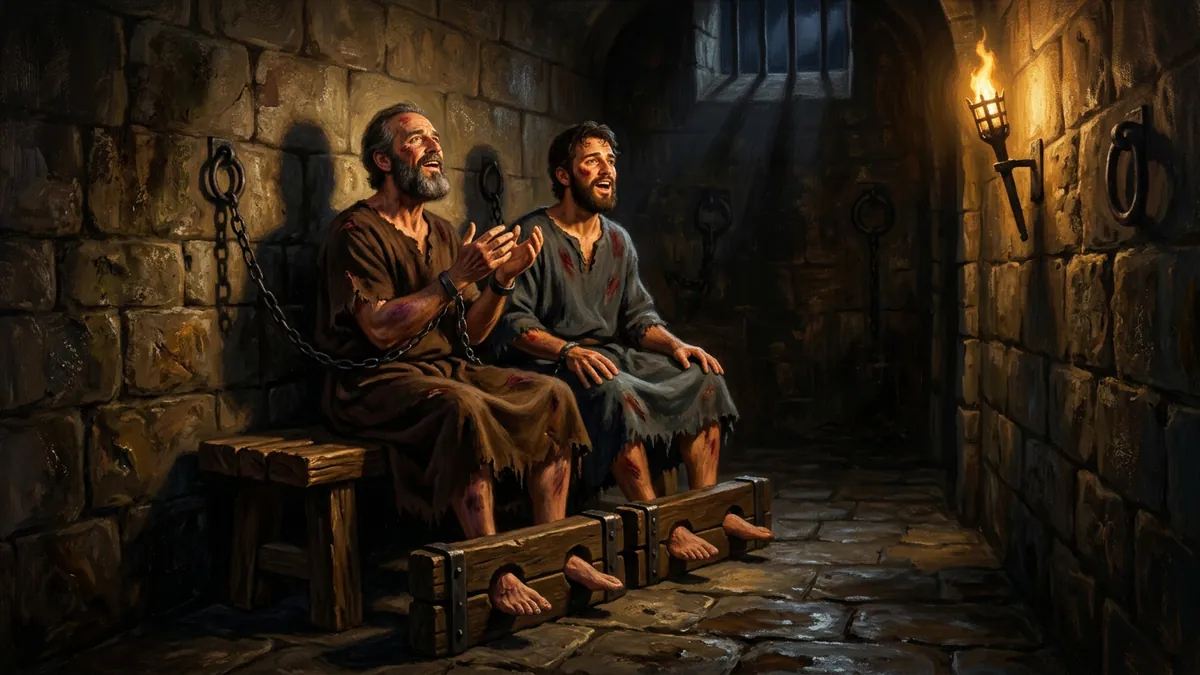
Having inflicted many bloody stripes upon them, the magistrates cast Paul and Silas into the municipal fortress prison, issuing a draconian command to the jailer to keep them under absolute security. The jailer—a hardened Roman army veteran accustomed to brutal execution protocols—took no chances. He shoved the bleeding missionaries into the innermost dungeon (esōteran phylakēn)—a pitch-black, airless subterranean vault beneath the bedrock, reeking of filth, moisture, and sewage. Furthermore, he thrust their feet into the heavy wooden stocks (xylon), stretching their legs wide apart and clamping their ankles between thick timber beams secured with iron pins. The posture caused agonizing muscle cramps, spasms, and unrelenting physical torment.
Any ordinary human beings would have descended into bitter despair, railing against the injustice of Roman tyranny or questioning the divine wisdom of the Macedonian vision. But the kingdom of God does not operate on earthly emotional algorithms. The flesh of Paul and Silas was shredded with lashes; their feet were immobilized in heavy timber; the darkness of the subterranean cavern was suffocating. Yet their spirits were seated with Christ in heavenly places!
As the chronological clock struck midnight—the darkest watch of the night—a supernatural sound shattered the silent misery of the dungeon. Paul and Silas began to pray and sing loud, ecstatic hymns of praise to Yahweh (humnountes ton Theon)! Luke records a striking detail: "and the prisoners were listening to them" (Acts 16:25). The Greek verb epēkroōnto indicates that the other condemned criminals, thieves, and murderers were listening with transfixed, mesmerized attention. In a place where only curses, groans of despair, and agonizing wails usually echoed, sacred melodies of unshakeable faith and divine joy were vibrating through the damp stone arches!
The Cosmic Tremor and the Shattered Chains
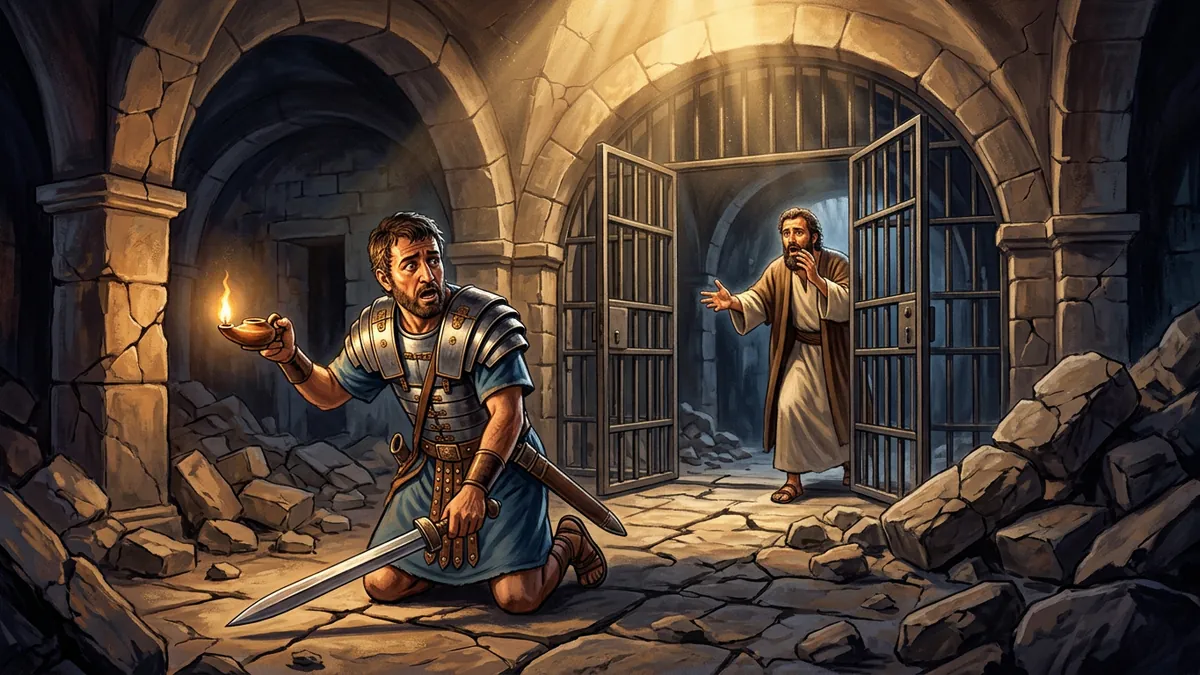
Suddenly, the high praises of the saints provoked a seismic response from the throne of the Almighty. A violent, cosmic earthquake (seismos megas) tore through the subterranean bedrock! The very foundations of the prison rocked like a ship upon turbulent waves. Stone lintels cracked, masonry plummeted, and with a deafening crash, every barred iron cell door flew wide open! At that precise moment, a second, more astonishing miracle occurred: the bonds, iron chains, and wooden stocks holding every single prisoner were supernaturally unfastened!
Awakened violently from his slumber by the subterranean roar and shaking masonry, the Roman jailer rushed into the corridor. Gazing into the gloom, he beheld the sight that every Roman warden dreaded above all earthly nightmares: the massive iron gates were standing wide open! Under the unforgiving mandates of Roman imperial military law (Codex Justinianus and Roman military jurisprudence), a guard who allowed prisoners to escape was legally sentenced to suffer the exact penalties assigned to those fugitives. If a murderer escaped, the jailer was crucified; if a thief escaped, he was enslaved. The jailer knew that Roman court-martial meant public degradation, torture, and a dishonorable, excruciating execution.
Preferring a swift, soldier's death by his own hand over public Roman execution, the jailer unsheathed his short iron sword (gladius) and positioned the point against his own chest, preparing to fall upon the blade in suicide. But from the pitch-black inner dungeon, Paul’s voice resonated through the settling dust like a trumpet of divine mercy:
"Do yourself no harm, for we are all here!" (Acts 16:28)
"What Must I Do to Be Saved?"
The suicide blade dropped clattering against the stone floor. Stunned beyond comprehension, the jailer shouted for torchlights, leaped into the subterranean vault, and fell trembling on his knees before the bruised missionaries. Why had they not fled? Why had none of the hardened criminals bolted through the open iron gates into the night? The jailer recognized instantly that this was no mere tectonic phenomenon; the uncreated power of the living God had intervened, and these bleeding Jewish preachers were custodians of a transcendent reality.
Gently leading Paul and Silas out of the foul dungeon into the courtyard air, the Roman officer fell prostrate and uttered the defining spiritual question of every human soul:
"Sirs, what must I do to be saved?" (Acts 16:30)
The jailer had likely heard the demonic Pythoness shouting through the marketplace that these men proclaim "the way of salvation." Facing the terror of physical death and the deeper horror of eternal judgment, the Roman veteran wanted life. Paul and Silas did not burden him with complex rabbinic rituals, lengthy ascetic disciplines, or ceremonial codes. Pointing him directly to the Cross and the Empty Tomb, they proclaimed the foundational pillar of the New Covenant:
"Believe on the Lord Jesus Christ, and you will be saved, you and your household." (Acts 16:31)
In the quiet hours of that midnight vigil, Paul and Silas spoke the glorious Word of the Lord to the jailer and to all who resided within his dwelling. The transformational fruit of true repentance manifested immediately. The same coarse hands that had mercilessly shoved the apostles into the stocks now brought cool water, tenderly washing the congealed blood and grime from their lacerated backs. Then, without delay, before the break of dawn, the jailer and his entire household were baptized into the name of the Father, the Son, and the Holy Spirit!
Ascending into the living quarters of the jailer's residence, the Roman officer set a rich banquet table before the bruised apostles. Luke concludes the nocturnal drama with an unforgettable portrait of redemption: "and he rejoiced, having believed in God with all his household" (Acts 16:34). In a single evening, an executioner had become a brother; a dungeon had been transformed into a temple of joyous communion!
The Roman Citizenship Defense and Apostolic Triumph
When the morning sun crested the hills of Philippi, the colonial praetors sent their lictors with a curt official decree: "Let those men go" (Acts 16:35). Having vented their fury and assuming the night in the stocks had taught the itinerants a sufficient lesson, the magistrates sought to quietly sweep the embarrassing riot under the rug.
Relieved, the jailer conveyed the news to Paul: "The magistrates have sent to let you go. Now therefore depart, and go in peace." But Paul stood his ground. Drawing himself up with dignified Roman majesty, the apostle delivered a staggering legal thunderbolt:
"They have beaten us openly, uncondemned Roman citizens, and have thrown us into prison. And now do they put us out secretly? No indeed! Let them come themselves and get us out." (Acts 16:37)
When the lictors reported these words to the praetors, sheer panic seized the municipal authorities. Under the sacred Lex Valeria (509 BC) and the Lex Porcia (195 BC), to scourge or imprison an uncondemned Roman citizen without a formal judicial trial was high treason against Caesar and the Roman Senate, punishable by forfeiture of office, exile, and death! The very magistrates who had arrogantly commanded their torture now hurried down to the prison with pale faces, bowing low, begging the apostles' pardon, and personally escorting them into the open streets of Philippi.
Paul and Silas walked calmly from the prison directly to the estate of Lydia. Gathering the believers together—the noble businesswoman Lydia, the transformed Roman jailer, and their rejoicing households—the apostles comforted and exhorted the newborn church. Leaving behind a vibrant, unshakable pillar of faith that would later receive Paul's most affectionate canonical epistle (the Epistle to the Philippians), the apostolic team departed in triumph. The midnight songs of the Philippian dungeon had ignited a fire that would never be extinguished, proving for all generations that no chains of tyranny, no subterranean darkness, and no imperial power can withstand the praiseworthy name of the Lord Jesus Christ!
Support Independent Biblical Research
Did this study bless you? Help support our independent bilingual research and interactive visual Bible tools.
⚡ Fast Facts
- Philippi was a privileged Roman colony (Colonia Iulia Augusta Philippensis) endowed with the 'Ius Italicum', exempting its citizens from imperial poll taxes and giving them full Roman legal rights.
- The slave girl possessed a 'spirit of Python' (pneuma pythōna)—associated in Greek mythology with the serpent guarding the Oracle of Delphi, believed to impart supernatural clairvoyance and fortune-telling.
- Under severe Roman military law (Digest 48.3.12), a jailer who permitted prisoners to escape suffered the exact penal execution assigned to those prisoners—which meant the Philippian jailer faced brutal execution by crucifixion or decapitation.
- Paul and Silas were beaten with lictors' birch rods (fasces) without a formal judicial trial, an egregious crime under the Valerian and Porcian Laws that severely punished magistrates who scourged Roman citizens.
❓ Frequently Asked Questions (FAQs)
Why did the demonic spirit possess the girl to speak the truth about Paul being servants of the Most High God?
In Acts 16:17, the demon proclaimed: 'These men are the servants of the Most High God, who proclaim to us the way of salvation.' This demonic testimony was a subtle spiritual tactic designed to infiltrate and contaminate the apostolic ministry. By associating the gospel with occult pagan divination, Satan sought to reduce the message of Christ to just another mystery cult. Paul refused demonic public relations, discerning that Christ's kingdom requires no endorsement from the kingdom of darkness.
What is the biblical significance of 'Believe on the Lord Jesus Christ, and you will be saved, you and your household'?
Acts 16:31 does not teach automatic proxy salvation where a father's faith magically saves unregenerate children without personal faith. Rather, Luke immediately clarifies in verses 32–34 that Paul spoke the word of the Lord to all who were in his house, and the entire household personally heard, believed in God, and was baptized. The father's conversion created an open doorway of gospel proclamation to his entire sphere of relational influence.
Why did Paul refuse to leave the Philippian prison secretly the following morning?
When the magistrates sent lictors to quietly release the apostles, Paul invoked his legal rights as a Roman citizen (Acts 16:37): 'They have beaten us openly, uncondemned Roman citizens, and have thrown us into prison. And now do they put us out secretly? No indeed! Let them come themselves and get us out.' Paul did not act out of carnal spite, but to legally protect the newborn, vulnerable Philippian church. If the apostles sneaked away as fugitive criminals, the nascent fellowship (including Lydia and the jailer) would have been targeted for Roman state treason. By compelling the magistrates to offer a public apology and escort them out, Paul secured enduring civil protection for the Christian community.