The Intellectual Jewel of the Ancient World
Following intense persecution in Thessalonica and Berea, the Apostle Paul was escorted south by faithful believers to the historic city of Athens. While waiting for Silas and Timothy to rejoin him, the solitary apostle walked the paved marble avenues of the cultural and philosophical cradle of Western civilization. For centuries, Athens had been the glorious fountainhead of art, architecture, democratic governance, and intellectual inquiry—the hallowed city of Socrates, Plato, Aristotle, and Sophocles.
Yet as Paul gazed across the magnificent public squares, his heart did not swoon with aesthetic infatuation. Luke records a striking psychological diagnosis: "his spirit was provoked within him when he saw that the city was given over to idols" (Acts 17:16). The Greek verb is parōxyneto—a sharp, visceral inward revulsion and righteous indignation. Despite centuries of brilliant philosophical dialogue, the cultural capital of Greece was spiritually blind, choked with thousands of pagan shrines, statues, and altars. The Roman satirist Petronius quipped with biting irony that in the streets of Athens, it was far easier to meet a god than a human being!
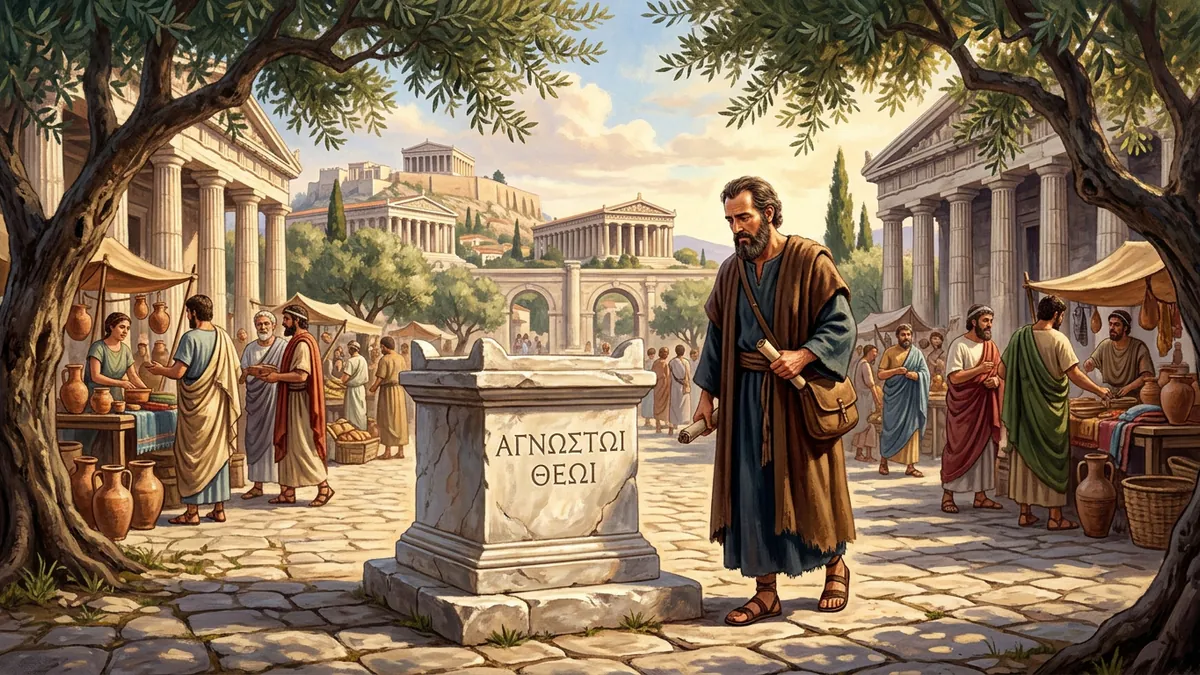
Paul did not retreat into cloistered isolation. On the Sabbath, he reasoned in the synagogue with the Jews and God-fearing Greeks. But on the weekdays, the tireless apostle entered the vibrant, open-air agora—the bustling civic marketplace nestled beneath the sheer limestone cliffs of the Acropolis. There, beneath shaded marble porticoes (stoas), merchants hawked olives and textiles, civic leaders debated imperial taxes, and philosophical intellectuals gathered to dissect every novel worldview.
The Clashing Philosophies: Stoics and Epicureans
As Paul passionately proclaimed the good news of Jesus Christ in the marketplace, he drew the immediate attention of two rival philosophical schools that dominated the Greco-Roman mind: the Epicureans and the Stoics.
The Epicureans—disciples of Epicurus—were materialists. They posited that the universe was the accidental product of colliding atoms in an infinite void. For them, gods might theoretically exist in some tranquil, distant celestial sphere, but they possessed zero interest in human history, answered no prayers, and executed no final moral judgment. Human destiny ended abruptly in the dust of physical death; therefore, the chief end of life was ataraxia—unperturbed tranquility, serenity of mind, and the avoidance of pain. When they heard Paul preaching a dynamic Sovereign Creator who intervenes in human affairs, they dismissed him with intellectual disdain: "What does this babbler want to say?" (Acts 17:18). The Greek word used was spermologos—a gutter slang term describing a scruffy crow hopping along the cobblestones picking up discarded garbage seeds, implying Paul was an uneducated collector of intellectual scraps!
The Stoics—followers of Zeno—held to a pantheistic determinism. For them, God was not a personal, loving Father, but the fiery rational principle (Logos) animating the material cosmos. They believed in fatalistic destiny, championing cold emotional detachment (apatheia), grim self-sufficiency, and personal moral pride. Both groups were completely bewildered by Paul's vocabulary, exclaiming: "He seems to be a proclaimer of foreign gods", because the apostle proclaimed Iēsous (Jesus) and Anastasis (Resurrection). The pagans actually misunderstood "Anastasis" to be a new female healing goddess accompanying Jesus!
The Ascent to the Areopagus: Mars Hill
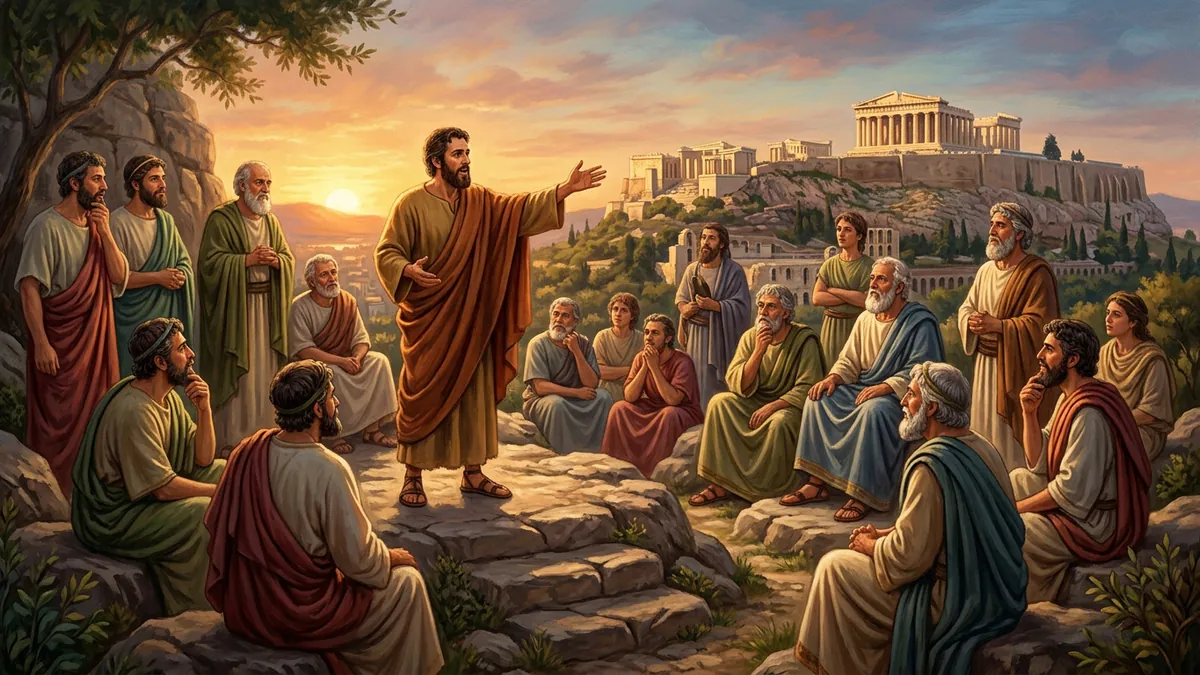
Intrigued by this provocative foreign itinerant, the philosophers took hold of Paul and escorted him up the ancient stone-cut steps to the summit of the Areopagus—the "Hill of Ares" (Mars Hill), a rugged, barren limestone ridge situated west of the Athenian Acropolis. For centuries, the Council of the Areopagus was the supreme constitutional, judicial, and religious senate of Athens. Meeting beneath the open sky, this elite tribunal examined foreign religious teachers, regulated municipal morality, and judged capital homicides. Standing beneath the blinding white marble columns of the Parthenon gleaming in the afternoon sun, surrounded by robed Athenian statesmen, judges, and philosophers, Paul stood in the most prestigious intellectual amphitheater on earth.
With aristocratic curiosity, the council inquired: "May we know what this new doctrine is of which you speak? For you are bringing some strange things to our ears. Therefore we want to know what these things mean" (Acts 17:19–20). Luke adds a wry sociological observation: "For all the Athenians and the foreigners who were there spent their time in nothing else but either to tell or to hear some new thing" (Acts 17:21).
Paul stepped forward into the center of the council. He did not begin by insulting their pagan darkness or railing against the golden idolatry of the Acropolis looming overhead. Instead, displaying supreme cultural agility and apologetic mastery, the apostle addressed them with profound rhetorical respect:
"Men of Athens, I perceive that in all things you are very religious; for as I was passing through and considering the objects of your worship, I even found an altar with this inscription: TO THE UNKNOWN GOD. Therefore, the One whom you worship without knowing, Him I proclaim to you." (Acts 17:22–23)
The Greek word Paul employed for "very religious" was deisidaimonesterous—a brilliant, double-edged diplomatic bridge. While it could mean superstitious, in classical Greek it conveyed deep reverence for spiritual powers. Paul had identified their tragic spiritual blind spot: despite their magnificent pantheon of Zeus, Athena, Apollo, and Ares, the Athenians were haunted by the terrifying possibility that some cosmic deity remained neglected, capable of unleashing wrath upon their city. Six centuries earlier, during a devastating plague in Athens, the Cretan sage Epimenides had instructed the city to release black and white sheep from the Areopagus, commanding altars to be erected wherever the sheep lay down, inscribed simply: Agnōstō Theō ("To the Unknown God"). Paul seized upon their ancient confession of ignorance to unveil the glorious Sovereign of the Universe!
The Sovereign Creator of Heaven and Earth
In a breathtaking cascade of theological truths, Paul systematically dismantled the foundational premises of both Epicurean materialism and Stoic pantheism. First, the apostle proclaimed the transcendent, uncreated Lordship of God:
"God, who made the world and everything in it, since He is Lord of heaven and earth, does not dwell in temples made with hands." (Acts 17:24)
Turning slightly, Paul could point directly to the majestic Parthenon, the temple of Athena Nike, and the colossal gold-and-ivory statue of Athena crafted by Phidias. How absurd to believe that the infinite Architect of the galaxies could be localized inside human masonry! Second, Paul shattered the pagan sacrificial economy that viewed deities as needy beings sustained by animal blood and wine libations:
"Nor is He worshiped with men's hands, as though He needed anything, since He gives to all life, breath, and all things." (Acts 17:25)
God is not a celestial beggar dependent on human rituals; He is the self-existent, overflowing Fountainhead of all cosmic life. Third, Paul struck directly at the racial arrogance of Athens. The Greeks proudly claimed to be autochthonous—born directly from the sacred soil of Attica, uniquely superior to all other "barbarian" races. Paul leveled all human pride with a single blow:
"And He has made from one blood every nation of men to dwell on all the face of the earth, and has determined their preappointed times and the boundaries of their dwellings, so that they should seek the Lord, in the hope that they might grope for Him and find Him, though He is not far from each one of us." (Acts 17:26–27)
Every tribe, empire, and civilization is descended from a single common ancestor, sovereignly governed by divine providence. To illustrate God's intimate proximity to humanity, Paul bypassed the Hebrew prophets—which meant nothing to pagan philosophers—and quoted their own revered Greek poets. First, he quoted Epimenides of Crete: "For in Him we live and move and have our being". Then, he quoted Aratus of Cilicia from his astronomical poem Phaenomena: "For we are also His offspring" (Acts 17:28).
Having established common ground from their own literature, Paul tightened the theological vice with unassailable logic: if human beings—endowed with consciousness, moral intellect, and creative reason—are the offspring of God, how can we be so utterly foolish as to imagine that the Divine Nature is like gold, silver, or stone, carved by human art and device?
The Climax: Repentance and the Risen Judge
Paul did not leave his sermon suspended in abstract philosophical contemplation. He pivoted with razor-sharp urgency to moral accountability, universal judgment, and the historical reality of the Cross and Resurrection:
"Truly, these times of ignorance God overlooked, but now commands all men everywhere to repent, because He has appointed a day on which He will judge the world in righteousness by the Man whom He has ordained. He has given assurance of this to all by raising Him from the dead." (Acts 17:30–31)
The era of pagan spiritual blindness was officially terminated. The living God does not negotiate with human philosophy; He commands all humanity to bow the knee in repentance. History is not an endless, cyclical loop of fatalistic doom, but a linear narrative marching toward an appointed day of cosmic justice, presided over by Jesus Christ, whose divine appointment was validated in space-time history by His physical resurrection from the tomb!
The Verdict on Mars Hill
At the mention of the bodily resurrection (anastasis), the philosophical veneer shattered. Greek dualism held that physical matter was intrinsically corrupt, a temporary prison house from which death liberated the soul. The idea that a corpse would be resurrected bodily into eternal life seemed grotesque, uncouth, and absurd.
A chorus of loud, mocking laughter (ekhleyazon) erupted from several cynical philosophers. Others, uncomfortable with the conviction piercing their consciences, attempted a polite postponement: "We will hear you again on this matter" (Acts 17:32). Paul did not debate them further; having faithfully discharged the divine message, he walked down the stone steps of the Areopagus.
Yet the Word of God never returns void. While the arrogant scoffed, the Holy Spirit captured precious souls in the very heart of pagan philosophy. Among those who believed was Dionysius the Areopagite—one of the elite, aristocratic judges of the supreme court—alongside a prominent noblewoman named Damaris, and several others (Acts 17:34). Dionysius, transformed by grace, would become the first bishop of Athens, anchoring the Christian faith in the intellectual capital of the Greco-Roman world.
Paul's sermon on Mars Hill stands as an enduring monument for the Church of Jesus Christ. It proves that the gospel of the resurrected Christ possesses the intellectual and spiritual power to confront the most sophisticated philosophies of human pride, tear down the idols of culture, and unveil the One True Living God in whom all creation lives, moves, and finds its eternal home.
Support Independent Biblical Research
Did this study bless you? Help support our independent bilingual research and interactive visual Bible tools.
⚡ Fast Facts
- Petronius, a contemporary Roman satirist, remarked that it was easier to find a god than a human being in the streets of Athens, reflecting the staggering density of pagan shrines.
- The Epicureans followed Epicurus (341–270 BC), believing the universe was a random collision of atoms, the gods were distant and unconcerned, and tranquility came from avoiding bodily pain and mental anxiety.
- The Stoics followed Zeno of Citium (334–262 BC), teaching a pantheistic worldview where God was the rational soul (Logos) of the cosmos, urging stoic endurance, emotional detachment (apatheia), and civic virtue.
- The phrase 'In Him we live and move and have our being' was adapted from a Cretan hexameter poem attributed to Epimenides (6th century BC), who also advised the Athenians to erect nameless altars during a historic plague.
❓ Frequently Asked Questions (FAQs)
Why did the Greek philosophers react with derision when Paul mentioned the resurrection of the dead?
In classical Greek philosophy—heavily influenced by Plato—the physical body (*sōma*) was viewed as a corrupt prison or tomb (*sēma*) of the immortal soul. Liberation at death meant discarding material entrapment forever. The idea of bodily resurrection (*anastasis*) was considered uncouth, irrational, and repulsive to a Greek intellect. When Paul insisted that the supreme proof of Christ's lordship was His bodily physical resurrection, their philosophical politeness collapsed into mocking laughter.
How did Paul adapt his evangelistic method between Jewish and Gentile audiences?
When preaching to Jews (e.g., in Antioch of Pisidia or Thessalonica), Paul began with the Abrahamic covenant, Mosaic Torah, and messianic prophecies, demonstrating that Jesus fulfilled the Hebrew Scriptures. In pagan Athens, having no common biblical foundation, Paul began with general revelation, cosmic creation, divine providence, and Greek literature, establishing the absurdity of idolatry before guiding them directly to Christ's resurrection and final judgment.
Who was Dionysius the Areopagite, and what became of his Christian legacy?
Dionysius was one of the elite, lifelong judges of the Areopagus council—the supreme municipal body responsible for religion, education, and moral legislation in Athens. His conversion was a monumental triumph of the gospel among the Greek intelligentsia. According to early church historian Eusebius of Caesarea, Dionysius became the first ordained bishop of Athens and sealed his faith with martyrdom under Roman imperial persecution.