The Imperial Prisoner and the Mediterranean Voyage
Having exercised his legal prerogative as a Roman citizen to appeal his case directly to Caesar Nero in Rome (Acts 25:11), the Apostle Paul was placed under the military custody of Julius, a centurion of the elite Augustan Cohort (Speira Sebastē). Accompanied by his faithful physician Luke and the Macedonian brother Aristarchus, Paul embarked on a maritime voyage that would become the most meticulously documented nautical narrative in the ancient Greco-Roman world.
Departing Caesarea in a coastal craft from Adramyttium, the voyage encountered contrary northwestern winds off Cyprus. At the Lycian port of Myra, Centurion Julius transferred his imperial prisoner detail and other captives to a massive Alexandrian grain freighter (ploion Alexandrinon). These grain ships were the supertankers of antiquity—measuring up to 180 feet in length, with a single massive square sail hoisted upon a colossal wooden pine mast, transporting Egyptian wheat from the Nile Delta to sustain the million hungry mouths of imperial Rome. Heavily laden with hundreds of tons of grain and carrying 276 passengers and crew, the vessel lumbered slowly westward across the choppy waters of the Mediterranean.
After many days of frustrating, agonizingly slow sailing, the ship slipped beneath the southern lee of Crete, finding precarious shelter at a roadstead named Fair Havens (Kaloi Limenes), near the city of Lasea. By now, the chronological calendar had advanced past the Day of Atonement (Yom Kippur, late September or early October). In ancient Mediterranean navigation, sailing after the autumnal equinox was notoriously dangerous, and after November 11 (the Roman mare clausum), all maritime commercial shipping ceased until spring. Perceptive to spiritual and physical realities, Paul issued an urgent prophetic warning to the ship's officers:
"Men, I perceive that this voyage will end with disaster and much loss, not only of the cargo and ship, but also our lives." (Acts 27:10)
However, Centurion Julius was more persuaded by the professional expertise of the ship's captain (nauklēros) and the owner (kybernētēs) than by the warnings of an itinerant Jewish tentmaker. Fair Havens was an open, exposed bay poorly suited for wintering. When a deceptive, gentle south breeze blew, the helmsman weighed anchor, hugging the rocky southern coastline of Crete toward the superior, protected harbor of Phoenix.
The Claws of Euroclydon: Fourteen Days in the Abyss
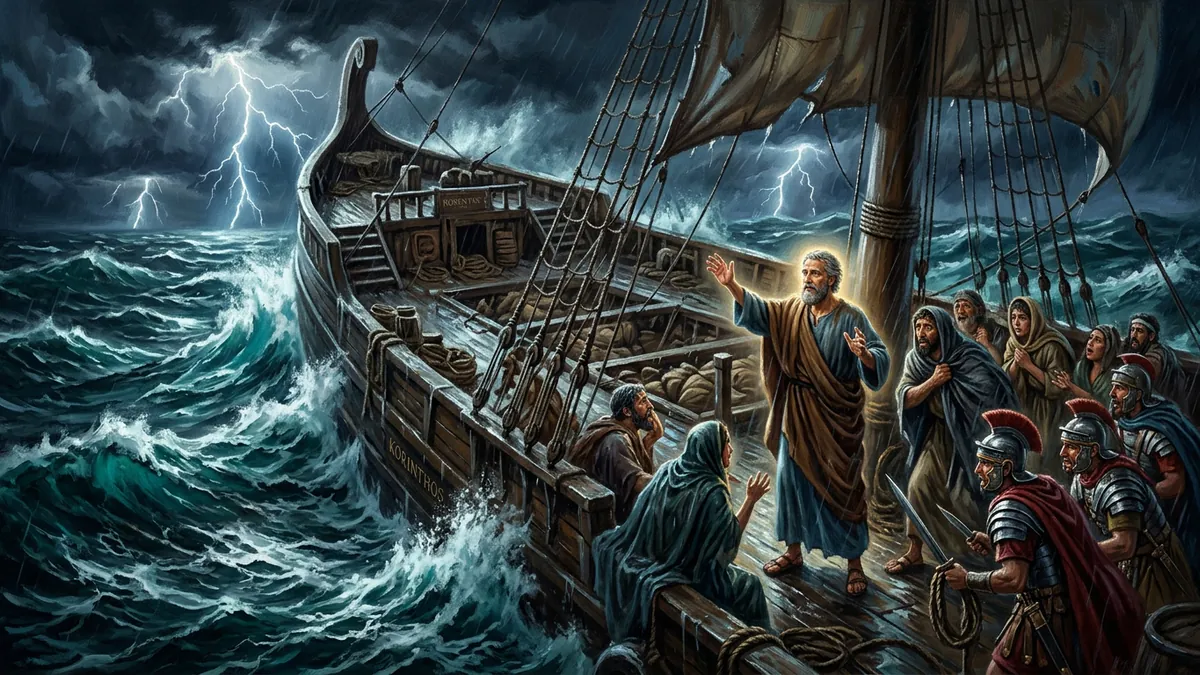
The illusion of safety dissolved in moments. Sweeping down from the 8,000-foot snow-capped peaks of Mount Ida on Crete struck a violent cyclonic hurricane gale known as Euroclydon (or Euraquilo, a lethal meteorological hybrid of the northeast wind Eurus and the north wind Aquilo). The howling tempest seized the wooden craft with brutal ferocity, preventing the crew from turning the bow into the wind. Yielding to the gale, the captain let the vessel drive helplessly before the tempest.
Running under the lee of a small desert islet named Cauda, the crew desperately secured the ship's lifeboat (skaphē), which had been trailing behind filling with seawater. Fearing that the violent twisting of the wooden hull would spring the planks and sink the vessel, the sailors wrapped heavy cables (hypozōmata) beneath the hull—a nautical practice known as frapping—to hold the timbers together against the crushing pressure of the swells. Terrified of being driven southwest into the lethal, ship-devouring quicksands of the African Syrtis off Libya, they lowered the main yard, struck sail, and drifted blindly before the storm.
For fourteen agonizing, terrifying days, the vessel was battered across the boiling waters of the Adriatic Sea (which then denoted the central Mediterranean between Greece, Italy, and Sicily). On the second day, the crew jettisoned the heavy deck cargo; on the third day, sailors and prisoners together hauled the heavy spare rigging, yards, and ship tackle overboard with their bare hands. Luke captures the psychological abyss of that floating coffin with chilling pathos:
"Now when neither sun nor stars appeared for many days, and no small tempest beat on us, all hope that we would be saved was finally given up." (Acts 27:20)
Without celestial navigation by the sun and stars, hopelessly lost in blinding ocean spray, soaked to the bone, frozen by autumn squalls, and unable to cook food, 276 human souls surrendered to the inevitable shadow of a watery grave.
The Celestial Messenger and the Breaking of Bread
In the pitch-black midnight of absolute despair, Apostle Paul stood up in the midst of the weeping sailors and hardened legionaries. Pale from hunger yet radiating supernatural authority, the prisoner spoke words that pierced the howling gale:
"Men, you should have listened to me, and not have sailed from Crete and incurred this disaster and loss. And now I urge you to take heart, for there will be no loss of life among you, but only of the ship. For there stood by me this night an angel of the God to whom I belong and whom I serve, saying, 'Do not be afraid, Paul; you must be brought before Caesar; and indeed God has granted you all those who sail with you.' Therefore take heart, men, for I believe God that it will be just as it was told me." (Acts 27:21–25)
Notice the staggering covenant reality: "God has granted you all those who sail with you!" The 275 pagan sailors, soldiers, and convicts were preserved from death not by Roman engineering, but as an unmerited bonus of sovereign grace given to a praying apostle! Paul was under divine imperial destiny: Caesar was waiting in Rome, and until Paul reached the imperial palace, the Mediterranean Ocean did not possess enough water to drown him!
On the fourteenth midnight, experienced seamen sensed the ominous roar of breakers indicating land was near. Casting sounding leads, they measured twenty fathoms (120 feet); a short distance further, they sounded fifteen fathoms (90 feet). Fearing the ship would be pulverized against submerged coastal reefs in the dark, the sailors cast four heavy iron anchors from the stern, praying desperately for the dawn.
As the grey light of morning filtered through the sea mist, Paul gathered the exhausted assembly. Knowing they would need physical strength to swim through the raging surf, he urged them to eat:
"And when he had said these things, he took bread and gave thanks to God in the presence of them all; and when he had broken it he began to eat. Then they were all encouraged, and also took food themselves." (Acts 27:35–36)
In the presence of 276 drenched, terrified pagans, Paul enacted a breathtaking liturgy of thanksgiving (eucharistēsen tō Theō). The peace of God settled over the battered vessel like a warm mantle.
The Shipwreck and the Miraculous Shore
At daylight, the crew spotted an unfamiliar bay with a sandy beach. Deciding to run the ship aground, they cut away the four anchors, untied the rudder lashings, hoisted the small foresail (artemōn) to the wind, and drove toward the shore. Striking a sandbar where two seas met (the shallow strait between the island of Malta and the islet of Salmonetta), the bow rammed deep into the mud and stuck immovable, while the violent pounding of the breakers began smashing the heavy wooden stern into splinters!
Seeing the vessel disintegrating, the Roman soldiers unsheathed their swords to slaughter all the prisoners, knowing that if a single convict escaped, the guards would pay with their own lives under Roman military justice. But Centurion Julius—moved by deep affection and reverence for Paul—shouted an order that overruled the soldiers. He commanded those who could swim to plunge into the breakers first, and the rest, some on planks and some on broken pieces of the ship, to kick toward the shore.
Luke records the triumphant fulfillment of the angelic promise:
"And so it was that they all escaped safely to land." (Acts 27:44)
Two hundred and seventy-six souls—not 275, not one lost to the depths—stood shivering, soaked, yet alive upon the rocky shores of Malta!
The Viper in the Fire and the Healing Revival
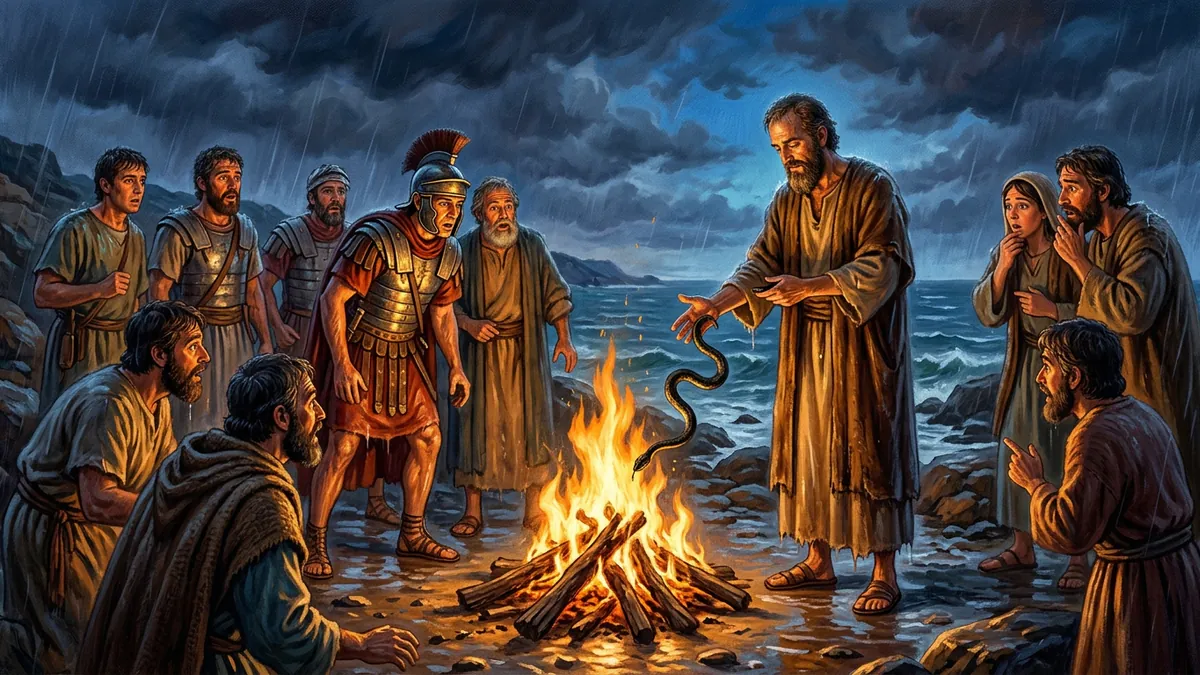
The native inhabitants of Malta (whom the Greeks called barbaroi simply because they spoke Punic rather than Greek) received the shipwrecked survivors with extraordinary hospitality (philanthrōpia). A torrential rain began to fall, accompanied by biting cold. The Maltese built a massive bonfire on the beach to warm the shivering passengers.
Ever the humble servant, Apostle Paul did not stand idly by expecting to be served. He walked into the wet brush, gathered a heavy armful of dried sticks, and stepped toward the bonfire to lay them upon the blazing coals. Suddenly, driven out by the intense heat, a venomous viper (echidna) leaped from the bundle and clamped its fangs directly into Paul’s flesh, hanging suspended from his hand!
When the superstitious islanders saw the dark serpent dangling from the apostle's wrist, they whispered among themselves with dread: "No doubt this man is a murderer, whom, though he has escaped the sea, yet Justice does not allow to live" (Acts 28:4). In Greek mythology, Dikē (Justice) was the goddess of vengeance who inevitably struck down wicked men who attempted to evade their rightful doom. The Maltese waited with bated breath, expecting Paul's arm to swell with deadly poison and his body to collapse in convulsions of sudden death.
Paul did not panic. He did not cry out for medicinal balm or scream in terror. Calmly, deliberately, the apostle shook the viper off his wrist straight into the heart of the roaring fire! The snake shriveled in the flames. Paul inspected his hand: not a mark, not a swelling, not a symptom of poison! Fulfilling the promises of Christ in Luke 10:19 and Mark 16:18, the servant of God was completely unharmed. After watching him for a long time and seeing no harm come to him, the fickle islanders completely reversed their verdict, proclaiming that Paul was an immortal god!
The Revival at the Estate of Publius
Nearby lay the sprawling estates of Publius, the official Roman governor and "chief man of the island" (prōtos tēs nēsou). Publius welcomed Paul and his companions into his villa, extending lavish hospitality for three days. Providence had orchestrated a divine appointment: the father of Publius lay bedridden in agonizing pain, suffering from recurring attacks of violent fever and gastric dysentery (dysenteria).
Paul entered the sickroom. Kneeling beside the moaning patrician, the apostle prayed fervently to the Lord Jesus Christ and laid his hands upon the dying man. Instantly, the burning fever broke, the infection ceased, and the governor's father arose in sound health! When news of this miraculous healing swept across the island, Luke records that all the diseased inhabitants of Malta came to Paul and were healed in the name of Jesus Christ.
For three full winter months, the shipwrecked apostles were showered with immense honor, provisions, and affection by the grateful Maltese people. When spring arrived and maritime navigation reopened, the islanders loaded their ship with everything necessary for their continued journey.
The shipwreck of Acts 27 is the ultimate historical parable of divine providence. Satan had unleashed the roaring fury of Euroclydon to swallow the apostle before he could reach Rome; he had sent a venomous viper on the beach to strike him down before he could testify. But God turned the storm into a vehicle of salvation, the shipwreck into an island revival, and the serpent into an instrument of apostolic vindication! Boarding another Alexandrian grain vessel adorned with the figurehead of the Twin Brothers (Castor and Pollux), Paul sailed victoriously into the Bay of Naples, marching along the Appian Way directly toward the heart of the Roman Empire, bearing the unchained Word of the Living God!
Support Independent Biblical Research
Did this study bless you? Help support our independent bilingual research and interactive visual Bible tools.
⚡ Fast Facts
- The Alexandrian grain ship (ploion Alexandrinon) was part of the vital imperial fleet transporting Egyptian wheat to feed the million citizens of Rome, typically measuring 180 feet long and 45 feet wide.
- The gale 'Euroclydon' (Greek: Euroklydōn, Latin: Euraquilo) was a notorious hybrid northeastern storm caused by cold European polar air clashing with warm Saharan thermal air over the Mediterranean.
- The sailors measured depth using sounding leads in 'fathoms' (orguias—the span of outstretched arms, roughly 6 feet); Luke accurately records soundings dropping from 20 fathoms (120 feet) to 15 fathoms (90 feet), matching the exact underwater bathymetry off Koura Reef in St. Paul's Bay, Malta.
- The title 'chief man of the island' (protos tēs nēsou) applied to Publius was long considered a historical error by critics until 19th-century archaeology uncovered ancient Maltese inscriptions confirming 'Prōtos Melitaiōn' was indeed the official Roman municipal title.
❓ Frequently Asked Questions (FAQs)
Why did the Roman soldiers plan to kill all the prisoners during the shipwreck, and how were they spared?
Under Roman military law, a soldier responsible for guarding a prisoner was executed if that prisoner escaped (as seen with the Philippian jailer). Fearing that prisoners would swim ashore and vanish into the Maltese wilderness, the soldiers unsheathed their swords to slaughter all 276 captives. However, Centurion Julius—having witnessed Paul's prophetic wisdom, spiritual integrity, and divine composure throughout the ordeal—specifically intervened to preserve Paul's life, commanding all who could swim to cast themselves into the sea first (Acts 27:42–43).
What theological truth is demonstrated by the breaking of bread amidst the violent storm?
In Acts 27:35, in the midst of roaring waves and shrieking winds, Paul took bread, gave thanks to God in the presence of them all, broke it, and began to eat. This act was deeply sacramental and pastoral. In a moment of existential despair, the apostle transformed a battered pagan ship into an altar of thanksgiving (eucharistia), demonstrating that God's covenant peace and providential sovereignty reign supreme even amidst cosmic chaos.
How did the viper incident on Malta fulfill Christ's prophetic promises?
In Luke 10:19, Jesus declared: 'Behold, I give you the authority to trample on serpents and scorpions, and over all the power of the enemy, and nothing shall by any means hurt you.' Similarly, in the Great Commission of Mark 16:18, Christ promised that His disciples 'will take up serpents; and if they drink anything deadly, it will by no means hurt them.' Paul shaking the venomous viper into the fire unharmed was a physical manifestation of the Kingdom of God triumphing over the venom of the serpent and the powers of darkness.