The Solitary Exile on the Aegean Rock
Toward the close of the first century, during the brutal reign of Roman Emperor Titus Flavius Domitian (AD 81–96), the dark fury of imperial persecution fell heavily upon the Christian Church. Demanding to be addressed across the empire as Dominus et Deus noster ("Our Lord and God"), Domitian unleashed systemic terror upon all who refused to bow before the imperial cult. In Ephesus, the elderly Apostle John—the last surviving eyewitness of the Twelve who had walked with Jesus of Nazareth—stood as an immovable rock of divine truth. Unable to silence the apostolic testimony, Roman authorities banished the nonagenarian apostle to the desolate, volcanic penal rock named Patmos.
Patmos was a crescent-shaped island of bleak volcanic basalt, measuring approximately ten miles in length, situated sixty miles southwest of Ephesus in the Aegean Sea. Used by the Roman imperial administration for relegatio in insulam—penal exile to an island—it was an outdoor quarry prison where political dissidents and criminals broke stone under the whips of brutal Roman wardens. Stripped of his congregation, separated from his spiritual children, and surrounded by the endless crashing of cold Aegean breakers, John writes with profound apostolic solidarity:
"I, John, both your brother and companion in the tribulation and kingdom and patience of Jesus Christ, was on the island that is called Patmos for the word of God and for the testimony of Jesus Christ." (Revelation 1:9)
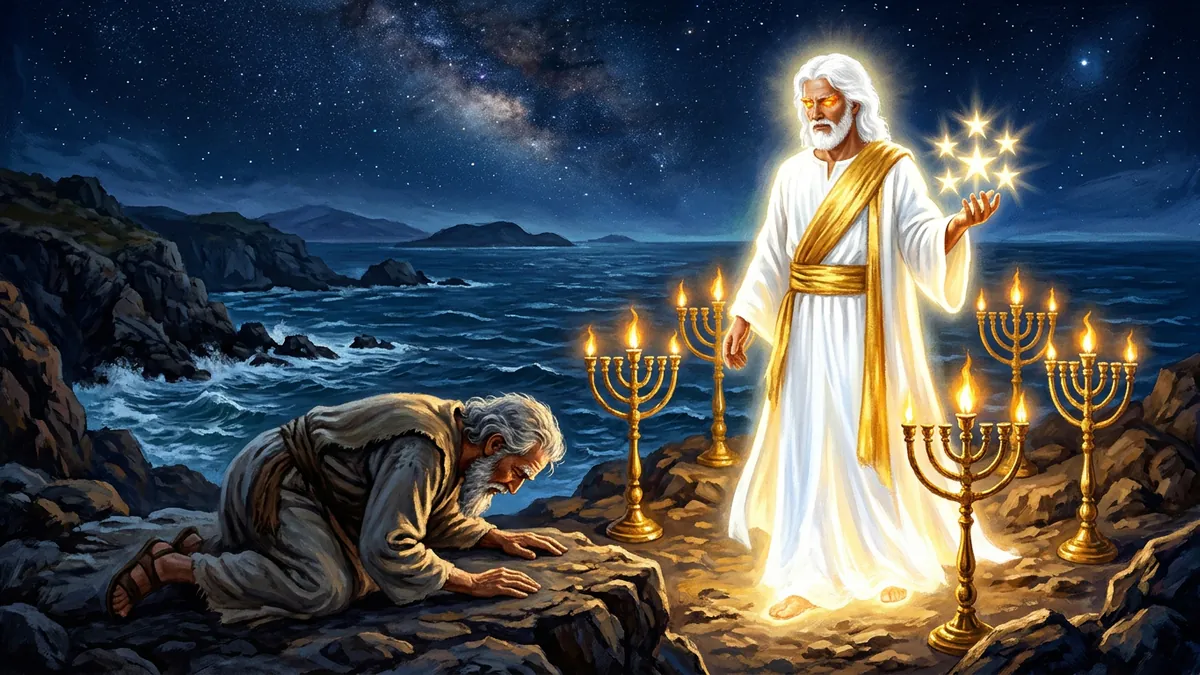
Yet Rome could only exile John’s frail physical body; they could never imprison his spirit! On the Lord’s Day (tē Kyriakē hēmera)—the sacred resurrection day of the Christian week—the solitary apostle knelt in prayer amidst the barren volcanic caves. Suddenly, John was seized by the Holy Spirit (egenomēn en pneumati). The physical parameters of space and time dissolved, and redemptive history crested its ultimate canonical peak.
The Unveiled King: The Glorified Son of Man
Behind John’s back echoed a deafening, supernatural sound: "a loud voice, as of a trumpet, saying, 'I am the Alpha and the Omega, the First and the Last'" (Revelation 1:10–11). Spinning around to behold the source of the cosmic trumpet, John’s eyes were flooded with transcendent, blinding splendor.
First, the apostle saw seven golden lampstands (hepta lychnias chrysaas), tall ornate menorahs glowing with holy celestial fire. Standing majestically in their very midst was One "like the Son of Man". Sixty years earlier, John had walked dusty Galilean roads with Jesus; he had seen Him hungry, weary, weeping at Lazarus’ tomb, and bleeding upon the Roman cross. But now, the veil of mortal humiliation was ripped away forever! John beheld the risen King in His uncreated, eternal theophanic majesty:
- The Royal-Priestly Garment: Clothed in a long flowing robe reaching down to His feet, girded across the chest with a golden band (zōnēn chrysān)—the attire of the sovereign High Priest entering the Holy of Holies.
- The Unblemished Purity: His head and hair were white like wool, as white as snow—the exact biblical imagery Daniel used to describe the Ancient of Days (Daniel 7:9), unveiling Jesus Christ as co-equal, co-eternal God with the Father.
- The Piercing Omniscience: His eyes were like a flame of fire (phlox pyros), piercing through all human hypocrisy, religious facades, and historical darkness with unvarnished, penetrating holiness.
- The Holy Omnipotence: His feet were like fine burnished brass (chalkolibanō), refined in a furnace, symbolizing an unbending foundation of holy judgment that tramples every demonic power.
- The Thunder of Cosmic Sovereignty: His voice resonated like the sound of many waters (phōnē hydatōn pollōn)—the terrifying, magnificent roar of Niagara and ocean swells mingled into divine speech.
- The Sovereign Governance: In His right hand He held seven stars, and out of His mouth went a sharp two-edged sword (rhomphaia distomos)—the piercing Word of God that slays falsehood and executes cosmic justice.
- The Unapproachable Light: His countenance was like the sun shining in full midday strength!
The Right Hand of Resurrection Power
Confronted with the blinding weight of uncreated glory, John did not walk up to casually embrace his friend. Fallen human nature cannot stand in the presence of unveiled holiness. John collapsed like a shattered stone:
"And when I saw Him, I fell at His feet as dead." (Revelation 1:17)
Paralyzed, breathless, and struck to the ground by divine terror, John lay in the dust. Then came the tenderest touch in biblical history. The King of Glory reached down with the very hand that held the seven galaxies and laid His right hand upon the trembling apostle. The voice that thundered like ocean waters softened into the eternal melody of comfort:
"Do not be afraid; I am the First and the Last. I am He who lives, and was dead, and behold, I am alive forevermore. Amen. And I have the keys of Hades and of Death." (Revelation 1:17–18)
What a triumphant declaration! "I was dead, and behold, I am alive forevermore!" The grave could not hold Him; Rome could not keep Him buried; Caesar could not conquer Him! The keys of Hades (the realm of departed spirits) and Death (the physical grave) hang securely at the belt of Jesus Christ. Domitian sat upon a temporary, fragile throne in Rome; Jesus Christ sat upon the eternal throne of the cosmos! John was commanded to write what he had seen, what is, and what will take place after these things.
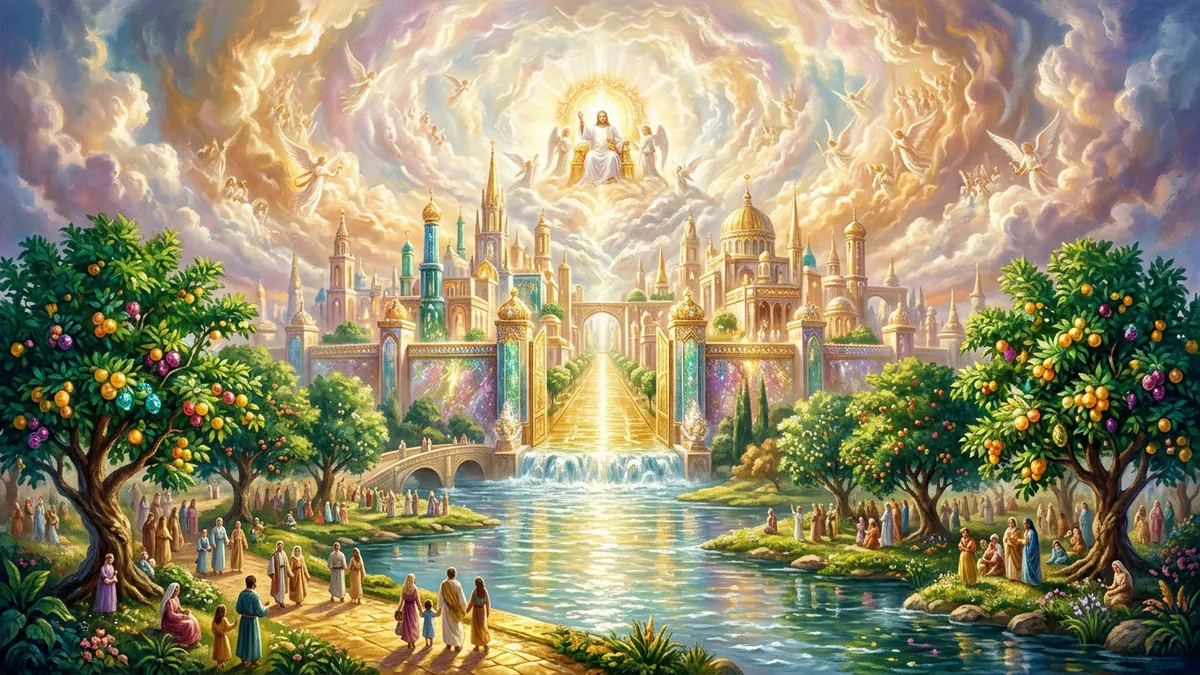
The Consummation: The New Heavens and the New Earth
Through the panoramic chapters of the Apocalypse, John was shown the grand unfolding of redemptive history: the seven seals of judgment, the seven trumpets of warning, the seven bowls of divine wrath, the downfall of Babylon the great, the binding of Satan in the abyss, and the Great White Throne Judgment where death and Hades are cast into the lake of fire.
Then, the cosmic curtain pulled back for the grand, eternal finale. The first heaven and the first earth—groaning under millennia of the curse, warfare, bloodshed, and decay—passed away into oblivion. Luke records the transcendent vision:
"Now I saw a new heaven and a new earth, for the first heaven and the first earth had passed away. Also there was no more sea. Then I, John, saw the holy city, New Jerusalem, coming down out of heaven from God, prepared as a bride adorned for her husband." (Revelation 21:1–2)
The absence of the "sea" symbolized the total elimination of chaos, separation, and threatening abyss that had isolated John on Patmos. The New Jerusalem—the celestial metropolis of the redeemed—descended into the renewed cosmos with breathtaking majesty. From the throne of the Almighty erupted a roaring declaration that dry-sponges every sorrow of human history:
"Behold, the tabernacle of God is with men, and He will dwell with them, and they shall be His people. God Himself will be with them and be their God. And God will wipe away every tear from their eyes; there shall be no more death, nor sorrow, nor crying. There shall be no more pain, for the former things have passed away." (Revelation 21:3–4)
Every tear shed in the quiet midnight watches, every sob of bereavement beside an open grave, every groan of chronic physical agony, every ache of persecution—God’s own tender hand will gently wipe them away forever! Death—the final enemy—is swallowed up in victory. Cancer, dementia, depression, and starvation are abolished for eternity.
The Architecture of Celestial Glory
Carried away in the Spirit to a great and high mountain, an angel showed John the breathtaking architectural blueprint of the Holy City. The city shone with the glory of God, its brilliance resembling a most precious jasper stone, clear as crystal.
The city was constructed as a colossal, perfect cube: 12,000 stadia (approximately 1,400 miles) in length, breadth, and height! In the Old Testament, the only room crafted as a perfect cube was the Holy of Holies (Debir) inside the Tabernacle and Temple, where the unmediated Shekinah glory dwelt above the Mercy Seat. The staggering theological revelation of the New Jerusalem is that the entire city is now the Holy of Holies! There is no temple inside the city, "for the Lord God Almighty and the Lamb are its temple" (Revelation 21:22). The city has no need of the physical sun or moon, for the uncreated glory of God illuminates it, and the Lamb is its lamp!
Its massive walls of jasper rested upon twelve foundation stones adorned with twelve precious gems—jasper, sapphire, chalcedony, emerald, sardonyx, carnelian, chrysolite, beryl, topaz, chrysoprase, jacinth, and amethyst—bearing the names of the Twelve Apostles of the Lamb. Its twelve gates were twelve solid, colossal pearls, each gate bearing the name of one of the twelve tribes of the children of Israel, signifying the eternal harmony of Old and New Covenant believers united in Christ.
The River of Life and the Eternal Reign
Finally, the angel led John to the spiritual epicenter of the celestial city:
"And he showed me a pure river of water of life, clear as crystal, proceeding from the throne of God and of the Lamb. In the middle of its street, and on either side of the river, was the tree of life, which bore twelve fruits, each tree yielding its fruit every month. The leaves of the tree were for the healing of the nations." (Revelation 22:1–2)
What humanity tragically lost in the Garden of Eden through the Fall of Adam is fully restored and surpassed in the New Jerusalem through the blood of the Lamb! The Tree of Life, once guarded by flaming cherubim, is now freely accessible to all the redeemed. The curse that had fractured human existence since Genesis 3 is officially annihilated: "And there shall be no more curse, but the throne of God and of the Lamb shall be in it, and His servants shall serve Him" (Revelation 22:3).
Then Luke records the supreme beatitude of the entire Bible:
"They shall see His face, and His name shall be on their foreheads." (Revelation 22:4)
Moses pleaded on Mount Sinai, "Show me Your glory," but was told no man could see God's face and live. But in the New Jerusalem, cleansed by the precious blood of Jesus, the redeemed shall gaze upon the unveiled face of Jesus Christ face-to-face forever! No shadows, no spiritual dimness, no night—for the Lord God gives them light, and they shall reign with Him forever and ever.
On the lonely volcanic cliffs of Patmos, the aged apostle John closed his prophetic scroll with the immortal heartbeat of the Church: "He who testifies to these things says, 'Surely I am coming quickly.' Amen. Even so, come, Lord Jesus!" (Revelation 22:20). The New Testament concludes not in despair or defeat, but in the blazing, triumphant dawn of the King of kings!
Support Independent Biblical Research
Did this study bless you? Help support our independent bilingual research and interactive visual Bible tools.
⚡ Fast Facts
- Patmos is a barren, crescent-shaped volcanic island in the Aegean Sea (measuring roughly 10 miles long and 6 miles wide), used by the Romans as an imperial penal colony (relegatio in insulam) for political exiles and Christian dissidents.
- The description of the Glorified Christ in Revelation 1:13–16 deliberately weaves together the messianic visions of Daniel 7:9 (The Ancient of Days with hair white like wool) and Daniel 10:5–6 (The Heavenly Man clothed in linen with eyes like flaming torches), affirming the absolute deity of Jesus.
- The seven golden lampstands (lychniai) symbolized the seven historical churches of Asia Minor, with Christ walking in their midst as their watchful, purifying High Priest.
- The New Jerusalem is described as a perfect cube—12,000 stadia (approximately 1,400 miles) in length, breadth, and height—deliberately mirroring the architectural dimensions of the Holy of Holies (Debir) in Solomon's Temple, signifying that in the eternal state, the entire city is the unmediated dwelling place of God.
❓ Frequently Asked Questions (FAQs)
Why did John fall as dead at Christ's feet when he had previously leaned on Jesus' chest at the Last Supper?
In the Gospels, John walked with Jesus in His state of humiliation—the Incarnate Son veiling His uncreated glory beneath mortal human flesh. John could lean affectionately upon Christ's bosom at the Last Supper (John 13:23). But on Patmos, the veil of flesh was permanently cast aside; John was confronted with the unveiled, blinding cosmic majesty of the exalted, glorified Lord of Heaven and Earth. No fallen human nervous system can sustain the direct gaze of uncreated divine glory without collapsing. Only when Christ placed His sovereign right hand upon John and spoke His grace could the apostle stand.
What is the theological meaning of Christ holding 'the keys of Hades and of Death'?
In the ancient world, keys symbolized absolute administrative ownership, jurisdiction, and sovereign authority. By conquering the grave through His bodily resurrection, Jesus Christ stripped Satan of the weapon of death (Hebrews 2:14–15). 'Death' (Thanatos) claims the physical body, while 'Hades' claims the departed soul. By holding both keys, Christ possesses absolute, undisputed authority over life, mortality, and eternity—no believer can enter eternity without Christ personally opening the door, and no grave can hold a saint when the King commands them to arise.
Why is there 'no temple' in the New Jerusalem (Revelation 21:22)?
Throughout redemptive history, the Tabernacle and Temple served as localized sanctuaries—shadowy architectural boundaries designed to allow a holy God to dwell near sinful people while protecting them from consuming holiness. But in the New Jerusalem, sin and the curse are completely obliterated. The city itself is the Holy of Holies. The Lord God Almighty and the Lamb are its temple; the entire redeemed cosmos enjoys unbroken, unmediated, face-to-face communion with the Triune God for all eternity.