
The fifth chapter of Second Kings presents one of the most stunning masterpieces of sovereign grace, radical humility, and spiritual conversion in the Old Testament. While the Northern Kingdom of Israel wallowed in cynical Baal worship, Yahweh reached beyond the covenant borders into the heart of pagan Syria to transform its supreme military commander. The account of Naaman the Syrian reveals that human greatness is hollow apart from divine mercy, and that God's cleansing fountain flows only for those willing to strip off their armor of pride.
Naaman was celebrated throughout Damascus as a colossal military hero. The scripture introduces him with an extraordinary accolade: he was "commander of the army of the king of Syria, a great man before his master and highly honorable, because through him Yahweh had given victory to Syria; he was also a mighty man of valor." Under the imperial providence of God, Naaman had led Syrian armies to victory, likely resisting the brutal onslaughts of the neo-Assyrian Empire. Yet, all his royal glory, battlefield medals, and aristocratic prestige were crushed beneath a terrifying, tragic qualification: מְצֹרָע (Metzora)—"but he was a leper."
No amount of gold, political influence, or military triumph could halt the relentless, disfiguring advance of his disease. The greatest warrior in the Levant was slowly rotting alive.
The Captive Maid and the Word of Faith
In the sovereign design of God, the instrument of Naaman's salvation was not a king, a diplomat, or a famous general. On one of their violent border raids into northern Israel, Syrian cavalry had dragged away a young Hebrew girl (נַעֲרָה קְטַנָּה - Na'arah Qetannah), who was assigned to serve Naaman's wife. Though torn from her homeland, family, and sanctuary, the young maid harbored no bitter malice toward her captors. Seeing the daily agony of her master, she spoke to her mistress with radiant, confident faith:
"If only my master were with the prophet who is in Samaria! For he would heal him of his leprosy."
Her testimony was electrifying. She did not say the prophet *might* pray; she spoke with absolute certainty: "he would heal him!" Desperate for life, Naaman reported her words to King Ben-Hadad of Syria. The monarch immediately dispatched Naaman with royal letters of state to the King of Israel, accompanied by an astronomical diplomatic treasure: ten talents of silver (approx. 750 lbs), six thousand shekels of gold (approx. 150 lbs), and ten royal changes of clothing—a fortune capable of purchasing entire cities.
The Panic of the King and the Prophet's Intervention
Naaman rode into Samaria and presented the Syrian king's letter to King Jehoram of Israel. The letter read with blunt diplomatic authority: "Now when this letter comes to you, behold, I have sent Naaman my servant to you, that you may heal him of his leprosy."
When the King of Israel read the demand, he went into hysterical panic. Tearing his royal robes, he screamed to his court: "Am I God, to kill and make alive, that this man sends to me to heal a man of his leprosy? Therefore please consider, and see how he seeks a quarrel against me!" Secular political power had no comprehension of supernatural grace; the apostate king saw only a military pretext for war.
When Elisha heard that the king had torn his clothes, he sent a scathing rebuke to the royal palace:
"Why have you torn your clothes? Please let him come to me, that he may know that there is a prophet in Israel!"
The Offense of the Muddy Jordan
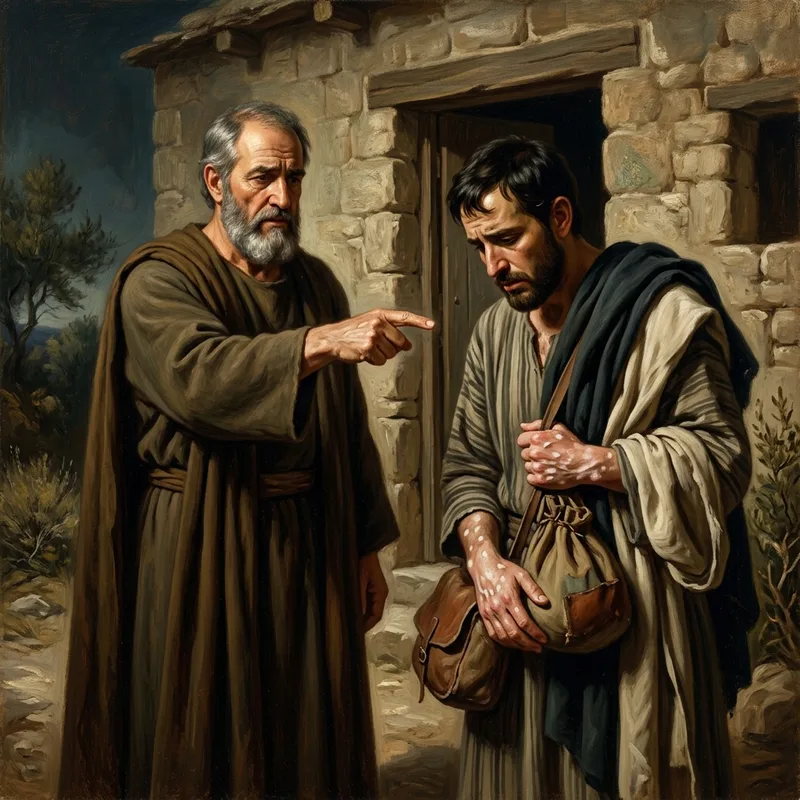
Naaman mounted his war chariot and rode down to Elisha's modest dwelling, accompanied by his dazzling cavalry escort. He pulled up before the prophet's gate, expecting the holy man to rush out, bow before his military stature, and stage a magnificent, theatrical ritual. He imagined Elisha standing over him, calling upon the name of Yahweh, and waving his hand over the diseased flesh to banish the leprosy.
Instead, Elisha did not even step outside! He simply dispatched a messenger to the doorway with a brief, humiliating directive: "Go and wash in the Jordan seven times, and your flesh shall be restored to you, and you shall be clean."
Naaman was infuriated. His aristocratic pride was wounded to the core. Striking his chariot rail, he roared in fury: "Behold, I thought, 'He will surely come out to me, and stand and call on the name of Yahweh his God, and wave his hand over the place, and heal the leprosy!' Are not the Abanah and the Pharpar, the rivers of Damascus, better than all the waters of Israel? Could I not wash in them and be clean?" Turning his war horses around, he stormed off in a rage.
Seven Dips in the Jordan
As Naaman galloped toward the Syrian border, his loyal servants rode alongside his chariot, addressing him with tender, respectful wisdom: "My father, if the prophet had told you to do something great, would you not have done it? How much more then, when he says to you, 'Wash, and be clean'?"
Their logic pierced his fury. Naaman realized the truth: he was willing to perform great feats of heroism or pay millions in gold, but he had resisted the simple, humbling obedience of faith. Turning his horses toward the Jordan rift valley, he descended the steep slopes to the muddy, brown waters of the river.
Stripping off his armor, his medals, and his fine Syrian tunic, Naaman stood exposed before his men, his scarred, rotting flesh visible in the sunlight. He stepped into the current. Once... twice... three times he submerged himself (טָבַל - Taval). Nothing happened. Four times... five times... six times. Still the white scales of leprosy disfigured his skin. It required complete, unreserved, sevenfold obedience.
Taking a deep breath, Naaman plunged beneath the water the seventh time. When he broke the surface, an astonishing miracle had occurred! The leprosy was gone! The decayed tissue, the lesions, and the dead skin had vanished completely. Scripture records with lyrical beauty: וַיָּשָׁב בְּשָׂרוֹ כִּבְשַׂר נַעַר קָטֹן—"his flesh was restored like the flesh of a little child, and he was clean!"
Covenant Conversion and the Refusal of Payment
Overwhelmed with awe, Naaman did not ride home to Damascus; he returned thirty miles to Samaria to find Elisha. Standing humbly before the prophet with his entire company, the Aramean general made an immortal, monotheistic confession of faith:
"Behold, now I know that there is no God in all the earth, except in Israel!"
Naaman pressed Elisha to accept a lavish blessing of gold, silver, and garments. But Elisha answered with an oath of holy integrity: "As Yahweh lives, before whom I stand, I will receive nothing!" Though Naaman urged him repeatedly, Elisha refused. The healing of God was a gift of free, unmerited grace; it could never be commodified or reduced to a pagan financial transaction.
Converted to exclusive devotion to Yahweh, Naaman made a humble request: "Please let your servant be given two mules' burden of earth; for your servant will no longer offer either burnt offering or sacrifice to other gods, but to Yahweh!" He desired to construct an altar of sacred covenant soil in Damascus, promising that while he must physically escort his elderly king into the pagan temple of Rimmon as a royal duty, his heart would worship Yahweh alone. Elisha blessed him with covenant peace: "Go in peace."
Gehazi's Covetousness and the Tragic Transfer
As Naaman's caravan disappeared down the road, a dark, toxic lust gripped the heart of Elisha's servant, Gehazi. Looking at the departing treasure, Gehazi muttered to himself: "Behold, my master has spared Naaman this Syrian, while not receiving from his hands what he brought; but as Yahweh lives, I will run after him and take something from him!"
Gehazi ran after the chariot. Seeing someone running, Naaman leapt down from his chariot to meet him, asking: "Is all well?" Gehazi spun a deceitful web: "All is well. My master has sent me, saying, 'Indeed, just now two young men of the sons of the prophets have come to me from the mountains of Ephraim. Please give them a talent of silver and two changes of garments.'"
Delighted to show gratitude, Naaman urged: "Please take two talents!" He tied two talents of silver (approx. 150 lbs) in two bags with two changes of garments and gave them to two servants to carry before Gehazi. Arriving at the citadel of Samaria, Gehazi took the loot, hid it secretly in his house, sent the servants away, and walked casually into the presence of his master.
Elisha looked at him with piercing prophetic clarity: "Where did you go, Gehazi?"
Gehazi lied smoothly: "Your servant went nowhere."
Elisha's voice fell like a gavel of cosmic judgment:
"Did not my heart go with you when the man turned back from his chariot to meet you? Is it a time to receive money and to receive garments, olive groves and vineyards, sheep and oxen, male and female servants? Therefore the leprosy of Naaman shall cling to you and your descendants forever!"
As the terrifying decree left the prophet's lips, the divine verdict struck Gehazi instantaneously. He walked out from Elisha's presence "a leper, white as snow." The tragic contrast was complete: an idolatrous Syrian general had stepped down into the waters of humility and received the flesh of a little child, while a privileged Hebrew servant of the prophet had chosen the path of greed and inherited lifelong, generational leprosy. God's grace cannot be bought, and His holiness will never be mocked.
Biblical Keywords & Theological Roots
A person afflicted with tzara'at / leprosy. Denoting a state of severe ceremonial and physical defilement that rendered a person ritualistically unclean under Mosaic law, highlighting Naaman's profound personal tragedy despite his worldly acclaim (2 Kings 5:1).
A little girl / young maiden. The Hebrew description of the captive Israeli maid whose unshakeable faith in Yahweh's prophet set the entire narrative of international redemption in motion (2 Kings 5:2).
To dip, plunge, immerse completely. Used of Naaman dipping himself seven times in the Jordan River, signifying absolute physical submission and ceremonial purification (2 Kings 5:14).
A little child / young boy. Denoting the pristine, radiant restoration of Naaman's flesh following his seventh immersion in the Jordan, fulfilling the prophetic promise of complete regeneration (2 Kings 5:14).
Covetous desire, greed, lust for material possession. The spiritual cancer that gripped Gehazi, driving him to monetize God's free grace and inherit lifelong leprosy (2 Kings 5:20).
Ancient Near Eastern & Archaeological Context
The historical narrative of 2 Kings 5 is set during the mid-ninth century BC (circa 850 BC), an era characterized by intermittent border skirmishes and fragile peace treaties between the Aramean kingdom of Damascus (under Ben-Hadad II / Hadadezer) and the Northern Kingdom of Israel (under Jehoram). The geopolitical prominence of Naaman is reflected in the biblical text's remarkable admission that Yahweh had granted victory to Aram through him—likely referencing Syrian resistance against the encroaching neo-Assyrian military expansion led by Shalmaneser III (noted on the Kurkh Monolith of 853 BC). Biblical leprosy (*Tzara'at*) encompassed a broad spectrum of disfiguring dermatological pathologies, including severe psoriasis, vitiligo, and true Hansen's disease. In Israel, Mosaic jurisprudence enforced rigorous ritual quarantine outside the camp (Leviticus 13–14); in pagan Syria, however, sufferers were not legally excluded from high civil office, explaining how Naaman retained his supreme military command. Ten talents of silver (approximately 750 pounds) and 6,000 gold shekels (roughly 150 pounds) constituted an astronomical royal fortune, demonstrating the desperate willingness of ancient monarchs to purchase health and divine favor. The rivers of Damascus—the Abanah (modern Barada) and Pharpar (modern Awaj)—flowed with cold, crystal-clear glacial runoff from Mount Hermon, transforming Damascus into an emerald desert oasis; by contrast, the lower Jordan River in the southern rift valley was sluggish, muddy, and brown, explaining Naaman's cultural indignation. Naaman's request for two mule-loads of Israelite dirt (*Adamah*) reflected the ancient Near Eastern belief in territorial deities, wherein Yahweh's presence was symbolically tethered to the sacred soil of His covenant land.
Practical Discipleship & Spiritual Application
- Bloom and Bear Witness Where You Are Planted: The captive Hebrew maid did not allow the injustice of slavery to silence her faith. Wherever God places you—even in difficult, unfair, or hostile environments—be a bold ambassador for Jesus Christ. Your simple word of testimony can transform lives.
- Surrender Intellectual Pride to Divine Simplicity: Naaman almost forfeited his healing because God's instructions did not match his preconceived human expectations. Do not stumble over the simplicity of the Gospel. Strip off the armor of self-righteousness and bathe in the cleansing fountain of Christ's blood.
- Protect the Free Grace of the Gospel: Salvation and spiritual gifts are never for sale. Beware the spirit of Gehazi that seeks personal financial profit or worldly acclaim through spiritual ministry. Freely you have received; freely give.
- Remember that Secret Sins Are Known to God: Gehazi thought he had hidden his silver and garments in the dark fortress, but Elisha's prophetic spirit was present. You can hide nothing from the eyes of Him with whom we have to do. Walk in radical transparency and holy integrity.
Support Independent Biblical Research
Did this study bless you? Help support our independent bilingual research and interactive visual Bible tools.
⚡ Fast Facts
- Naaman is explicitly mentioned by Jesus Christ in Luke 4:27 as the premier historical example of sovereign grace passing over unfaithful Israel to heal a humble Gentile outsider.
- The weight of silver and gold brought by Naaman (10 talents of silver and 6,000 shekels of gold) would be valued in excess of several million dollars in modern bullion value.
- Naaman's request for 'two mules' burden of earth' (2 Kings 5:17) represents an ancient Near Eastern legal and cultic practice: creating a portable sanctuary of sacred soil in Damascus upon which to sacrifice exclusively to Yahweh.
- Gehazi's tragic judgment is one of the Bible's starkest examples of instantaneous generational consequence, contrasting sharply with the blessing he could have inherited as Elisha's prospective successor.
❓ Frequently Asked Questions (FAQs)
Why did Elisha refuse to meet Naaman personally at the door?
Elisha's refusal was not rude indifference, but a calculated pastoral strategy to shatter Naaman's aristocratic pride. Naaman arrived expecting royal treatment, public rituals, and dramatic incantations honoring his military stature. By sending a mere messenger with simple instructions to wash in the muddy Jordan, Elisha demonstrated that divine healing is an act of sovereign grace requiring humble obedience, not a transaction between earthly dignitaries.
Why was dipping in the Jordan River so offensive to Naaman?
Damascus was famous throughout the ancient world for its breathtaking, snow-fed rivers—the Abanah and Pharpar—which flowed crystal-clear from Mount Hermon and transformed the desert into an oasis. In comparison, the lower Jordan River was slow, muddy, and brown. To an elite general, being commanded to strip off his armor and bathe in what he considered an inferior, dirty foreign stream was deeply insulting to his national and military pride.
Why was Gehazi's punishment so severe and generational?
Gehazi's sin was not merely theft; it was a blasphemous distortion of the Gospel. By accepting money from a new Gentile convert, Gehazi implied that God's miraculous grace could be purchased with cash, transforming Yahweh's prophet into a pagan soothsayer. To preserve the holiness of God's name and teach the absolute purity of grace, God enacted an immediate poetic justice: the physical disease that left the humble Gentile clung permanently to the hypocritical Hebrew servant.