The prophetic ministry of Elisha the son of Shaphat was marked by an astonishing overflow of supernatural grace. While his master Elijah had operated primarily as a thunderous storm of prophetic judgment against kings and apostate idolatry, Elisha walked among the ordinary villages, fields, and homes of Israel as a gentle shepherd of divine mercy. Second Kings chapter 4 records an extraordinary cycle of four pastoral miracles that demonstrated Yahweh's unfailing covenant compassion for destitute widows, barren noblewomen, and hungry disciples during an era of deep spiritual apostasy.
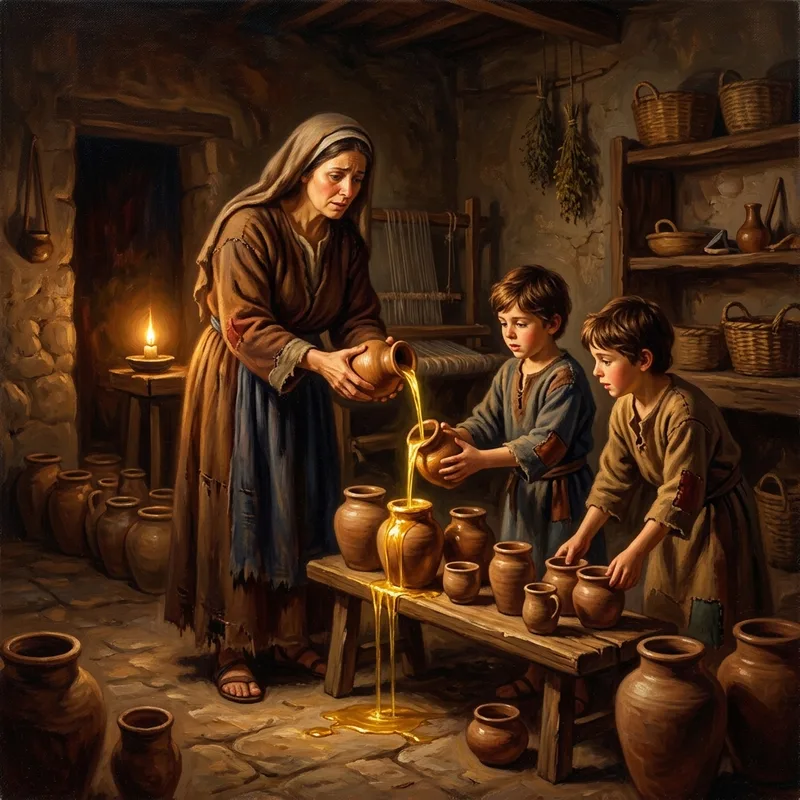
The first crisis struck the household of a deceased prophet from the guild of the sons of the prophets. His grief-stricken widow came weeping to Elisha with an agonizing plea: "Your servant my husband is dead, and you know that your servant feared Yahweh; but the creditor has come to take my two children to be his slaves!" Under the ancient Near Eastern debt customs, insolvent debtors could have their family members seized as bonded laborers until the debt was satisfied. For this faithful widow, losing her two sons meant the permanent extinguishment of her family line and a lifetime of absolute destitution.
Elisha looked upon her with deep pastoral tenderness and asked two diagnostic questions: "What shall I do for you? Tell me, what do you have in the house?"
She answered in despair: "Your maidservant has nothing in the house at all, except a small jar of oil (אָסוּךְ שָׁמֶן - Asuk Shemen)."
The Miracle of the Inexhaustible Oil
To human eyes, a single ceramic flask of anointing oil was completely worthless against the staggering demands of an aggressive creditor. But in the economy of God, divine miracles always begin with whatever meager, overlooked resource is willingly yielded into His hands. Elisha issued strange and audacious instructions:
"Go outside, borrow vessels from all your neighbors—empty vessels, and not a few! Then go inside, shut the door behind you and your sons, and pour oil into all these vessels; and set aside whatever is full."
The widow did not argue with the prophet's logic. She and her sons combed the neighborhood, borrowing every basin, clay jar, and amphora they could carry. Returning home, she shut the door behind her, sealing out the skeptical gaze of the world, and began to pour from her tiny flask into the first large empty jar. To her astonishment, the thick golden olive oil flowed like an unbroken mountain spring! Vessel after vessel was filled to the brim. She cried out to her son, "Bring me another vessel!" He answered, "There is not another vessel left!" Instantly, the miraculous flow of oil ceased.
She rushed to the man of God, trembling with awe. Elisha instructed her with practical wisdom: "Go, sell the oil and pay your debt; and you and your sons can live on the rest!" God did not merely provide the bare minimum to stave off slavery; He supplied a lavish surplus that sustained the family for years to come.
The Shunammite Noblewoman and the Promised Son
Elisha's itinerant ministry frequently led him across the fertile agricultural plains of Jezreel to the town of Shunem, nestled beneath the Hill of Moreh. Living in Shunem was a wealthy noblewoman (אִשָּׁה גְדוֹלָה - Isha Gedolah) renowned for her social influence and hospitality. Recognizing that Elisha was no ordinary traveler, she urged her husband to build a consecrated rooftop chamber (עֲלִיַּת־קִיר) furnished with a bed, table, chair, and oil lampstand, so that whenever the prophet passed by, he would have quiet sanctuary.
Moved by her selfless kindness, Elisha sent his servant Gehazi to ask how he could repay her: "Would you like a word spoken on your behalf to the king or to the commander of the army?" Her answer revealed a heart completely free of ambition: "I dwell among my own people." She sought neither political influence nor financial reward.
Gehazi whispered to Elisha: "In truth, she has no son, and her husband is old." In ancient Israel, childlessness was an agonizing personal and social reproach. Elisha summoned the woman to the doorway and declared with prophetic certainty: "About this season, when the time comes around, you shall embrace a son!" Overcome with emotion, she cried: "No, my lord, O man of God, do not lie to your maidservant!" Yet Yahweh remembered her, and the following spring she gave birth to a healthy son, filling her home with boundless joy.
Tragedy in the Harvest Field and Unshakeable Faith
Years passed, and the boy grew into childhood. One scorching summer morning, he went out into the golden wheat fields to join his father among the reapers. Suddenly, the intense Levant sun overwhelmed the child. Clutching his head, he screamed in agony: "My head! My head!"
His father instructed a servant to carry the boy home to his mother. She held her agonizing child on her lap until noon, when he drew his final breath and died in her arms. Any ordinary mother would have torn her clothes and erupted in deafening wails of despair. But the Shunammite possessed an extraordinary, unshakeable covenant faith. She carried the limp corpse of her only son up the exterior stairs, laid him upon the bed of the man of God, shut the door, and went out.
She requested a servant and a donkey from her husband, intending to ride sixteen miles across the valley to Mount Carmel where Elisha resided. Perplexed, her husband asked: "Why are you going to him today? It is neither the New Moon nor the Sabbath!"
Her answer was an immortal, one-word confession of supernatural peace:
שָׁלוֹם
"Shalom!" ("It is well!")
She galloped relentlessly toward Mount Carmel. Looking down from the mountain ridge, Elisha saw the dust cloud of her approaching chariot and sent Gehazi running to meet her: "Is it well with you? Is it well with your husband? Is it well with the child?" Again she answered: "Shalom!" She would not entrust her broken heart to a servant; she was coming directly to the man of God.
Reaching the summit, she threw herself prostrate at Elisha's feet, clutching his ankles in desperate grief. Gehazi moved to push her away, but Elisha restrained him: "Leave her alone, for her soul is bitter within her, and Yahweh has hidden it from me and has not told me." Weeping, she poured out her heart: "Did I ask a son from my lord? Did I not say, 'Do not deceive me'?"
Resurrection on the Prophet's Bed
Elisha immediately handed his prophetic staff to Gehazi and commanded: "Gird up your loins, take my staff in your hand, and go! If you meet anyone, do not greet him, and if anyone greets you, do not answer him; and lay my staff on the face of the child!"
The mother looked Elisha in the eye and swore an oath: "As Yahweh lives, and as your soul lives, I will not leave you!" She knew that a piece of dead wood held no power; she needed the living prophet of God. Elisha arose and accompanied her back to Shunem.
Gehazi ran ahead, reached the house, and laid the staff upon the boy's face. But there was neither sound nor response. Gehazi returned to meet them, confessing: "The child has not awakened."
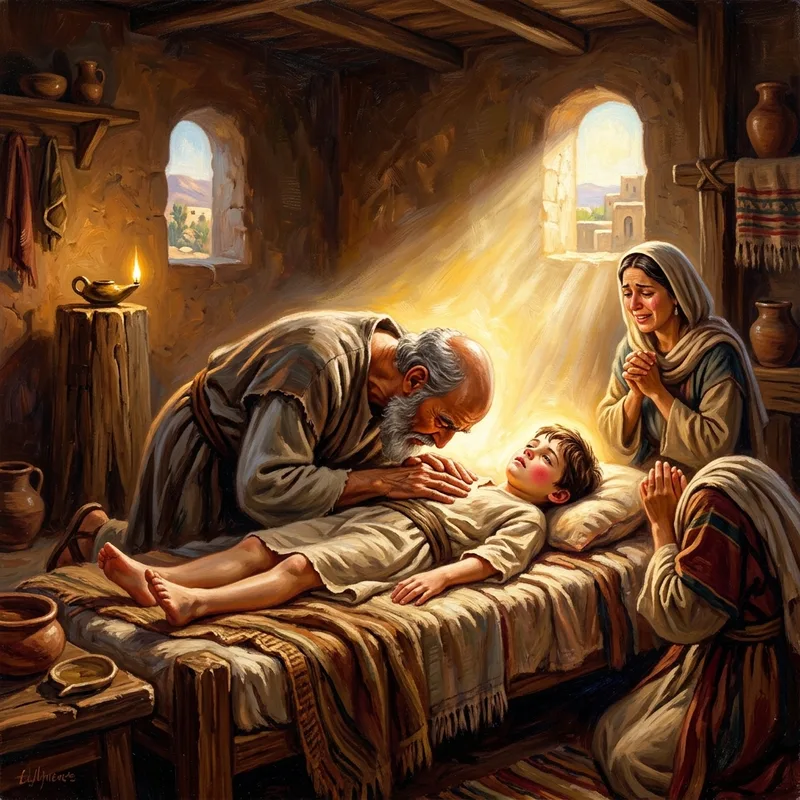
Arriving at the house, Elisha climbed the stairs alone and found the child lying dead on his bed. He shut the door upon the two of them and prayed earnestly to Yahweh. Stepping forward in sacrificial, costly intercession, Elisha climbed onto the bed and stretched himself across the child—mouth to mouth, eyes to eyes, and hands to hands. As he pressed his warm living body against the cold corpse, the flesh of the child grew warm!
Elisha stepped down, paced back and forth in the room in agonizing prayer, and stretched himself upon the child a second time. Suddenly, the boy sneezed seven times, expelling the congestion of death, and opened his eyes! Elisha called Gehazi: "Call this Shunammite!" When she entered the upper room, Elisha pointed to her living boy and whispered: "Pick up your son." Overwhelmed with reverent awe, she fell at his feet, bowed herself to the ground, picked up her resurrected son, and walked out in radiant triumph.
The Purified Stew and Multiplied Loaves at Gilgal
The chapter reaches its theological climax with two community miracles among the sons of the prophets at Gilgal during a severe national famine. While preparing a large communal pot of stew, one young student unwittingly gathered wild poisonous gourds (פַּקֻּעֹת שָׂדֶה - paqqu'ot sadeh) and shredded them into the cauldron. As the men began to eat, they tasted the bitter poison and cried out in terror: "O man of God, there is death in the pot (מָוֶת בַּסִּיר - Mavet ba-Sir)!" Elisha simply commanded: "Bring flour!" He threw a handful of meal into the boiling pot, and instantly the toxic poison was neutralized, rendering the food completely wholesome.
Soon after, a pious man arrived from Baal-shalisha bringing firstfruits (בִּכּוּרִים - Bikkurim) to the prophet: twenty small loaves of barley bread and fresh ears of grain in his sack. Elisha instructed his servant: "Give it to the men, that they may eat."
His attendant objected in disbelief: "How can I set this before a hundred men?"
Elisha repeated with unshakeable authority: "Give it to the men, that they may eat; for thus says Yahweh: 'They shall eat and have some left over!'"
The servant distributed the twenty small barley loaves among the hundred hungry men. Not only was every man completely satisfied, but they left remnants uneaten, precisely according to the word of Yahweh. Through oil, resurrection, purified food, and multiplied bread, Elisha demonstrated that the God of Israel is the supreme Giver and Preserver of life, anticipating the glorious fullness of Jesus Christ, the Living Bread who conquered death forever.
Biblical Keywords & Theological Roots
A flask / cruse of anointing oil. A hapax legomenon in the Hebrew Bible denoting a small ceramic vial used for personal anointing or domestic lighting, signifying the minuscule remainder of the widow's earthly possessions (2 Kings 4:2).
Peace, completeness, soundness, welfare. The audacious one-word confession uttered by the Shunammite woman to Gehazi and her husband while her only son lay dead in the upper room (2 Kings 4:23, 26).
A prominent / wealthy noblewoman. A technical Hebrew designation indicating aristocratic standing, extensive land holdings, social influence, and remarkable generosity (2 Kings 4:8).
Death in the pot! The terrified cry of the sons of the prophets at Gilgal upon tasting the toxic wild gourds (*paqqu'ot sadeh*), miraculously neutralized by Elisha casting meal into the cauldron (2 Kings 4:40).
Firstfruits. The sacred initial harvest produce prescribed under Leviticus 23:10, brought from Baal-shalisha by a faithful layman to Elisha and multiplied to feed a hundred men with surplus remaining (2 Kings 4:42).
Ancient Near Eastern & Archaeological Context
The prophetic cycle of 2 Kings 4 unfolded during the mid-ninth century BC in the Northern Kingdom of Israel (likely during the reign of Jehoram son of Ahab). Ancient Near Eastern debt laws were notoriously harsh: under early Israelite customary practice and broader Levantine legal traditions (such as the Code of Hammurabi §117), insolvent debtors were legally compelled to surrender their children or wives as bondslaves to satisfy debt obligations, though the Torah explicitly sought to mitigate this through the sabbatical year and Jubilee protections (Leviticus 25:39–43; Exodus 21:2). For a prophet's widow facing an unscrupulous creditor, foreclosure meant the permanent destruction of her household. Shunem was a fertile agricultural village situated in the southern foothills of the Hill of Moreh overlooking the Jezreel Valley, directly along the primary north-south trade route between Samaria and Mount Carmel. The Shunammite's title as an *Isha Gedolah* designated a woman of substantial wealth, noble landowning status, and independent domestic authority. Her construction of an *aliyyah* (an exterior roof-chamber accessed by an outside staircase) provided optimal privacy for visiting travelers without disturbing the household. The sudden collapse of her young son in the midday heat points to classic hyperthermia or pediatric cerebral sunstroke, a frequent hazard during Levant summer harvests. Gilgal, a regional center for the prophetic guild (*Benei ha-Nevi'im*), was gripped by severe famine, driving the young disciples to forage poisonous wild colocynth melons (*Citrullus colocynthis*), an aggressive desert purgative resembling edible squash. Elisha's miraculous multiplication of twenty barley loaves from Baal-shalisha during the Feast of Firstfruits prefigures Jesus Christ's feeding of the multitudes in Galilee.
Practical Discipleship & Spiritual Application
- Bring Your Emptiness to God's Abundance: The widow's oil only stopped flowing when there were no more empty vessels to receive it. God does not measure His supply by our bank accounts, but by our capacity to bring our empty, humble lives to Him. Never underestimate the small 'jar of oil' you currently possess.
- Cultivate Selfless, Discerning Hospitality: The Shunammite woman created a sacred space for the prophet simply because she discerned holiness in him. Open your home, resources, and heart to God's servants and people without expecting a return; God notices every cup of cold water given in His name.
- Confess Faith Over Circumstances: When heartbreak strikes and natural hope is extinguished, let your tongue proclaim 'Shalom.' Refuse to align your speech with the defeatism of the world; take your dead situations directly to the feet of Jesus Christ who holds the keys of death and Hades.
- Invest in Practical Community Ministry: Elisha did not stay confined to royal courts; he sweetened bitter stew, multiplied bread for hungry students, and comforted grieving widows. True ministry meets people in their everyday crises with the tangible compassion and provision of Christ.
Support Independent Biblical Research
Did this study bless you? Help support our independent bilingual research and interactive visual Bible tools.
⚡ Fast Facts
- The 'double portion' requested by Elisha was literally manifested in 2 Kings 4, which records four distinct, magnificent miracles in a single chapter: oil multiplied, a child raised from death, stew detoxified, and bread multiplied.
- Elisha is the second person in the entire Bible through whom a human resurrection was performed, following his master Elijah's raising of the widow of Zarephath's son (1 Kings 17).
- The multiplication of twenty barley loaves to satisfy one hundred men with food left over (2 Kings 4:42–44) is the direct Old Testament prophetic prototype of Jesus Christ feeding the 5,000 and 4,000 in the Gospels.
- The Shunammite woman is celebrated in rabbinic and Christian commentary as the model of the 'woman of valor' (Eshet Chayil) who used her wealth, discernment, and steadfast faith to safeguard both prophetic ministry and family lineage.
❓ Frequently Asked Questions (FAQs)
Why did Elisha instruct the widow to borrow empty vessels and shut the door?
Borrowing empty vessels was an active test of obedient faith: the extent of her supernatural provision was limited only by her capacity to gather vessels. Shutting the door protected the sacred, intimate nature of the miracle from public mockery, opportunistic creditors, and carnal sensationalism. Miracles of divine supply are holy transactions between God and the believer, requiring quiet trust rather than worldly theatricality.
Why did Gehazi's placement of Elisha's staff fail to resurrect the Shunammite's son?
The staff was an external symbol of prophetic office, but inanimate objects possess no inherent spiritual life. Furthermore, Gehazi lacked spiritual sensitivity and genuine covenant faith, as evidenced later by his greedy pursuit of Naaman's wealth. Resurrection life cannot be mass-produced through religious relics or secondary delegates; it required Elisha's personal presence, agonizing intercession before Yahweh, and sacrificial bodily contact.
How does the Shunammite woman's response of 'Shalom' inspire believers facing grief?
The Shunammite's declaration 'Shalom' ('It is well') in 2 Kings 4:26 represents one of scripture's highest models of victorious faith. Facing the sudden death of her only son, she refused to allow her speech to align with the finality of the grave. By speaking shalom, she anchored her soul in the unshakeable goodness of Yahweh, demonstrating that true faith does not deny the reality of pain, but subordinates tragedy to the sovereign supremacy of God.