In Matthew 13:31-32, Mark 4:30-32, and Luke 13:18-19, Jesus delivered a concise yet prophetically breathtaking parable: the Parable of the Mustard Seed. At a moment when His disciples were anxious about their small numbers, political weakness, and fierce opposition from Roman authorities and Temple priests, Christ unveiled the unstoppable, exponential destiny of the Kingdom of God.
1. Proverbial Insignificance
In first-century Jewish speech, 'small as a mustard seed' was a standard colloquial idiom denoting the tiniest conceivable entity. The black mustard seed (Sinapis nigra) was a speck barely one to two millimeters wide. A single gust of wind could blow it away; a casual step could crush it into oblivion. To the proud Roman Empire and religious Sanhedrin, Jesus and His band of uneducated Galilean fishermen appeared precisely like a mustard seed: utterly inconsequential, fragile, and destined for obscurity.
2. The Miracle of Underground Transformation
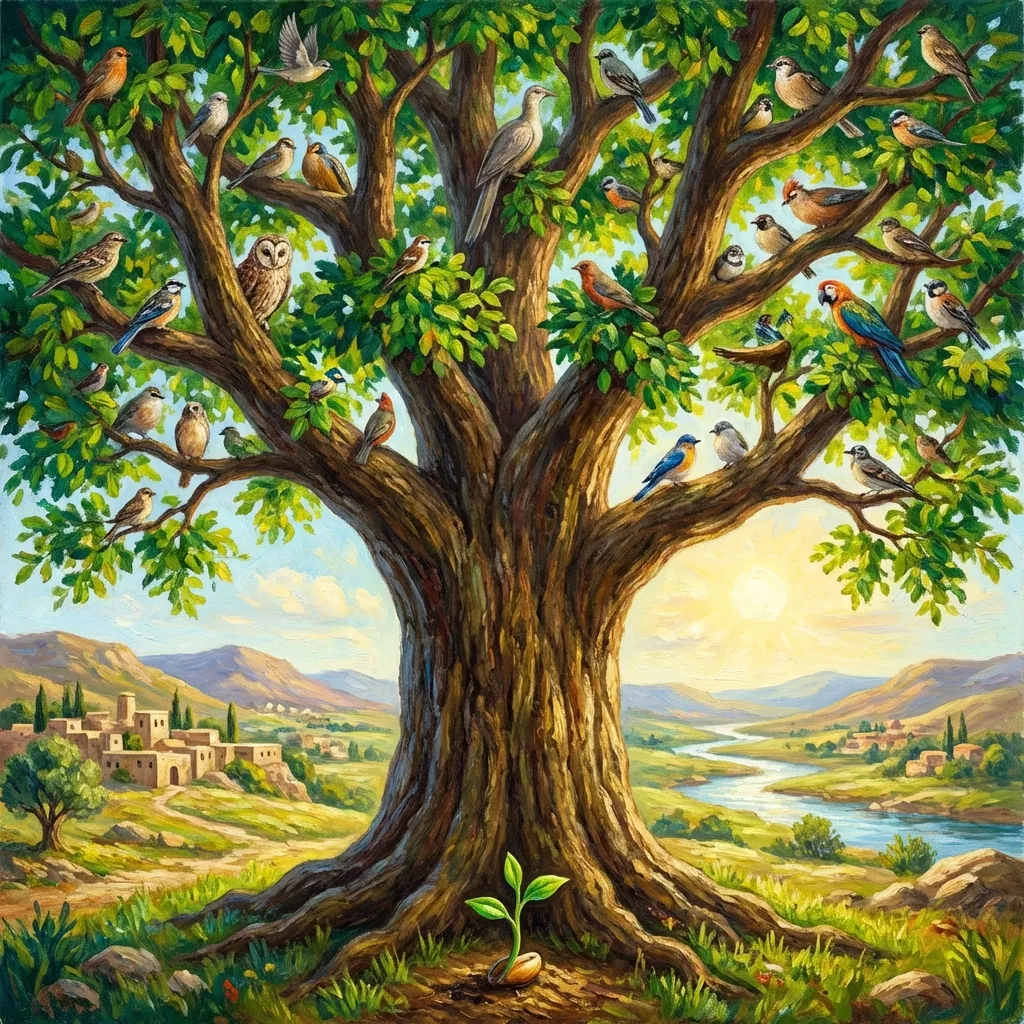
Yet Jesus said: "A man took it and planted it in his field. Though it is the smallest of all seeds, yet when it grows, it is the largest of garden plants and becomes a tree" (Matthew 13:31-32). What worldly eyes overlook as weak contains divine DNA. Buried beneath the dark soil of the earth, dying to its outer shell, the seed unleashes explosive biological vitality. In a single season, it shoots upward, spreading robust branches ten to twelve feet high.
3. Old Testament Echoes: The Cosmic Tree
Jesus' description intentionally evokes the grand prophetic visions of the Old Testament. In Ezekiel 17:22-23 and Daniel 4:10-12, the prophets portrayed cosmic kingdoms as towering cedar trees where the beasts of the field find shade and birds dwell in the branches. By applying this majestic royal imagery to a mustard bush, Jesus was turning imperial expectations upside down: the eternal Kingdom of God would not arrive as a violent Roman military conqueror, but as an organic, living kingdom of grace.
4. Shelter for the Birds of the Air
Christ concluded: "So that the birds come and perch in its branches." In prophetic scripture, 'birds of the air' consistently represent the Gentile nations (Ezekiel 31:6). From its humble, localized origins in a remote Roman province, the Gospel of Jesus Christ would expand to cross every ocean, border, and culture, offering eternal shade, shelter, and salvation to billions of souls from every tribe and tongue.
5. Living by Kingdom Perspective
This parable delivers an indispensable antidote to modern discouragement. We live in a culture that worships size, speed, and viral popularity. God's Kingdom operates on the principle of the mustard seed: faithful, quiet obedience in the hidden place that produces exponential eternal fruit. Never despise the day of small beginnings; the God who directs the mustard seed guarantees the final harvest.
Biblical Keywords & Theological Roots
Grain/seed of mustard (Sinapis nigra); the smallest agricultural seed known to ancient Galilean farmers, producing an enormous shrub.
Smallest, least; symbolizing the apparently insignificant, unimpressive origins of Jesus and His small band of disciples.
To nest, dwell, make nests; the birds of the air nesting in its branches, symbolizing the Gentile nations finding shelter in the Kingdom.
Ancient Near Eastern & Archaeological Context
The black mustard seed (*Brassica nigra* or *Sinapis nigra*) was proverbial in rabbinic literature as the smallest known seed deliberately cultivated by Galilean farmers (often measuring barely 1 to 2 millimeters in diameter). Despite its microscopic beginning, in the warm, fertile, volcanic soil of the plain of Gennesaret, the mustard seed rapidly grew into a sprawling, tree-like shrub reaching heights of 10 to 12 feet within a single growing season. Its thick branches and pungent seeds naturally attracted flocks of small songbirds, goldfinches, and linnets seeking shade, shelter, and nourishment, fulfilling Old Testament prophetic visions (Ezekiel 17:22-24; Daniel 4:10-12) of the cosmic kingdom welcoming the nations.
🔑 Key Spiritual Takeaways
- Never Despise Small Beginnings: The Kingdom of God advances not through immediate earthly fanfare, but through quiet, organic, supernatural growth.
- The Contrast of Humble Origins: Christianity began with an infant in a feed trough and a crucified Galilean, yet expanded to encompass billions across every continent.
- Shelter for the Nations: The branches of God's Kingdom offer spiritual shelter, safety, and salvation to people of every tongue, tribe, and ethnicity.
- Individual Faith Multiplies: A mustard seed of faith planted in the heart can dismantle mountains and birth generational fruitfulness.
Support Independent Biblical Research
Did this study bless you? Help support our independent bilingual research and interactive visual Bible tools.
⚡ Fast Facts
- Rapid Growth: The black mustard seed (less than 2 millimeters) grows in a single season into a sprawling tree-like shrub reaching 10 to 12 feet high.
- Proverbial for Smallness: In first-century Jewish culture, 'small as a mustard seed' was a common Hebrew idiom denoting the tiniest measurable quantity.
- Old Testament Echoes: The imagery of a great tree where birds find shade directly echoes Ezekiel 17:22-23 and Daniel 4:10-12, describing cosmic kingdoms.
- Unstoppable Expansion: The parable guaranteed that Christ's tiny, persecuted movement starting with twelve obscure peasants would grow to encompass the entire globe.
❓ Frequently Asked Questions (FAQs)
Is the mustard seed literally the smallest seed on earth?
Botanically, orchid seeds are smaller. However, Jesus was speaking to ancient Galilean farmers in their localized agricultural vocabulary. Among the seeds cultivated in Palestinian vegetable gardens, the black mustard seed (*Brassica nigra*) was proverbially the smallest seed sown by hand.
Who do the 'birds of the air' represent in this parable?
In Old Testament prophetic symbolism (Ezekiel 17:23; 31:6; Daniel 4:12), birds nesting in the branches of a mighty tree represent the Gentile nations finding refuge, protection, and citizenship under God's sovereign rule.
What encouragement does this parable offer to struggling believers?
It assures us that apparent insignificance is not failure. Your quiet prayers, small acts of service, and humble witness carry supernatural Kingdom DNA. God takes what is hidden and small and supernaturally expands it for eternal glory.