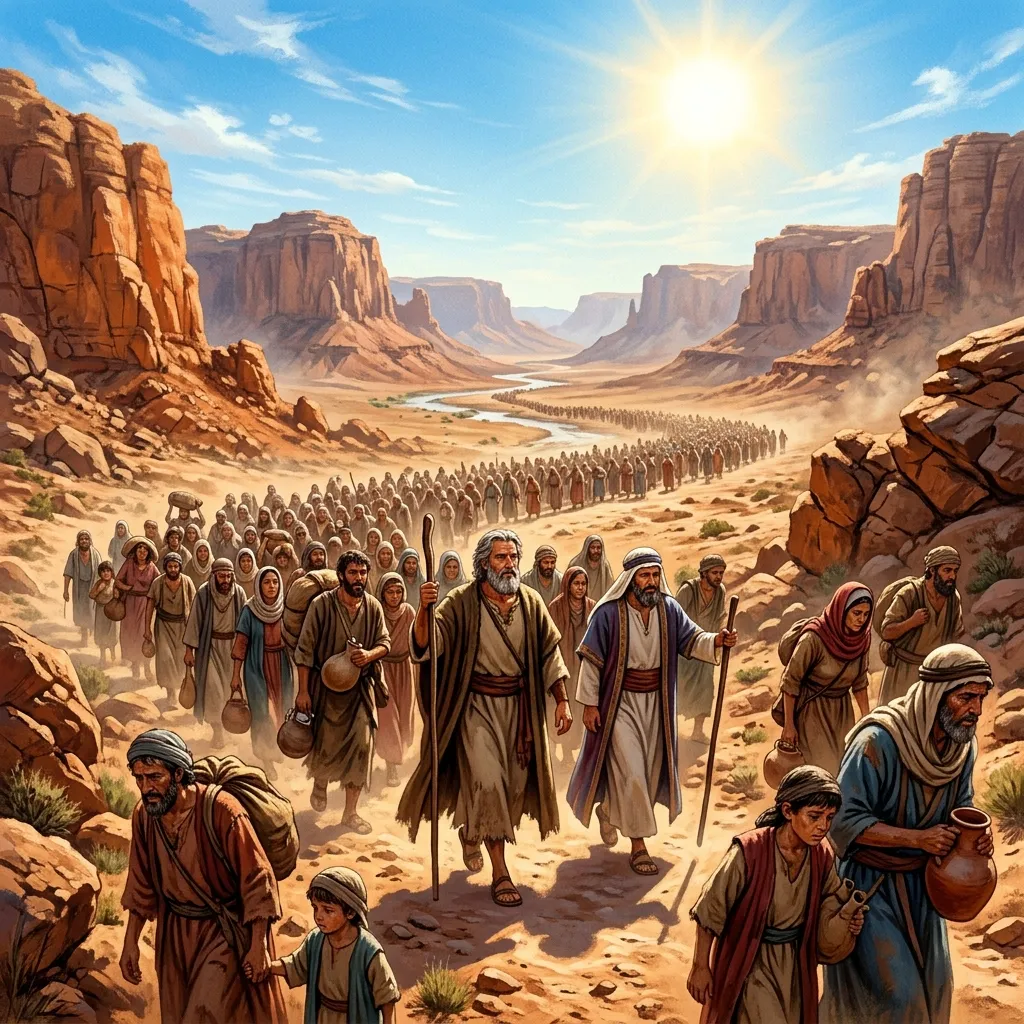
The calendar of redemptive history turned toward the close of an agonizing era. Nearly four decades had slipped away since the catastrophe at Kadesh-Barnea, where an unbelieving generation had surrendered to the paralyzing terror of the ten faithless spies and drawn the sentence of death in the desert dust. Year after grinding year, the vast encampment had traced serpentine paths across the windswept wilderness of Paran and Zin, leaving behind a trail of hundreds of thousands of shallow desert graves. Now, in the first month of the fortieth year, the surviving remnant—a new generation forged in the crucible of hardship—marched back to the very place where their fathers had rebelled: Kadesh, nestled in the desolate wilderness of Zin.
For Moses, the return to Kadesh opened with profound personal heartbreak. Miriam, his beloved elder sister, drew her final breath. Miriam was the courageous young girl who, eighty years earlier, had stood vigil among the Nile reeds to ensure baby Moses was rescued by Pharaoh’s daughter; she was the prophetess who had led the women of Israel in ecstasy with timbrels and dancing on the shores of the Red Sea. Now, her weary journey was finished. They buried her in the stony soil of Kadesh. Moses had scarcely dried his tears of fraternal bereavement when the ancient, familiar nightmare descended upon him once more. Kadesh, usually sustained by the vital oasis springs of *Ein el-Qudeirat*, suffered an acute hydrological drought. The underground limestone aquifers failed; the wadi beds turned to baking stone, and the desert winds scorched the throats of over a million people and their vast herds of cattle.
Instead of turning to Yahweh in humble prayer—the God who had rained down manna every morning for forty years and guided them by the pillar of fire—the congregation reverted instantly to the toxic spiritual pathology of their deceased parents. A mutinous mob swarmed around Moses and Aaron, shouting litigious, venomous accusations: "If only we had died when our brethren died before Yahweh! Why have you brought up the assembly of Yahweh into this wilderness, that we and our animals should die here? And why have you made us come up out of Egypt, to bring us to this evil place? It is not a place of grain or figs or vines or pomegranates; nor is there any water to drink!" (Numbers 20:3–5). It was breathtaking insolence. After four decades of supernatural divine preservation, they still spoke of the cruel slave-ovens of Egypt as paradise, while blaspheming the Promised Land as an 'evil place.'
Moses and Aaron turned away from the shouting multitude and made their way to the entrance of the Tabernacle of Meeting. Exhausted, emotionally bruised, and overwhelmed by the sheer insolence of the people, the two elderly brothers fell face down upon the desert sand before the presence of the Lord. In that moment of absolute human helplessness, the blinding Shekinah glory of Yahweh flashed forth from the sanctuary. The voice of God spoke to Moses with clear, tender compassion for the thirsty flock: "Take the staff; assemble the congregation, you and Aaron your brother. Speak to the rock before their eyes, and it will yield its water; thus you shall bring water for them out of the rock, and give drink to the congregation and their animals" (Numbers 20:8).
The divine command was crystal clear, precise, and profoundly gracious. God did not instruct Moses to denounce the congregation; He did not command a plague of judgment, nor did He tell Moses to strike the rock. He simply commanded: Take the staff... and speak to the rock before their eyes. Moses went into the Holy Place and took the staff from before the presence of Yahweh—the very staff of Aaron that had miraculously budded, flowered, and yielded almonds as an eternal sign of divine election. Accompanied by Aaron, Moses strode out toward the massive limestone cliff face (*sela*) that towered over the arid basin of Kadesh. The vast assembly of Israel gathered around the base of the crag, their parched throats burning, their eyes fixed upon their leader.
Standing before the rock, Moses looked down upon the sea of hostile, murmuring faces. Something snapped within the soul of the meekest man on earth. The compounded weight of forty years of slander, the raw agony of Miriam’s fresh grave, and the relentless, ungrateful mutiny of the people ignited a storm of petulant, ungodly fury within his spirit. Instead of fixing his gaze upon the gentle grace of God, Moses looked at the rebellion of man. In a state of reckless, inflamed passion, Moses lifted his voice and shouted at the crowd: "Hear now, you rebels! Must we bring water for you out of this rock?" (Numbers 20:10).
The words were catastrophic. In that single, ill-fated sentence, Moses committed multiple spiritual transgressions. First, he denounced the congregation with the harsh, contemptuous epithet "Morim" (rebels), unleashing human wrath rather than reflecting God’s tender mercy. Second, and far more lethal, Moses uttered the fatal pronoun: "Must WE bring water for you out of this rock?" In that moment of blinding arrogance, Moses and Aaron usurped the exclusive glory of Almighty God! They presented themselves to the eyes of the congregation as the miracle-working architects of salvation, rather than humble, dependent vessels of Yahweh’s sovereign grace.
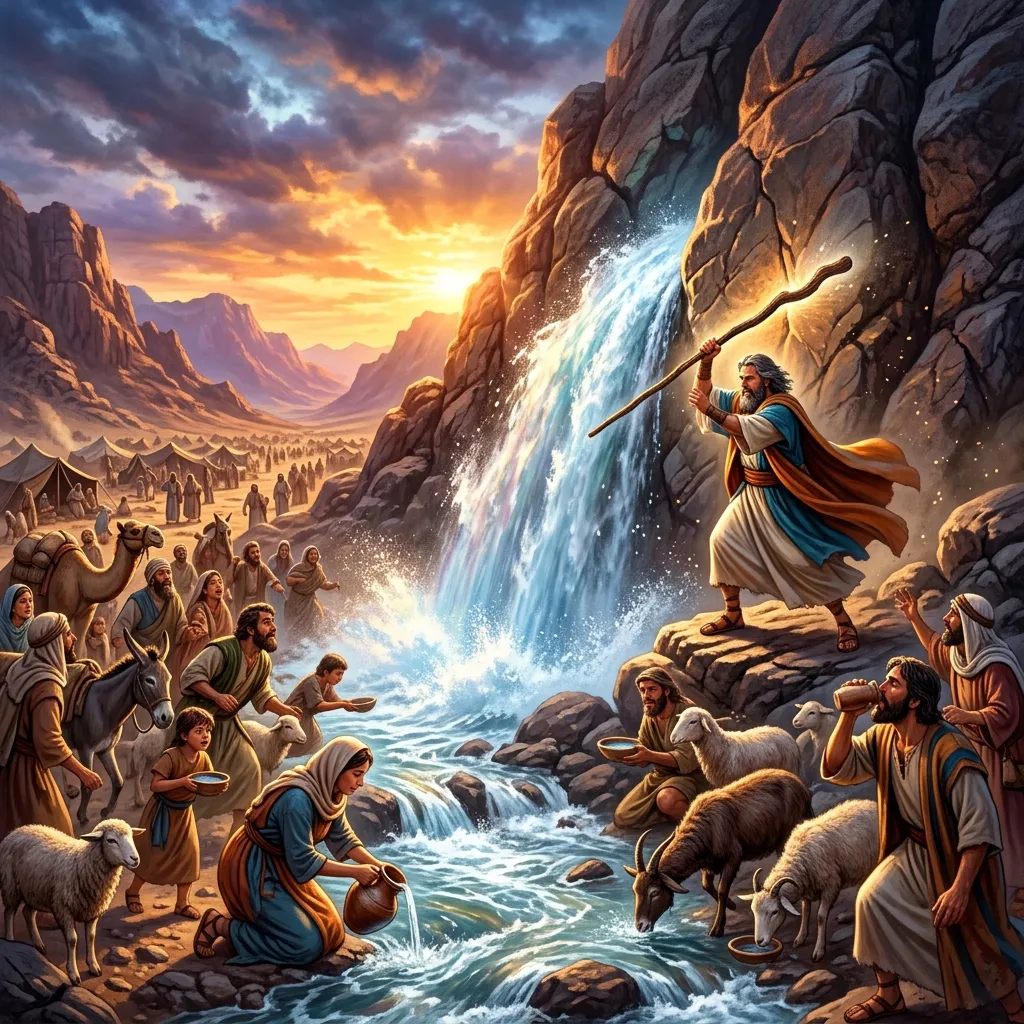
Then, consumed by rage, Moses lost all spiritual restraint. He completely abandoned the divine instruction to *speak* to the rock. Lifting the holy staff high into the air with both hands, Moses brought it down with violent force against the stone cliff—CRACK! And then, not satisfied with one blow, he swung the staff a second time with furious, pounding vengeance—CRACK!
The silence that followed was suffocating. Then, by the sheer, unmerited mercy of a compassionate God who loves His thirsty sheep despite the failure of their shepherd, the subterranean foundations of the rock fractured. A roaring, crystalline torrent of sweet, ice-cold water exploded from the deep fissures of the limestone cliff! It gushed forth like a roaring river, cascading down the desert rocks into the dry wadi basin. Cries of sheer delight and relief echoed across the camp. Men, women, little children, and desperate cattle plunged their faces into the roaring streams, drinking deeply of the life-giving water until their parched bodies were completely revitalized. Grace abounded where sin was present; the thirst of Israel was satisfied.
Yet as the rejoicing multitude drank from the miraculous river, Moses and Aaron stood in terrifying isolation before the rock. The water flowed, but the heaven above them was silent. Suddenly, the voice of Yahweh cut through the rushing sound of the waters like a sharp, two-edged sword, speaking privately to Moses and Aaron: "Because you did not believe Me, to hallow Me in the eyes of the children of Israel, therefore you shall not bring this assembly into the land which I have given them" (Numbers 20:12).
The sentence fell like a thunderbolt upon the heart of Moses. For forty agonizing years, through hunger, thirst, heat, rebellion, and warfare, Moses had carried this obstinate nation upon his shoulders like a nursing father. He had interceded for them when God threatened to consume them at Sinai; he had turned away divine wrath at Kadesh-Barnea and after the rebellion of Korah. His single, supreme earthly longing was to set foot in the good land flowing with milk and honey—to see the fulfillment of the promise made to Abraham, Isaac, and Jacob. And now, at the very threshold of Canaan, in the fortieth year, that dream was irrevocably stripped away. He would never lead the congregation across the Jordan River.
The tragedy at Meribah reveals the uncompromising holiness of God. The Lord explained Moses' sin with clinical precision: "Because you did not believe Me, to hallow Me..." To hallow God (*qadash*) means to set Him apart as uniquely holy, righteous, and true. By striking the rock in violent rage and exclaiming 'Must we bring water?', Moses had presented Yahweh to the congregation as a petulant, short-tempered deity who was coerced into providing water by human agitation. Furthermore, Moses had destroyed a sublime prophetic blueprint. As the Apostle Paul reveals in 1 Corinthians 10:4, "that Rock was Christ." At Mount Horeb forty years earlier, God had commanded Moses to strike the rock (*Tzur*), typifying Jesus Christ being smitten once and for all on the cross of Calvary for the sins of the world (Hebrews 9:28). But at Kadesh, the rock was a high cliff (*Sela*); it was only to be *spoken* to. Under the New Covenant, Christ is never to be crucified again; believers need only speak to Him in prayer, and the living waters of the Holy Spirit flow freely (John 7:37–39). By striking the rock twice in human anger, Moses prophetically portrayed Christ as needing to be re-crucified.
Moses accepted the divine decree with heartbroken, silent humility. The waters were named Meribah—the waters of strife—because there the children of Israel contended with Yahweh, and there He was hallowed among them. Shortly thereafter, Moses led his brother Aaron up the slopes of Mount Hor. In the presence of Eleazar, Aaron’s son, Moses stripped the holy high priestly garments from his dying brother and placed them upon Eleazar. Aaron died there upon the mountain peak, and Israel wept for thirty days. Meribah stands across the centuries as a sobering monument of warning: no amount of past spiritual faithfulness exempts a servant of God from the solemn duty of reverencing His holiness today. God's grace is boundless, but His leaders must always sanctify His holy name before the eyes of His people.
Biblical Keywords & Theological Roots
Strife, contention, quarrel, or legal lawsuit; derived from the root *rib* (to contend or plead a cause), designating the place where Israel litigated against Yahweh and His servants.
A high cliff, craggy precipice, or lofty mountain rock; contrasted with *tzur* (boulder at Horeb), representing the exalted, unassailable majesty of God from which living water was to flow by spoken word.
Rebels, contentious ones, or recalcitrant apostates; from the verbal root *marah* (to be bitter, rebellious, or disobedient), the harsh, rash epithet hurled by Moses at the congregation.
To strike, smite, beat, or hit violently; used of striking with a staff in forceful human wrath, repeated twice by Moses in direct violation of the divine command to speak.
To sanctify, treat as holy, set apart, or manifest sacred purity; representing Moses and Aaron's tragic failure to display God's gentle, gracious character before the eyes of the congregation.
Ancient Near Eastern & Archaeological Context
The wilderness of Zin forms the jagged, parched southern frontier of the biblical Negev, characterized by towering limestone cliffs, arid wadis, and extreme temperature fluctuations. Kadesh (identified with the modern oasis of *Ein el-Qudeirat*) was the most vital natural aquifer in the region, relying on deep subterranean karstic aquifers that periodically dry up during prolonged desert droughts. In Ancient Near Eastern legal and dispute terminology, a formal grievance brought by a community against its leaders was known as a *rib*—a judicial lawsuit or contentious strife (*Meribah*). In desert nomadism, access to water was a matter of immediate life and death; disputes at communal springs often escalated into armed tribal warfare. Furthermore, the rock at Horeb forty years earlier (Exodus 17) was designated in Hebrew as *Tzur* (a low, solid boulder) which was explicitly commanded to be struck (*nakah*), whereas the rock at Kadesh was a *Sela* (a towering, craggy cliff face), which Moses was commanded merely to speak to (*dibber*).
Practical Discipleship & Spiritual Application
- Guarding Your Spirit and Tongue Under Prolonged Exhaustion: After forty years of patient endurance, the grief of losing his sister Miriam combined with relentless complaints pushed Moses over the edge. Beware of the subtle danger of burnout; emotional exhaustion often leaves the door wide open for ungodly anger and rash speech (Psalm 106:32–33).
- The Typology of the Once-Struck Rock: At Horeb, the rock was struck—typifying Jesus Christ, the Rock of Ages, who was smitten once and for all on the cross of Calvary for our sins (Exodus 17:6; 1 Cor 10:4). To strike the rock a second time shattered this sacred prophetic blueprint, implying Christ's sacrifice was insufficient. Today, we do not strike the Rock; we speak to Him in faith.
- Leaders Face a Stricter Judgment Before the Flock: God did not revoke His grace from the thirsty people, but He held Moses and Aaron to an exacting standard. To whom much is given, much is required (Luke 12:48). Misrepresenting God's character before the congregation carries profound spiritual consequences.
- Grace Still Flows Despite Human Failure: Even though Moses acted in petulant anger and disobeyed the precise divine instruction, abundant water still poured forth from the rock to quench the thirst of hundreds of thousands of people and their livestock. God's miraculous compassion for His sheep is not held hostage by the spiritual failure of His undershepherds.
⚡ Fast Facts
- Miriam died and was buried at Kadesh in the wilderness of Zin at the start of the fortieth year of the wilderness journey (Numbers 20:1).
- Psalm 106:33 explicitly explains Moses' sin: 'They provoked his spirit, so that he spoke rashly with his lips.'
- At Horeb (Exodus 17:6), God commanded Moses to strike (*nakah*) the rock (*tzur*); at Kadesh (Numbers 20:8), God commanded him only to speak (*dibber*) to the rock (*sela*).
- Because of this incident, Aaron died shortly thereafter atop Mount Hor, where his high priestly garments were transferred to his son Eleazar.
❓ Frequently Asked Questions (FAQs)
To modern readers, striking a rock instead of speaking to it might appear to be a trivial technicality. However, in the eyes of God, Moses committed a catastrophic theological and leadership failure on multiple fronts. First, it was direct disobedience: God explicitly commanded Moses to *speak* to the rock. Striking it twice was an act of willful presumption. Second, Moses spoke rashly and arrogantly, stealing God's glory: 'Hear now, you rebels! Must *we* bring water for you out of this rock?' (Numbers 20:10). By saying 'Must *we*', Moses and Aaron presented themselves as the miracle-working source of the water rather than humble instruments of Yahweh. Third, Moses misrepresented God's character. God was moved with deep compassion for His thirsty, suffering people; Moses approached them with boiling fury, making God appear petulant and vindictive. As the paramount covenant mediator through whom the Law was delivered, Moses had to exemplify absolute holiness before Israel. God told him plainly: 'Because you did not believe Me, to hallow Me in the eyes of the children of Israel, therefore you shall not bring this assembly into the land which I have given them' (Numbers 20:12).
The Apostle Paul reveals the mystery in 1 Corinthians 10:4: 'They drank of that spiritual Rock that followed them, and that Rock was Christ.' The two rocks embody two distinct dispensations of Christ's redemptive work. At Horeb (Exodus 17), the rock (*Tzur*) was smitten by Moses' staff under the direct presence of Yahweh standing upon it. This was a majestic prophetic picture of the crucifixion: the Son of God smitten by the rod of divine justice once and for all on Calvary, from whose pierced side flowed living water and blood (John 19:34). At Kadesh forty years later, the rock (*Sela*) was an exalted cliff. It was never to be struck again, because Christ dies only once for all time (Hebrews 9:28; Romans 6:9–10). Under the New Covenant, believers do not strike Christ; we simply *speak* to Him in prayer and faith, and the living waters of the Holy Spirit gush forth (John 7:37–39). By striking the rock twice, Moses unintentionally shattered this divine typological blueprint, spiritually symbolizing that Christ needed to be crucified again in shame.
Miriam was not merely Moses' biological older sister; she was the courageous young girl who had stood vigil by the Nile reeds eighty years earlier to preserve baby Moses' life (Exodus 2:4–8), and she had led the women of Israel in triumphant worship after crossing the Red Sea (Exodus 15:20–21). Numbers 20 opens with her death and burial at Kadesh. Moses was in the raw throes of deep fraternal grief. Immediately following her funeral, before Moses even had time to mourn, the natural springs dried up, and the people descended upon him like a pack of wolves, mercilessly demanding water and blaming him for their misery. The combination of intense bereavement, physical dehydration, emotional burnout, and the weariness of four decades of unceasing murmuring battered Moses' psychological defenses. While his grief does not excuse his disobedience, it reveals Moses' profound humanity and highlights the crushing weight borne by spiritual shepherds.