The wilderness journey had entered its most grueling and spiritually demoralizing corridor. Having departed from the heights of Mount Hor, where Aaron the high priest had breathed his last and his sacred garments were transferred to his son Eleazar, the massive encampment of Israel moved south. The direct, well-watered royal trade route known as the King's Highway sliced directly through the lush plateau of the Kingdom of Edom. Moses had dispatched courteous, fraternal envoys to the king of Edom, promising that Israel would stay strictly on the main road, paying for every drop of water and mouthful of grain, and harming neither field nor vineyard. But the Edomite monarch had responded with ruthless hostility, mobilizing a heavily armed army and warning Moses that any border transgression would be met by the sword. Refusing to wage an unprovoked war against their estranged brethren—the descendants of Esau—Moses gave the order to turn southward into the desolate, baking chasm of the Wadi Arabah.
The Arabah was a geological oven. Hemmed in by the jagged, red granite crags of the Edomite mountains to the east and the blistered limestone plateau of the Negev to the west, the rift valley trapped the desert heat like a furnace, with temperatures regularly soaring beyond 115 degrees Fahrenheit. The path was agonizing: loose scree tore the soles of their sandals, hot thermal winds whipped blinding dust into their eyes, and water sources were virtually non-existent. Day after day, week after week, the people dragged their weary feet through the dry wadis, watching the green, fertile hills of Edom mock them from the eastern ridge. In the exhausting monotony of the detour, the fragile psychological endurance of the nation collapsed completely. Numbers 21:4 records the tragic descent: "And the soul of the people was much discouraged because of the way."
Discouragement in the heart of an unbeliever rapidly metastasizes into mutinous rage. Instead of crying out to Yahweh for strength, the congregation erupted in vicious, blasphemous rebellion against God and Moses: "Why have you brought us up out of Egypt to die in the wilderness? For there is no food and no water, and our soul loathes this worthless bread!" (Numbers 21:5). The accusation was horrifying in its insolence. For nearly forty consecutive years, every single morning except the Sabbath, the heavens had miraculously opened above their tents, showering down the pristine, supernatural manna—the bread of angels, fresh with the dew of heaven and sweet as honey. It had sustained their children, nourished their elders, and preserved their strength. Yet now, in arrogant contempt, they spat upon heaven's mercy, reviling God’s daily miracle as lechem ha-qeloqel—despicable, worthless, nauseating bread!
In that moment, the righteous, protective restraint of God was withdrawn. For four decades in that lethal, hostile wilderness, the supernatural hedge of Yahweh's presence had shielded Israel from the countless horrors of the desert: venomous predators, dehydration, heat stroke, and marauding nomadic raiders. Now, because the people despised His holy bread and rejected His covenant leadership, God lifted that protective barrier, allowing the latent terrors of the wilderness to invade the camp. Out from the subterranean crevices of the dry granite rocks, out from beneath the thorn bushes and baking sands, swarmed thousands of lethal, venomous vipers: the nechashim seraphim—the fiery serpents.
These were the deadly saw-scaled vipers (*Echis coloratus*), aggressive and hyper-toxic. In an instant, the peaceful encampment became an apocalyptic landscape of terror. The serpents slithered silently into tents, wrapped themselves around bedposts, struck at men tending the livestock, and bit children sleeping upon woven mats. Shrieks of agonizing pain shattered the desert air. The venom injected into their veins was brutally destructive: a cocktail of hemorrhagins and neurotoxins that caused catastrophic internal bleeding, localized necrosis, burning tissue destruction, and systemic shock. The victims felt as though liquid fire had been poured directly into their blood vessels—a searing, unbearable agony that caused the throat to swell, the kidneys to fail, and the lungs to suffocate. Within hours, hundreds of Israelites were writhing in fatal convulsions; thousands more lay dying across the camp. The angel of death swept through every tribe, and the cries of mourning echoed from ridge to ridge.
Confronted by the sheer horror of their folly, the stubborn pride of Israel broke into pieces. The survivors rushed in terror to the tent of Moses, weeping and confessing their guilt: "We have sinned, for we have spoken against Yahweh and against you! Pray to Yahweh that He take away the serpents from us!" (Numbers 21:7). There were no excuses, no legalistic debates, no accusations of tyranny. For the first time in their journey, they named their sin with absolute clarity. And Moses, demonstrating once more the Christlike heart of an intercessor, harbored no bitterness against the people who had slandered him hours earlier. He immediately fell upon his face and pleaded with Yahweh for the life of his dying sheep.
Yahweh answered Moses' prayer, but in a manner that shattered all human wisdom and religious expectation. God did not instantly banish the serpents, nor did He provide a medicinal herbal poultice or a magical incantation. Instead, the Lord commanded Moses: "Make a fiery serpent, and set it on a pole; and it shall be that everyone who is bitten, when he looks at it, shall live" (Numbers 21:8).
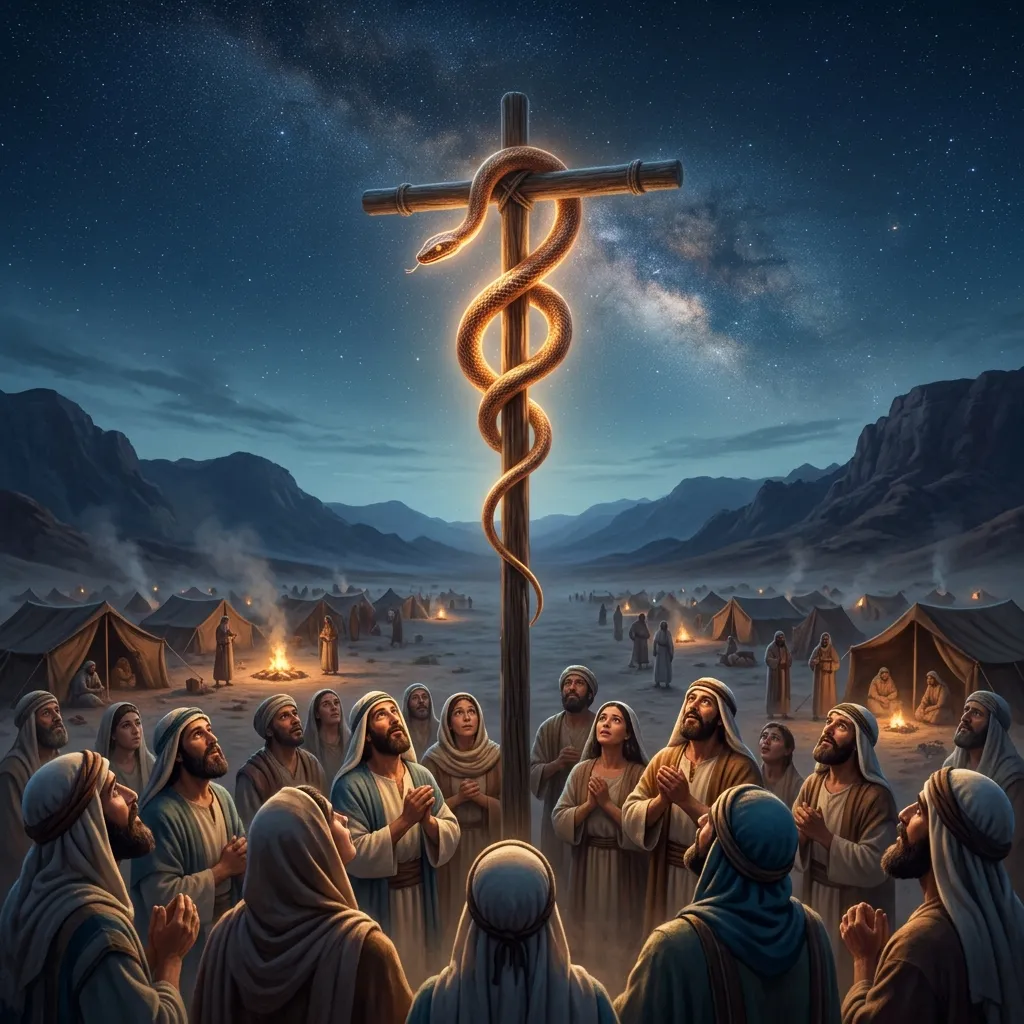
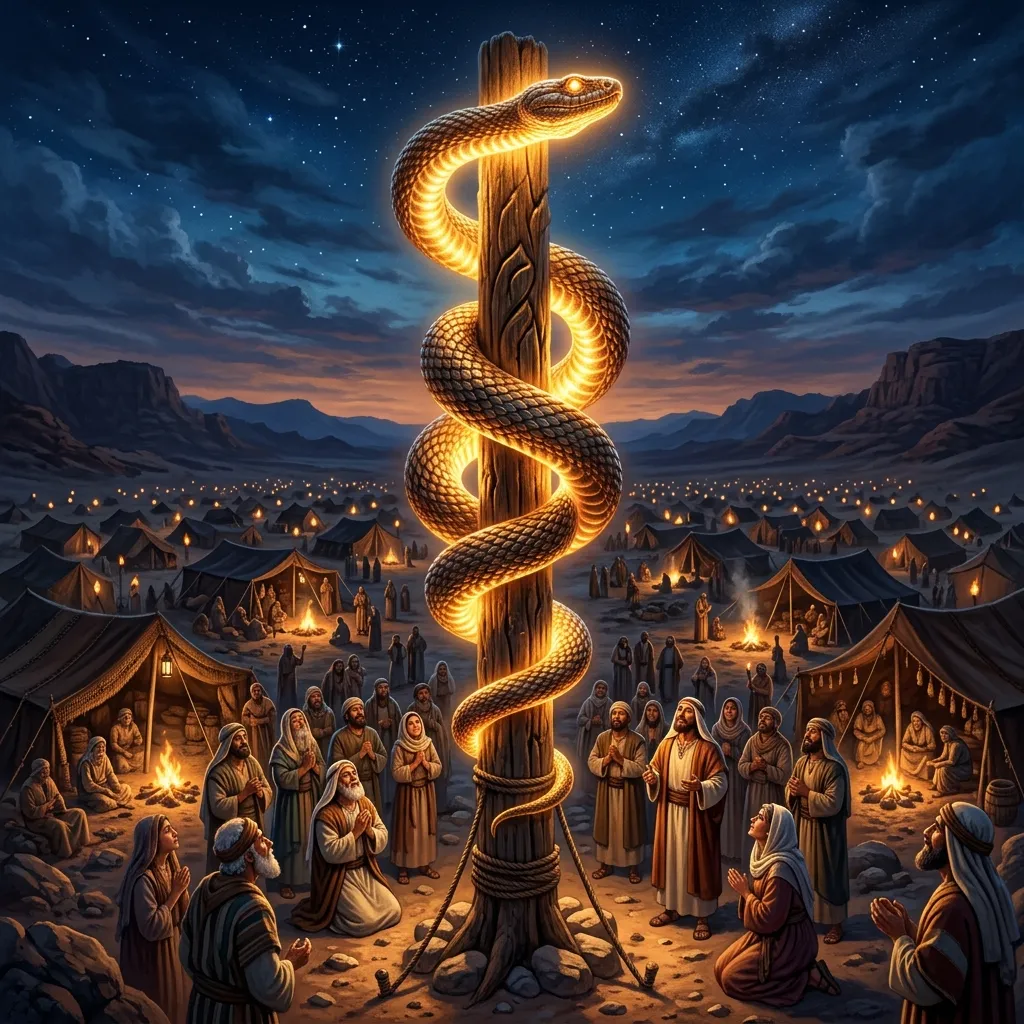
The command was deeply startling. To craft the image of a serpent—the very creature that had deceived mankind in Eden and was currently killing their families—seemed utterly paradoxical. Yet Moses understood the divine logic. He took pure copper and bronze (*nechosheth*)—the metal associated in the sanctuary with the altar of sacrifice and the fiery judgment of God. With skillful artisan hammer blows, he fashioned the realistic, glistening likeness of a coiled, deadly viper with flaring fangs. Then, gathering a tall wooden beam, he affixed the bronze serpent high upon the cross-arm standard (*nes*). Moses carried this towering banner to a prominent, elevated hill in the very center of the camp, lifting it high against the blazing desert sky so that it was visible from every quadrant of the encampment.
Then the prophetic proclamation echoed through the dying ranks: Look to the standard! Look upon the bronze serpent and live! The scene that unfolded was one of breathtaking, dramatic faith. In thousands of tents across the Arabah, men, women, and little children lay on the verge of physical death, their limbs swollen with black necrosis, their breath rattling in their chests. Medical science was powerless; human willpower was futile. But as the desperate, dying victims dragged themselves to their tent doors, or were gently lifted by weeping relatives, they turned their fading eyes toward the center of the camp. They fixed their gaze (*nabat*) upon the bronze serpent gleaming in the sunlight high upon the wooden pole.
The moment their eyes locked upon that standard with expectant faith, a supernatural miracle exploded in their bodies! The searing fire in their veins was extinguished; the lethal coagulopathy reversed; the swelling subsided; fresh, vibrant, resurrection life (*chayah*) flooded their cells. The dying leaped to their feet, completely whole, their strength restored in an instant! Conversely, whoever in stubborn skepticism refused to look—reasoning that looking at a piece of bronze was foolish or unscientific—perished miserably in their tents. Salvation was completely independent of human effort, ritual performance, or moral merit. It was received entirely through a single, trusting gaze upon the divinely appointed substitute.
For fourteen centuries, this mysterious event stood in the sacred scrolls of the Torah, baffling Jewish commentators. Why would God use a bronze serpent to save? Then, on a dark night in Jerusalem, the Lord Jesus Christ Himself unveiled the mystery to Nicodemus, a master of the Sanhedrin: "And as Moses lifted up the serpent in the wilderness, even so must the Son of Man be lifted up, that whoever believes in Him should not perish but have eternal life" (John 3:14–15).
The typology is breathtaking in its perfection. The serpent represents the curse of sin and Satan that has infected the bloodstream of all humanity, bringing certain, eternal spiritual death. We are all bitten, burning with the lethal poison of rebellion against God. But on Calvary, God did the unthinkable: He took His spotless, holy Son and sent Him "in the likeness of sinful flesh" (Romans 8:3). Jesus, who knew no sin, was made sin for us (2 Corinthians 5:21). On that wooden Roman cross, the Son of Man was lifted up as our substitute, and the full fury of divine judgment against sin fell upon Him. When the bronze serpent was impaled on the pole, it had no venom; it was bronze—judgment executed and finished. In the same way, the power of sin and Satan was judged and crushed at the cross. Today, the divine invitation rings across the globe to every dying sinner: look away from your own failing efforts, look away from your self-righteousness, look to the crucified and risen Savior lifted high on the cross—look and live!
Biblical Keywords & Theological Roots
Fiery serpent or burning snake; from *saraph* (to burn or incinerate), describing both the luminous coppery appearance of the vipers and the agonizing, burning sensation caused by their lethal venom.
Copper, bronze, or brass; an intentional Hebrew wordplay with *nachash* (serpent), symbolizing enduring strength under the refining fire of divine judgment.
A standard, banner, signal pole, or rallying ensign; an elevated military and theological beacon erected upon a high peak so as to be clearly visible across great distances.
To look intently, gaze expectantly, regard with focused attention, or behold with faith; denoting a deliberate, purposeful turning of the eyes rather than a casual glance.
To live, revive, recover health, be preserved alive, or receive resurrection life; representing instantaneous supernatural deliverance from venomous physical death.
Ancient Near Eastern & Archaeological Context
The geographical setting of Numbers 21 is the Wadi Arabah—the deep geological rift valley extending from the southern shore of the Dead Sea to the Gulf of Aqaba (Elath). Denied transit through the King's Highway by the armed king of Edom (Numbers 20:14–21), Israel was forced into a punishing, waterless circumvention through intensely rugged granitic gorges where summer temperatures routinely exceed 115°F (46°C). The region is the natural habitat of highly lethal desert vipers, notably the saw-scaled viper (*Echis coloratus*) and the black desert cobra (*Walterinnesia aegyptia*), whose hemotoxic and neurotoxic venoms cause excruciating burning pain, systemic hemorrhaging, and rapid respiratory failure. Crucially, the Arabah is home to Timna—the largest copper-mining district in the ancient Levant. Archaeological excavations at Timna uncovered a Late Bronze Age Midianite-Kenite tent shrine containing a five-inch cast copper and gilded serpent artifact dating to the 13th–12th century BC, corroborating that metal serpent symbolism was deeply embedded in the metallurgical and religious iconography of this exact wilderness region.
Practical Discipleship & Spiritual Application
- Beware the Lethal Poison of Despising God's Gracious Provision: The crisis began not with external enemies, but with internal contempt for heaven's gift. Calling the supernatural manna 'worthless bread' (Numbers 21:5) revealed hearts blind to daily grace. When we cultivate a grumbling, ungrateful spirit, we invite spiritual vipers that poison our joy and faith.
- The Image of Judgment Becomes the Instrument of Life: God commanded Moses to shape the very likeness of that which was killing the people—a serpent—in bronze and lift it high upon a pole. In Christ, God made Him who knew no sin to be sin for us (2 Corinthians 5:21). On Calvary, the very curse that condemned humanity was judged in the body of Jesus.
- The Sublime Typology of John 3:14–15: Jesus declared to Nicodemus: 'As Moses lifted up the serpent in the wilderness, even so must the Son of Man be lifted up, that whoever believes in Him should not perish but have eternal life.' Just as the dying Israelite could not heal himself through herbs, self-effort, or religious rituals, our only salvation from the venom of sin is gazing by faith upon the crucified Christ.
- The Utter Simplicity of the Gospel: Look and Live: God did not require the dying victims to climb the mountain, touch the bronze serpent, or recite complex formulas. They simply had to turn their failing eyes toward the standard and believe God's promise. 'Look unto Me, and be ye saved, all the ends of the earth' (Isaiah 45:22). Salvation is not achieved by works; it is received by faith through a single gaze upon the Savior.
⚡ Fast Facts
- The Hebrew phrase *nachash saraph* literally means 'burning serpent', referring to the agonizing burning sensation produced by the viper's lethal neurotoxins.
- Moses fashioned the serpent out of *nechosheth* (bronze or copper)—an intentional phonetic and linguistic pun with *nachash* (serpent).
- Jesus explicitly cited this historical event in John 3:14 as the paramount Old Testament type of His impending crucifixion on Calvary.
- Centuries later, because Israel began idolizing and burning incense to this bronze serpent, calling it *Nehushtan* ('a piece of brass'), righteous King Hezekiah broke it into pieces (2 Kings 18:4).
❓ Frequently Asked Questions (FAQs)
The serpent is indeed the ancient emblem of deception, sin, and the curse originating from the Garden of Eden (Genesis 3:1–15). However, that is precisely the profound theological point of this divine ordinance! In the biblical theology of atonement, the substitute must bear the exact likeness of that which brought the curse. God did not command Moses to erect a bronze lamb or a golden dove; He commanded the image of the deadly viper itself. By fashioning a serpent out of bronze—the biblical metal representing divine judgment and the refining furnace of holiness (Exodus 27:1–8)—and impaling it high upon a wooden standard (*nes*), God visually declared: 'The deadly serpent that is killing you has been rendered impotent; it has been judged, neutralized, and impaled on a tree!' As the Apostle Paul triumphantly explains in Romans 8:3 and 2 Corinthians 5:21, God sent His own Son 'in the likeness of sinful flesh' and made Him who knew no sin to be sin for us. On the cross, Christ bore our curse, putting sin and Satan to open shame (Colossians 2:14–15).
The biblical description matches the endemic vipers of the hyper-arid Arabah rift, most notably the Palestine saw-scaled viper (*Echis coloratus*) and the desert horned viper (*Cerastes cerastes*). These nocturnal pit vipers conceal themselves under loose sands, rocks, and scrub brush. Their venom contains potent metalloproteinases, procoagulants, and hemorrhagins that disrupt the human clotting cascade, resulting in severe consumptive coagulopathy, spontaneous internal bleeding, excruciating localized swelling, tissue necrosis, and acute renal failure. The bite produces an intense, searing, fire-like agony in the victim's veins, aptly named *saraph* (fiery/burning). In a crowded, nomadic tent community of over a million people moving through rocky gorges, a sudden infestation of these aggressive vipers meant hundreds were bitten simultaneously, overwhelmed by agonizing fever, dehydration, and suffocating death.
While the bronze serpent was a glorious instrument of salvation in the wilderness, fallen human nature is perpetually prone to turn instruments of grace into objects of idolatry. Second Kings 18:4 records that by the eighth century BC, the Israelites had preserved Moses' bronze serpent as a sacred cultic talisman, bringing it to the Temple precincts and burning incense to it as if it were a pagan fertility or healing deity. Righteous King Hezekiah, in his sweeping religious reformation, courageously smashed the ancient relic to dust, naming it *Nehushtan*—which contemptuously translates to 'a mere piece of brass' or 'a worthless bronze trinket.' Hezekiah recognized that when a holy memorial displaces the Living God and becomes an idol of superstitious veneration, it must be ruthlessly destroyed. True faith looks past the symbol to the God who saves.