The encampment of Israel at the foot of the desert hills was an ocean of mourning, terror, and smoldering spiritual agitation. In the terrible aftermath of Korah’s rebellion, the earth had violently cleaved open, swallowing the households of the mutinous Kohathite and his Reubenite conspirators into the black jaws of Sheol. A torrent of supernatural fire had leaped from the Tabernacle, consuming two hundred and fifty prominent princes bearing bronze censers. And when the congregation had gathered the following morning in stubborn, unchastened fury to accuse Moses and Aaron of murdering 'the people of Yahweh,' a swift and lethal plague had devastated the ranks, cutting down fourteen thousand seven hundred men and women before Aaron sprinted into the dying multitude with his smoking censer to stand between the living and the dead. The plague had ceased, but the toxic root of cynicism had not been eradicated. Beneath the weeping and the funeral shrouds, whispers still circulated among the tents: Why Aaron? By what right does one family from one clan monopolize access to the holy presence of God?
Yahweh knew the deep-seated pride of the human heart. Left unaddressed, this perpetual undercurrent of grumbling would inevitably spawn another insurrection, bringing about the total annihilation of the nation. Therefore, the Lord determined to settle the question of the priesthood once and for all, not with another terrifying display of seismic fury or devouring flame, but through a breathtaking sign of supernatural life and resurrection power. The Lord summoned Moses and commanded: "Speak to the children of Israel, and get from them a staff from each father's house, all their leaders according to their fathers' houses—twelve staffs. Write each man's name on his staff. And you shall write Aaron's name on the staff of Levi. For there shall be one staff for the head of each father's house" (Numbers 17:2–3).
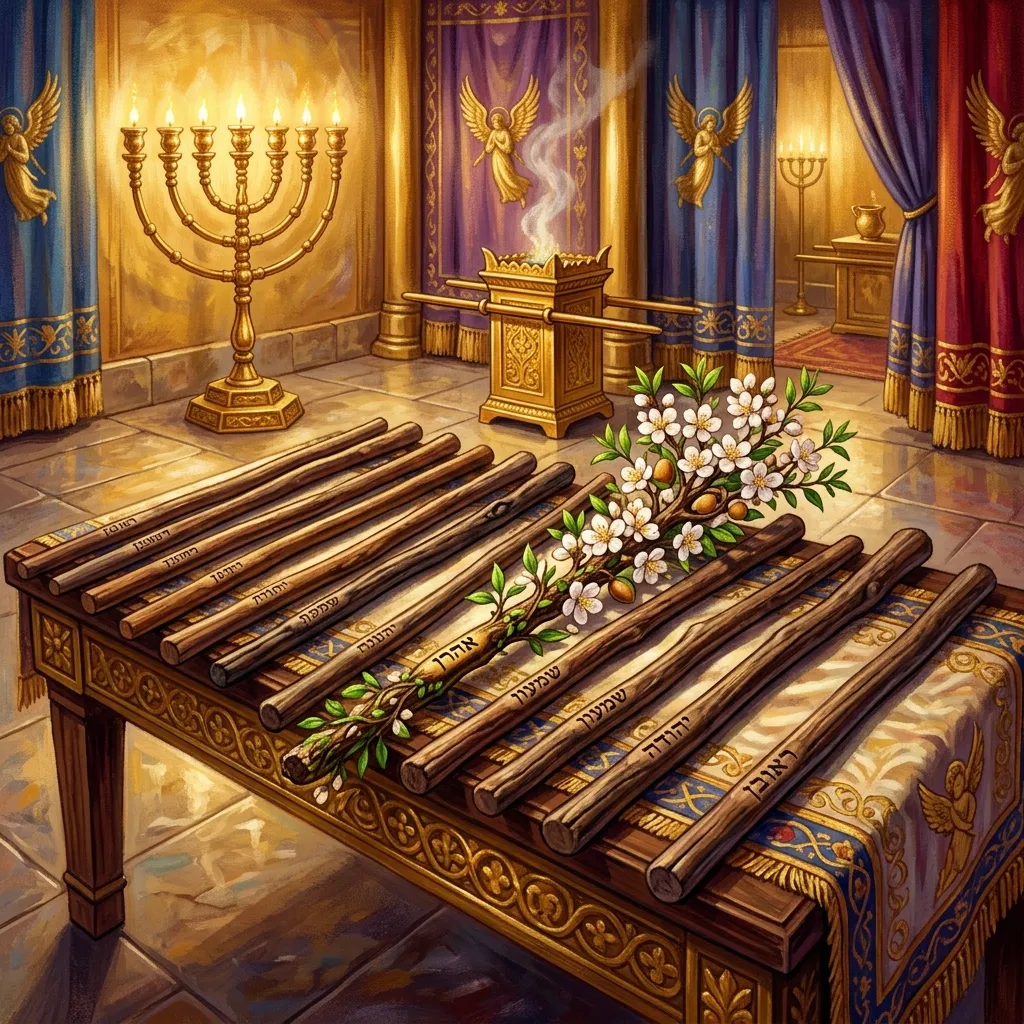
In Ancient Near Eastern tribal culture, a wooden staff (*matteh*) was the ultimate emblem of patriarchate sovereignty. It was not a casual stick picked up from the desert floor, but a seasoned, polished branch carved with the ancestral lineage and heraldic symbols of the clan. A tribal prince leaned upon his staff during judicial assemblies; he extended it to ratify covenants, and he brandished it to lead his clansmen into battle. Yet every staff was unequivocally dead. Severed from its parent trunk years or decades earlier, stripped of its protective bark, smoothed by generations of calloused hands, and desiccated by the arid desert heat, not a single drop of life-giving sap remained within its dry fibers. Moses summoned the twelve paramount princes of Israel. One by one, the chiefs of Judah, Reuben, Simeon, Dan, Naphtali, Gad, Asher, Issachar, Zebulun, Ephraim, Manasseh, and Benjamin handed their ancestral scepters to Moses, each bearing the deeply etched name of their prince. Upon the twelfth staff, representing the sacred tribe of Levi, Moses carved the name of Aaron.
Moses received the twelve dry rods and turned toward the sanctuary. The Lord had commanded: "You shall place them in the Tabernacle of Meeting before the Testimony, where I meet with you. And it shall be that the rod of the man whom I choose will blossom; thus I will rid Myself of the complaints of the children of Israel, which they murmur against you" (Numbers 17:4–5). Moses pulled back the heavy, embroidered curtain of fine woven linen, dyed blue, purple, and scarlet, and entered the Holy Place. Passing the golden Table of Showbread, the glowing Menorah, and the sweet-scented Altar of Incense, he pulled aside the inner veil (*parokhet*) into the terrifying, pitch-black silence of the Holy of Holies. There, resting directly upon the arid desert dirt, sat the Ark of the Covenant, overlaid with pure gold and overshadowed by the wings of the two golden cherubim flanking the Mercy Seat (*kapporeth*). Moses took the twelve dry, lifeless staffs and laid them reverently side by side upon the ground before the Ark of the Testimony. Then he stepped outside, sealed the sacred entrance, and left the silent sanctuary in the hands of the Living God.
Throughout that tense, breathless night, the desert wind whispered across the silent rows of black goatskin tents. Thousands of families lay awake, wondering what morning would reveal. Would the fire fall again? Would another leader be consumed? The tribal princes knew their honor was on trial before the Supreme Judge of heaven and earth. Outside the Tabernacle, the pillar of cloud hung motionless against the starry canopy of the wilderness sky, glowing with an inner, amber luminescence.
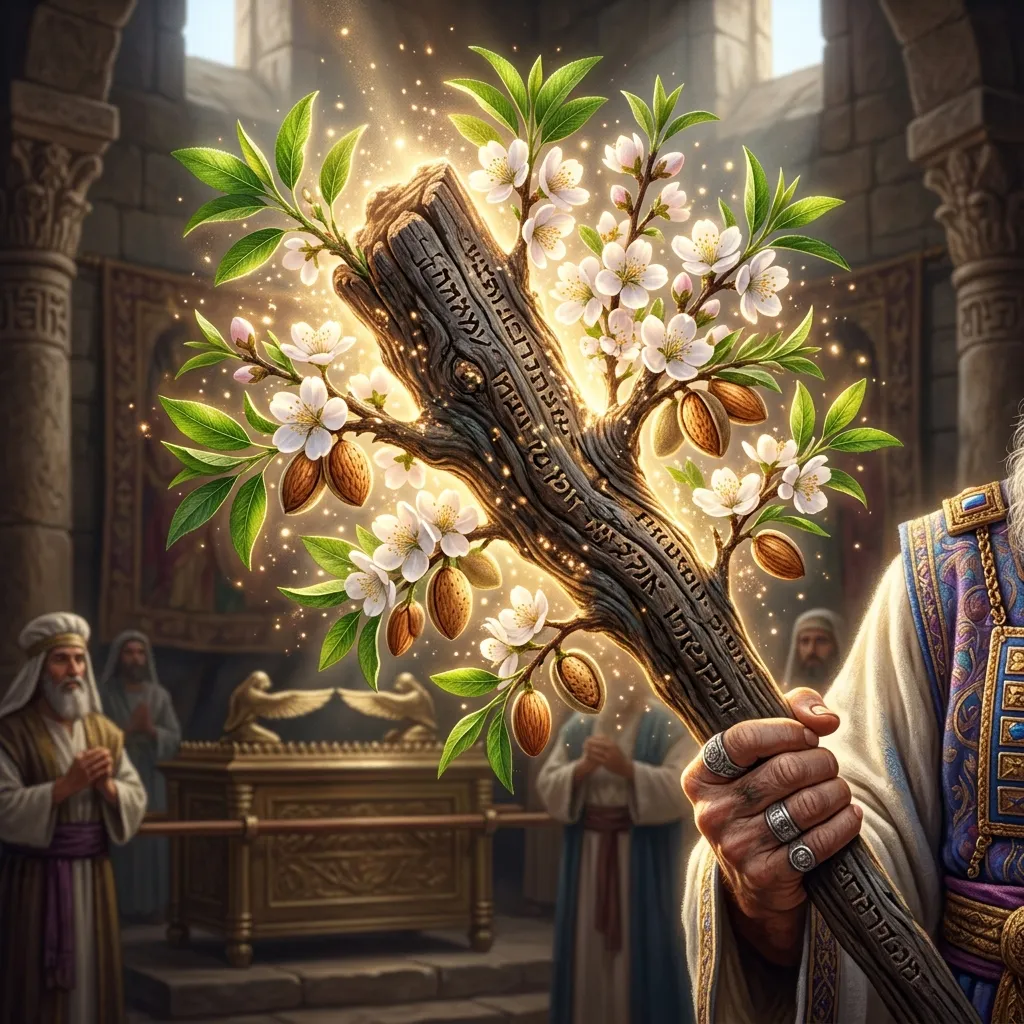
As the first streaks of dawn illuminated the eastern horizon of Paran, Moses strode through the gathered camp toward the court of the Tabernacle. A massive, anxious multitude held its breath. Moses vanished behind the courtyard gate, entered the Holy of Holies, and approached the sacred Ark. In the radiant Shekinah aura that illuminated the golden cherubim, a sight of staggering beauty met his eyes. Eleven of the staffs lay exactly as he had placed them: dry, hardened, and lifeless wood, unchanged by the passing of the night. But the staff inscribed with the name of Aaron was utterly transformed. It was no longer a barren stick; it had become an explosion of supernatural vitality!
Moses gathered all twelve staffs into his arms and carried them outside into the brilliant morning sun, displaying them before the eyes of all the children of Israel. The leaders of the tribes leaned forward in stunned silence. As Moses presented each of the eleven tribal rods, their owners examined them—dry, brittle, and barren as seasoned timber. Then Moses lifted high the staff of Aaron. An audible gasp rippled through the hundreds of thousands gathered in the plain. In a single night, within the windowless darkness of the sanctuary, Aaron's dry rod had passed through the entire life cycle of botanical maturity. It had put forth tender, swelling green buds (*perach*); it had burst into radiant, snow-white and pink blossoms (*tzitz*); and clustered among the fresh green leaves hung fully formed, fragrant, succulent, ripe almonds (*shekedim*) ready for harvest!
The theological brilliance of the miracle was unmistakable. The tree was an almond tree—the *shaqed*, the prophetic "watcher tree" of ancient Canaan. The almond was known as the first tree to awaken from the dead sleep of winter, its blossoms appearing while the frost still gripped the soil, signaling that God was actively watching over His creation to bring life out of death. By causing a completely dead, rootless, branchless piece of timber to burst into buds, blossoms, and ripe fruit overnight without soil, water, or natural sunlight, Yahweh provided an incontrovertible visual demonstration of resurrection power. True spiritual authority does not stem from human charisma, patriarchal seniority, political alliances, or democratic consensus; it is the supernatural gift of the God who calls those things which do not exist as though they did, and who breathes life into that which is dead.
The Lord spoke to Moses: "Bring Aaron's rod back before the Testimony, to be kept as a sign against the rebels, that you may put their complaints away from Me, lest they die" (Numbers 17:10). Moses obeyed. He carried the budded, fruiting staff back into the Holy of Holies, placing it as an eternal reliquary beside the golden urn containing the manna and the two tablets of the Ten Commandments. Whenever future generations might be tempted to question why the seed of Aaron alone was consecrated to bear the sacred vessels and offer atoning incense, that flowering almond branch stood as an unassailable, silent witness: God had chosen Aaron, and God’s choice was sealed with the undeniable signature of resurrection life.
The impact upon the congregation was immediate, profound, and transformative. The arrogant, self-righteous mutiny that had claimed "all the congregation are holy" was shattered into pieces. Replaced by a healthy, trembling fear of the Lord, the children of Israel cried out in sheer terror to Moses: "Behold, we perish, we die, we all perish! Whoever comes even near the Tabernacle of Yahweh must die! Shall we all be utterly consumed?" (Numbers 17:12–13). At last, the nation understood the unapproachable holiness of God and the desperate necessity of a divinely appointed mediator. They realized that without the consecrated High Priest standing at the brazen altar and interceding behind the veil, the holiness of Yahweh would consume them in an instant.
For believers across the ages, Aaron’s budded rod points forward across the centuries to the ultimate High Priest: Jesus Christ. Like that dry staff, Christ took upon Himself our mortal human nature; He was cut off from the land of the living, crucified upon a barren Roman cross of wood, and laid in the sealed, dark tomb. Yet on the third day, within the darkness of the grave, the supernatural power of the Father awakened Him. He burst forth from the tomb in incorruptible resurrection life—the Firstfruits of them that sleep. Just as Aaron's rod was vindicated by life out of death, Jesus was declared to be the Son of God with power by His resurrection from the dead (Romans 1:4). He is our perpetual High Priest, living forever to make intercession for us, and the flowering fruit of His eternal priesthood will never fade.
Biblical Keywords & Theological Roots
A staff, rod, scepter, branch, or tribe; used both for the physical wooden staff carried by tribal princes and for the twelve political tribes branching out from Jacob.
To blossom, sprout, sparkle, or burst into radiant bloom; describing the instantaneous, supernatural flowering of dead wood under the Shekinah presence of God.
The almond tree or fruit; etymologically derived from *shaqad* (to watch, be vigilant, or awaken early), symbolizing resurrection life and Yahweh's unwavering watchfulness over His covenant.
To ripen, yield mature fruit, bring to completion, or wean; indicating that Aaron's staff did not merely develop fragile blossoms, but produced fully developed, succulent, ripe almonds.
A miraculous sign, pledge, token, banner, or memorial monument; a divinely established visual evidence placed before the Testimony to perpetually silence rebellious murmuring.
Ancient Near Eastern & Archaeological Context
In the tribal cultures of the Ancient Near East and Bronze Age Levant, a leader's wooden staff (*matteh* or *shevet*) was far more than a walking stick or defensive weapon; it was an official legal scepter inscribed with ancestral heraldry, symbolizing patriarchal authority, dynastic legitimacy, and the ruling chief's judicial power over his clan. When an elder carved his tribal patronymic onto seasoned hardwood, that branch was severed from its living root, desiccated, smoothed, and completely dead. The almond tree (*Amygdalus communis*, Hebrew *shaqed*) was profoundly revered across ancient Canaan and the Sinai for being the very first tree to awaken from the cold death of winter, exploding in brilliant white and pink blossoms as early as January or February—symbolizing vigilant divine watchfulness. The preservation of Aaron's flowering staff alongside the golden pot of manna before the Ark of the Covenant inside the Holy of Holies (Hebrews 9:4) mirrored Ancient Near Eastern temple reliquary practices, where miraculous victory trophies were permanently archived to settle dynastic disputes.
Practical Discipleship & Spiritual Application
- Divine Vindication Belongs to God, Not Human Striving: Aaron did not engage in political campaigns or debate tribal elders to defend his high priestly calling. He simply placed his dry staff before the Ark of the Testimony and let God speak. When your calling is questioned or attacked, do not retaliate in the flesh; place your life in the secret place of the Most High and let Him vindicate you.
- Supernatural Life Bursting from Dead Wood: Every staff deposited before the Lord was equally dead, dried, and severed from its roots. Yet in the presence of the Shekinah glory, Aaron's rod received supernatural resurrection life. God does not use human talent, self-confidence, or natural vitality; He takes that which is dead in itself and infuses it with miraculous resurrection power.
- The Almond Tree as an Emblem of Divine Vigilance: The almond is the *shaqed*—the watcher tree that blooms while winter still lingers. God watches over His word to perform it (Jeremiah 1:11–12). Even in seasons of spiritual drought, grief, or national confusion, God's sovereign promises are actively awakening and blossoming in secret.
- The Fruit of True Ministry is Matured Fruitfulness: Aaron's staff demonstrated the complete life cycle of supernatural grace in a single night: swelling buds (*perach*), radiant blossoms (*tzitz*), and ripe, mature almonds (*shekedim*). Genuine spiritual leadership is authenticated not by titles, charisma, or loud claims, but by the holy fruit of the Spirit nurtured in the presence of God.
⚡ Fast Facts
- Exactly twelve wooden staffs were laid before the Ark—one for each ancestral tribe, with Aaron's name inscribed on the staff of Levi.
- The almond tree is the very first fruit tree to bloom in the Levant, producing exquisite white blossoms as early as late January.
- Aaron's budded staff was commanded to be placed permanently inside the Ark of the Covenant alongside the golden pot of manna and the Two Stone Tablets (Hebrews 9:4).
- This miracle produced an immediate shift in Israel's posture: the murmuring crowd cried out in terror, 'Behold, we perish, we die, we all perish! Whoever comes near the Tabernacle of Yahweh must die!'
❓ Frequently Asked Questions (FAQs)
God's selection of an almond branch was deeply intentional, functioning as a profound linguistic and theological pun. In Hebrew, the word for almond is *shaqed* (שָׁקֵד), which shares the exact consonantal root with the verb *shaqad* (שָׁקַד), meaning 'to watch, to be awake, to be vigilant, or to hasten.' The almond tree was celebrated across the ancient Levant as the 'watcher tree' because while all other vegetation remained dormant and seemingly dead in the chill of mid-winter, the almond was the first to awaken, bursting into radiant white-pink blossoms. By causing Aaron's rod to bear almond buds, flowers, and ripe fruit, Yahweh was proclaiming: 'I am watching over My priesthood, and I am watching over My covenant with Aaron to perform it.' Furthermore, the almond blossoms directly mirrored the botanical design of the golden Menorah in the Holy Place, whose six branches and central shaft were crafted with cups shaped like almond blossoms with calyxes and petals (Exodus 25:33–34), visually tying Aaron's vindicated priesthood to the perpetual light of the sanctuary.
Both biblical descriptions are historically and sequentially harmonized. In Numbers 17:10, God commanded Moses: 'Bring Aaron's rod back before the Testimony, to be kept as a sign against the rebels.' Initially, the rod was placed directly before the Ark of the Covenant, in the Holy of Holies, resting at the foot of the Mercy Seat. However, Hebrews 9:4 records that within the golden Ark of the Covenant itself rested three sacred reliquaries: 'the golden pot that had the manna, Aaron's rod that budded, and the tablets of the covenant.' During the wilderness wanderings, to prevent damage during transit when the Kohathites carried the Ark upon their shoulders, the flowering rod and the pot of manna were placed inside the chest itself. By the time King Solomon dedicated the permanent stone Temple in Jerusalem centuries later, 1 Kings 8:9 notes that 'nothing was in the ark except the two tablets of stone which Moses put there at Horeb.' The rod and manna had served their dispensational purpose as wilderness testimonies and were preserved in the temple archives or had yielded their primary testimony once Israel entered permanent rest.
Aaron's rod that budded is one of the most sublime Old Testament typologies of the resurrection of Jesus Christ and His eternal, unchangeable High Priesthood. A wooden staff is severed from its living tree—it is dried, seasoned, and unequivocally dead, incapable of generating sap or life by natural means. Yet, when laid in the presence of Yahweh, that dead branch miraculously brought forth fresh life, sweet fragrance, and mature fruit in a single night. Similarly, Jesus Christ was cut off from the land of the living, crucified on a wooden tree, and placed in the dark tomb of death. On the third day, by the power of the Holy Spirit and the presence of the Father, He broke the bonds of death and rose in incorruptible glory. Just as the budding of Aaron's rod permanently silenced all human disputation over who possessed the divine right to the priesthood, the resurrection of Jesus Christ is the ultimate, undeniable sign that He alone is the eternal High Priest after the order of Melchizedek (Hebrews 5:5–10; Romans 1:4), bearing eternal fruit for all who trust in Him.