The famine was no longer an inconvenience; it had become an existential death sentence. Across the parched limestone hills of Canaan, the pastures had withered to white powder, the seasonal wadis had run dry, and the bleating of dying sheep echoed across the empty valleys. Old patriarch Jacob looked into the hollow, terrified eyes of his sons and spoke with blunt urgency: "Why do you look at one another? Indeed I have heard that there is grain in Egypt; go down to that place and buy for us there, that we may live and not die" (Genesis 42:1-2). Ten brothers saddled their donkeys and embarked on the two-hundred-mile trek south, unaware that they were marching directly into the sovereign snare of divine reconciliation.
1. The Bowing Sheaves: Meeting the Unrecognized Ruler
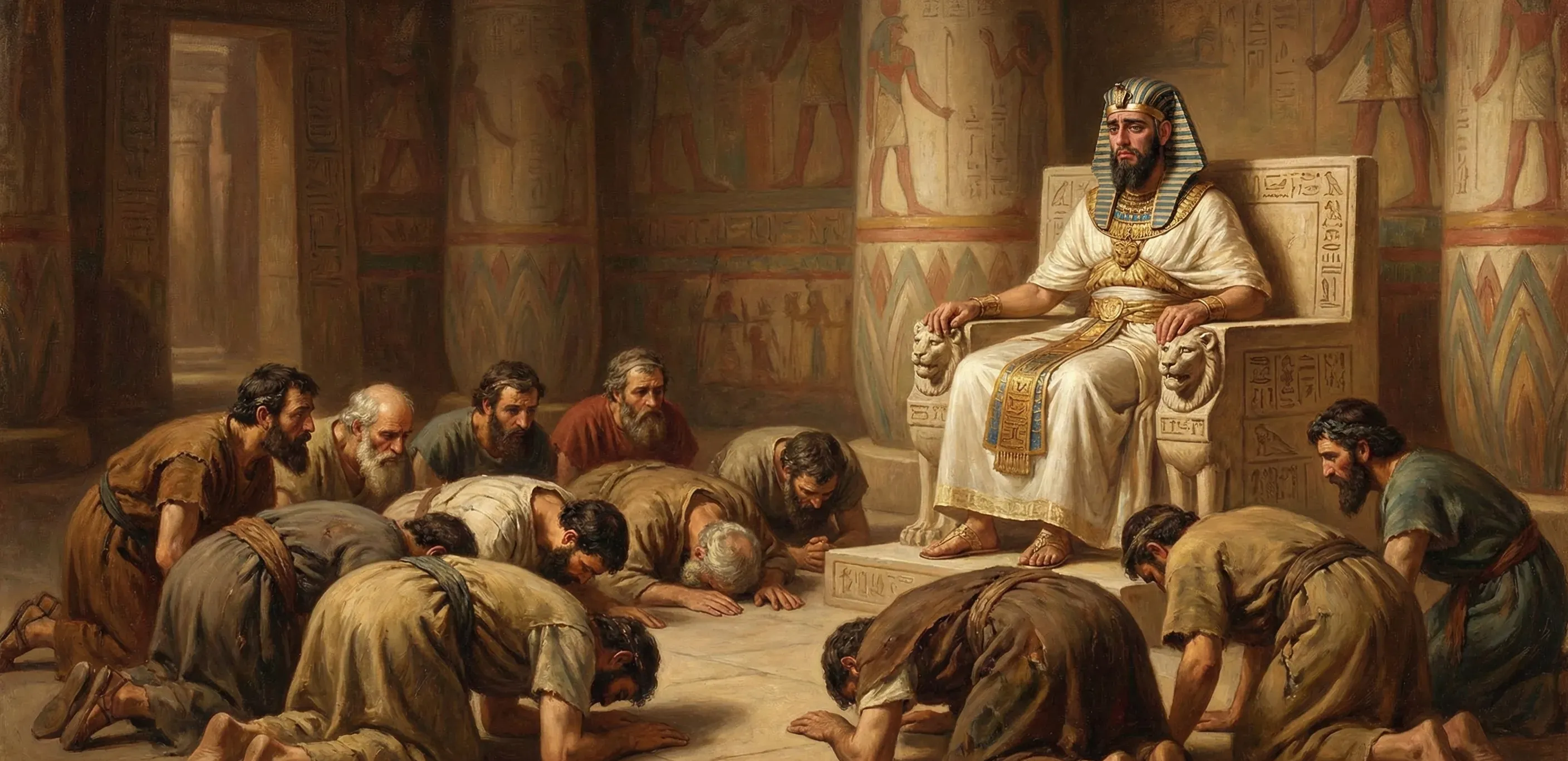
Arriving at the bustling administrative grain depot in Memphis, the ten Hebrew shepherds found themselves amidst thousands of desperate foreign refugees. Towering above the crowded grain silos, seated upon an elevated ivory throne flanked by armed Egyptian spearmen, was the Grand Vizier of Egypt—Zaphenath-Paneah.
He was clothed in royal byssus linen, wearing the golden collar of investiture (*Rabad*), his face clean-shaven according to Egyptian aristocratic etiquette, speaking through an official court interpreter in fluent Egyptian. The brothers had not the slightest suspicion that this imposing imperial monarch was their long-lost brother.
Approaching the dais, the ten brothers dropped to their knees and prostrated themselves with their faces touching the stone floor. Moses records a breathtaking, cosmic detail:
"And Joseph's brothers came and bowed down before him with their faces to the earth. Joseph saw his brothers and recognized them, but he acted as a stranger to them... Then Joseph remembered the dreams which he had dreamed about them." (Genesis 42:6-9)
Twenty-two years earlier in the harvest fields of Hebron, seventeen-year-old Joseph had dreamed that their sheaves bowed down before his sheaf. His brothers had scoffed, burned with murderous jealousy, and cast him into a pit to abort that destiny. Yet here, in the heart of the pagan Egyptian empire, their foreheads pressed against the dust in literal, mathematical fulfillment of the word of God!
2. The Furnace of Conviction: Simeon Bound
Joseph recognized them instantly (*Nakar*), but he knew that superficial reconciliation would be spiritual poison. Had their hearts changed? Did they still harbor the same lethal envy toward Rachel's remaining son, young Benjamin?
Assuming the persona of a stern, suspicious minister of state, Joseph barked through his interpreter: "You are spies! You have come to see the nakedness of the land!"
The brothers panicked, desperately defending their pedigree: "No, my lord, but your servants have come to buy food. We are all one man's sons; we are honest men... Your servants are twelve brothers, the sons of one man in the land of Canaan; and in fact, the youngest is with our father today, and one is no more."
Joseph seized upon their words: to prove their honesty, one brother would be bound in prison while the remaining nine carried grain home and returned with their youngest brother Benjamin. He threw them all into custody for three days. Inside the prison cell, twenty-two years of buried guilt finally breached the surface of their consciences. They said to one another, unaware that the Egyptian ruler standing nearby understood every Hebrew syllable:
"We are truly guilty concerning our brother, for we saw the anguish of his soul when he pleaded with us, and we would not hear; therefore this distress has come upon us." (Genesis 42:21)
Overcome with emotion, Joseph turned away from them into an adjoining chamber and wept bitterly. Composing himself, he took Simeon—the violent brother second in birth—and bound him before their eyes as collateral, sending the others home with sacks filled with grain, secretly ordering his steward to hide each man's purchase silver back inside the mouth of his sack.
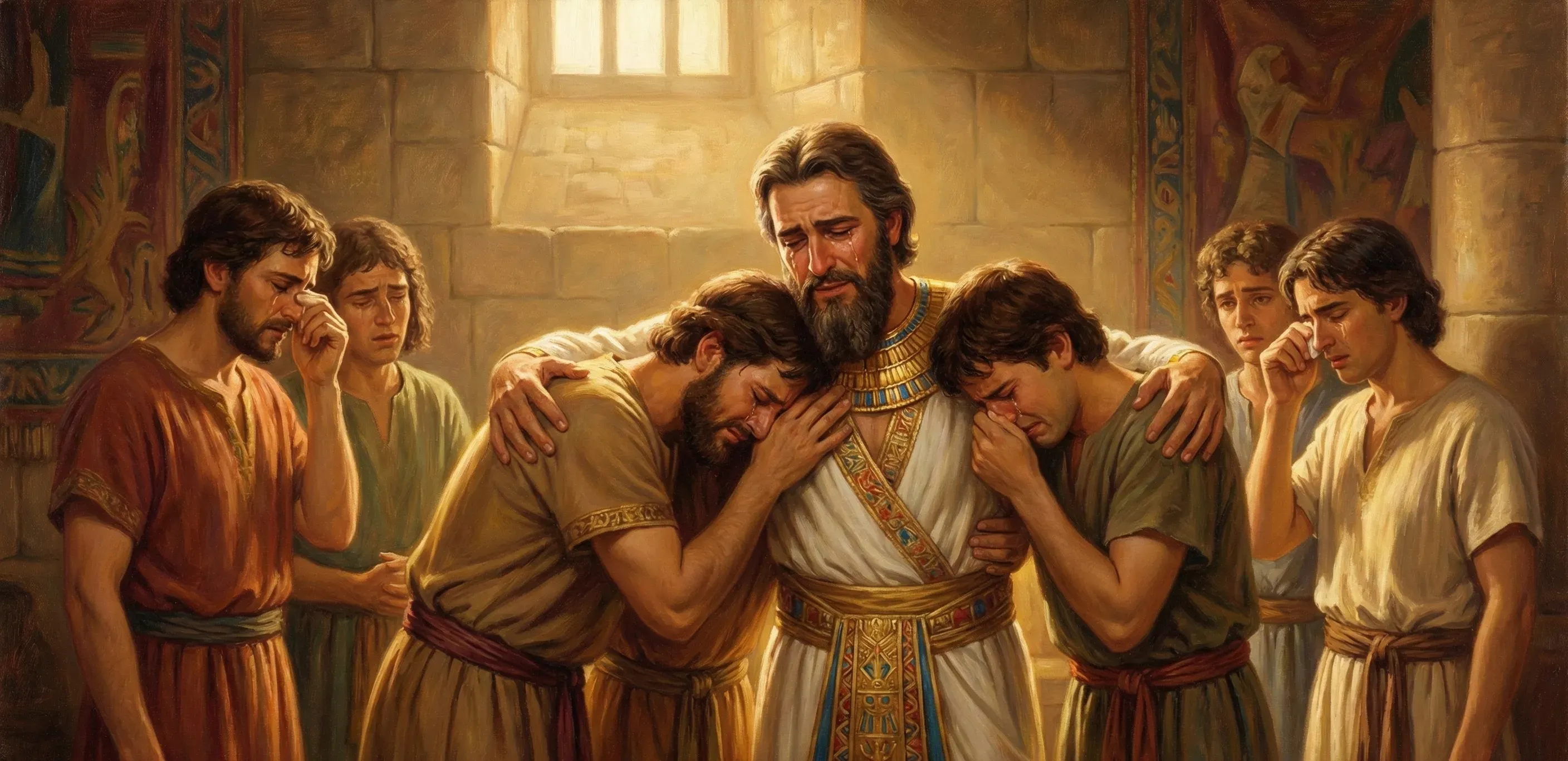
The Sovereign Revelation: Overcome with convulsive weeping, Joseph throws off his ministerial reserve and cries out: "I am Joseph! Does my father still live?"
3. The Royal Banquet and the Staggering Seating Chart
When the grain was exhausted in Canaan, Jacob had no choice but to surrender Benjamin into Judah's personal guarantee: "I myself will be surety for him; from my hand you shall require him" (Genesis 43:9). The brothers returned to Egypt with double silver, gifts of honey and pistachios, and young Benjamin trembling by their side.
When Joseph saw Benjamin, his maternal brother (*Rachamim*), his bowels yearned with deep compassion. He ordered his chief steward to slaughter an animal and prepare a grand banquet in his private residence.
At noon, the brothers entered the palace. Joseph greeted them, asking tenderly: "Is your father well, the old man of whom you spoke? Is he still alive?" Seeing Benjamin, Joseph said: "God be gracious to you, my son." The flood of tears rose so violently that Joseph sprinted into his private bedchamber and wept aloud, washing his face before returning with icy composure: "Serve the bread."
Then came the moment of utter bewilderment. The steward seated the eleven brothers at their table in exact chronological order according to their birthright—from Reuben the firstborn down to Benjamin the youngest. The brothers stared at one another in sheer astonishment; how could an Egyptian vizier know the precise ages of eleven foreign nomadic shepherds? Moreover, when food was served, Benjamin's portion from Joseph's own table was five times larger than anyone else's—a subtle test to see if fraternal jealousy would flare up against Rachel's younger son. But the brothers drank and feasted merrily with him, harboring no visible envy.
4. The Silver Cup in Benjamin's Sack
The climax arrived at dawn. As the eleven brothers loaded their donkeys with grain to return home, Joseph commanded his steward to execute the ultimate moral test:
"Put my cup, the silver cup, in the mouth of the sack of the youngest, along with his grain money." (Genesis 44:2)
Barely had they cleared the city gates when the sound of galloping Egyptian chariots thundered behind them. Joseph's steward overtook them, shouting: "Why have you repaid evil for good? Is not this the cup from which my lord drinks, and by which he indeed divines?"
Outraged by the accusation, confident in their innocence, the brothers made a fatal, rash pledge: "With whomever of your servants it is found, let him die, and we also will be my lord's slaves!"
The steward began his search—starting with Reuben, descending through the brothers. Sack after sack was empty. Finally, reaching the last donkey, the steward thrust his arm into Benjamin's sack and pulled out the gleaming royal silver chalice (*Gabi'a*).
A cry of collective agony shattered the morning air. The brothers tore their clothes in grief. They did not abandon Benjamin; they reloaded their donkeys and rode back into the city, throwing themselves at Joseph's feet.
5. Judah's Substitutionary Plea: The Heart of the Gospel
Joseph confronted them: "What deed is this you have done?"
Here was the exact moral fork in the road. In Dothan, they had sold Rachel's firstborn into slavery and walked away without a backward glance. Now, they had the perfect legal excuse to sacrifice Rachel's second son: the Egyptian ruler declared that only the one caught with the cup would be retained as a slave, while the rest were free to return in peace to their father.
It was at this precise precipice that Judah stepped forward. In one of the most magnificent, heart-wrenching speeches in the history of human literature (Genesis 44:18-34), Judah recounted their elderly father's fragile soul:
"Now therefore, please let your servant remain instead of the lad as a slave to my lord, and let the lad go up with his brothers. For how shall I go up to my father if the lad is not with me, lest perhaps I see the evil that would come upon my father?" (Genesis 44:33-34)
The transformation was complete! Judah, who had coldly commodified Joseph for twenty shekels of silver, was now offering his own physical life and liberty as a substitutionary sacrifice to save his brother and preserve his father's heart.
6. "I Am Joseph!": The Sovereign Theology of Providence
Joseph could restrain himself no longer. He cried out in Egyptian to his guards: "Make everyone go out from me!"
Left entirely alone with his eleven brothers, Joseph's emotional dam burst. He wept with such explosive, unrestrained force that the Egyptians and the household of Pharaoh heard him through the palace corridors. Through sobs of tears, he spoke to them in their native Hebrew tongue:
"I am Joseph! Does my father still live?" (Genesis 45:3)
His brothers were paralyzed, terrified into stony silence. They were trapped in the private chambers of the second most powerful man on earth, whom they had betrayed and sold. Retaliation seemed certain.
But Joseph said gently, "Please come near to me." As they approached, weeping, Joseph unveiled the supreme redemptive thesis of Scripture:
"I am Joseph your brother, whom you sold into Egypt. But now, do not therefore be grieved or angry with yourselves because you sold me here; for God sent me before you to preserve life... So now it was not you who sent me here, but God!" (Genesis 45:4-8)
Joseph threw his arms around his brother Benjamin's neck and wept, and Benjamin wept upon his neck. Then he kissed all his brothers and wept over them, and after that, his brothers found their voices and talked with him.
Years later, after Jacob died, the brothers feared that Joseph would finally unleash vengeance. But Joseph reaffirmed his theology with tears: "Do not be afraid, for am I in the place of God? As for you, you meant evil against me; but God meant it for good, in order to bring it about as it is this day, to save many people alive" (Genesis 50:19-20). The pit, the chains, Potiphar's false charges, and the forgotten dungeon were all sovereign threads woven by the master hand of God to save the covenant family and preserve the lineage of the Savior of the world.
Biblical Keywords & Theological Roots
To recognize, discern, or disguise oneself; used in Genesis 42:7-8 where Joseph 'recognized' his brothers, but 'acted as a stranger' and disguised himself from them.
To examine, scrutinize, test like precious metal in a furnace; used by Joseph when testing whether his brothers possessed genuine moral repentance.
A deep goblet, royal cup, or ornate chalice of silver; used as an imperial tool of state administration and the dramatic instrument of testing.
Deep compassion, yearning of the inner bowels with maternal tenderness and pity; describing Joseph's overwhelming emotional love when seeing Benjamin.
To calculate, design, invent, weave together, or plan; used in Genesis 50:20: 'You calculated (chashavtem) evil against me, but God calculated (chashavah) it for good.'
Ancient Near Eastern & Archaeological Context
During the Second Intermediate Period and the Middle Kingdom of Egypt, catastrophic regional famines frequently devastated the Levant and the Syrian desert due to prolonged failure of winter Mediterranean rainfall. However, Egypt possessed an ecological safety net: the annual flooding of the Nile, fed by monsoonal precipitation in the faraway Ethiopian highlands. Consequently, ancient Asiatic Semitic clans (*Aamu*) routinely petitioned Egyptian authorities for permission to enter the northeastern delta border to pasture their herds and purchase surplus grain.
Entry into Egypt was tightly controlled through a sophisticated chain of border fortresses known in Egyptian records as the 'Walls of the Ruler' (*Khem-Rau*), situated along the *Wadi Tumilat* in the eastern Nile Delta. As Grand Vizier, Joseph held absolute operational command over this commercial artery. When ten Semitic shepherds arrived requesting massive grain acquisitions, protocol mandated that foreign delegations be interrogated by state ministers to verify they were not reconnaissance spies (*mer-shema*) probing Egyptian border defenses prior to an invasion.
Furthermore, ancient Egyptian social customs maintained strict ethnic segregation regarding culinary practices. Genesis 43:32 explicitly records that 'the Egyptians could not eat food with the Hebrews, for that is an abomination to the Egyptians.' Egyptian religious purity codes classified pastoralists as ritually unclean; hence, Joseph sat alone at a elevated ministerial table, his Egyptian courtiers sat at a second segregated table, and the Hebrew brothers were served at a third. Joseph's seating of the eleven brothers in precise birth-order from the eldest (Reuben) to the youngest (Benjamin) was viewed as an alarming display of supernatural, occult omniscience by the bewildered shepherds.
Practical Discipleship & Spiritual Application
- The Healing Power of Biblical Providence: Bitterness is the natural human reaction to betrayal, injustice, and lost years. Yet Joseph harbored zero vindictiveness toward the men who had cast him into a pit and sold him into slavery. Why? Because his gaze was fixed upon the sovereign providence of God: 'God sent me before you to preserve life.' When we view life's heartbreaks through the lens of God's overarching redemptive plan, forgiveness replaces bitterness.
- The Necessity of Genuine Repentance and Restitution: True reconciliation cannot bypass repentance. Joseph loved his brothers deeply, but he did not rush into superficial sentimentalism. He required proof that their characters had been transformed—testing whether they would abandon Benjamin as they had abandoned him. God loves us unconditionally, but true fellowship with Him and others requires honest confession and turned hearts.
- The Power of Substitutionary Intercession: Judah's transformation is one of the greatest character arcs in Scripture. The man who once sold his brother for twenty pieces of silver stood before the Grand Vizier and pleaded: 'Let your servant remain instead of the lad as a slave to my lord.' Judah offered himself as a willing substitute to bear the punishment of the guilty. This is the heart of the Gospel: Christ taking our chains so that we may walk free.
- Weeping as Holy Strength, Not Weakness: Joseph was the most powerful executive on earth, yet Scripture records that he wept repeatedly—in secret, in his chambers, and finally in loud, unrestrained sobs before his household. Compassion, tears of reconciliation, and emotional vulnerability are not signs of weakness; they are the marks of a heart saturated with the mercy of God.
⚡ Fast Facts
- Literal Fulfillment of Prophetic Dreams: When the ten brothers bowed with their faces to the earth before Joseph (Genesis 42:6), they fulfilled the exact prophetic vision of the harvest sheaves bowing down (Genesis 37:7) that they had violently sought to destroy twenty-two years earlier.
- The Transformation of Judah: In Genesis 37:26, Judah had coldly proposed selling seventeen-year-old Joseph into slavery for profit; in Genesis 44:33, a completely transformed Judah offers his own physical freedom to become a perpetual slave in Egypt so that his younger brother Benjamin may go free.
- The Divination Cup (Gabi'a): In ancient Egypt, heavy silver chalices were used by high officials for hydromancy (divining by observing reflections in water or oil); Joseph strategically used his silver cup as a legal and psychological tool to confront their past guilt.
- Sovereign Redemptive Thesis: Genesis 50:20 provides the cornerstone Old Testament verse on the doctrine of providence: 'As for you, you meant evil against me; but God meant it for good, in order to bring it about as it is this day, to save many people alive.'
❓ Frequently Asked Questions (FAQs)
Joseph did not act out of personal vengeance, but out of divine discernment. He needed to ascertain whether his brothers had truly repented of their fratricidal jealousy, or whether they harbored the same murderous hatred toward Benjamin (Rachel's second son) and their father Jacob. By orchestrating a scenario that put Benjamin in jeopardy, Joseph provided them with a mirror to their past sin, allowing them to choose self-sacrifice over betrayal.
Judah's impassioned plea before the Grand Vizier (Genesis 44:18-34) is one of the most sublime speeches in human history. Judah does not excuse their guilt; instead, he recounts their father's fragile heartbreak, confesses their unworthiness, and willingly offers his own body as a substitute slave so that Benjamin may return safely to Jacob. This voluntary substitutionary sacrifice marks Judah as the royal shepherd-leader of Israel and prefigures Jesus Christ, the Lion of the Tribe of Judah, who gave Himself as a ransom for all.
Joseph did not minimize the moral wickedness of his brothers' actions ('You meant evil against me'), but he placed human malice inside the higher, sovereign architecture of God's redemptive purpose ('God meant it for good'). Divine providence does not make God the author of evil, but it reveals God's omnipotent ability to take the real, sinful choices of men and supernaturally weave them into the salvation of nations and the preservation of the Messianic lineage.