High above the sun-scorched, mineral-choked waters of the Dead Sea, jutting three thousand seven hundred feet into the desert skies like a fang of blackened volcanic rock, stood the impregnable fortress of Machaerus. Built by the Hasmonean kings and fortified with sheer stone battlements by Herod the Great, it was an architectural paradox: above ground, an opulent Roman winter palace with cooling marble colonnades, fragrant baths, and gilded banquet halls; subterraneanly, a labyrinth of suffocating limestone dungeons dripping with stagnant water and bitter isolation. Deep within those subterranean bowels sat John the Baptist—the greatest born of women, the herald of the King of Glory, the burning and shining lamp of Israel. His hands, which had once parted the cool waters of the Jordan to baptize the Son of God, were now chafed by raw iron fetters. Yet even within the subterranean silence of that cliffside dungeon, John's prophetic voice echoed across Palestine with terrifying, unquenchable power, rattling the gilded bedchambers of the tetrarch and setting the stage for one of history's most tragic confrontations between corrupt human tyranny and unyielding divine truth!
1. The Voice in the Palace: Truth Defying Tyranny
The Gospel writers waste no words on sentimental preambles when unveiling John's collision with Herod Antipas. Matthew records: "For Herod had laid hold of John and bound him, and put him in prison for the sake of Herodias, his brother Philip's wife. Because John had said to him, 'It is not lawful for you to have her!'" (Matthew 14:3–4).
Consider the breathtaking courage of this solitary prophet. Herod Antipas was an absolute client-monarch who held the power of summary execution in the palm of his hand. When the tetrarch committed treason against his own marriage, divorcing the daughter of King Aretas IV of Nabataea to steal the wife of his brother Philip, the Jerusalem Sanhedrin remained dead silent. The Sadducean high priests looked the other way; the punctilious Pharisees confined their righteous indignation to whispered complaints in safe corners. To challenge the marriage was to challenge the imperial throne.
Into that cowardly moral vacuum walked John the Baptist. He did not couch his indictment in polite diplomatic subtleties. He did not formulate a committee or seek political asylum. Standing face to face with the tetrarch, John leveled his finger at the royal couch and thundered the unyielding verdict of Leviticus: "Ouk exestin soi echein autēn!"—"It is not lawful for you to have her!"
Under God's holy law (Leviticus 18:16; 20:21), union with a brother's living wife was branded as moral filth (*tebel*). By publicly indicting the monarch, John proclaimed that kings, emperors, and governors are not laws unto themselves; they are subjects beneath the eternal court of the Living God.
2. The Uneasy Monarch and the Vengeful Queen
Herodias was incandescent with rage. An ambitious, calculating woman descended from the royal bloodline of the Maccabees and Herodians, she craved imperial recognition. John's denunciation struck at the very legitimacy of her royal status. Mark records her venomous obsession: "Therefore Herodias held a grudge against him and wanted to kill him, but she could not" (Mark 6:19).
Why could she not immediately dispatch an assassin into John's cell? Because Herod Antipas was paralyzed by a profound, agonizing psychological conflict. Mark unveils the dark interior life of the troubled tetrarch:
"For Herod feared John, knowing that he was a just and holy man, and he protected him. And when he heard him, he did many things, and heard him gladly." (Mark 6:20).
What a bizarre paradox! The monarch held the prophet in iron chains, yet the monarch was the true prisoner! Herod would slip down into the cool shadows of the prison to listen to the rugged desert preacher. Each sermon pierced Herod's conscience like a dagger; he felt the terrifying beauty of divine holiness, yet he was hopelessly bound to the intoxicating web of Herodias' lust and royal prestige. Herod was a man divided: he feared God just enough to preserve John's life from Herodias' poisons, but loved his sin too much to set the prophet free.
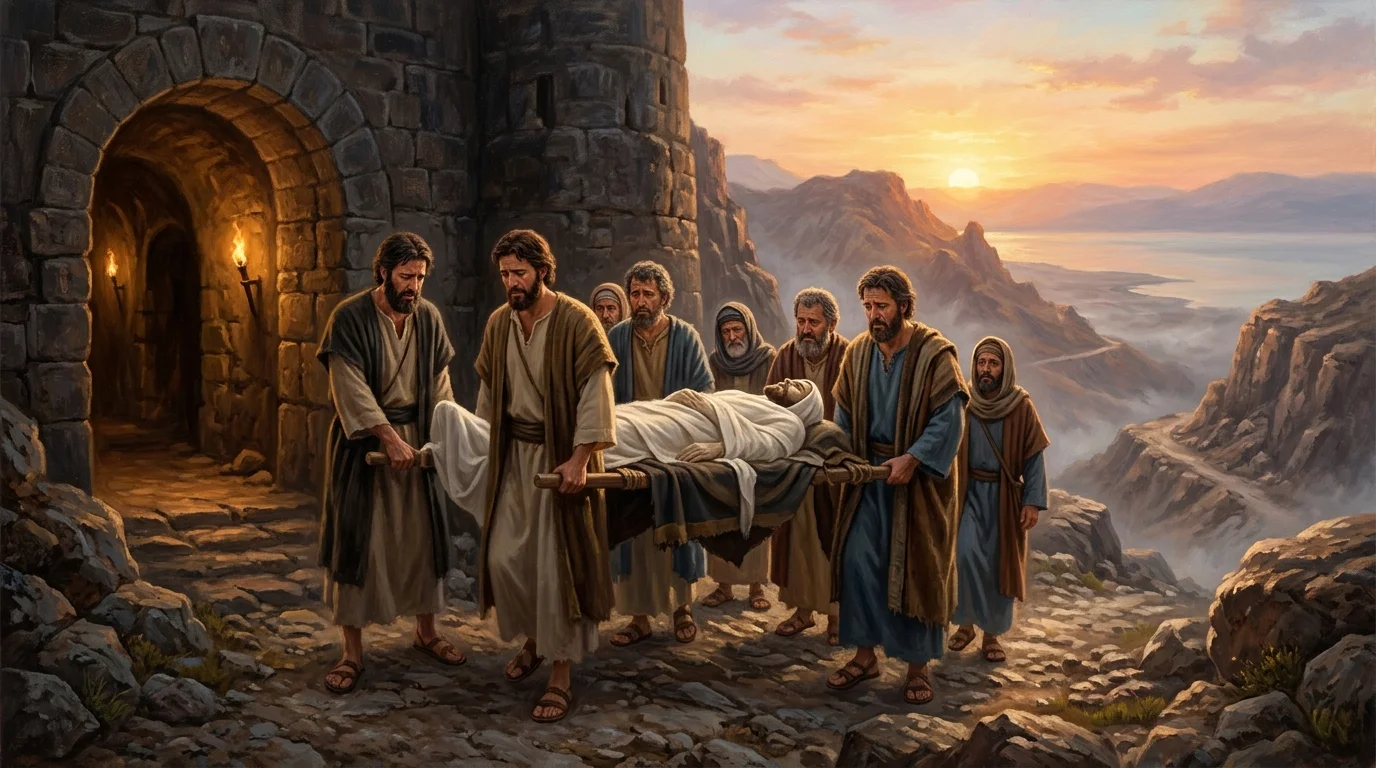 The Sacred Burial at Dawn: Faithful disciples carrying the body of John the Baptist from the stone gates of Machaerus toward an honorable tomb in the valley below.
3. The Birthday Banquet at Machaerus
Herodias knew her husband's weaknesses: his carnal appetite, his fragile ego, and his desperate craving for the applause of men. She bided her time like an adder coiled in the desert brush, waiting for what Mark evocative terms "an opportune day" (Mark 6:21).
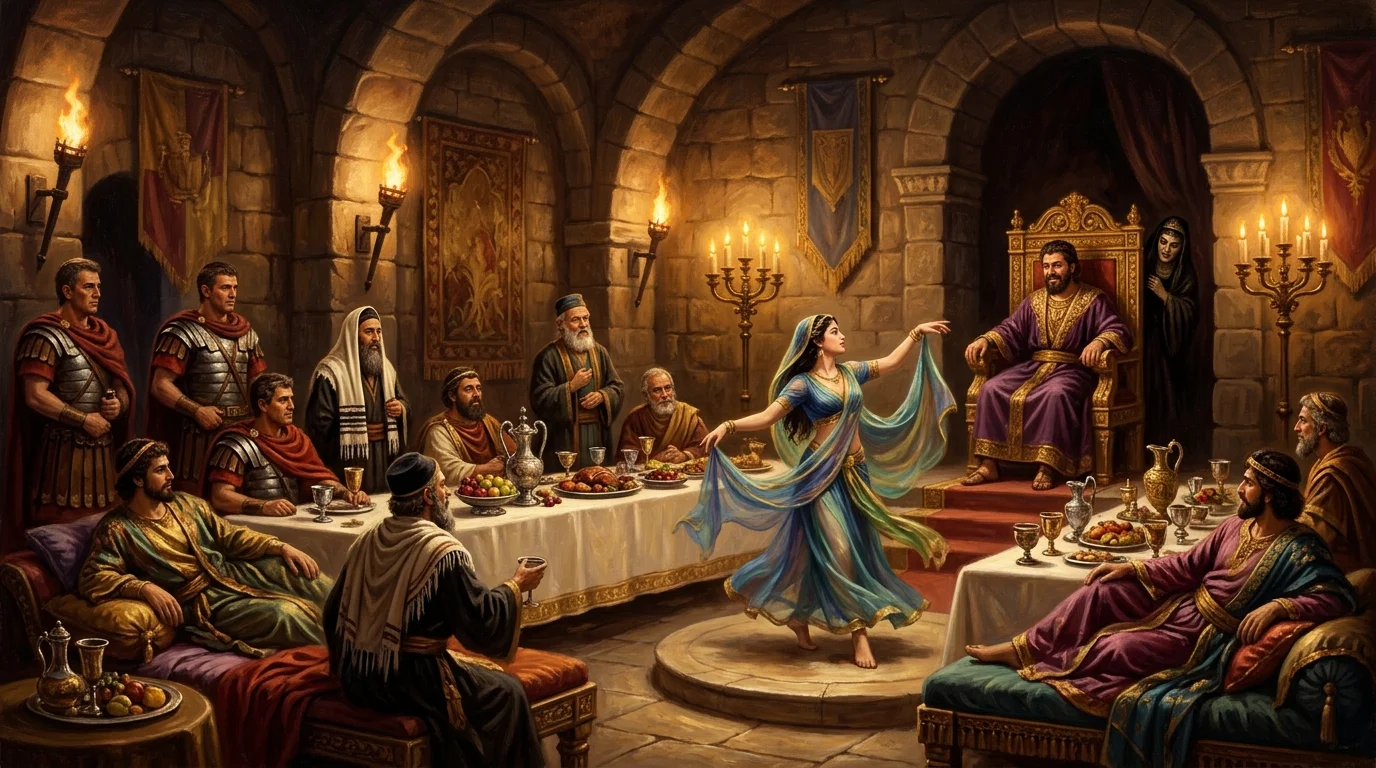
That day arrived with Herod's genesia—his lavish royal birthday festival. The banquet halls of Machaerus blazed with hundreds of olive oil torches and golden candelabras. The heavy scent of roasted meats, frankincense, and aged vintage wines filled the vaulted stone chambers. Around the banquet couches reclined the elite echelon of Judean society: Roman military tribunes (*chiliarchoi*), high civic magistrates, and the wealthy aristocracy of Galilee.
As the hours wore on and the wine flowed freely, Herod's inhibitions dissolved into drunken revelry. At that precise psychological moment, Herodias sprang her lethal trap.
The heavy velvet curtains parted, and into the center of the hall stepped young Salome—Herodias' teenage daughter from her first marriage with Philip. In ancient aristocratic Near Eastern culture, daughters of royal blood did not perform solo dances before intoxicated male crowds; such performances were reserved for common courtesans and slave girls. But Herodias discarded all maternal modesty and royal dignity for the sake of murder.
Salome danced. The rhythmic chime of finger cymbals and the intoxicating sway of silk fabrics captured the lustful gaze of the drunken assembly. Mark records the disastrous climax: "When Herodias' daughter came in and danced, and pleased Herod and those who sat with him, the king said to the girl, 'Ask me whatever you want, and I will give it to you!' He also swore to her, 'Whatever you ask me, I will give you, up to half my kingdom!'" (Mark 6:22–23).
It was the reckless, boastful boast of an insecure ruler intoxicated by applause. He offered her treasures, palaces, or provinces—up to half his realm.
4. The Silver Charger: Murder on a Platter
Salome did not answer immediately. Slipping out through the arched portico, she ran to the private chambers of her mother, breathless: "What shall I ask?"
For years, Herodias had nursed her unquenchable hatred. She did not ask for Persian emeralds, Egyptian silk, or Roman palaces. Her answer was instantaneous, cold, and dripping with venom:
"The head of John the Baptist!" (Mark 6:24).
The young girl hurried back into the banquet hall with morbid, shameless eagerness. Standing before the reclining tetrarch, her voice rang out across the hushed assembly: "I want you to give me at once the head of John the Baptist on a platter!"
The word she used was pinax—a large wooden or silver platter customarily used to present roasted meats and delicacies to guests at royal feasts! She demanded that the holy head of God's prophet be served as a culinary trophy before the drunken nobles.
A chilling silence fell over the banquet hall. Mark captures the king's immediate agony: "And the king was exceedingly sorry; yet, because of the oaths and because of those who sat with him, he did not want to refuse her" (Mark 6:26).
Here stands one of the most pathetic portraits in human literature. Herod knew John was an innocent, holy man of God. He knew this execution was an unholy, grotesque crime that would stain his soul forever. Yet he was hopelessly trapped by human pride. He could not bear the sneers of the Roman tribunes; he could not endure the mockery of the Galilean lords; he could not lose face before his guests. To save his petty reputation among drunken sinners, Herod was willing to murder the greatest prophet heaven had ever dispatched to earth!
5. The Executioner in the Deep and the Honorable Burial
The monarch gave the fatal nod. Mark records with chilling military precision: "Immediately the king sent an executioner and commanded his head to be brought. And he went and beheaded him in prison, brought his head on a platter, and gave it to the girl; and the girl gave it to her mother" (Mark 6:27–28).
The executioner—a Roman spekoulator—descended the winding stone staircases into the subterranean silence of Machaerus. Torchlight flickered against the damp walls of the cell. John needed no trial, no formal sentencing; he had known from the hour he stepped into the Jordan that his life would be poured out as a drink offering. Without resistance, the prophet knelt upon the cold stone floor, committing his spirit into the hands of Yahweh Sabaoth. The broadsword flashed in the torchlight, and with a single stroke, John's earthly witness was sealed in blood.
Carried up the stone steps upon the silver charger, the severed head—its eyes closed in noble repose, its bearded face serene in the peace of God—was presented to Salome in the banquet hall. The drunken revellers looked upon the grisly trophy, and the maiden handed the charger to Herodias. The serpent queen held the silent head of the man who had rebuked her sin. She imagined she had silenced his voice forever.
How foolish are the calculations of the wicked! When news of the atrocity reached the wilderness, John's disciples did not scatter in cowardly panic. They marched directly to the fortress of Machaerus. Standing before the Roman guards, they demanded the remains of their master.
Matthew records with breathtaking, tender gravity: "Then his disciples came and took away the body and buried it, and went and told Jesus" (Matthew 14:12).
They washed the mutilated corpse with tears of love, wrapped it reverently in clean white linen, and carried it down the crags of Machaerus to rest in an honorable stone tomb. And then, having finished their final duty to their earthly teacher, they turned their steps toward Galilee. They walked through the dusty roads until they found Jesus, falling at His feet and pouring out their broken hearts.
6. The Eternal Vindication of the Herald
Herod Antipas thought he had permanently extinguished the light of John the Baptist. But guilt is a hound that never loses the scent of the murderer.
Months later, when reports reached the palace of Jesus performing staggering miracles across Galilee—opening blind eyes, cleansing lepers, and raising the dead—Herod's soul convulsed in terror. Matthew records the tetrarch's haunted confession: "This is John the Baptist; he is risen from the dead, and therefore these powers are at work in him!" (Matthew 14:2). Herod was haunted by the prophet he had decapitated; John's voice could not be silenced by an executioner's blade!
History records the swift, ignominious collapse of Herod and Herodias. Driven by insatiable ambition, Herodias eventually pressured Antipas to travel to Rome to petition Emperor Caligula for a royal crown. Instead, Caligula stripped Antipas of his tetrarchy, confiscated his wealth, and banished him into shameful exile in Gaul (modern France), where he died in poverty and disgrace.
John the Baptist lost his head, but inherited an eternal crown of glory! Jesus Christ Himself delivered his immortal epitaph before the crowds of Judea: "Assuredly, I say to you, among those born of women there has not risen one greater than John the Baptist" (Matthew 11:11).
John stood as the supreme model of prophetic integrity: a man who feared God so deeply that he feared the face of no mortal king; a man who loved truth more than earthly breath; a faithful friend of the Bridegroom who rejoiced to decrease so that Jesus Christ might increase and reign forever!
Ancient Near Eastern & Archaeological Context
In the early decades of the first century, the Herodian dynasty maintained a tenuous grip over the Jewish homeland under the eagle banners of imperial Rome. Herod Antipas, son of Herod the Great who had slaughtered the infants of Bethlehem, ruled the territories of Galilee and Perea as tetrarch. While visiting his half-brother Herod Philip in Rome, Antipas fell into a scandalous affair with Philip's wife Herodias—who was also their niece. Abandoning his lawful Nabataean wife, Antipas brought Herodias into his palace in Tiberias. Under Mosaic Law (Leviticus 18:16; 20:21), marrying a brother's wife while the brother lived was strictly branded as incestuous filth (*tebel*). Most religious leaders remained mute, paralyzed by fear of royal decapitation. But from the arid Jordan wilderness emerged John the Baptist—clothed in camel's hair and girded in leather—striding into the royal courts to declare the sovereign supremacy of the Law of Almighty God over the lust of kings.
Support Independent Biblical Research
Did this study bless you? Help support our independent bilingual research and interactive visual Bible tools.
⚡ Fast Facts
- Machaerus Fortress was perched 3,700 feet above the Dead Sea in modern Jordan, serving as both a luxurious winter palace and a brutal political prison
- Herod Antipas was not a true sovereign king, but a Roman-appointed 'tetrarch' (ruler of a fourth part), ruling Galilee and Perea under Caesar's supervision
- Herodias was not only Philip's wife, but also the niece of both Philip and Antipas, making the incestuous union doubly condemned under Leviticus 18:16 and 20:21
- The Greek word for the executioner in Mark 6:27 is 'spekoulator', a technical Latin military loanword denoting an imperial bodyguard trained in private executions
❓ Frequently Asked Questions (FAQs)
Mark 6:20 reveals that Herod knew John was a 'just and holy man' and protected him from Herodias' immediate murderous plots. When Herod listened to John preach in the fortress, he was deeply perplexed, troubled in conscience, yet strangely drawn to the prophet's uncompromising moral authority. Herod was torn between religious dread of divine wrath and political enslavement to lust and worldly prestige.
To marry Herodias, Herod Antipas divorced his first wife, the daughter of King Aretas IV of Nabataea (Petra). Insulted by this betrayal, Aretas invaded Herod's territory years later, obliterating Antipas' army. First-century Jewish historian Flavius Josephus recorded that the Jewish population universally regarded the destruction of Herod's army as direct divine retribution for his wicked murder of John the Baptist.
John the Baptist had consistently directed his followers to Jesus, proclaiming: 'He must increase, but I must decrease' (John 3:30). In their deepest hour of bereavement, confusion, and grief, the disciples remembered their prophet's supreme commission. By taking refuge in Jesus, they found the ultimate fulfillment of John's ministry and transferred their allegiance to the Lamb of God.