As the fishing boat carrying Jesus and His disciples bumped against the wooden pylons of the Capernaum wharf, the pebbled shoreline was already swarming with an enormous, expectant crowd. Word had swept across the Galilean hills that the Master had returned from the Gentile territory of the Decapolis. But as Christ stepped onto the sand, the crushing multitude parted in astonishment. Pushing through the crowd came Jairus—not an ordinary peasant, but the archisynagōgos, the revered ruler of the Capernaum synagogue. Stripped of all religious pride, this distinguished dignitary threw himself face-down in the dust at the feet of the itinerant preacher, sobbing out a father's broken heart: "My little daughter lies at the point of death. Come and lay Your hands on her, that she may be healed, and she will live!" (Mark 5:23). Jesus went with him immediately. Yet en route to the dying child's home, in the suffocating crush of the Galilean alleys, an unscheduled collision of sovereign grace occurred: a bleeding outcast touched the border of His garment, and an encounter with the Lord of life conquered both chronic disease and the chill of physical death.
1. The Synagogue Ruler at the Rabbi's Feet
Jairus was a man of supreme social standing. As the ruler of the synagogue, he was the administrative and spiritual custodian of Capernaum's religious life. He selected the readers of the Torah, invited visiting rabbis to preach, maintained moral discipline, and sat in the chief seats of honor.
Yet crisis is the great equalizer. His only daughter, twelve years of age—the blossoming dawn of Jewish womanhood—lay in their stone home gasping her final, shallow breaths. Every potion, poultice, and prayer of the village physicians had failed. The angel of death was hovering over the doorpost.
In that desperate moment, Jairus cast away his theological prejudices. Many of his fellow Pharisees despised Jesus as a Sabbath-breaker and a friend of tax collectors. Jairus did not care. A dying child obliterates pride. Prostrating himself at Christ's dusty sandals, he used the tender Greek diminutive: to thygatrion mou—"My little daughter, my little lamb, lies dying!"
Jesus did not hesitate. Without demanding an oath of loyalty or checking his theological credentials, Christ turned His steps toward Jairus' home.
2. Twelve Years of Living Death
As Jesus hurried through the narrow alleys, a massive throng accompanied Him. Mark describes the scene with visceral realism: the crowd was "thronging Him" (Greek: synethlibon auton)—literally suffocating, elbowing, jostling, and crushing against Him from every side.
In that heaving ocean of humanity walked a ghost of a woman.
For twelve agonizing years—every single year that Jairus' daughter had brought joy and laughter into her father's home—this unnamed woman had lived in a private, unremitting hell. She suffered from rhysis haimatos—a chronic, incurable uterine hemorrhage.
To understand her plight, one must examine the terrifying Levitical purity laws of Leviticus 15:25–27. Because of her constant discharge of blood, she was classified as perpetually tameh (ceremonially unclean).
- She could never enter the basalt synagogue or worship at the Temple in Jerusalem.
- Any chair she sat upon, any bed she rested on, any vessel she touched contracted defilement.
- If her husband embraced her, he became unclean; if her children kissed her, they became unclean. Her disease had almost certainly forced her into a forced divorce and complete domestic isolation.
- Anyone she accidentally brushed against in public became ritually impure until sundown. If the crowd had recognized her, they could have legally stoned her for contaminating the congregation!
Mark adds a biting, tragic critique of ancient medical practice: "She had suffered many things from many physicians. She had spent all that she had and was no better, but rather grew worse" (Mark 5:26). The Talmud lists dozens of bizarre, agonizing folk remedies for her condition—carrying ashes of ostrich eggs, drinking wine infused with pulverized Persian onions, or sitting over trenches of burning dung. The charlatans took all her money; the quacks took her health. She was penniless, physically anemic, socially radioactive, and spiritually abandoned.
3. The Touch of Desperate Faith
She had heard the reports about Jesus. She knew she could never approach Him openly; she could never ask Him to lay His hands on her head, for that would render the holy Prophet ceremonially defiled.
So she conceived a secret, desperate theology:
"If only I may touch His clothes, I shall be made well!" (Mark 5:28; Matthew 9:21).
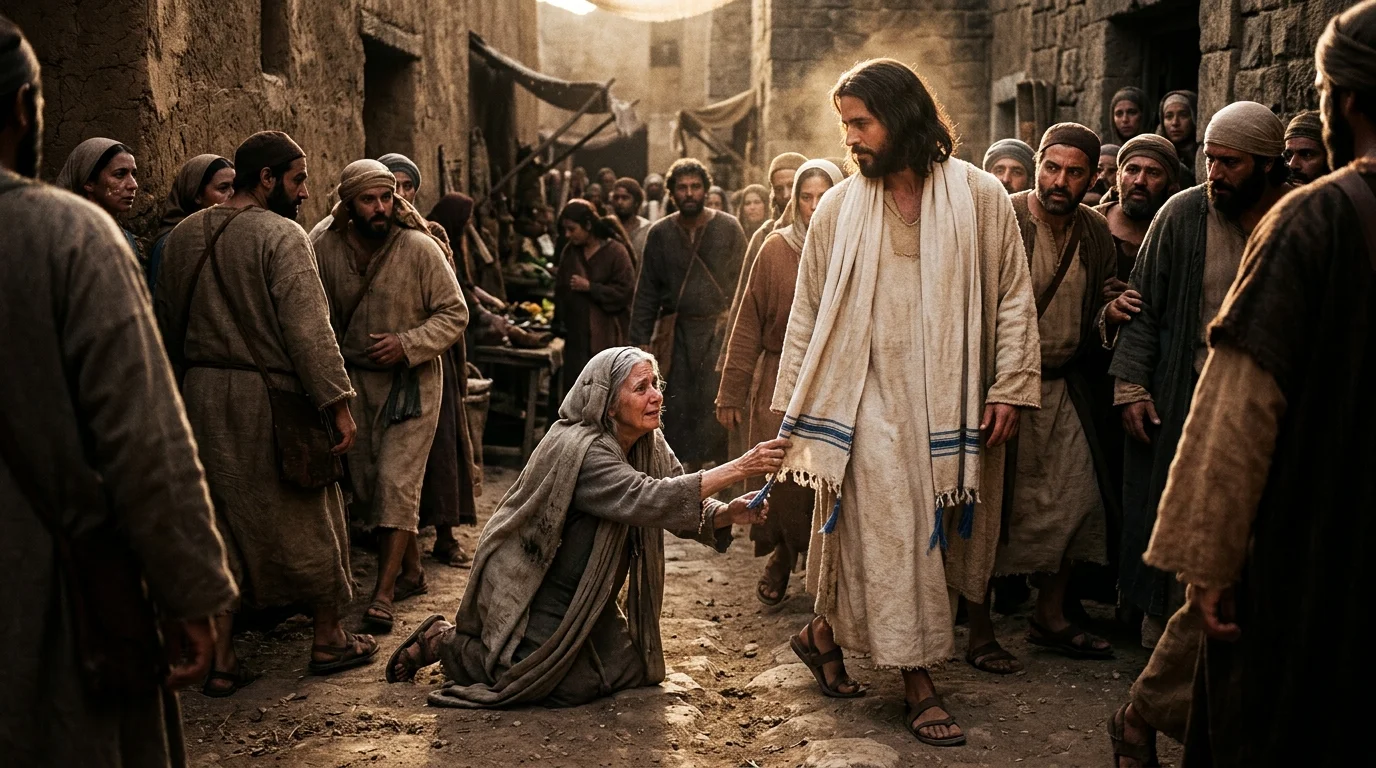
Crawling through the dust, weaving between the legs of burly Galilean fishermen and pushing past the jostling multitude, she reached the hem of His garment.
Matthew and Luke specify that she touched the kraspedon (Matthew 9:20; Luke 8:44). Under Numbers 15:38–39, every observant Jewish male wore four twisted white-and-blue tassels—the tzitzit—sewn to the four corners of his outer cloak (tallit). The blue thread symbolized heaven, covenant obedience, and Yahweh's commandments. Malachi 4:2 had prophesied: "The Sun of Righteousness shall arise with healing in His wings (kanaph / borders)!"
With trembling, outstretched fingertips, she brushed the blue tassel of His hem.
Instantly, a cosmic transaction took place!
Mark records that immediately the fountain of her blood was dried up (exēranthē hē pēgē tou haimatos autēs). After four thousand days of relentless bleeding, the hemorrhage ceased in a single millisecond. A wave of supernatural warmth and vitality surged through her withered veins. She felt in her body that she was permanently healed of her plague!
4. "Who Touched My Clothes?"
Simultaneously, Jesus stopped dead in His tracks. Luke records: "Jesus immediately knew in Himself that power (dynamis) had gone out of Him" (Mark 5:30; Luke 8:46).
Turning around in the heaving crowd, Christ looked out and asked:
"Who touched My clothes?"
Peter scoffed in sheer disbelief: "Master, the multitudes throng and press You, and You say, 'Who touched Me?'" Hundreds of people were bumping against Jesus; soldiers were pushing Him, children were brushing His sleeves, curious onlookers were jostling His shoulders.
Jesus replied: "Somebody touched Me, for I perceived power going out from Me!"
What a profound distinction! Thousands were pressing Jesus out of curiosity, entertainment, or physical proximity; but only one person touched Him with the fingertip of faith! The crowd received nothing; the woman received the fullness of God.
Jesus swept His eyes across the crowd until His gaze locked onto her. Realizing she could not remain hidden, the woman stepped forward, trembling with terror, and fell prostrate before His feet. Before the entire gaping multitude—including Jairus, who was tapping his foot in frantic impatience—she confessed everything: her twelve years of shame, her secret touch, and her instantaneous cure.
Would Jesus denounce her for making Him ritually unclean? Would He rebuke her for contaminating the crowd?
Jesus looked down upon her with infinite tenderness. He spoke a word He never uttered to any other woman in the four Gospels:
"Daughter, your faith has made you well. Go in peace, and be healed of your affliction." (Greek: Thygater, hē pistis sou sesōken se; hypage eis eirēnēn...) (Mark 5:34).
He called her "Daughter!" She who had been an outcast, an orphan of society, was publicly adopted into the family of God. Christ sent her into eirēnē (the fullness of covenant shalom).
5. The Crushing News: "Your Daughter Is Dead"
While the joy of that miracle still echoed in the street, dark figures pushed through the crowd from Jairus' household. Their faces were ashen; their eyes were filled with tears. Pulling Jairus aside, they delivered the mortal blow:
"Your daughter is dead. Why trouble the Teacher any further?" (Mark 5:35).
Those words must have felt like a dagger plunged directly into Jairus' chest. The delay had proved fatal! If only this bleeding woman had not interrupted them! If only Jesus had walked faster! Now it was over. A physician can treat a disease, but what can anyone do against the icy finality of the grave?
Overhearing the word spoken, Jesus did not allow Jairus' soul to plummet into the abyss of despair. Christ instantly locked eyes with the shattered father and spoke the immortal watchword of resurrection hope:
"Do not be afraid; only believe!" (Greek: Mē phobou; monon pisteue) (Mark 5:36).
Jesus commanded Jairus: "Do not look at the corpse; do not listen to the messengers; do not yield to the cold logic of death. Fix your eyes on Me!"
6. "Talitha, Koumi!": Victory Over the Grave
Arriving at Jairus' home, the courtyard was already engulfed in chaos. In first-century Jewish funeral custom, even the poorest family hired at least two flute players and a professional wailing woman to scream ancient funeral laments (Mishnah Ketubot 4:4). The house echoed with theatrical shrieks, the beating of breasts, and the mournful dirge of flutes.
Jesus stepped across the threshold and challenged the room:
"Why make this commotion and weep? The child is not dead, but sleeping!" (Mark 5:39).
Instantly, the paid mourners stopped their weeping and laughed Him to scorn (kategelōn auton). They knew the clinical signs of death: her pulse was gone, her chest was still, her skin was cold.
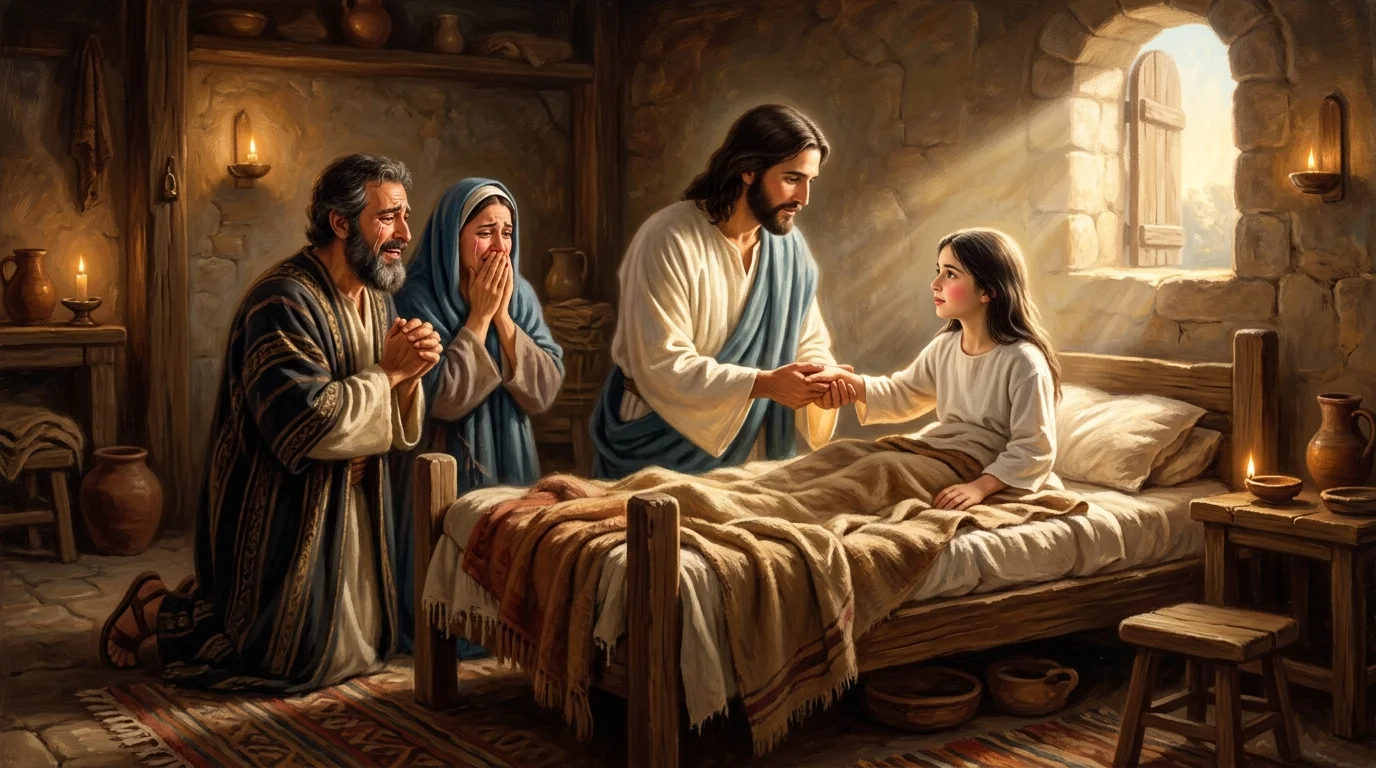
With righteous authority, Jesus evicted the cynical crowd from the house. He permitted only five witnesses into the sacred death chamber: Peter, James, John, and the weeping mother and father.
They stepped into the quiet room. On a wooden couch lay the stiffening corpse of the twelve-year-old girl.
Under Numbers 19:11, touching a dead human body contracted the most severe ritual defilement in Judaism. Priests and rabbis avoided corpses at all costs. But Jesus did not fear defilement; when holiness touches defilement, holiness wins! When life touches death, death dies!
Walking over to the couch, Jesus reached out His warm hand and took the cold, limp hand of the dead child.
Then, speaking in His native Galilean Aramaic with the tender voice of a parent waking a sleeping child for breakfast, Christ commanded:
"Talitha, koumi!" (Mark 5:41).
Mark translates it for his Roman audience: "Little girl, I say to you, arise!" The Aramaic word talitha was a tender pet name derived from the word for a young lamb—"My little lamb, arise!"
Instantly, the supernatural shockwave of life reversed cellular death! Her lungs gasped with air; her heart kicked into rhythmic beating; color flushed into her pale cheeks.
Her eyelids fluttered open, she sat up on the couch, and she arose and walked!
Luke records: "Her spirit returned, and she arose immediately!" (Luke 8:55). The parents were overcome with a holy, paralyzing ecstasy (ekstasei megalē).
Then, in a breathtaking display of practical, tender compassion, Jesus turned to the astonished parents and gave two instructions:
- He commanded them strictly that no one should broadcast the miracle, guarding His mission from political sensationalism.
- He commanded: "Give her something to eat!" (Mark 5:43).
What sublime divine balance! The Lord who had just reached across the chasm of eternity to yank a soul back from the underworld immediately remembered that the little girl was hungry and needed a piece of warm bread.
In one unforgettable afternoon in Capernaum, Jesus proved His absolute, unrivaled supremacy: He is the healer of twelve years of hopeless chronic disease, and He is the Resurrection and the Life who holds the keys of death and Hades forever.
Ancient Near Eastern & Archaeological Context
First-century Capernaum was a thriving Galilean lakeside town with a magnificent white limestone synagogue built atop basalt foundations, where Jairus served as the 'archisynagōgos' (presiding ruler of the synagogue). Jairus was responsible for arranging public Torah readings, maintaining liturgical order, and overseeing community discipline—a man of supreme religious and social standing. In stark contrast, the unnamed woman represented the lowest rung of ritual ostracization. Under the Levitical Holiness Code (Leviticus 15:25–30), a woman suffering from an irregular discharge of blood was perpetually 'tameh' (ceremonially unclean). Anything she sat upon, touched, or leaned against contracted defilement. Anyone who brushed against her clothing was barred from Temple worship until evening washings. For twelve years—the exact lifespan of Jairus' daughter—she was socially exiled, physically anemic, legally divorced or unmarried, and financially bankrupt after subjecting herself to brutal first-century folk remedies (such as carrying ashes of ostrich eggs or drinking potions of Persian onions). When these two narratives collided in Capernaum's packed streets, the lowest ritual outcast and the highest synagogue ruler met at the same place: the feet of Jesus.
Support Independent Biblical Research
Did this study bless you? Help support our independent bilingual research and interactive visual Bible tools.
⚡ Fast Facts
- Under Leviticus 15:25–27, a woman with chronic uterine bleeding was classified as ceremonially unclean; anyone she touched became unclean, making her twelve-year isolation a living social, marital, and religious death
- The woman touched the 'kraspedon'—the sacred twisted blue tassel (tzitzit) required on the four corners of Jewish mantles under Numbers 15:38–39 to remember Yahweh's covenant commandments
- The Aramaic phrase 'Talitha, koumi' recorded by Mark is an authentic eyewitness transcription of Christ's native Galilean dialect, meaning 'Little lamb / maiden, arise!'
- Both miracles involve the number twelve: the woman suffered twelve years of living death, and Jairus' daughter experienced twelve years of blossoming life before dying
❓ Frequently Asked Questions (FAQs)
Jesus did not ask out of ignorance, but out of pastoral redemption. Power had gone out of Him consciously, and He knew who had touched Him. Had the woman slipped away unnoticed, she would have possessed physical healing but remained trapped in social secrecy, fear of retribution for ritual contamination, and lingering shame. By calling her forth, Jesus transformed a clandestine touch into a public testimony of faith, gave her the tender title 'Daughter' (the only woman in the Gospels He directly addresses with this familial name), and publicly restored her into the covenant community.
Jesus instituted the 'Messianic Secret' in Galilee to prevent the crowds from reducing His ministry to a sensationalist spectacle. Had reports spread that He could raise decomposed corpses at will, the Galilean multitudes would have forcibly crowned Him as an earthly political king to overthrow Rome, distorting His true redemptive mission as the Suffering Servant destined for the Cross. Furthermore, He sought to shield the fragile young girl and her weeping family from intrusive public exploitation.
This tender detail highlights the harmony of divine omnipotence and compassionate practical care. First, eating solid food provided undeniable, empirical proof to her stunned parents that she was not a ghost, phantasm, or temporary resuscitated apparition, but fully, physically alive. Second, the child had been dying of high fever for days without eating; in the joyous ecstasy of the resurrection miracle, the parents might easily have neglected her urgent physical nourishment.