The heavy shock of John the Baptist's bloody execution had cast a dark pall of grief over the apostolic band. Desiring to shelter His emotionally exhausted disciples and commune in solitary prayer with the Father, Jesus said to them: "Come aside by yourselves to a deserted place and rest a while" (Mark 6:31). Stepping into a wooden fishing boat at Capernaum, they pushed off across the turquoise waters of the Sea of Galilee, heading northeast toward the uninhabited basalt foothills near Bethsaida Julias. But privacy in Galilee had become an impossibility. As the boat glided across the placid lake, sharp-eyed villagers spotted the Master's vessel. Word swept like wildfire across lakeside hamlets. Thousands of men, women, and children burst from their stone cottages, running on foot along the northern coastline, crossing the Jordan ford, and outrunning the sailing vessel! When the wooden hull scraped against the pebbled sands of the deserted shore, Jesus did not find the quiet sanctuary of solitary prayer; He stepped out into a heaving, chaotic ocean of twenty thousand desperate souls!
1. The Shepherd's Heart: Moved with Compassion
How would an ordinary human leader react when exhausted, grieving, and confronted by thousands of demanding, intrusive people invading His private retreat? Irritation? Frustration? Resentment?
Mark records Christ's reaction with one of the most sublime sentences in Holy Scripture: "And Jesus, when He came out, saw a great multitude and was moved with compassion for them, because they were like sheep not having a shepherd. So He began to teach them many things" (Mark 6:34).
The Greek verb translated "moved with compassion" is esplanchnisthē. It does not signify superficial pity or polite sympathy; it denotes a violent, visceral yearning in the deepest physical core of one's being. Jesus looked past their noise and dust. He saw a nation abandoned by its religious elite: the haughty Pharisees burdened them with legalistic bondage; the corrupt Sadducees exploited them in the Temple markets; the tyrannical Herodians crushed them with taxation. They were bleeding, wounded, and leaderless—sheep wandering toward the edge of an abyss.
Forgetting His own grief, Christ climbed the grassy slopes, sat among them, and began to speak of the Kingdom of God, while laying His healing hands upon their sick and afflicted until late in the afternoon.
2. The Impossible Arithmetic of Faith
As the sun began to sink behind the western Galilean hills, casting long amber shadows across the rolling slopes, a logistical crisis loomed. Luke notes: "When the day began to wear away, the twelve came and said to Him, 'Send the multitude away, that they may go into the surrounding towns and country, and lodge and get provisions; for we are in a deserted place here'" (Luke 9:12).
The disciples' advice seemed entirely sensible. The sun was setting; they were in an uninhabited wilderness (*erēmos topos*); thousands of nursing infants, weary mothers, and elderly pilgrims were beginning to faint with hunger. The practical, logical solution was clear: dismiss them while there is still daylight so they can fend for themselves in nearby villages.
Then, Jesus dropped a verbal thunderbolt that stunned the apostolic band into frozen disbelief:
"They do not need to go away. You give them something to eat!" (Matthew 14:16; Mark 6:37).
Imagine the disciples' incredulous expressions! Peter probably blinked in shock; Judas clutched the communal money pouch in terror. Philip, a native of nearby Bethsaida who knew the regional markets, quickly calculated the financial impossibility: "Two hundred denarii worth of bread is not sufficient for them, that every one of them may have a little!" (John 6:7).
A single denarius represented an entire day's wage for an agricultural laborer. Two hundred denarii equaled nearly eight months of hard labor—more money than the disciples possessed in their entire treasury. And even that staggering sum would provide only a dry crust for each mouth. Human arithmetic had hit a dead end.
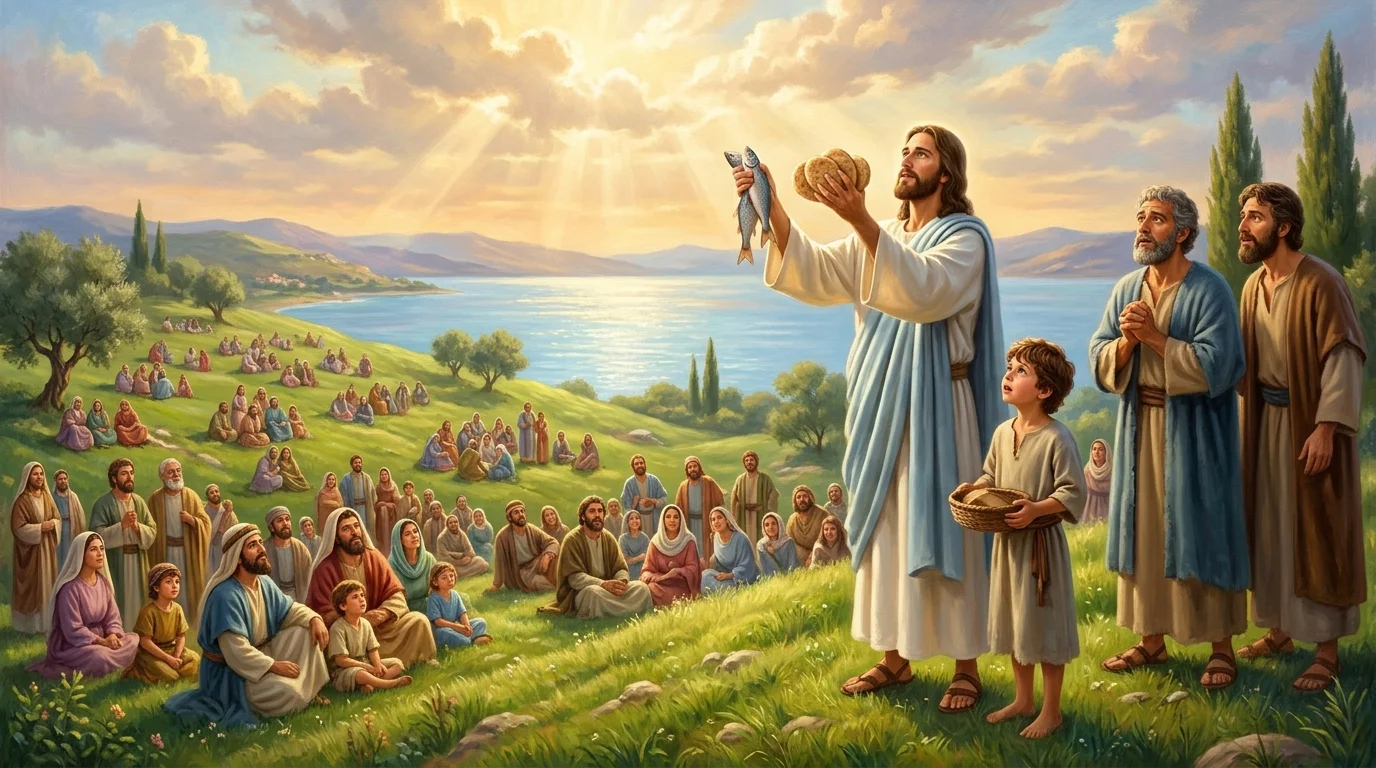
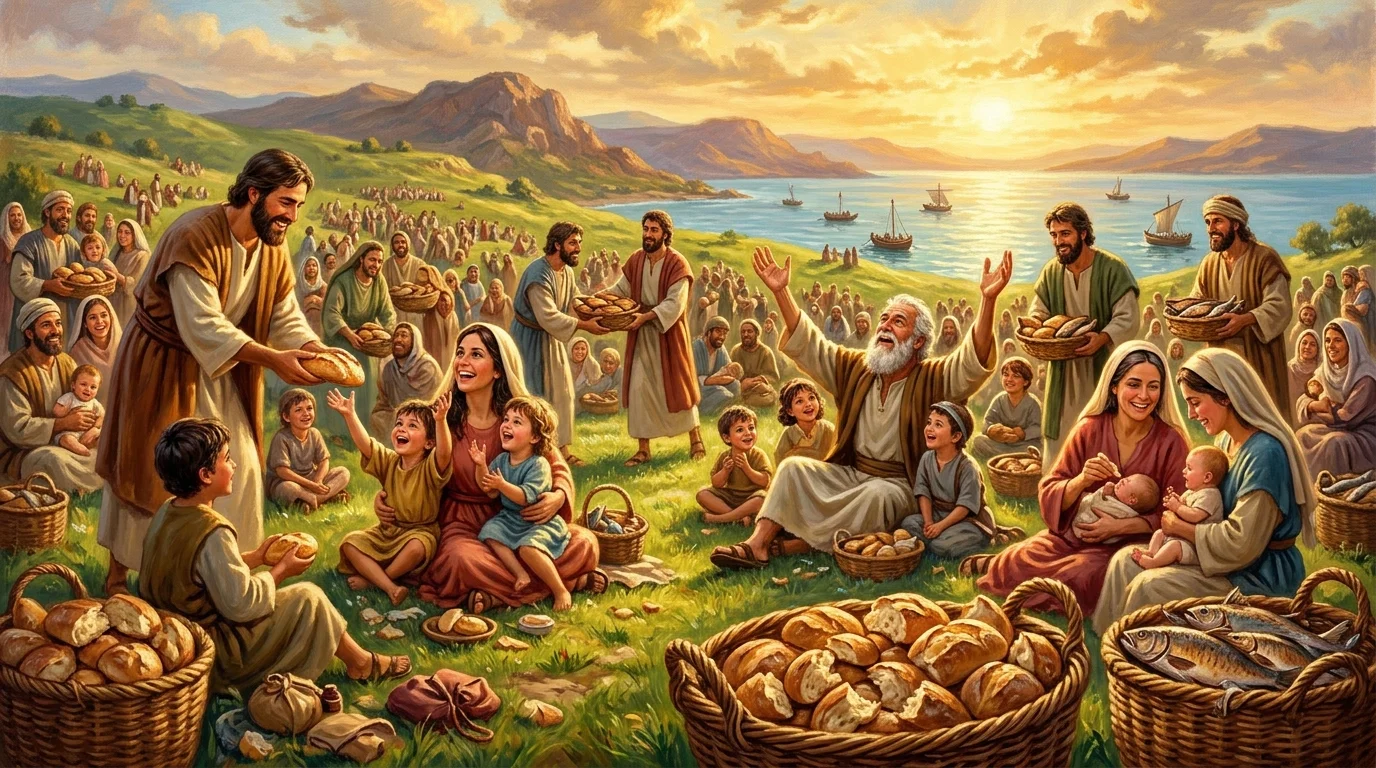 The Abundant Harvest: Joyous families reclining in companies across the green hillside as Christ's multiplied bread fills every hand to overflowing.
3. A Boy's Surrendered Lunch
While Philip stared at the hopeless mathematics, Andrew, Simon Peter's brother, stepped forward with a hesitant observation: "There is a lad here who has five barley loaves and two small fish, but what are they among so many?" (John 6:9).
Notice the exquisite human details preserved by John's eyewitness testimony. An unnamed young boy had packed a modest traveler's lunch. His mother had baked five loaves of barley (artous krithinous). Barley was the coarse, heavy, inexpensive bread of the absolute poorest classes—the food of peasants, slaves, and beasts of burden. Along with the bread were two small salted or dried fish (opsaria), used as a savory relish to soften the dry bread.
It was a child's meager portion, barely sufficient to satisfy one hungry youth. Andrew spoke the universal question of human insufficiency: "What are they among so many?"
Yet that is precisely where the kingdom of God begins! Jesus did not ask for a royal treasury; He asked for whatever they had. Christ gave the quiet, authoritative command:
"Bring them here to Me." (Matthew 14:18).
The little boy did not clutch his lunch in selfish fear. He did not hoard his crusts against the coming night. With open, trusting hands, he surrendered his entire livelihood into the large, scarred hands of the Carpenter from Nazareth. Little is always much when placed into the hands of Almighty God!
4. Order on the Green Grass: Symposia of Grace
Jesus took command of the mountain. John notes: "Now there was much grass in the place" (John 6:10)—a glorious confirmation of spring at Passover time.
Christ instructed His disciples: "Make the people sit down in groups of fifty."
Mark records the scene with unforgettable, vivid artistry: "So they sat down in ranks, in hundreds and in fifties" (Mark 6:40). The Greek phrase Mark uses is prasiai prasiai, an agricultural idiom meaning "garden plots" or flowerbeds! Clothed in their festive Passover garments of saffron, crimson, indigo, and undyed wool, the thousands of pilgrims reclined on the emerald green slopes like vibrant, blooming flowerbeds arranged across a royal terrace.
Furthermore, Mark describes them reclining in symposia—the Greek term for an orderly royal banquet. Before a single crumb was multiplied, Jesus treated the hungry, dusty wilderness crowd as honored guests at the banquet table of the King! There was no stampede, no chaotic shoving, no panic. Divine order superseded human anxiety.
5. The Hands That Break and Multiply
With twenty thousand expectant eyes fixed upon Him, Jesus stood on the hillside. The sun hung low over the horizon, bathing the mountain in golden celestial light.
Matthew records the sacred liturgical sequence: "And He took the five loaves and the two fish, and looking up to heaven, He blessed and broke and gave the loaves to the disciples; and the disciples gave to the multitudes" (Matthew 14:19).
Trace the fourfold sacred rhythm that prefigures both the Last Supper and Calvary:
- He Took: He received the humble, imperfect offering of human surrender.
- He Looked Up to Heaven and Blessed: He acknowledged the Father as the sole source of all life and sustenance, speaking the traditional Hebrew blessing: "Baruch Atah Adonai Eloheinu, Melech Ha-Olam, ha-motzi lechem min ha-aretz" (Blessed are You, O Lord our God, King of the Universe, who brings forth bread from the earth).
- He Broke: Supernatural multiplication did not happen while the bread remained whole; it multiplied in the breaking! In the kingdom of God, blessing precedes breaking, and breaking produces abundance.
- He Gave: The Greek verb for "gave" (edidou) is in the imperfect tense, signifying continuous, uninterrupted action! As Jesus broke the bread, it continuously generated in His hands. He kept giving, and giving, and giving!
The disciples took the multiplied bread and roasted fish, running up and down the grassy aisles. They filled the hands of smiling fathers, laughing children, and weeping mothers. Every basket they emptied filled up again! The Creator who speaks stars into existence was quietly creating wheat and fish out of nothingness upon the Galilean hillside.
6. Twelve Baskets Full: The Inexhaustible King
The result was staggering. Scripture records: "So they all ate and were filled!" (Matthew 14:20).
The Greek word for "filled" is echortasthēsan, originally used to describe fattening cattle until they could eat no more. It means gorgeously satisfied, brimming to full capacity. Not a single person received a meager sample; twenty thousand weary pilgrims ate until they could not swallow another morsel!
Then Jesus spoke a command of exquisite environmental and theological stewardship: "Gather up the fragments that remain, so that nothing is lost" (John 6:12).
The disciples walked through the trampled grass, picking up broken pieces of crusty barley bread and roasted fish. When they finished, they had collected twelve full baskets (kophinoi)—heavy, woven wicker hampers!
What breathtaking divine irony! The disciples had started with five loaves; they ended with twelve colossal baskets of food—one full basket for each of the twelve doubtful apostles who had said, "Send them away!" Each disciple carried a tangible, heavy monument of Christ's limitless sufficiency on his shoulder.
The crowd was electrified. Remembering the prophecies of Deuteronomy 18:15, a roar went up across the mountain: "This is truly the Prophet who is to come into the world!" (John 6:14). They began whispering of revolution, plotting to seize Jesus by force and crown Him as their political king to march against Roman legions.
Recognizing their carnal misunderstanding, Jesus immediately dispersed His disciples into the boat and withdrew alone into the dark mountain heights to pray. He had not come to hand out earthly political bread; He had come to offer His very flesh for the life of the world.
The next day in Capernaum, Christ unveiled the eternal meaning of the hillside feast: "I am the Bread of Life. Your fathers ate the manna in the wilderness, and are dead. This is the bread which comes down from heaven, that one may eat of it and not die... If anyone eats of this bread, he will live forever!" (John 6:48–51).
The miracle of the five loaves was a prophetic signpost pointing to the Cross: Christ was broken that a starving world might feast upon eternal life and never hunger again!
Ancient Near Eastern & Archaeological Context
The Feeding of the Five Thousand took place on the northeast shoreline of the Sea of Galilee, in the grassy foothills just outside Bethsaida Julias—a city rebuilt and renamed by Tetrarch Herod Philip in honor of Julia, the daughter of Caesar Augustus. The Gospel of John provides a crucial chronological marker: 'Now the Passover, a feast of the Jews, was near' (John 6:4). This explains both the lush green condition of the spring grass and the immense size of the crowd. Tens of thousands of Jewish pilgrims from northern Galilee and the Golan were actively marching southward down the Jordan Valley toward Jerusalem for the annual Passover feast. When these eager caravans discovered that the famed Galilean prophet had landed on the northern shore, they coalesced into a massive, surging ocean of humanity. In first-century Jewish popular expectation, the Messiah was foretold to replicate the miracle of Moses by providing supernatural wilderness manna during the Passover season.
Support Independent Biblical Research
Did this study bless you? Help support our independent bilingual research and interactive visual Bible tools.
⚡ Fast Facts
- The Feeding of the Five Thousand is the ONLY miracle performed by Jesus recorded in all four canonical Gospels (Matthew, Mark, Luke, and John)
- Counting women and nursing children who accompanied families for the Passover pilgrim trek, the actual crowd fed was estimated between 15,000 and 20,000 people
- Barley loaves ('artous krithinous') were the cheapest, coarsest bread in antiquity, predominantly eaten by the poorest peasants, laborers, and domestic livestock
- The twelve baskets gathered ('kophinoi') were heavy, individual wicker baskets carried by Jewish travelers to preserve kosher food from Gentile ritual contamination
❓ Frequently Asked Questions (FAQs)
Jesus gave this startling imperative to shatter their self-reliance and expose the bankruptcy of human resources. By forcing the disciples to confront the sheer impossibility of feeding twenty thousand people with their meager treasury, Christ prepared their hearts to depend entirely on divine omnipotence and learn that Christian ministry is simply distributing what Christ supernaturally provides.
The twelve baskets ('kophinoi') corresponded directly to the twelve tribes of Israel and the twelve apostles. In biblical theology, leftovers in God's kingdom are not waste; they signify that Christ's redemptive provision is inexhaustible. He not only met the immediate physical starvation of the wilderness, but preserved abundant covenant nourishment for all twelve tribes of God's people.
The following day across the lake in Capernaum, the crowds sought Jesus solely for physical bread. Jesus confronted their carnal motives and revealed the true spiritual reality behind the miracle: 'I am the Bread of Life. He who comes to Me shall never hunger' (John 6:35). The physical multiplication of barley loaves pointed directly to His broken body on the Cross as the eternal source of spiritual salvation.