Following their journey through northern Galilee, Jesus and His disciples returned to their familiar ministry headquarters in lakeside Capernaum. The whitewashed basalt buildings of the fishing port bustled with merchants, Roman tax officials along the Via Maris, and Jewish pilgrims preparing for upcoming feasts. Yet beneath the mundane rhythm of maritime trade, religious scrutiny followed Christ's every step. No sooner had Simon Peter set foot in the streets than he was cornered by local tax collectors tasked with gathering the annual half-shekel temple tribute.
1. The Ambush in Capernaum
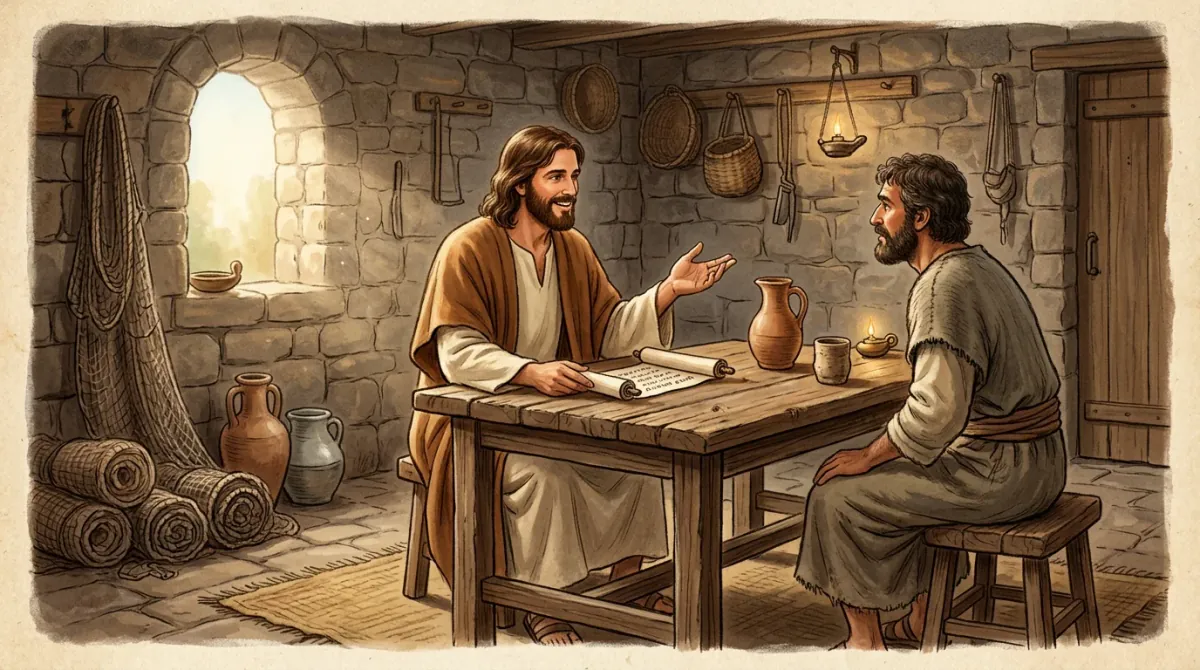 Inside their stone Capernaum dwelling, Jesus smiles warmly, revealing divine omniscience and teaching Peter about the covenant freedom of the King's children.
The collectors approached Peter with a thinly veiled theological trap: "Does your Teacher not pay the temple tax?" (Matthew 17:24). The original Greek specifies the Didrachmon—a two-drachma coin equivalent to the Jewish half-shekel mandated in Exodus 30:13. Every adult Jewish male over twenty was expected to pay this sacred levy in the month of Adar to support the morning and evening sacrifices, incense, and maintenance of the Jerusalem Temple.
Peter, fiercely protective of his Master’s reputation and anxious to demonstrate orthodoxy, instinctively blurted out: "Yes!" He did not pause to consult Jesus or consider the theological implications of his hasty defense. Yet as Peter hurried down the basalt alleyways toward the stone courtyard where Jesus was staying, an uneasy weight settled over his mind. Had he spoken out of turn? Did the Lord of the Temple truly owe tribute to His own sanctuary?
2. Divine Omniscience Behind Closed Doors
Before Peter could open his mouth to recount the encounter, Jesus anticipated his every thought. The Gospel of Matthew notes with breathtaking precision: "When he had come into the house, Jesus anticipated him" (Matthew 17:25). Before Peter could articulate a single syllable, Christ laid bare the secret conversation that had transpired on the street corner. The King of glory needed no earthly report; the hidden thoughts of men were completely transparent before His gaze.
Smiling gently across the rustic wooden table, Jesus engaged His fisherman disciple in a profound Socratic dialogue regarding royal law and identity:
"What do you think, Simon? From whom do the kings of the earth take customs or taxes, from their sons or from strangers?"
Peter answered with obvious common sense: "From strangers." In the ancient world, no monarch taxed his own family. The royal princes and children of the palace lived on royal revenue; they were never subjected to tribute. Then came Christ's staggering conclusion:
"Then the sons are free!" (Matthew 17:26)
3. The Royalty of the King's Children
In those four explosive words, Jesus unveiled the absolute bedrock of New Covenant identity. The Jerusalem Temple was not merely an earthly civic building; it was the sacred palace and dwelling place of the Most High God, Christ’s heavenly Father. As the only begotten, eternal Son of God, Jesus possessed absolute, sovereign immunity. He was not a servant owing tribute to the Temple; He was the Lord of the Temple whose very glory filled the sanctuary!
Furthermore, by including Simon in the plural "sons" (huioi), Jesus graciously drew His disciples into His own royal status. Through union with the Son, believers are not spiritual slaves terrified of falling short of ceremonial ledgers; they are royal heirs of the Kingdom, exempt from legalistic condemnation and walking in the liberty of the children of God.
4. The Humility of Grace: 'Lest We Offend Them'
Having firmly established His absolute theological right to refuse payment, Jesus made a stunning pastoral pivot. He did not assert His rights with arrogant defiance or mount a public protest against the temple establishment. Instead, He declared:
"Nevertheless, lest we offend them..." (Matthew 17:27)
The Greek verb skandalizō denotes placing a trap or stumbling block in another person's spiritual path. Had Jesus refused to pay, the tax collectors and the watching multitude would have concluded that He despised the Temple, rejected God's Law, and led His followers into profane rebellion. Their spiritually immature minds could not yet comprehend His divine Sonship. Therefore, out of tender love for their souls, Christ voluntarily laid down His lawful rights, choosing to suffer personal inconvenience rather than hinder the progress of the Gospel.
5. The Hook, the Lake, and the Fish
Then came the most astonishing command ever spoken to a professional fisherman:
"Go to the sea, cast in a hook, and take the first fish that comes up. And when you have opened its mouth, you will find a piece of money; take that and give it to them for Me and you." (Matthew 17:27)
Consider the breathtaking dimensions of this command! Peter was an experienced commercial fisherman who operated large drag nets with crews of hired men. To tell an expert net fisherman to walk down to the shore with a single handheld line and iron hook (ankistron) was unconventional in the extreme. Yet Peter had learned through miraculous boat-sinking catches that when Jesus speaks, nature bows in absolute submission.
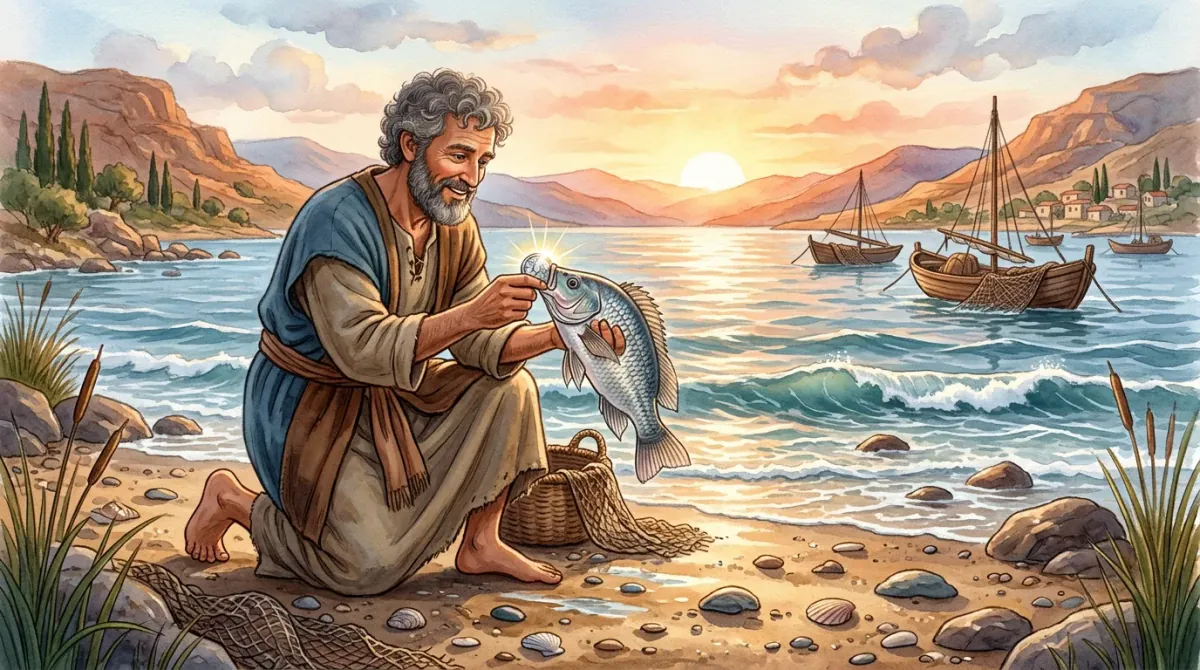
Peter took his line and walked down to the water’s edge. He baited the hook and cast it out into the sparkling blue ripples of the lake. Almost immediately, the line pulled taut. Reeling in the line, Peter pulled ashore a vigorous, shimmering freshwater tilapia—the native fish known to this day throughout the region as St. Peter’s Fish.
Kneeling in the sand, Peter grasped the fish and gently opened its jaws. Resting inside the mouth was a heavy, gleaming silver coin: an authentic Roman-era Statēr! A stater was worth exactly four Attic drachmas or one full Jewish shekel. It was the precise, exact mathematical amount required to pay the two-drachma temple tax for exactly two adult men: Jesus and Peter!
6. Sovereign Omniscience and Heavenly Supply
Pause to reflect on the staggering micro-sovereignty demonstrated in this miracle:
- Some careless traveler or merchant had dropped a silver stater coin into the deep waters of the lake days or weeks earlier.
- As the coin settled onto the rocky lakebed, a single tilapia had snapped it up, mistaking its shine for food.
- Unable to swallow or spit out the heavy coin, the fish carried it securely in its oral cavity.
- Christ, sitting miles away inside a stone house in Capernaum, saw both the coin and the fish through His divine omniscience.
- At Christ’s silent sovereign impulse, that specific fish was guided through millions of gallons of water straight to Peter’s single baited hook at the exact second Peter cast his line!
Holding the glistening silver coin in his hand, Peter walked back up the Capernaum streets with tears of wonder and worship. He paid the collectors, satisfying the temple tribute without a shred of compromise. The lesson was etched permanently upon his soul: the King's children are truly free, and their Father in heaven holds the keys of the entire cosmos to supply all their needs according to His riches in glory.
Ancient Near Eastern & Archaeological Context
In first-century Jewish society, the collection of the temple tax (Machatzit ha-Shekel) was an intensely sensitive theological and nationalistic issue. Originating in Exodus 30:11–16 as an atonement census offering for the wilderness Tabernacle, it had evolved by the Greco-Roman era into an annual tribute of two Attic drachmas (a half-shekel) paid by Jewish men over age twenty across the Roman diaspora.
The tax collectors set up payment booths throughout Judea and Galilee approximately one month before the Passover feast, in the month of Adar. Unlike the Roman provincial poll tax (tributum capitis) collected by hated collaborationist tax farmers, the temple tax was regarded by the Pharisees and religious authorities as a sacred civic duty supporting the continuous morning and evening burnt offerings (*Tamid*), incense, and Temple maintenance in Jerusalem.
However, sectarian debate swirled around the tax. The Qumran Essene community argued that the tax was a once-in-a-lifetime obligation, not an annual fee. The Sadducean priesthood often clashed over its administration. When the tax collectors approached Peter in Capernaum, they were testing Jesus’ orthodoxy: Did this radical Galilean rabbi honor the sacred Temple system, or did He encourage civil disobedience against the religious establishment? By entering the home and initiating the conversation before Peter could speak, Jesus unveiled His divine omniscience, reframing the debate from legal compliance to the profound reality of royal divine sonship.
Practical Discipleship & Spiritual Application
- Walking in Royal Sonship: As born-again believers in Jesus Christ, we are children of the ultimate King. We do not relate to God as fearful debt-slaves under religious coercion, but as beloved sons and daughters who enjoy covenant freedom.
- Sacrificing Rights for the Gospel: Jesus possessed absolute divine immunity from the temple tax, yet He voluntarily waived His rights to prevent spiritual stumbling. True Christian maturity is willing to lay down lawful personal liberties for the sake of winning others to Christ.
- God's Hyper-Specific Providence: God does not merely govern galaxies; He directs a single fish in the depths of the Sea of Galilee to swallow a lost coin and bite Peter's hook at the precise second needed. No detail of your financial need is hidden from His sovereign care.
- Obedience in Common Labors: Peter was a professional net fisherman, yet he humbly obeyed Jesus’ unconventional instruction to use a single hook. When we bring our ordinary skills and surrender them in faith to Christ, He turns daily work into a stage for divine miracles.
Support Independent Biblical Research
Did this study bless you? Help support our independent bilingual research and interactive visual Bible tools.
⚡ Fast Facts
- The Temple Tax Mandate: Established in Exodus 30:11–16 as the 'half-shekel atonement money' (Machatzit ha-Shekel), collected annually in the month of Adar from every Jewish male aged twenty and older
- The Perfect Stater Coin: The Greek coin found in the fish was a 'statēr' (equivalent to four Attic drachmas or one Tyrian shekel), which precisely matched the required two-drachma tax for exactly two adult men
- Unique Angling Miracle: This is the only miracle in the Gospels where Peter catches a fish with a hook and line (ankistron) rather than a casting or drag net
- Royal Immunity of the Sons: Jesus established the foundational doctrine of New Covenant liberty: as the unique Son of the Living God, Jesus had no legal obligation to pay tribute to His Father's house, yet He submitted to avoid giving offense
❓ Frequently Asked Questions (FAQs)
What was the purpose of the two-drachma temple tax?
The two-drachma tax (Didrachmon) was a religious tribute collected annually from every adult Jewish male worldwide to support the daily morning and evening sacrifices, incense, priestly vestments, and general maintenance of the Jerusalem Temple. Unlike Roman civil taxes collected by hated publicans, this was a sacred Jewish religious tax instituted originally in Exodus 30 as ransom money for the Tabernacle.
Why did Jesus claim that the 'sons are free' from paying the tax?
Jesus used an analogy from earthly monarchies: human kings do not levy taxes on their own biological sons and royal princes; they collect revenue from conquered subjects and strangers. Since the Jerusalem Temple was the earthly palace and dwelling of God the Father, Jesus—as the eternal, beloved Son of God—was inherently exempt from paying tribute to His own Father's house. By extension, Peter and all who belong to the Kingdom are royal heirs, liberated from legalistic bondage.
Why did Jesus choose to pay the tax through a fish rather than His common money bag?
While Judas carried the apostolic money bag, Jesus chose this astonishing miracle to accomplish three divine purposes: First, it preserved the principle of covenant freedom while practicing sacrificial humility ('lest we offend them'). Second, it proved to Peter that Christ possesses total omniscience and micro-sovereignty over every creature, knowing exactly which fish swallowed a lost Roman coin in the lake. Third, it demonstrated that God supplies the needs of His servants through divine providence in ways that surpass ordinary human calculation.