Nestled in Luke 15:8-10, the Parable of the Lost Coin is the intimate centerpiece of Christ's trilogy on redemption. Responding to the grumbling Pharisees who sneered that "this man welcomes sinners and eats with them," Jesus unveils the relentless, searching love of God through the desperate diligence of an impoverished Galilean woman sweeping her darkened home to recover a single lost silver drachma.
1. The Loss of a Sacred Treasure
Jesus presented a poignant domestic crisis: "Or suppose a woman has ten silver coins and loses one. Doesn't she light a lamp, sweep the house and search carefully until she finds it?" (Luke 15:8). In 1st century Judea, a silver drachma represented a full day's wage. More significantly, for a married peasant woman, these ten coins frequently constituted her bridal dowry (*semadi*), strung together on a silver chain and worn across her forehead as a sacred badge of marital covenant. To lose one coin was not simply a financial deficit; it was an emotional and social catastrophe that threatened her dignity and marital honor.
2. Darkness, Dust, and the Unsparing Search
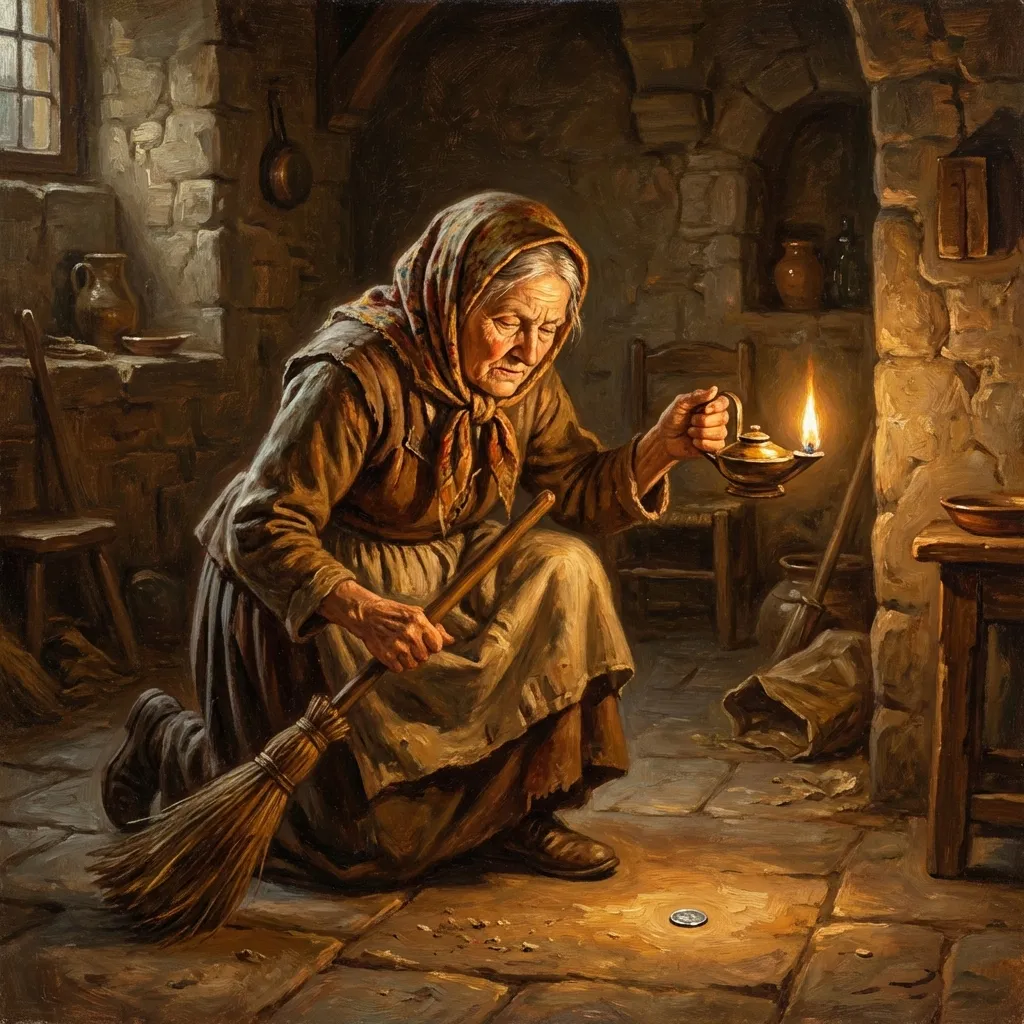
The architecture of a peasant house magnified the difficulty. Constructed of dark basalt or unmortared fieldstones with no glass windows, the interior was pitch black even under the noon sun. The floor was packed earth covered with reeds and straw. The moment the coin slipped from her fingers, it vanished into the dirt. But the woman did not surrender to despair. She lit an olive oil lamp (haptō lychnon), took a twig broom, and began sweeping vigorously (saroō). She moved chests, pulled back mats, cleared away dust, and listened with breath held for the faint metallic clink of silver striking stone.
3. The Total Helplessness of the Inanimate Coin
This parable carries a unique theological accent distinct from the Lost Sheep or the Prodigal Son. A lost sheep knows it is hungry, feels the cold, and bleats in terror. A lost son feels his degradation and can resolve to walk home. But a lost coin is completely inanimate; it has no consciousness of its lostness, no capacity to cry out for help, and no power to alter its location. It lies silent, helpless, and paralyzed in the dirt. It represents the utter spiritual deadness of fallen humanity (Ephesians 2:1). If salvation depended upon the coin finding the woman, it would remain buried forever. The seeker must do all the work.
4. The Overflowing Communal Celebration
Suddenly, the broom brushed against something hard. The lamp's yellow flame caught the glint of polished silver! Overwhelmed with relief, the woman clasped the drachma to her chest. She could not contain her joy: "And when she finds it, she calls her friends and neighbors together and says, 'Rejoice with me; I have found my lost coin'" (Luke 15:9). She invited her female neighbors to share in her relief. Her bridal headband was restored; her honor was intact; the missing treasure was home.
5. The Ecstatic Joy of the Heavenly Court
Jesus delivered the breathtaking punchline: "In the same way, I tell you, there is rejoicing in the presence of the angels of God over one sinner who repents" (Luke 15:10). Notice the exact phrase: rejoicing in the presence of the angels. It is not merely the angels who are rejoicing; it is God Himself whose triumphant, overflowing joy echoes before His celestial court! The religious leaders despised tax collectors and sinners as worthless chaff, but to the heart of God, every broken sinner is an irreplaceable, coin-stamped treasure of infinite worth.
Biblical Keywords & Theological Roots
Drachma; silver Greek coin roughly equivalent to the Roman denarius, representing an entire day's subsistence wage.
To ignite, kindle, light a lamp; penetrating dark corners with divine illumination to recover that which is lost.
To sweep, cleanse vigorously with a broom; removing accumulated domestic debris until the silver chimes against stone.
Ancient Near Eastern & Archaeological Context
In rural 1st century Palestine, peasant women lived within strict economic constraints. A single silver drachma represented roughly a day's wage for an agricultural laborer. For a married peasant woman, her ten-coin bridal headdress (*semadi*) was legally protected personal property that could not be seized by creditors, even in bankruptcy. Losing one of these coins was not merely an economic forfeiture; in village gossip culture, it could invite suspicion of negligence or unfaithfulness to her marital covenant. The peasant house was small (typically 12 by 12 feet) with walls of unmortared basalt and a floor made of packed earth covered with reeds, into which a small coin would instantly sink out of sight.
🔑 Key Spiritual Takeaways
- Inherent Value of the Lost: A coin cannot lose its silver content merely by being lost in the dust; human souls retain infinite dignity and worth to the Creator.
- The Initiative of Grace: The lost coin was completely inanimate—it could not know it was lost, could not cry out, and could not seek help; God takes the absolute initiative to find us.
- Diligent, Exhaustive Seeking: God spares no effort, lights the lamp of the Spirit, and sweeps the dark world to rescue His cherished treasure.
- The Joy of Heaven: The heart of God overflows with personal, ecstatic joy whenever a lost, broken sinner is restored to fellowship.
Support Independent Biblical Research
Did this study bless you? Help support our independent bilingual research and interactive visual Bible tools.
⚡ Fast Facts
- The Bridal Dowry Headdress: In 1st century Palestine, married Jewish women wore a headband (*semadi*) strung with ten silver coins given by their bridegroom—losing one coin was a devastating emotional and social disaster equivalent to losing a wedding ring.
- Windowless Peasant Living: Galilean village homes typically had low ceilings, no glass windows, and dirt floors strewn with dried rushes and straw, creating a pitch-black interior even at high noon.
- The Sound of Silver: Sweeping with a twig broom (*sarōma*) was an acoustic search; the woman listened intently for the metallic chime of the silver drachma striking the stone floor.
- Universal Celestial Rejoicing: Just as with the Lost Sheep, the parable concludes with rejoicing 'in the presence of the angels of God over one sinner who repents' (Luke 15:10).
❓ Frequently Asked Questions (FAQs)
Why is the Lost Coin placed between the Lost Sheep and the Prodigal Son in Luke 15?
The three parables form a literary progression of escalating loss and intimacy: 1 out of 100 sheep (1%), 1 out of 10 coins (10%), and 1 out of 2 sons (50%). The Lost Sheep highlights a sinner who wandered away foolishly; the Lost Coin highlights a sinner lost in the domestic routine through no deliberate malice; the Prodigal Son highlights willful, rebellious departure.
What does the woman's lamp and broom represent in Christian allegory?
Historically, church fathers viewed the woman as an emblem of the Holy Spirit working through the Church, lighting the lamp of the Word of God and sweeping away the dust of worldly corruption to locate and retrieve the image of God stamped upon the soul.
Why did the woman spend effort and money inviting neighbors to celebrate finding a single coin?
In Middle Eastern honor culture, finding the coin cleared her name of negligence and restored her complete bridal dowry. The celebration was an outburst of communal relief and shared joy, mirroring the celestial party erupting in heaven when one sinner repents.