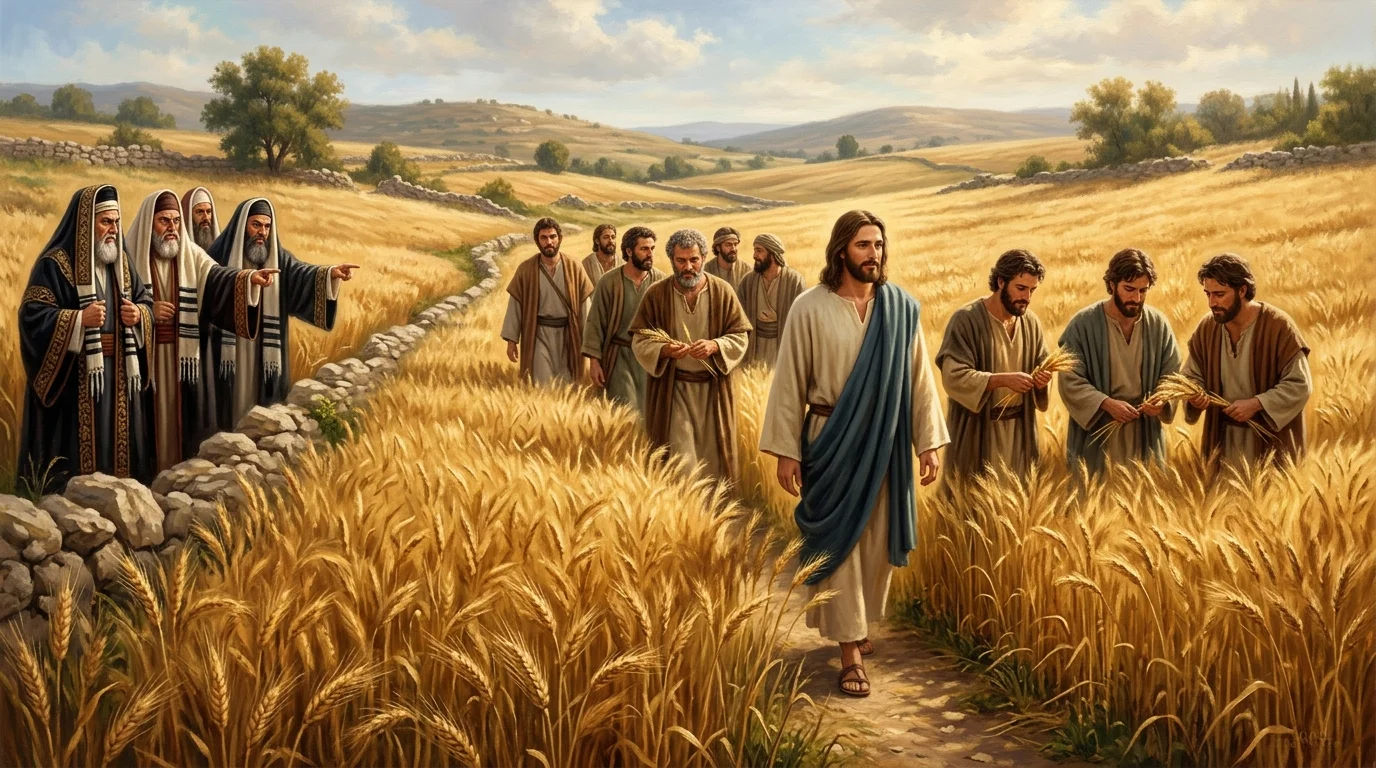
Under the golden dome of an azure Galilean sky, a gentle breeze rippled across sprawling wheatfields ready for harvest. Through the narrow dirt path cutting through the standing grain walked Jesus of Nazareth and His disciples. Famished from days of demanding itinerant ministry, the disciples reached out their hands, plucked ripe ears of wheat, and rubbed the husks between their palms to chew the raw, sweet grain. But peering through the margins of the field, unseen hunters were tracking their every step. Within moments, the rustling of wheat was drowned out by the harsh, venomous hiss of Pharisaic accusation: "Look, why do they do what is not lawful on the Sabbath?" What began as a minor agricultural dispute in a wheatfield erupted into a monumental theological duel that swept into the local synagogue, exposed the lethal cruelty of religious legalism, and established Jesus Christ as the absolute Lord of the Sabbath.
1. The Ripening Wheatfields & The Accusing Shadows
The incident occurred on what Luke designates as the "second Sabbath after the first" (Luke 6:1)—the springtime season between Passover and Pentecost when the barley and wheat crops of the Jezreel Valley and Lower Galilee stood tall and golden.
Jesus and His disciples were traveling on foot between Galilean villages. They possessed no travel rations, no money bags, and no wagon of supplies. Exhausted and hungry, the disciples utilized a gracious provision explicitly codified in the Law of Moses:
"When you come into your neighbor’s standing grain, you may pluck the heads with your hand, but you shall not use a sickle on your neighbor’s standing grain." (Deuteronomy 23:25).
God's law was profoundly humanitarian: a starving traveler was legally entitled to satisfy his immediate hunger by plucking grain with his fingers, provided he did not carry a commercial sickle to steal his neighbor's crop. The disciples were guilty of neither theft nor trespassing.
Yet stalking them along the boundary stones was an espionage squad of Pharisees. These religious watchdogs were not interested in worshiping God or feeding the poor; their entire spiritual life was consumed by microscopic surveillance. The moment they saw the disciples roll the grain in their hands, they pounced!
2. The Legalistic Web of Thirty-Nine Melakhot
The Pharisees leveled a thunderous accusation: "Look! Why do they do what is not lawful on the Sabbath?" (Mark 2:24).
Where in the Hebrew Scriptures was plucking a handful of grain on the Sabbath forbidden? Nowhere! The accusation rested entirely upon the human traditions of the Oral Torah.
In their obsessive desire to prevent any violation of the Fourth Commandment, the scribes had categorized labor into thirty-nine primary prohibitions (Avot Melakhot). In their hyper-refined casuistry, the disciples had committed four simultaneous felonies:
- Plucking the heads: Legally classified as reaping (Qotzer).
- Rubbing the husks between their palms: Legally classified as threshing (Dosh).
- Blowing the chaff away: Legally classified as winnowing (Zoreh).
- Eating the kernels: Legally classified as preparing a meal.
According to the extreme schools of Shammai, the disciples were technically guilty of capital crimes worthy of death! They had elevated their human fences above human life, weaponizing the Sabbath as an instrument of oppression.
3. The Precedent of David & The Priestly Temple Exception
Jesus did not flinch, nor did He debate their tedious rabbinic sub-clauses. He struck at the root of their spiritual hypocrisy by appealing to Scripture itself:
"Have you not read what David did when he was hungry, he and those who were with him: how he entered the house of God and ate the showbread which was not lawful for him to eat, nor for those who were with him, but only for the priests?" (Matthew 12:3–4).
Jesus took them back to 1 Samuel 21. When David, the anointed king of Israel, was fleeing for his life from murderous King Saul, he arrived famished at the sanctuary of Nob. High Priest Ahimelech had no common bread, only the twelve holy loaves of the Bread of the Presence (Lechem ha-Panim), which had just been replaced on the golden table. Under Leviticus 24:9, that sacred consecrated bread was strictly reserved for Aaron and his sons.
Yet Ahimelech gave the sacred bread to David and his ravenous companions, and Scripture records no divine rebuke! Why? Because in the divine economy, ceremonial regulations must always yield to human necessity and the preservation of life! The ritual bread was designed to honor God; starving the Lord's anointed to protect a ritual would have been an abomination.
Then Jesus delivered a second scriptural blow: "Or have you not read in the law that on the Sabbath the priests in the temple profane the Sabbath, and are blameless?" (Matthew 12:5). On every Sabbath, Levitical priests slaughtered, skinned, butchered, hoisted, and burned double the daily animal sacrifices, hauling heavy wood and lighting massive fires. Technically, they performed intense physical labor; yet they were blameless because the service of the Temple transcended the Sabbath rest.
Then came the staggering Christological thunderbolt: "Yet I say to you that in this place there is One greater than the temple!" (Matthew 12:6). If temple service justified the priests' labor, how much more did the presence of the Living Temple—the incarnate Son of God—justify His disciples feeding their bodies to serve Him!
4. The Sovereign Proclamation: Lord of the Sabbath
Jesus drove the truth straight into their legalistic hearts by quoting Hosea 6:6: "If you had known what this means, 'I desire mercy and not sacrifice,' you would not have condemned the guiltless." (Matthew 12:7).
The Pharisees knew the letter of the law, but were utterly ignorant of the heartbeat of God. God does not take pleasure in external ritual sacrifices when human hearts are cold, merciless, and devoid of love (Hesed).
Then, turning to the horizon, Jesus pronounced the foundational charter of biblical rest:
"The Sabbath was made for man, and not man for the Sabbath. Therefore the Son of Man is also Lord of the Sabbath." (Mark 2:27–28).
God did not create humanity on the sixth day to be slaves to a calendar day! He instituted the Sabbath as a joyful gift of rest, freedom, and spiritual restoration for weary humanity. And as the divine Creator who originally spoke the Sabbath into existence at Creation, Jesus Christ possessed absolute sovereign authority (Kyrios tou sabbatou) to govern, interpret, and fulfill its holy purpose!
5. The Synagogue Showdown & The Withered Hand
On another Sabbath, the conflict reached its boiling climax inside the local Galilean synagogue.
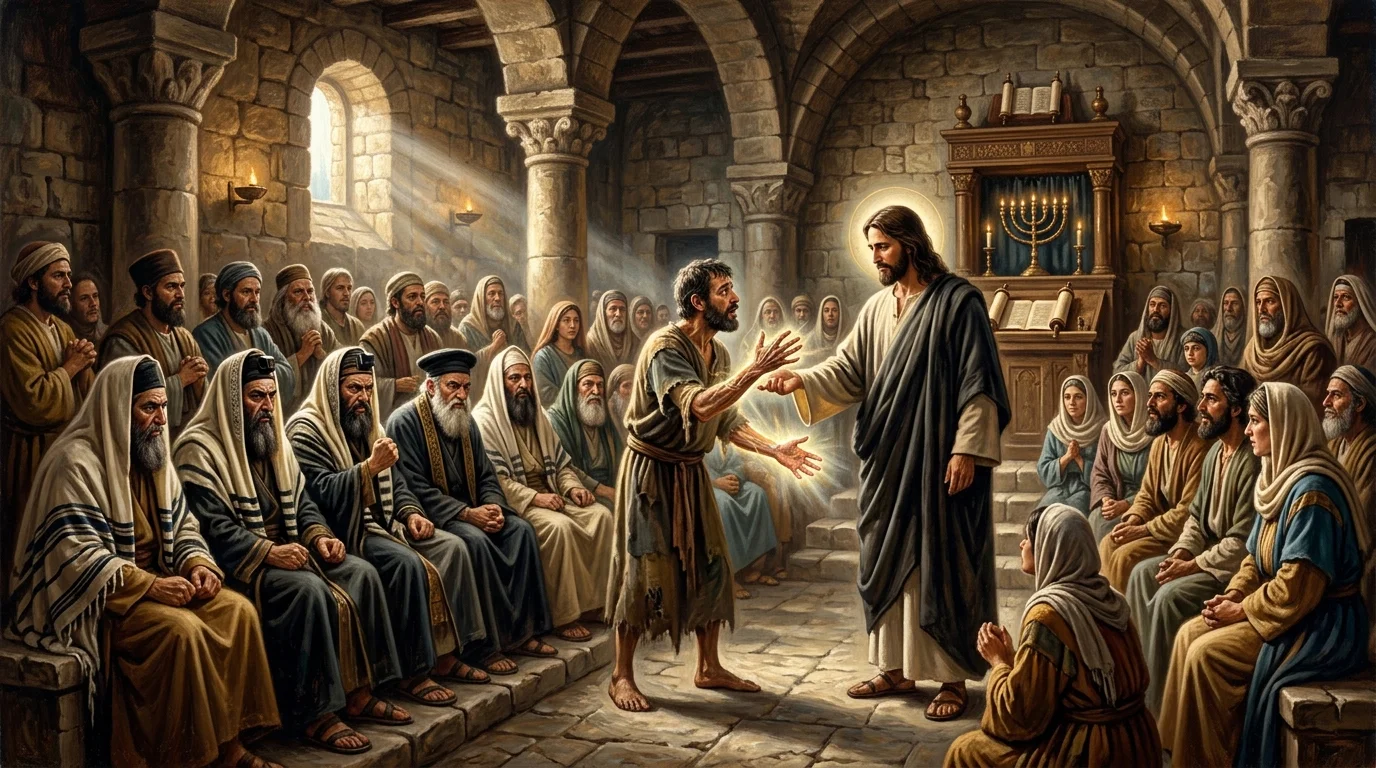
Sitting in the congregation was a man with a withered right hand (Luke 6:6 - cheir dēxia xēra). His limb was completely paralyzed, atrophied from nerve damage and muscle decay, hanging useless like a dead branch. According to an ancient second-century Christian tradition recorded in the Gospel of the Hebrews, this man was a stone mason who pleaded with Jesus: "I was a stone mason, seeking a living with my hands; I pray Thee, Jesus, restore my health, that I may not shamelessly beg for food."
The scribes and Pharisees sat watching Jesus like coiled vipers: "they watched Him closely, whether He would heal him on the Sabbath, so that they might accuse Him." (Mark 3:2).
Under rabbinic law (Pikuach Nefesh), medical aid was legally permissible on the Sabbath only if a patient was in imminent danger of death—such as severe trauma, choking, or a collapsing wall. A withered hand was a chronic condition; waiting twenty-four hours until Sunday would cause no mortal peril. To heal him today would constitute a deliberate violation of their oral fences.
Jesus knew their thoughts. He did not perform a secretive miracle in a corner. He took command of the room with fearless majesty:
"Step forward!" (Greek: Egeire eis to meson - "Arise into the center!" - Mark 3:3).
The crippled man stood up and walked into the center aisle before the eyes of the entire assembly.
6. Righteous Anger & The Miracle of Wholeness
Jesus turned to the rows of stony-faced Pharisees and leveled a piercing moral challenge:
"I ask you one thing: Is it lawful on the Sabbath to do good or to do evil, to save life or to destroy it?" (Luke 6:9).
A deathly silence gripped the synagogue. Their casuistry was trapped. If they answered, "It is lawful to do good," they validated His healing; if they answered, "It is lawful to do evil," they condemned themselves. Furthermore, by framing the choice between saving life and destroying it, Jesus exposed their dark reality: while He was standing in the synagogue seeking to *save* a man’s life and restore his dignity, they were sitting in the synagogue actively plotting to *murder* the Son of God! Who was the true Sabbath-breaker?
Then Matthew records His devastating illustration: "What man is there among you who has one sheep, and if it falls into a pit on the Sabbath, will not lay hold of it and lift it out? Of how much more value then is a man than a sheep! Therefore it is lawful to do good on the Sabbath." (Matthew 12:11–12).
The Pharisees refused to answer; they kept silent (esiōpōn).
What happened next is one of the most revealing moments in the life of Christ:
"And when He had looked around at them with anger, being grieved by the hardness of their hearts..." (Mark 3:5).
Jesus swept His eyes across the congregation. His gaze flashed with holy, blazing anger (met' orgēs)—a pure, sinless wrath against the demonic cruelty of religion that sacrifices human beings upon the altar of human traditions. Yet intertwined with His wrath was deep, aching grief (syllypoumenos) over their self-inflicted spiritual blindness.
Turning His gaze to the trembling cripple, Jesus commanded:
"Stretch out your hand!" (Mark 3:5).
Consider the impossibility of the command: the man's hand was withered, rigid, and dead! Yet faith always obeys what the Lord commands. The man willed his arm forward—and as he stretched it forth, divine power surged through the dead nerves and shriveled tendons!
"And his hand was restored as whole as the other!" (Mark 3:5).
Color rushed into the pale skin; bent fingers straightened with supple strength; vigor returned in an instantaneous creative miracle! The stone mason flexed his fingers, gazing in tearful adoration at his restored hand.
The Pharisees were humiliated, unmasked, and consumed with irrational madness (anoias). Rushing out of the synagogue, they immediately did the unthinkable: they entered into a sinister political conspiracy with the Herodians—their bitter political enemies who supported Roman rule—to plot the execution of Jesus Christ (Mark 3:6).
On that Sabbath day, religion chose death, but Jesus gave life! In the wheatfields and in the synagogue, the Lord of the Sabbath proved that the true rest of God is found not in dead ritualism, but in the life-giving, liberating grace of Jesus Christ!
Ancient Near Eastern & Archaeological Context
Under the Torah (Exodus 20:8–11; Deuteronomy 5:12–15), the Fourth Commandment required ceasing from ordinary occupational labor on the seventh day. However, during the intertestamental period, the Pharisaic scribes erected a massive protective 'fence around the Torah' (Gezerot), codifying thirty-nine specific categories of primary forbidden labors (Avot Melakhot) in the Mishnah. Among these, reaping (Qotzer), threshing (Dosh), winnowing (Zoreh), and selecting (Borer) were capital Sabbath violations. When Jesus' disciples plucked grain heads and rubbed them in their palms to satisfy acute hunger, the Pharisees charged them with performing four sequential illegal agricultural operations! Furthermore, rabbinic law strictly ruled that medical healing on the Sabbath was permissible only if human life was in immediate mortal peril (Pikuach Nefesh). A withered hand was a chronic disability, not an acute emergency; therefore, healing it on the Sabbath was classified as unlawful work. In response, Jesus demonstrated that delaying mercy is fundamentally immoral, and exposed that while the Pharisees plotted to kill a man on the Sabbath, He was actively saving life.
Support Independent Biblical Research
Did this study bless you? Help support our independent bilingual research and interactive visual Bible tools.
⚡ Fast Facts
- Plucking standing grain from a neighbor's field by hand was explicitly permitted in Mosaic Law (Deut 23:25); the Pharisees objected solely because it occurred on the Sabbath
- The Oral Torah classified plucking grain as reaping, rubbing in palms as threshing, blowing away husks as winnowing, and eating as food preparation—four distinct capital offenses
- Mark 3:5 is the only Gospel passage that explicitly describes Jesus looking around 'with anger' (met' orgēs), perfectly harmonized with grief (syllypoumenos) over spiritual blindness
- The political alliance between pious Pharisees and secular, Rome-friendly Herodians (Mark 3:6) was unprecedented, formed purely out of shared hatred for Jesus
❓ Frequently Asked Questions (FAQs)
In 1 Samuel 21, when David and his companions were starving and fleeing from Saul, High Priest Ahimelech gave them the holy Bread of the Presence ('Lechem ha-Panim'), which only priests were legally permitted to eat under Leviticus 24. Jesus demonstrated that moral necessity, preservation of human life, and compassionate mercy take precedence over ceremonial ritual regulations. If David was blameless, how much more the true Davidic Messiah and His followers!
God instituted the Sabbath at Creation as a gracious covenant gift—a sanctuary in time for rest, spiritual renewal, physical refreshment, and joyful worship. Over centuries, legalistic rabbinism inverted God's intention, transforming the day of rest into an agonizing, burdensome straitjacket of endless micro-rules. Jesus restored the true theology of the Sabbath: humans were not created to serve an abstract day; the day was created by God to serve human well-being and flourishing.
Mark 3:5 reveals Christ's holy, sinless emotion: He looked around at them 'with anger, being grieved by the hardness of their hearts.' His anger was not personal spite or vindictiveness, but righteous moral outrage at religious hypocrisy that cared more about technical ritual fences than relieving the agony of a crippled human brother. His anger was tempered with heartbreaking sorrow ('syllypoumenos') over their self-inflicted spiritual blindness.