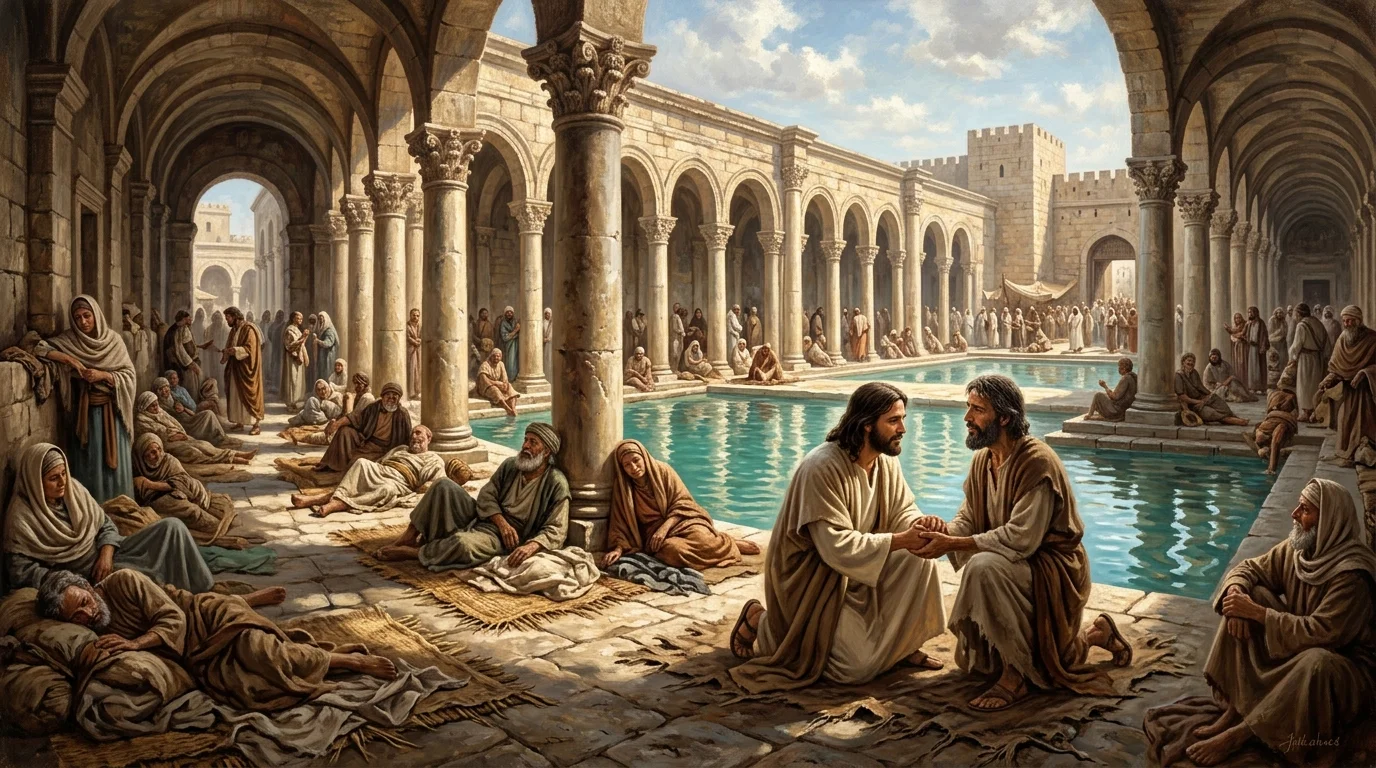
In the shadows of Jerusalem's towering Herodian Temple, just outside the Sheep Gate where spotless lambs were led to daily sacrifice, lay an open-air pavilion of human despair: the Pool of Bethesda. Beneath its five stone porticoes, hundreds of blind, lame, and paralyzed outcasts lay stranded on rotting straw mats, bound in a tragic lottery of superstition awaiting the bubbling of the water. Yet on a solemn Sabbath afternoon, the Lord of Life walked into this valley of dry bones. Bypassing the frantic throngs, Jesus stood before a man whose life had been shattered by thirty-eight years of continuous paralysis. With three thunderous words of authority, Christ shattered nearly four decades of decay, carried a bedroll into the crosshairs of religious rage, and unveiled the supreme mystery of His eternal equality with God the Father.
1. The Five Porticoes of Bethesda & The Sea of Suffering
Jerusalem during feast seasons was a spectacle of liturgical splendor: white-robed Levitical choirs chanting Psalms, silver trumpets echoing from Mount Moriah, and fragrant clouds of frankincense ascending into the azure Judean sky. Yet barely a stone's throw from this religious majesty, through the Sheep Gate (Probatikē), lay a horrific contrast.
The Pool of Bethesda—derived from the Aramaic Beit Chesda, meaning "House of Mercy"—consisted of two massive rectangular stone reservoirs carved into the limestone bedrock. Surrounding the double pool were four monumental perimeter colonnades, with a fifth central portico dividing the northern and southern basins.
Under the vaulted shade of these five porticoes lay an agonizing spectacle: "a great multitude of sick people, blind, lame, paralyzed" (John 5:3). The air was thick with the stench of suppurating sores, unwashed garments, and utter despair. Men and women with atrophied limbs, milky blind eyes, and contorted spines lay shoulder to shoulder on dirty sleeping mats.
They were trapped in a cruel, superstitious hope. Periodically, subterranean springs or siphon channels would burst into the reservoirs, causing the water to bubble and swirl. Popular folklore held that an angel of the Lord troubled the water, and whoever stepped in first after the stirring would be miraculously healed. It was a merciless race where only the strong could win; the most severely disabled were perpetually doomed to lose.
2. Thirty-Eight Years in the Dust
Jesus entered Bethesda alone. He did not arrive with fanfare or an entourage of disciples. He walked quietly among the ranks of suffering humanity, His holy eyes scanning the sea of misery until they rested upon one solitary, forgotten man.
Scripture records the staggering duration of his agony: "Now a certain man was there who had an infirmity thirty-eight years." (John 5:5).
Consider the sheer weight of that number! For thirty-eight years—longer than Jesus had walked the earth in human flesh, longer than the average Roman lifespan—this man had been paralyzed. When he first lay down on his mat, Caesar Augustus had not yet consolidated his empire, Herod the Great was still building the Temple, and an entire generation of Israelites was wandering toward the grave.
For almost four decades, this man had watched his youth vanish, his family abandon him, and his friends drift away. His legs were atrophied matchsticks, his muscles wasted to withered sinews. He had become part of the architecture of the pool—a fixture of hopelessness.
3. The Piercing Diagnostic Question
Jesus knelt down on the stone pavement beside the bedridden invalid. Looking into eyes clouded with decades of defeat, the Master asked a question that seemed almost absurd on the surface:
"Do you want to be made well?" (Greek: Theleis hygiēs genesthai? - John 5:6).
Why ask a paralyzed man if he wants to be healed? Because chronic illness can become a psychological prison. After thirty-eight years, this man had developed deep institutionalization and learned helplessness. As an invalid, he had a recognized spot by the pool, received coins from passersby, and was exempt from social responsibility. To be made whole meant abandoning the familiar identity of victimhood, facing the demands of labor, and stepping into the frightening unknown of accountability.
Notice the man’s tragic response: "Sir, I have no man to put me into the pool when the water is stirred up; but while I am coming, another steps down before me." (John 5:7).
He did not say "Yes!" He offered an excuse. He pointed to his loneliness ("I have no man") and the competition of others ("another steps down before me"). He was looking to a muddy pool for magic, and to frail human hands for help. He did not realize that the Creator of water, the Sovereign Architect of the universe, was kneeling within inches of his trembling face!
4. The Word of Creation & The Carrying of the Mat
Jesus did not touch the bubbling water. He did not lift the man into the pool. He bypassed all superstition and spoke with the primordial power that said in Genesis, "Let there be light":
"Rise, take up your bed and walk!" (John 5:8).
Three razor-sharp Greek imperatives: Egeire (Rise!), aron (Take up!), peripatei (Walk!).
The effect was instantaneous and absolute: "And immediately the man was made well, took up his bed, and walked." (John 5:9).
In a microsecond of creative omnipotence, divine energy surged through shriveled nerve channels! Dead bone marrow rekindled; withered cartilage expanded; ligaments, tendons, and muscles instantly regenerated with adult strength. The man did not need weeks of physical therapy to learn balance. He sprang to his feet, bent down with supple vigor, rolled up the coarse woven mat (krabbaton) upon which he had suffered for nearly four decades, hoisted it onto his shoulder, and walked briskly out of the portico into the sunlit streets of Jerusalem!
5. The Sabbath Ambush & The Meeting in the Temple
The Gospel of John adds a thunderous theological clause: "And that day was the Sabbath." (John 5:9).
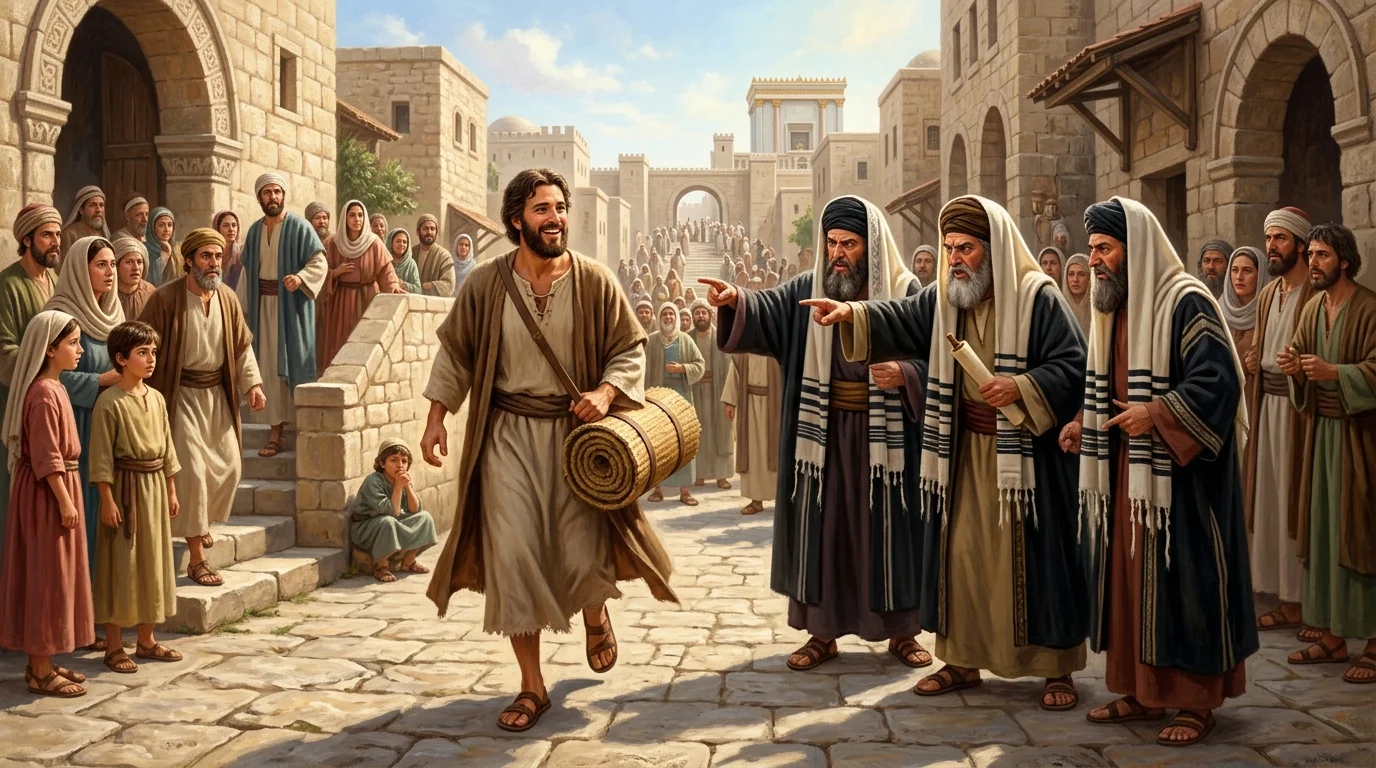
As the healed man marched down the limestone thoroughfares with his bedroll on his shoulder, praising God, he was abruptly intercepted by a committee of religious authorities. The Pharisees did not celebrate that a hopeless invalid had been delivered from thirty-eight years of agony. They did not weep with joy. With narrowed eyes, they pointed an accusing finger at the rolled-up mat:
"It is the Sabbath; it is not lawful for you to carry your bed!" (John 5:10).
Under the Oral Law (the Mishnah tractate Shabbat), the rabbis had divided labor into 39 forbidden categories (Melakhot). The final category strictly prohibited carrying an object from a private domain into a public domain. Carrying a portable bedroll was legally classified as a burden, a desecration of the holy rest worthy of stoning!
The man innocently replied: "He who made me well said to me, 'Take up your bed and walk.'" He possessed an unshakeable common-sense logic: whoever had the divine power to heal thirty-eight years of paralysis had the supreme moral authority to tell him what to do with his mat! When they demanded to know who commanded him to carry it, the man could not answer, for Jesus had slipped away into the crowd.
Later that afternoon, the healed man entered the glorious courts of the Temple. There, beneath the towering marble colonnades, Jesus sought him out and found him. Looking into his eyes, Christ spoke words of sobering pastoral authority:
"See, you have been made well. Sin no more, lest a worse thing come upon you." (John 5:14).
Jesus revealed that while physical healing is precious, spiritual redemption is eternal. Physical paralysis for thirty-eight years was a terrible tragedy; but dying in unrepentant sin and facing eternal damnation is infinitely worse! Christ came not merely to mend broken limbs, but to rescue immortal souls from hell.
6. The Great Discourse on Divine Equality & The Fourfold Witness
The man departed and told the authorities that it was Jesus who had made him whole. The Sanhedrin erupted in fury. They summoned Jesus and began persecuting Him, seeking to execute Him because He had done these things on the Sabbath.
Jesus did not apologize or claim that His action was a rare exception. Instead, He leveled a theological claim that shook Jerusalem to its foundations:
"My Father has been working until now, and I have been working." (John 5:17).
The Jewish leaders recognized immediately what this meant. All Jewish theologians agreed that although God rested on the seventh day from Creation, He never ceased His sovereign work of providence—giving life, sending rain, and sustaining the heartbeat of the cosmos on the Sabbath. By declaring "My Father works, and I work," Jesus was claiming that He operated on the exact same divine plane of sovereignty as God the Father!
John writes: "Therefore the Jews sought all the more to kill Him, because He not only broke the Sabbath, but also said that God was His Father, making Himself equal with God." (John 5:18).
Rather than retracting His statement, Jesus amplified His divine prerogatives with cosmic grandeur:
- Divine Unity: "Whatever the Father does, the Son also does in like manner." (v. 19).
- Sovereign Power Over Life: "For as the Father raises the dead and gives life to them, even so the Son gives life to whom He will." (v. 21).
- Absolute Judicial Authority: "For the Father judges no one, but has committed all judgment to the Son, that all should honor the Son just as they honor the Father." (v. 22–23).
- The General Resurrection: "The hour is coming in which all who are in the graves will hear His voice and come forth—those who have done good, to the resurrection of life, and those who have done evil, to the resurrection of condemnation." (v. 28–29).
Finally, knowing that the Torah demanded two or three witnesses to substantiate any capital claim (Deuteronomy 19:15), Jesus summoned four incorruptible witnesses to take the stand:
- John the Baptist: The burning and shining lamp who testified to the Lamb of God (v. 33–35).
- His Miraculous Works: The divine signs, instantaneous healings, and sovereign miracles that only God can perform (v. 36).
- God the Father: Who testified audibly from heaven at the Jordan River baptism (v. 37).
- The Holy Scriptures & Moses: The very Torah the Pharisees worshiped, which prophetically points to Christ on every page: "For if you believed Moses, you would believe Me; for he wrote about Me!" (v. 39, 46).
At the Pool of Bethesda, the stagnant waters of human helplessness were forever eclipsed by the Fountain of Living Water. The thirty-eight-year invalid walking with his mat was an undeniable living proof that Jesus of Nazareth is the Lord of the Sabbath, the Conqueror of disease, and the eternal Son of God who gives life to all who believe!
Ancient Near Eastern & Archaeological Context
The Pool of Bethesda was located just outside the northern wall of Jerusalem's Temple Mount, adjacent to the Sheep Gate (Nehemiah 3:1) through which sacrificial sheep were brought for temple offerings. For centuries, skeptics argued that John's description of a pool with 'five covered porticoes' was an allegorical invention, since Greek architecture rarely built five-sided structures. However, in the late 19th and mid-20th centuries, French archaeologists excavating near the Crusader Church of St. Anne uncovered the massive twin pools of Bethesda, measuring roughly 300 feet long, carved deep into limestone bedrock. A central stone partition divided the northern and southern pools, with colonnades on the four exterior sides and a fifth colonnade across the central dam, precisely validating John 5:2! In the Hellenistic and Roman periods, subterranean water channels fed the reservoirs from seasonal rainfall and subterranean springs, causing intermittent bubbling ('stirring of the water') which popular folk superstition attributed to an angel of healing. Surrounding the pools were stone vaults where hundreds of incurable invalids lived, establishing a tragic sanctuary of suffering right in the shadow of the glorious Temple.
Support Independent Biblical Research
Did this study bless you? Help support our independent bilingual research and interactive visual Bible tools.
⚡ Fast Facts
- Archaeological excavations near St. Anne's Church in Jerusalem confirmed John's precise description of the Pool of Bethesda with two large basins and five distinct colonnaded porticoes
- Thirty-eight years was longer than the average lifespan in first-century antiquity, symbolizing total human helplessness and Israel's 38-year wilderness wandering (Deut 2:14)
- Carrying a bedroll on the Sabbath violated the 39 Melakhot of the Oral Torah (Shabbat 7:2), which classified moving objects between public and private domains as capital labor
- Jesus declared that 'the Father works until now, and I work' (John 5:17), citing the Jewish theological consensus that God continually sustains the universe on the Sabbath
❓ Frequently Asked Questions (FAQs)
After 38 years of chronic illness, the invalid's spirit had succumbed to deep institutionalization, passive resignation, and learned helplessness. Sickness had become his entire identity and survival mechanism through begging. By asking this piercing diagnostic question, Jesus awakened the man's dormant desire, challenged his despair, and called for an active response of faith to receive divine restoration.
Rabbinic tradition strictly forbade medical treatment on the Sabbath unless a person was in imminent danger of death. Since the paralytic was stable and had lived 38 years in that condition, the Pharisees considered waiting until Sunday mandatory. Furthermore, commanding the man to carry his bedroll ('krabbaton') violated their human fences regarding bearing burdens between domains, which they prioritized above compassion and divine mercy.
Jesus presented four undeniable witnesses: (1) The prophetic witness of John the Baptist, who was a burning and shining lamp; (2) The evidential witness of His miraculous signs and works given by the Father; (3) The audible witness of the Father Himself at Christ's baptism; and (4) The scriptural witness of Moses and the Old Testament Scriptures, which testify directly of Christ.