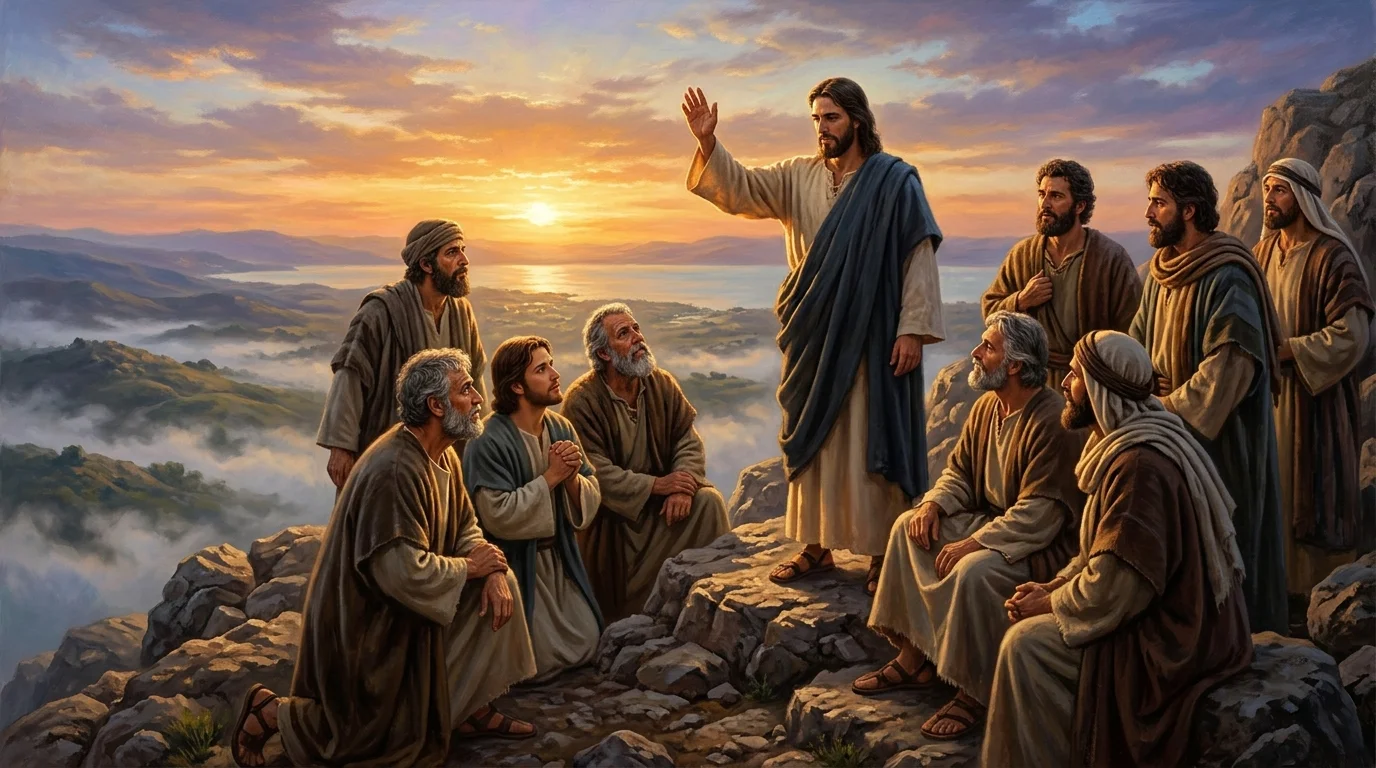
As twilight melted into indigo night over the rugged heights of lower Galilee, Jesus slipped quietly away from the pressing multitudes and ascended the lonely mountain crags. While the world slept below, the Son of God knelt beneath the canopy of stars, wrestling through the dark night watches in unceasing prayer with His Father. The destiny of the Church, the redemption of the nations, and the appointment of the apostolic foundation hung in the spiritual balance. At dawn, Jesus summoned the disciples and selected twelve ordinary men to be His Apostles. Then, descending to a lush, sloping meadow overlooking the sparkling Sea of Galilee, Christ sat down, opened His mouth, and delivered the greatest sermon ever spoken: the Sermon on the Mount—the revolutionary Magna Carta of the Kingdom of Heaven that redefined righteousness, shattered religious hypocrisy, and laid down the unshakeable bedrock of Christian discipleship.
1. The All-Night Vigil & The Calling of the Twelve
Luke records the momentous prelude with solemn reverence: "Now it came to pass in those days that He went out to the mountain to pray, and continued all night in prayer to God." (Luke 6:12).
Before every monumental watershed in His ministry, Jesus prayed. But this was not a brief petition; it was a full nocturnal vigil—en tē proseuchē tou Theou. Kneeling upon the cold limestone rock, Jesus poured out His soul until the eastern horizon flushed with the rose and gold of dawn.
When day broke, He called His wider circle of followers to the summit. From among them, He sovereignly selected twelve men whom He designated Apostles (Greek: Apostoloi - "sent ones" commissioned with royal authority):
- Simon Peter & Andrew: Rough-hewn fishermen from Bethsaida.
- James & John: The Sons of Thunder (Boanerges), ambitious yet fiercely loyal.
- Philip & Bartholomew (Nathanael): The inquiring missionary and the guileless scholar of Cana.
- Matthew (Levi) & Thomas (Didymus): The redeemed Roman tax collector and the twin of honest doubts.
- James son of Alphaeus & Simon the Zealot: The humble hidden servant and the former nationalist rebel.
- Thaddaeus (Jude) & Judas Iscariot: The man of tender heart and the tragic son of perdition who would betray Him.
What an astonishing collection of men! There were no aristocratic priests from Jerusalem, no trained scholars of the Sanhedrin, no philosophers from Athens. By uniting a Roman collaborator like Matthew with a fierce anti-Roman Zealot like Simon, Christ demonstrated that the Kingdom of God transcends all political, social, and economic divisions. These twelve flawed earthen vessels would become the foundation stones of the New Jerusalem!
2. The Mountain Pulpit & The Eight Beatitudes
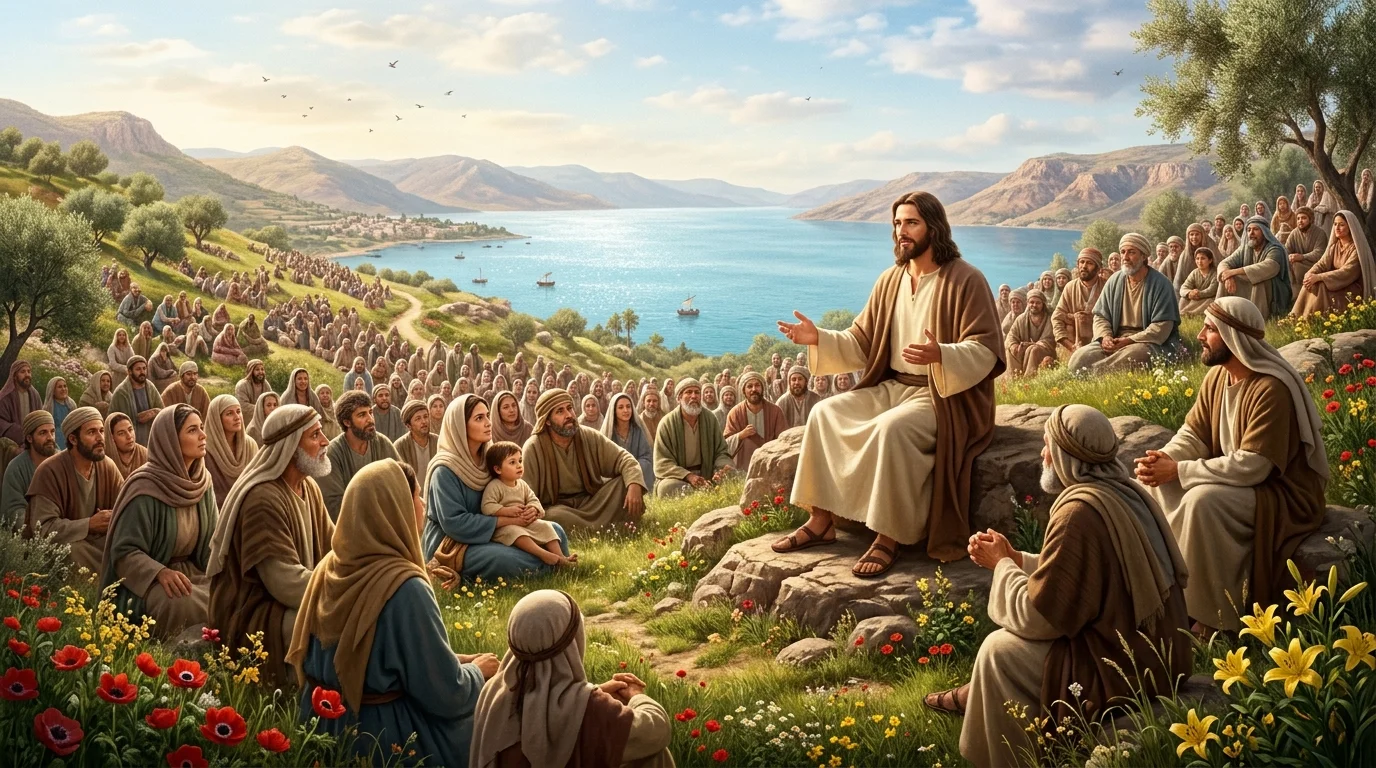
Descending to a natural amphitheater on the mountain slope near Tabgha, Jesus sat down in the traditional rabbinic posture of authoritative teaching. Thousands of pilgrims from Galilee, the Decapolis, Jerusalem, Judea, and beyond the Jordan carpeted the green hillside.
Opening His mouth, Christ unleashed the Eight Beatitudes (Matthew 5:3–12). The world shouts: "Blessed are the wealthy, the ruthless, the powerful, and the proud!" But the King of Heaven inverted every earthly standard:
- "Blessed are the poor in spirit, for theirs is the kingdom of heaven." (v. 3). Not the self-sufficient, but those who recognize their total spiritual bankruptcy before God.
- "Blessed are those who mourn, for they shall be comforted." (v. 4). Those who weep over their sins and the brokenness of the world shall receive the eternal consolation of the Spirit.
- "Blessed are the meek, for they shall inherit the earth." (v. 5). The gentle, whose strength is surrendered under God's control, shall possess the renewed cosmos.
- "Blessed are those who hunger and thirst for righteousness, for they shall be filled." (v. 6). Those whose craving for holiness exceeds their craving for physical bread shall be satisfied to overflowing.
- "Blessed are the merciful, for they shall obtain mercy." (v. 7). Those whose hearts beat with compassionate forgiveness shall receive the boundless grace of God.
- "Blessed are the pure in heart, for they shall see God." (v. 8). Those whose inward motives are undivided and holy shall gaze upon the uncreated glory of the Almighty.
- "Blessed are the peacemakers, for they shall be called sons of God." (v. 9). Those who reconcile broken souls to God and man reflect the very character of their heavenly Father.
- "Blessed are those who are persecuted for righteousness' sake, for theirs is the kingdom of heaven." (v. 10–12). Those insulted, hunted, and slandered for Christ's name share in the noble company of the prophets and great is their reward in heaven!
3. Salt, Light, and The Heart-Level Law
Turning to His disciples, Jesus defined their cosmic purpose: "You are the salt of the earth... You are the light of the world." (Matthew 5:13–14). In the ancient world, salt was the sole preservative against rotting decay. Christians are not called to retreat into isolation, but to penetrate society as moral preservatives, seasoning the earth with truth. Light cannot be hidden; set upon a lampstand, it dispels the suffocating darkness so that men may see their good works and glorify their Father in heaven.
Then, anticipating the accusations of the Pharisees, Jesus declared His relationship to the Old Testament Scriptures:
"Do not think that I came to destroy the Law or the Prophets. I did not come to destroy but to fulfill. For assuredly, I say to you, till heaven and earth pass away, one jot or one tittle will by no means pass from the law till all is fulfilled." (Matthew 5:17–18).
The yod (jot) was the smallest letter in the Hebrew alphabet; the tittle was a tiny pen-stroke distinguishing similar consonants. Not a single microscopic stroke of God’s Word would fail!
Then came the terrifying standard: "Unless your righteousness exceeds the righteousness of the scribes and Pharisees, you will by no means enter the kingdom of heaven." (v. 20). The Pharisees possessed meticulous external righteousness—counting cumin seeds and washing cups. But Christ demanded internal reality!
Across six sweeping antitheses—"You have heard that it was said... BUT I SAY TO YOU"—Jesus penetrated to the root of human sin:
- The Law said, "You shall not murder"; Christ revealed that simmering unrighteous anger and venomous contempt ("Raca!") are heart-murder worthy of judgment (v. 21–22).
- The Law said, "You shall not commit adultery"; Christ revealed that looking at a woman to lust after her is adultery in the heart (v. 27–28).
- He abolished deceitful oaths, demanding crystalline integrity: "Let your 'Yes' be 'Yes', and your 'No', 'No'." (v. 37).
- He dismantled legalistic vengeance (lex talionis: eye for eye), commanding non-retaliation and going the second mile (v. 38–42).
- Finally, He delivered the apex command of kingdom love: "Love your enemies, bless those who curse you, do good to those who hate you, and pray for those who spitefully use you and persecute you, that you may be sons of your Father in heaven!" (v. 44–45). God causes His golden sun to rise upon the evil and the good, and sends His rain upon the just and the unjust. True godliness is active, unconditional love!
4. Secret Devotion & The Pattern of Prayer
In chapter 6, Jesus attacked religious exhibitionism. When giving alms, do not sound a trumpet in the streets; let not your left hand know what your right hand does, and your Father who sees in secret will reward you openly. When fasting, do not disfigure your face with gloomy theater; anoint your head and wash your face so your fast is seen only by God.
When praying, do not babble endless repetitions like the pagans who think they will be heard for their many words. Instead, Jesus delivered the eternal model of communion: The Lord's Prayer (Matthew 6:9–13):
- "Our Father in heaven, hallowed be Your name:" Approaching God with childlike intimacy (Abba) yet reverent awe for His transcendent holiness.
- "Your kingdom come, Your will be done on earth as it is in heaven:" Complete surrender to divine sovereignty before bringing personal requests.
- "Give us this day our daily bread:" Daily dependence on God's faithful physical provision.
- "And forgive us our debts, as we forgive our debtors:" Walking in perpetual grace, releasing all bitterness toward others.
- "And do not lead us into temptation, but deliver us from the evil one:" Pleading for supernatural protection against satanic snares.
- "For Yours is the kingdom and the power and the glory forever. Amen."
5. Banishing Anxiety: Birds of the Air & Lilies of the Field
Looking out across the sun-drenched Galilean hillside, Jesus addressed humanity's universal plague: crippling anxiety over food, clothing, and the future.
Pointing to the sky where falcons and sparrows soared freely, Christ said: "Look at the birds of the air, for they neither sow nor reap nor gather into barns; yet your heavenly Father feeds them. Are you not of more value than they?" (Matthew 6:26). Which of you, by worrying, can add a single cubit to his height?
Then, gesturing toward the scarlet anemones and white lilies blooming amidst the grass, He continued: "Consider the lilies of the field, how they grow: they neither toil nor spin; and yet I say to you that even Solomon in all his glory was not arrayed like one of these!" (v. 28–29). If God so lavishly clothes the fragile wild grass which flourishes today and is cast into the clay oven tomorrow, will He not much more clothe you, O you of little faith?
Jesus unveiled the master key to unshakeable peace: "Therefore do not worry, saying, 'What shall we eat?' or 'What shall we drink?' or 'What shall we wear?' For after all these things the Gentiles seek. For your heavenly Father knows that you need all these things. But seek first the kingdom of God and His righteousness, and all these things shall be added to you!" (Matthew 6:31–33).
6. The Two Foundations: Rock vs. Shifting Sand
In chapter 7, Christ warned against hypocritical, censorious judgment—trying to remove a tiny speck from a brother's eye while ignoring the telephone pole lodged in one's own! He commanded persistent prayer: "Ask, and it will be given to you; seek, and you will find; knock, and it will be opened to you." He gave the Golden Rule: "Whatever you want men to do to you, do also to them."
He warned of the Narrow Gate that leads to life, and the wide highway that leads to destruction. He unmasked false prophets as wolves in sheep’s clothing, known by their fruits. He issued the chilling warning: "Not everyone who says to Me, 'Lord, Lord,' shall enter the kingdom of heaven, but he who does the will of My Father in heaven." (Matthew 7:21).
Then Jesus brought His immortal discourse to a thunderous, unforgettable climax with the Parable of the Two Builders:
"Therefore whoever hears these sayings of Mine, and does them, I will liken him to a wise man who built his house on the rock: and the rain descended, the floods came, and the winds blew and beat on that house; and it did not fall, for it was founded on the rock." (Matthew 7:24–25).
"But everyone who hears these sayings of Mine, and does not do them, will be like a foolish man who built his house on the sand: and the rain descended, the floods came, and the winds blew and beat on that house; and it fell. And great was its fall!" (Matthew 7:26–27).
In the arid ravines (wadis) of Palestine, dry sandy riverbeds look smooth, peaceful, and inviting during the dry summer months. A lazy builder builds quickly on the soft sand without digging down. But when the winter cloudbursts erupt, torrential flash floods roar down the mountain gorge! The foundation of sand is liquefied, and the house collapses into catastrophic ruin! The wise builder digs deep through soil and gravel until he hits solid limestone bedrock (petra), anchoring his structure permanently.
The difference between salvation and destruction is not merely *hearing* the words of Christ; it is *doing* them!
As the final echo of Jesus’ voice died away over the lake, the vast multitude sat in breathless silence. Matthew records the staggering impact:
"And so it was, when Jesus had ended these sayings, that the people were astonished at His teaching, for He taught them as one having authority, and not as the scribes." (Matthew 7:28–29).
He cited no dead rabbis, quoted no human traditions, and offered no legalistic compromises. He spoke as the Lawgiver of Sinai in human flesh, unveiling the eternal heart of God and offering an unshakeable Kingdom that can never be moved!
Ancient Near Eastern & Archaeological Context
First-century Roman Galilee was a hotbed of political rebellion, heavy imperial taxation, and grinding economic despair. The Jewish populace passionately anticipated a military Messiah—a triumphant warrior-king like David or Judas Maccabeus who would raise an army, crush the Roman legions, expel the pagan Gentiles, and restore Israel's geopolitical dominance. In direct contrast to this militaristic nationalism, Jesus delivered the Sermon on the Mount upon a hill overlooking the Sea of Galilee (traditionally identified near Tabgha/Capernaum). Instead of declaring holy war against Rome, Christ declared war on human pride, selfishness, and hypocrisy. He presented a radical counter-cultural kingdom where the poor in spirit are crowned, peacemakers are celebrated, enemies are loved and prayed for, and greatness is measured by humble servant-leadership. The rabbinic teaching style of the era relied strictly on citing ancient authorities ('Rabbi Hillel says... Rabbi Shammai says...'). Jesus stunned the crowds by speaking with sovereign, self-authenticating divine authority ('You have heard that it was said... BUT I SAY TO YOU!'), establishing Himself as the supreme Lawgiver and the Prophet greater than Moses.
Support Independent Biblical Research
Did this study bless you? Help support our independent bilingual research and interactive visual Bible tools.
⚡ Fast Facts
- Luke 6:12 records that Jesus spent the 'entire night in prayer to God' (en tē proseuchē tou Theou) before choosing the Twelve, demonstrating absolute dependence on the Father
- The Twelve Apostles correspond typologically to the twelve sons of Jacob and the twelve tribes of Israel, inaugurating the eschatological New Israel of God
- The Mount of Beatitudes near Tabgha forms a natural acoustic amphitheater where a speaker's voice naturally carries to thousands seated on the grassy slope
- The Greek word 'Makarioi' does not denote superficial emotional happiness, but the objective state of being divinely congratulated and sharing in God's eternal joy
❓ Frequently Asked Questions (FAQs)
Jesus deliberately chose unlettered fishermen, a despised tax collector, and a political zealot rather than elite Jerusalem scribes or aristocratic priests to demonstrate that the power of the Gospel belongs entirely to God (1 Cor 1:26–29). Their diversity proved the reconciling power of the Kingdom, and their lack of rabbinic prestige ensured that all glory for the transformation of the Roman Empire would be attributed to the Holy Spirit.
In Matthew 5:17, Jesus declared He came not to destroy the Law, but to fulfill it ('plērōsai'). The Mosaic Law condemned external actions (murder, physical adultery); Jesus penetrated to the internal heart motivations behind those actions, revealing that unrighteous anger is heart-murder and lustful intent is heart-adultery. Christ magnified the Law to its ultimate divine standard, showing humanity's desperate need for a Savior, and then satisfied that standard through His own sinless obedience and atoning cross.
Jesus concluded the Sermon on the Mount by contrasting the wise builder who dug deep and founded his house upon the bedrock ('petra') with the foolish builder who built upon shifting sand. Both houses experienced identical violent rainstorms, flash floods, and hurricane winds. The distinction lay entirely in their foundation: hearing Christ's words and putting them into obedient practice builds an indestructible life that survives the storms of trials, death, and final divine judgment.