The story of King Josiah and the rediscovery of the Book of the Law is one of the most powerful revivals in human history. Rising to power in a nation deeply polluted by half a century of witchcraft, child sacrifice, and rampant idolatry, this young king proved that a single heart fully surrendered to the Word of God can ignite a national revolution. His deep brokenness upon hearing the long-forgotten Scriptures sparked the most comprehensive biblical reformation the ancient world had ever witnessed.
1. The Boy King Who Sought the God of David
The decades preceding Josiah were the darkest in the history of Judah. King Manasseh, Hezekiah's wicked son, had reigned for fifty-five years, filling Jerusalem with innocent blood, erecting altars to Baal in the Temple courts, practicing black magic, and burning his own children in the fires of Molech in the Valley of Hinnom. Manasseh's son Amon continued this evil until he was assassinated by his own servants. Amid this moral wreckage, eight-year-old Josiah was crowned King of Judah.
Despite growing up surrounded by pagan decadence, young Josiah possessed a tender, searching heart. In the eighth year of his reign, while he was still a sixteen-year-old youth, he began to seek the God of his ancestor David with genuine passion. By the age of twenty, he initiated an aggressive campaign across Judah and Jerusalem, smashing carved idols, chopping down Asherah poles, and grinding pagan incense altars into dust.
In his eighteenth year as king, at age twenty-six, Josiah turned his attention to the dilapidated condition of Solomon's Temple. For decades, the sacred sanctuary had been neglected, vandalized, and used for idolatrous rituals. Josiah sent his royal secretary Shaphan to Hilkiah the High Priest with orders to collect the silver contributed by worshippers at the Temple doors and hire carpenters, builders, and masons to purchase timber and dressed stone to repair the house of the Lord.
2. The Astonishing Discovery in the Temple Rubble
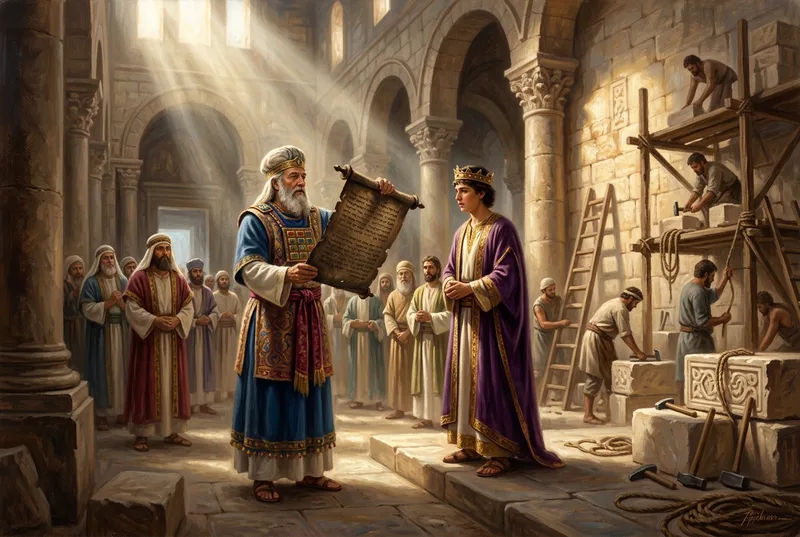
High Priest Hilkiah discovered the long-lost scroll of the Law of Moses amid the debris of the Temple restoration, presenting it to King Josiah.
As the workmen cleared out decades of accumulated debris, broken masonry, and cobwebs from the dark storage rooms and secret chambers of the Temple, Hilkiah the High Priest stumbled upon a treasure infinitely more valuable than gold. Hidden away—likely concealed by faithful priests during Manasseh's purges to protect it from destruction—lay an ancient parchment scroll. Hilkiah unrolled it with trembling hands and recognized the sacred Hebrew script.
Excited, Hilkiah hurried to Shaphan the royal secretary and declared: "I have found the Book of the Law in the Temple of the Lord!" Hilkiah handed the scroll to Shaphan, who read it and immediately recognized it as the foundational Torah—the Law of Moses, specifically the Book of Deuteronomy.
Shaphan rushed back to the royal palace to give his progress report to the king. After reporting that the silver had been paid to the craftsmen, Shaphan added: "Hilkiah the priest has given me a scroll." And there, in the presence of King Josiah, Shaphan unrolled the parchment and began to read aloud the words of the living God.
3. Tearing of the Royal Robes and the Prophetess Huldah
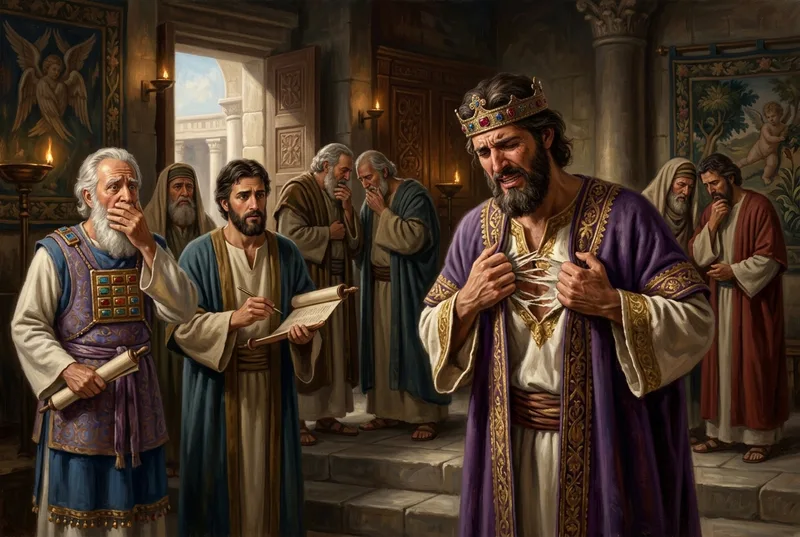 Hearing the severe warnings and covenant curses written in the Law, King Josiah tore his royal robes in deep anguish and broken repentance.
As Josiah listened to the holy requirements of God, the beauty of the covenant, and the terrifying curses pronounced upon a generation that abandoned Yahweh to worship idols (Deuteronomy 28), the weight of national guilt crushed his soul. He realized that his ancestors had systematically violated every single commandment of God, storing up wrath against the kingdom. Overcome with grief and conviction, King Josiah seized his royal purple robes and tore them in two!
Weeping in broken repentance, the king issued an urgent command to Hilkiah, Shaphan, and his chief counselors: "Go and inquire of the Lord for me and for the people and for all Judah about what is written in this scroll that has been found! Great is the Lord's anger that burns against us because those who have gone before us have not obeyed the words of this scroll!"
The royal delegation sought out Huldah the prophetess, who lived in the Second District of Jerusalem. Huldah delivered the uncompromised word of Yahweh: God's wrath would indeed be poured out upon Jerusalem because of their persistent idolatry, and it would not be quenched. But concerning the young king, God spoke words of tender comfort:
"Because your heart was responsive and you humbled yourself before the Lord when you heard what I spoke against this place... and because you tore your robes and wept in my presence, I also have heard you, declares the Lord. Therefore I will gather you to your ancestors in peace. Your eyes will not see all the disaster I am going to bring on this place."
4. The National Covenant Renewal and Total Purge of Idols
Armed with the Word of God, Josiah summoned all the elders of Judah, the priests, the prophets, and all the citizens of Jerusalem, from the youngest to the oldest, to the Temple courtyards. Standing by the royal pillar, King Josiah personally read aloud in their hearing every word of the Book of the Covenant. The king then made a solemn covenant before Yahweh—to follow the Lord, obey His commands, regulations, and decrees with all his heart and all his soul, and to perform the words of the covenant written in this book. And all the people pledged themselves to the covenant.
Then began the most radical, thorough spiritual cleansing in biblical history. Josiah commanded Hilkiah to remove from the Temple all articles made for Baal, Asherah, and the starry hosts, burning them outside Jerusalem in the fields of the Kidron Valley and scattering their dust over common graves. He tore down the quarters of the male shrine prostitutes within the Temple precincts. He desecrated Topheth in the Valley of Hinnom so no one could ever sacrifice their son or daughter to Molech again. He removed the royal horses dedicated to the sun god and burned the chariots of the sun with fire.
Josiah then marched north to Bethel, tearing down the ancient golden calf altar that Jeroboam had built three centuries earlier, smashing it to dust and burning human bones upon it—fulfilling the exact 300-year-old prophecy of 1 Kings 13:2 that a king named Josiah would defile Jeroboam's altar. Finally, Josiah reinstituted the Passover of the Lord with such perfection, reverence, and joy that Scripture records: "The Passover had not been observed like this in Israel since the days of the prophet Samuel, nor had any of the kings of Israel observed such a Passover!"
The Holy Spirit's final verdict on King Josiah in 2 Kings 23:25 remains unequaled: "Neither before nor after Josiah was there a king like him who turned to the Lord as he did—with all his heart and with all his soul and with all his strength, in accordance with all the Law of Moses." Josiah's life proves that when the Word of God is rediscovered and obeyed with a broken, humble heart, it possesses the power to revive dead souls and transform nations.
Reflections on the Story:
- The Danger of Losing God's Word: The Book of the Law was lost inside God's own Temple. We must beware of maintaining religious buildings, rituals, and programs while neglecting the actual study, preaching, and obedience of Scripture.
- The Mark of True Repentance: When Josiah heard God's Word, he did not make excuses or debate theological technicalities; he tore his clothes, wept, and immediately aligned his life and kingdom with God's commands.
- A Responsive Heart is Precious to God: God told Josiah, "Because your heart was responsive and you humbled yourself... I have heard you." God is drawn to hearts that tremble at His Word (Isaiah 66:2).
- Wholehearted Devotion (The Shema in Action): Josiah fulfilled the great commandment—loving God with all his heart, soul, and strength. Our revival must never be half-hearted; it demands the complete eradication of idols in our lives.
⚡ Fast Facts
- Boy King: Josiah began reigning at age 8 and sought the God of his ancestor David at age 16.
- The Temple Discovery: High Priest Hilkiah found the scroll of the Law hidden amid temple rubble in 622 BC.
- Tearing of Robes: Hearing the curses written in Deuteronomy against disobedience, Josiah tore his clothes in grief.
- Prophetess Huldah: Huldah prophesied that judgment would fall on Judah, but Josiah would be spared because of his humble heart.
❓ Frequently Asked Questions (FAQs)
During the 55-year reign of wicked King Manasseh and his son Amon, pagan idols and altars were placed directly inside the Temple, the copies of Scripture were neglected, banned, or hidden by faithful priests to protect them from destruction, leading to widespread biblical illiteracy.
Josiah burned all vessels made for Baal and Asherah, tore down the quarters of male shrine prostitutes, desecrated Topheth in the Valley of Hinnom to end child sacrifice, smashed the golden calf altar at Bethel (fulfilling a 300-year-old prophecy from 1 Kings 13:2), and celebrated a glorious Passover.
2 Kings 23:25 gives the highest praise: 'Neither before nor after Josiah was there a king like him who turned to the Lord as he did—with all his heart and with all his soul and with all his strength, in accordance with all the Law of Moses.'