
The story of King Hezekiah's illness and miraculous recovery is one of the most intimate encounters with the power of prayer in the Old Testament. Facing an imminent death sentence in the prime of his life, Hezekiah did not consult astrologers or resign himself to fate; he turned his face to the wall and poured out his heart to Yahweh. In response, God not only reversed the terminal diagnosis and granted him fifteen additional years, but also bent the laws of nature itself, moving the shadow of the sun backward as a cosmic guarantee of His healing promise.
1. The Sentence of Death and the Tearful Prayer
Shortly around the time of the Assyrian invasion, at approximately thirty-nine years of age, King Hezekiah fell critically ill. A malignant, inflamed boil (ulcer) spread across his body, poisoning his bloodstream and causing agonizing fever. The royal physicians were helpless; the infection was terminal. While the king lay suffering in his palace bedchamber, the revered prophet Isaiah son of Amoz entered the room. But Isaiah did not bring words of comfort. He spoke the direct, crushing decree of the Almighty:
"This is what the Lord says: Put your house in order, because you are going to die; you will not recover!"
Having delivered the devastating message, Isaiah turned and walked out of the bedchamber. For a monarch at the height of his influence, with no royal heir yet born to carry on the Davidic line, this pronouncement was an absolute catastrophe. Yet Hezekiah did not lash out in anger or surrender to despair. He knew that the God who commands the universe is also a God of unfathomable mercy. Hezekiah turned his face toward the stone wall, away from his attendants and royal counselors, and wept bitterly as he prayed:
"Remember, Lord, how I have walked before you faithfully and with wholehearted devotion and have done what is good in your eyes!"
His prayer was short, raw, and saturated with sincere tears. Hezekiah did not claim sinless perfection, but he appealed to the integrity of his heart—how he had destroyed the idols, opened the Temple, and trusted Yahweh when the armies of Sennacherib threatened Jerusalem.
2. The Instant Turnaround and the Promise of Fifteen Years
The response of heaven was astonishingly swift. Before Isaiah had even walked across the middle courtyard of the royal palace complex, the word of the Lord came rushing to him again: "Go back and tell Hezekiah, the ruler of my people: 'This is what the Lord, the God of your father David, says: I have heard your prayer and seen your tears; I will heal you! On the third day from now you will go up to the Temple of the Lord. I will add fifteen years to your life. And I will deliver you and this city from the hand of the king of Assyria. I will defend this city for my sake and for the sake of my servant David.'"
Isaiah immediately hurried back into the bedchamber. Imagine the astonishment of the dying king when the prophet who had just pronounced his funeral rites returned moments later with a promise of life, health, and fifteen additional years! God demonstrated that while His sovereign decrees stand firm, genuine heartfelt tears and humble prayer can unlock the boundless reservoirs of divine mercy.
To initiate the healing process, Isaiah commanded: "Prepare a poultice of figs." The attendants took a cake of pressed, dried figs and placed it directly over the inflamed, toxic boil. God chose to work through natural medical means, sanctifying the poultice so that the poison was drawn out and the ulcer began to close.
3. The Cosmic Sign on the Sundial of Ahaz
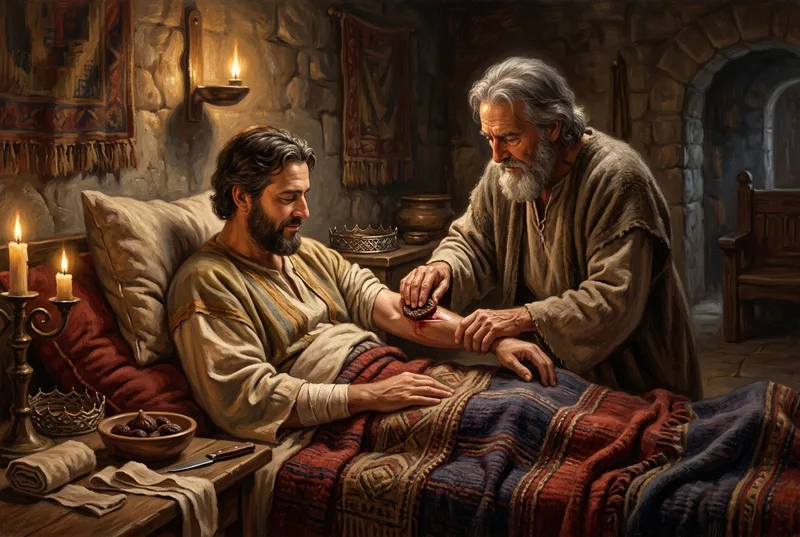 Isaiah applied a poultice of pressed figs to the inflamed boil, as God used both medicine and miracle to restore King Hezekiah.
Weak and overwhelmed by the magnitude of the promise, Hezekiah asked Isaiah for a confirmation: "What will be the sign that the Lord will heal me and that I will go up to the Temple of the Lord on the third day?"
Isaiah presented him with an extraordinary divine choice: "This is the Lord's sign to you that the Lord will do what he has promised: Shall the shadow go forward ten steps, or shall it go back ten steps?"
In the palace courtyard stood the stairway (sundial) of King Ahaz, an architectural stone staircase designed with steps that measured the passage of the sun throughout the day. Hezekiah reasoned, "It is a simple matter for the shadow to go forward ten steps; rather, have it go back ten steps!" To push the shadow forward would merely mimic the natural passage of time, but to reverse the shadow would require the sovereign disruption of the cosmos itself.
Then the prophet Isaiah cried out to the Lord in faith. And Yahweh answered with an astounding cosmic wonder: the shadow cast by the sun on the stairway of Ahaz visibly moved backward by ten full steps! The celestial clock was reversed by the hand of the Creator. As Hezekiah watched from his balcony, the light shifted backward, sealing the truth that the God who controls the planetary orbits holds the days of human life in His hands.
4. Recovery, Praise, and the Warning of Pride
On the third day, exactly as promised, the fever broke, the boil was cleansed, and King Hezekiah walked up the steps of Solomon's Temple to offer thanksgiving sacrifices. He composed a famous hymn of praise, recorded in Isaiah 38: "The living, the living—they praise you, as I am doing today; parents tell their children about your faithfulness. The Lord will save me, and we will sing with stringed instruments all the days of our lives in the Temple of the Lord."
Yet this glorious story carries a sobering footnote. Soon after his recovery, envoys from Merodach-Baladan, prince of Babylon, arrived with letters and a gift, having heard of his illness and the miraculous celestial sign. Flattered by the attention of a rising world power, Hezekiah let down his guard. In a moment of pride, he showed the Babylonian ambassadors everything in his storehouses—the silver, gold, spices, fine olive oil, armory, and everything found among his treasures. He failed to give glory to God or point them to the Lord who had saved him.
Isaiah came to Hezekiah and confronted him: "Hear the word of the Lord Almighty: The time will surely come when everything in your palace, and all that your predecessors have stored up until this day, will be carried off to Babylon. Nothing will be left! And some of your descendants will be taken away and become eunuchs in the palace of the king of Babylon." The story of Hezekiah's recovery remains a timeless lesson: God is deeply moved by our prayers and tears, but we must steward our seasons of blessing and answered prayer with enduring humility and vigilance.
Reflections on the Story:
- The Power of Tears in Prayer: God said to Hezekiah, "I have heard your prayer and seen your tears." God does not merely listen to our formulated words; He sees our deepest emotional aches and values our brokenness.
- God Uses Both Medicine and Miracles: Isaiah applied a poultice of figs alongside the supernatural miracle. We should never despise practical medical treatment while trusting God as the ultimate healer.
- God is Lord Over Time and Nature: The sundial shadow moving backward proves that God is not bound by natural laws. He is the author of time, capable of redeeming wasted years and restoring our strength.
- Guard Your Heart After the Breakthrough: Spiritual breakthroughs and answered prayers are often followed by subtle temptations of pride. When God elevates us and heals us, we must point all glory back to Him.
⚡ Fast Facts
- The Death Sentence: Isaiah initially announced that Hezekiah's terminal illness would claim his life.
- Tearful Prayer: Hezekiah turned his face to the wall and wept bitterly, appealing to his walk of integrity before God.
- Fifteen Years Added: Before Isaiah even left the middle court, God commanded him to return with the promise of 15 more years.
- The Cosmic Sign: The shadow cast by the sun on the stairway/sundial of Ahaz miraculously retreated backward ten steps.
❓ Frequently Asked Questions (FAQs)
Isaiah's initial prophetic announcement revealed the natural trajectory of Hezekiah's fatal disease. However, biblical prophecies of judgment or death often carry an implicit call to repentance and prayer. In response to heartfelt, humble intercession, God graciously extended His mercy.
Isaiah instructed the king's attendants to prepare a cake of pressed figs (a poultice) and apply it directly to the inflamed boil or ulcer. God utilized this natural poultice as the physical instrument through which divine healing was imparted.
When envoys from Merodach-Baladan of Babylon arrived with letters and gifts to congratulate him on his recovery, Hezekiah's pride led him to show them all his royal treasures and armory. Isaiah prophesied that Babylon would one day carry all those treasures and his descendants into exile.