The sixth chapter of the book of Isaiah stands as one of the most majestic and spiritually profound passages in all of world literature. It records the dramatic transformation of a young aristocrat into the prince of Old Testament prophets. In a moment of national anxiety and mourning, Isaiah was granted a glimpse behind the veil of eternity, standing in the throne room of the cosmos where the absolute holiness of God was unveiled. It is an encounter that moves from crushing conviction to supernatural cleansing, culminating in an unreserved surrender to the divine mission.
1. The Throne Room of the Sovereign King
The historical backdrop of this vision was a time of deep national grief and political instability. For fifty-two years, King Uzziah had governed Judah with remarkable wisdom, expanding the borders, fortifying Jerusalem's towers, and developing a formidable military machine. For generations of citizens, Uzziah was the only monarch they had ever known. But Uzziah succumbed to pride, unlawfully entered the Temple to burn incense, was struck with leprosy, and finally died in isolation in 740 BC. With the throne of David suddenly empty and the ruthless Assyrian Empire expanding westward, the future of Judah hung in the balance.
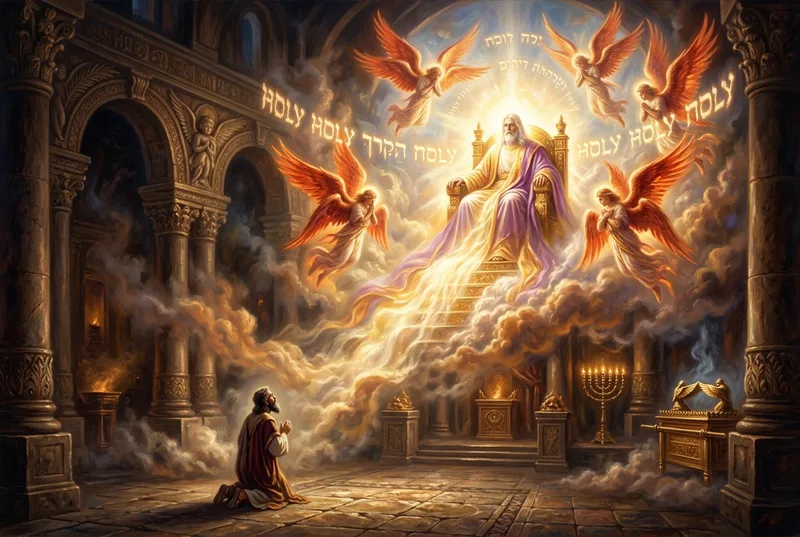
In that pivotal year of crisis, Isaiah entered the Temple in Jerusalem. Suddenly, the earthly stone colonnades dissolved into a breathtaking cosmic reality: "I saw the Lord, high and exalted, seated on a throne; and the train of his robe filled the temple!" Isaiah realized that while an earthly king had died, the true Sovereign Ruler of the universe was alive, reigning in absolute majesty, undisturbed by the geopolitical chaos of earth. The hem of Yahweh's royal robe was so vast, magnificent, and luminous that it completely flooded the heavenly sanctuary with radiant glory.
Hovering above the throne were the Seraphim—celestial beings whose Hebrew name literally means 'burning ones'. Each seraph possessed six wings: with two wings they covered their faces in reverent humility before the blinding radiance of God's purity; with two wings they covered their feet in creaturely modesty; and with two wings they flew, ready to execute divine commands at the speed of thought. As they flew, they called to one another in an eternal, antiphonal chant that shook the cosmos:
"Holy, holy, holy is the Lord Almighty; the whole earth is full of his glory!"
In Hebrew, repetition indicates intensity; repeating a word three times (the Trisagion) is the ultimate superlative. God is not merely holy; He is the absolute perfection of holiness, distinct from all creation. At the sound of the angelic voices, the heavy stone doorposts and threshold foundations shook violently, and the entire Temple was filled with thick, fragrant clouds of holy smoke.
2. The Cry of Brokenness: 'Woe to Me!'
Confronted with the raw, blinding perfection of God's holiness, Isaiah did not feel proud or privileged. He felt completely undone. In an instant, all human self-righteousness, moral comparison, and aristocratic pride vaporized. In the blazing light of divine purity, Isaiah saw the deep corruption of his own human nature. Believing he was about to be incinerated by holy justice, he cried out in agonizing brokenness:
"Woe to me! I am ruined! For I am a man of unclean lips, and I live among a people of unclean lips, and my eyes have seen the King, the Lord Almighty!"
Isaiah specifically identified his lips because the mouth is the direct overflow of the human heart (Matthew 12:34). In a culture polluted by deceit, gossip, idolatrous oaths, and blasphemy, Isaiah realized that even his best words were tainted. True revival always begins with this profound crisis of conviction—when an individual sees God as He truly is, sees themselves as they truly are, and abandons all self-justification.
3. The Burning Coal from the Altar
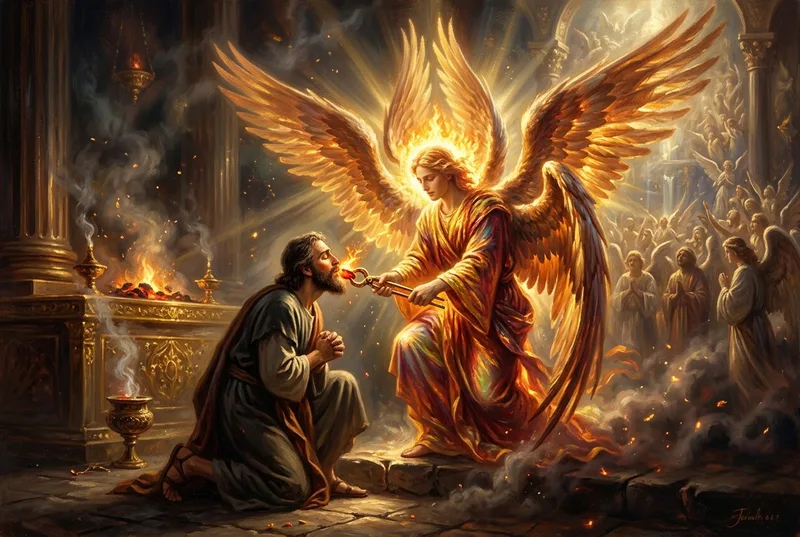 A radiant Seraph took a burning coal with tongs from the altar and touched Isaiah's lips, purging his guilt and cleansing his sin.
God did not leave His broken servant in despair. Grace immediately responded to genuine repentance. One of the radiant Seraphim flew to the golden heavenly altar, where the sacred fire burned perpetually. Using golden tongs because the coal was too sacred and hot for even an angelic being to touch with bare hands, the Seraph flew swiftly down to where Isaiah was kneeling on his face.
The angel brought the glowing, fiery coal to Isaiah's mouth and touched his trembling lips. Then the Seraph spoke words of supernatural absolution: "See, this has touched your lips; your guilt is taken away and your sin atoned for!"
The fire of the altar did not burn Isaiah to ashes; it burned away his impurities. The burning coal symbolized the holy fire of atonement—the sacrifice that cleanses what human effort can never purify. In an instant, Isaiah's guilt was removed, his condemnation vanished, and his mouth was consecrated as a holy instrument for divine proclamation. Sanctification had preceded commission.
4. The Divine Commission: 'Here Am I. Send Me!'
With his sins forgiven and his heart purified, Isaiah could now hear the heartbeat of God. For the first time in the narrative, the Lord Himself spoke. God did not issue a rigid command or force conscription; He asked a question that resonated through the heavenly courts:
"Whom shall I send? And who will go for us?"
The plural pronoun ('for us') pointed to the majestic counsel of the triune Godhead. Without a moment's hesitation, without asking where he would be sent, what the compensation would be, or how difficult the task would prove, the cleansed prophet leapt to his feet and responded with immortal surrender:
"Here am I. Send me!" (Isaiah 6:8)
God then gave Isaiah his commission—a sober and difficult prophetic calling. Isaiah was told to preach to a spiritually blind and deaf generation whose hearts had grown callous through rebellion. He would minister through the reigns of four kings (Uzziah, Jotham, Ahaz, Hezekiah), warning of exile and devastation, but also penning the most glorious messianic prophecies in human history: foretelling the Virgin birth (Isaiah 7:14), the Wonderful Counselor and Prince of Peace (Isaiah 9:6), and the Suffering Servant who was pierced for our transgressions (Isaiah 53). Isaiah's encounter remains the ultimate blueprint of Christian calling: seeing the King, being cleansed by the fire of grace, and saying 'yes' to His global mission.
Reflections on the Story:
- Earthly Thrones Shake, God's Throne Remains: When earthly leaders die, political systems destabilize, or personal security collapses, we can rest in the truth that the Lord Almighty remains seated in unshakeable majesty on His throne.
- The Absolute Holiness of God: We must recover a reverent awe of God's holiness. Before we can appreciate the sweetness of divine grace, we must see the breathtaking majesty of His purity.
- Cleansing Before Calling: God did not commission Isaiah while he was unclean. True spiritual ministry requires personal holiness, repentance, and the cleansing fire of God's Word and Spirit.
- Total Availability: Isaiah did not ask for details before saying 'yes'. Once we have experienced the radical forgiveness of God, the only natural response is total, unconditional availability: "Here am I. Send me!"
⚡ Fast Facts
- The Death of Uzziah: The vision occurred in 740 BC, a time of political uncertainty following King Uzziah's 52-year reign.
- The Seraphim: Heavenly burning beings with six wings—two covering their faces, two covering their feet, and two flying.
- The Trisagion: The seraphim sang the three-fold declaration of holiness: 'Holy, Holy, Holy is the Lord Almighty; the whole earth is full of his glory!'
- The Burning Coal: An altar coal touched Isaiah's lips, symbolizing the purging of sin and the purification required for divine ministry.
❓ Frequently Asked Questions (FAQs)
King Uzziah had reigned for 52 years of great stability and prosperity. His death left the nation anxious about the future and vulnerable to the rising Assyrian empire. God revealed to Isaiah that while earthly kings die, the true sovereign King of Kings remains eternally on His throne.
In ancient Jewish thought, seeing the holy God directly would result in immediate death. Exposed to the blinding, absolute purity and holiness of God, Isaiah instantly realized the profound depth of his own moral uncleanness and the corrupt speech of his nation.
God warned Isaiah that his ministry would be exceptionally hard: he would preach to a people whose hearts were callous, whose ears were dull, and whose eyes were closed, ministering until cities lay ruined and the land was utterly desolate, preserving only a holy seed remnant.