For twenty agonizing years, the dark shadow of Canaanite oppression suffocated the northern tribes of Israel. Following the death of Ehud, the children of Israel had once again relapsed into spiritual compromise and idolatry, provoking the covenant discipline of Yahweh. The Lord delivered them into the ruthless iron fist of Jabin, king of Canaan, who reigned from the fortified acropolis of Hazor. Jabin's power was personified in his merciless supreme commander, Sisera, who held court at Harosheth-Haggoyim. Sisera struck paralyzing terror into Hebrew villages with an unprecedented technological war machine: nine hundred scythe-wheeled war chariots of iron (*rekhev barzel*). The highways were deserted; commerce collapsed; Hebrew villagers abandoned their farms to huddle in mountain caves. Israel was completely disarmed: "Not a shield or spear was seen among forty thousand in Israel" (Judges 5:8).
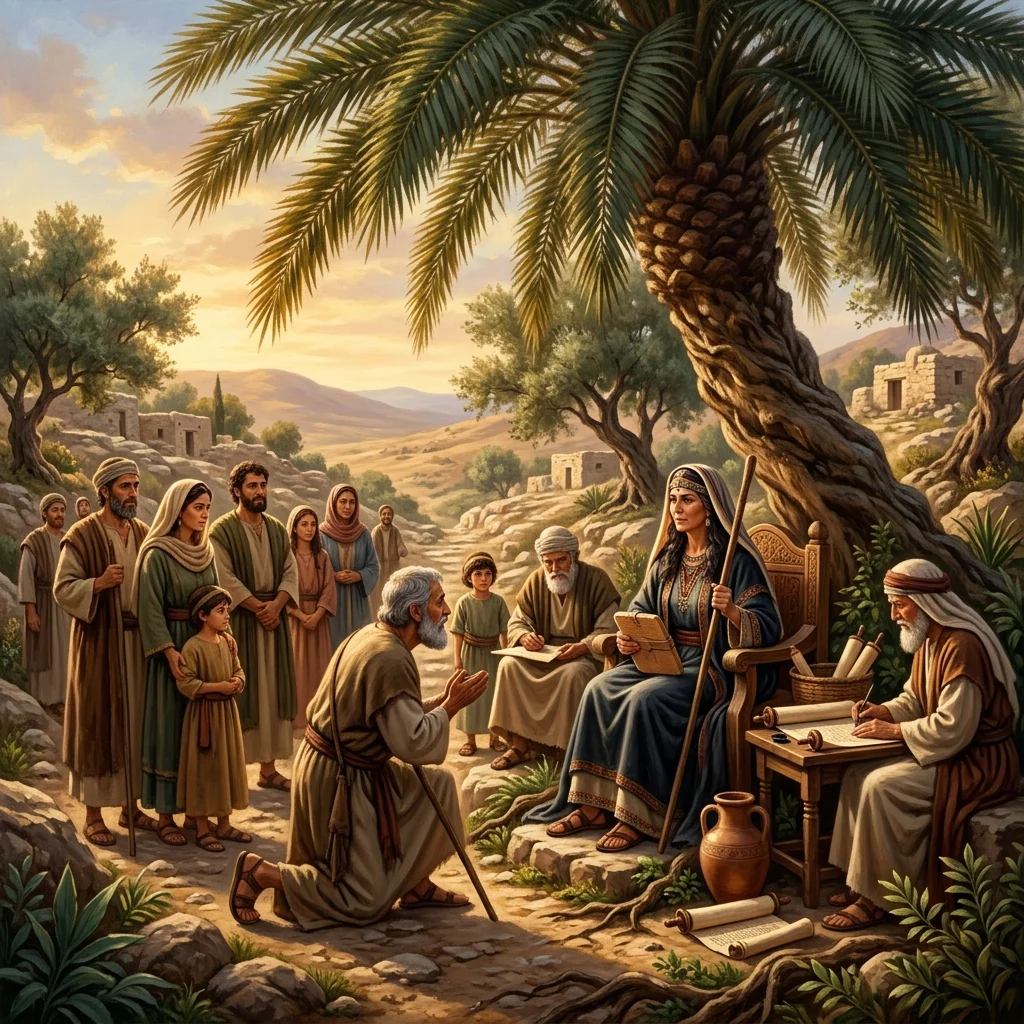
In the depth of their desperation, the children of Israel cried out to Yahweh. Heaven's response was neither an imperial army nor a seasoned warlord; rather, God raised up an extraordinary woman: Deborah, the wife of Lappidoth. Deborah was a prophetess (*neviah*) who walked in profound, unbroken communion with the living God. She exercised judicial leadership over Israel, not by dynastic inheritance or physical force, but by the undeniable moral authority of divine wisdom. Beneath a famous date palm between Ramah and Bethel in the rugged hill country of Ephraim, the 'Palm of Deborah' became the supreme supreme court of the nation, where Hebrews from every territory climbed the mountains to seek her inspired counsel and righteous arbitration.
One fateful morning, the Spirit of God stirred Deborah with an electrifying military revelation. Summoning Barak, the son of Abinoam, from Kedesh in the territory of Naphtali, she issued a divine command that defied human military logic: "Has not Yahweh God of Israel commanded: 'Go and deploy troops at Mount Tabor; take with you ten thousand men of the sons of Naphtali and of the sons of Zebulun; and against you I will deploy Sisera, the commander of Jabin's army, with his chariots and his multitude at the River Kishon; and I will deliver him into your hand'?" (Judges 4:6-7).
Barak looked at the prophetess with a mixture of awe and realistic dread. Mount Tabor was a massive limestone dome rising eighteen hundred feet abruptly from the flat floor of the Jezreel Valley. It provided impenetrable sanctuary for light infantry, but the moment Hebrew soldiers descended into the valley floor, Sisera's nine hundred scythe-chariots would shred them to pieces like wheat beneath a thresher. Recognizing that only the direct tangible presence of God could conquer such terrifying technology, Barak replied with an ultimatum of his own: "If you will go with me, then I will go; but if you will not go with me, I will not go!" (Judges 4:8).
Deborah did not flinch, but she delivered a stinging prophetic qualifier: "I will surely go with you; nevertheless, there will be no glory for you on the journey you are taking, for Yahweh will sell Sisera into the hand of a woman!" (Judges 4:9). Barak consented. Leaving her palm tree, Deborah marched north beside Barak to Kedesh, where ten thousand resolute volunteers from the tribes of Naphtali and Zebulun answered the trumpet call, climbing the forested slopes to take their stand upon the heights of Mount Tabor.
Word of the Hebrew mobilization flashed across Canaan. Sisera reacted with instantaneous arrogance. Marshaling his entire mechanized host—nine hundred iron chariots accompanied by tens of thousands of armored Canaanite infantry—Sisera marched out from Harosheth-Haggoyim into the broad Plain of Megiddo, deploying along the banks of the winding River Kishon (*Nachal Qishon*). To Sisera's tactical eye, the Hebrews were helpless bait trapped on a mountain. When they were starved out or forced down, his thundering iron squadrons would run them down in the open fields.
Then arrived the divine moment of destiny. As the Canaanite chariots glinted menacingly in the morning heat along the riverbank, Deborah turned to Barak with burning eyes and uttered the battle cry of the ages: "Up! For this is the day in which Yahweh has delivered Sisera into your hand! Has not Yahweh gone out before you?" (Judges 4:14).
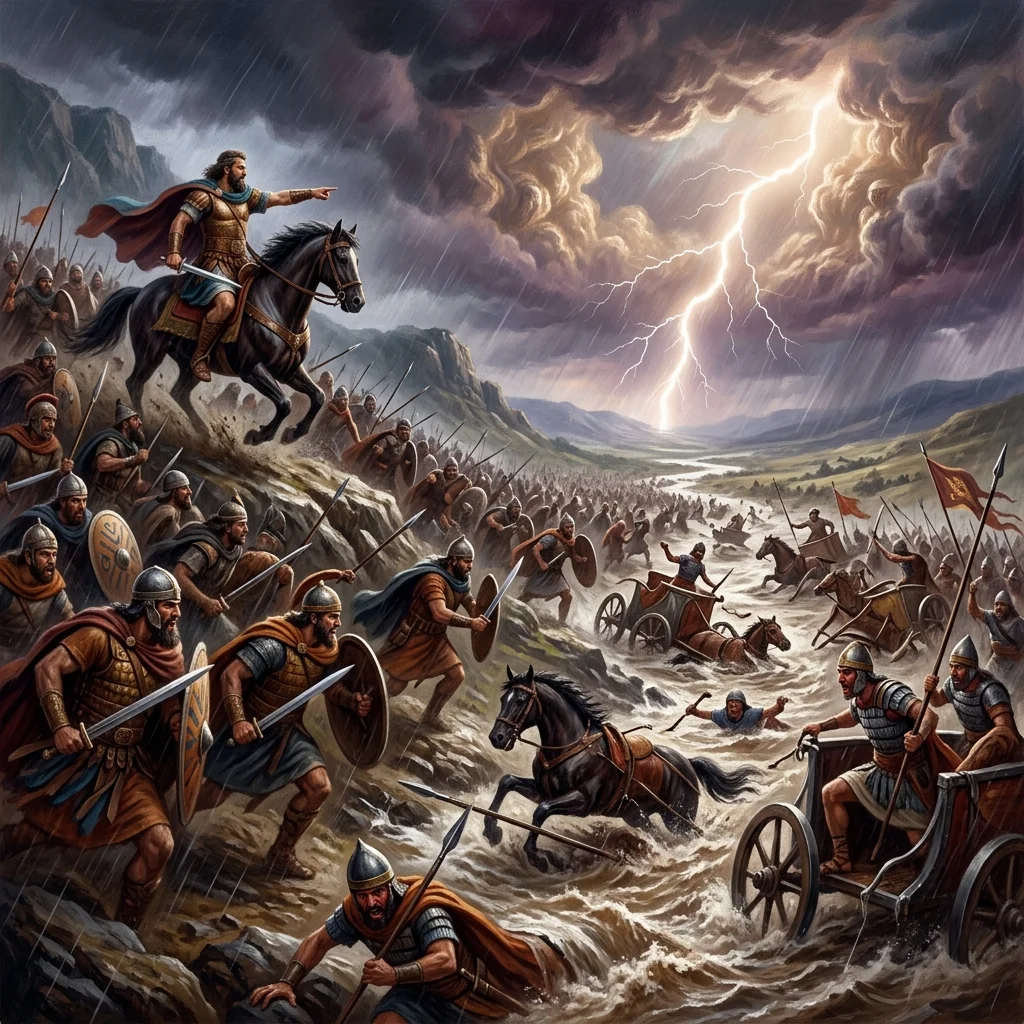
Trusting in the unseen God, Barak unleashed his ten thousand infantry. Like a mountain avalanche, the lightly armed Hebrews charged down the steep slopes of Mount Tabor straight toward the fearsome Canaanite lines! To Sisera, it appeared to be suicidal madness. He ordered his nine hundred chariots forward into the charge, their scythes whirring and hooves pounding the earth.
Suddenly, the Lord of Hosts unleashed heaven's cosmic artillery! The sky darkened to ominous bruised purple; violent thunder shook the very foundations of the valley, and a catastrophic Mediterranean cloudburst exploded directly over the watershed of Mount Tabor and the Carmel range (Judges 5:4, 20-21). Torrents of water cascaded off the ridges into the twisting bed of the Kishon. Within minutes, the dry riverbed turned into a raging, overflowing flash flood, transforming the alluvial vertisol clay plains of Megiddo into an ocean of deep, sucking mud!
The nine hundred iron chariots—the pride of Canaanite military power—became useless iron coffins. The heavy iron-rimmed wheels sank to their axles in the quagmire; panicked chariot horses slipped, fractured legs, and overturned their drivers into the churning mud. The technological superiority of Canaan was annihilated in minutes by the finger of God! As the Canaanite lines collapsed into screaming pandemonium, Barak's agile infantry descended upon them with the sword. The Kishon swept away thousands of drowning soldiers; not a single Canaanite warrior escaped.
Seeing his army obliterated, Sisera leaped from his immobilized royal chariot and fled on foot in sheer panic toward the northeast. Running for miles across the rugged scrubland, exhausted and gasping for breath, he stumbled upon the encampment of Heber the Kenite near Kedesh. Standing at the entrance of a nomadic tent was Jael, Heber's wife. Recognizing the terrified general, Jael stepped out and offered shelter: "Turn aside, my lord, turn aside to me; do not fear!" (Judges 4:18).
Sisera slipped inside the dark tent. Trembling from exhaustion and shock, he begged for a sip of water. Jael opened a skin of fermented curdled milk (*hem'ah*), giving him a rich, soothing drink, and covered him with a heavy rug. Thinking he had found absolute sanctuary, Sisera commanded her: "Stand at the door of the tent, and if any man comes and inquires of you, saying, 'Is there any man here?' you shall say, 'No!'" Overcome by the soporific milk and sheer physical exhaustion, the Canaanite commander fell into a dead sleep.
Then Jael acted with cold, heroic resolve. Creeping silently across the tent rug, she seized a sharp wooden tent peg (*yated*) and a heavy wooden mallet used by nomadic women to erect their goat-hair shelters. Kneeling over the slumbering warlord, she placed the sharp point of the peg against his temple and struck the mallet with all her might! The stake pierced through his skull and drove deep into the earthen floor. Sisera shuddered once and died.
Minutes later, Barak arrived in hot pursuit, his sword drawn. Jael stepped out of the tent to meet him: "Come, and I will show you the man whom you seek!" Entering the tent, Barak beheld the surreal sight: Sisera, the terror of twenty years, lay dead with a tent peg driven through his temples. The prophecy of Deborah had reached its exact, humiliating fulfillment: Yahweh had sold Sisera into the hand of a woman!
That very day, Deborah and Barak lifted their voices in the immortal victory canticle of Judges 5—an archaic hymn of cosmic celebration praising Yahweh, exalting the courage of the volunteer tribes, and concluding with the glorious kingdom benediction: "Thus let all Your enemies perish, O Yahweh! But let those who love Him be like the sun when it comes out in full strength!" (Judges 5:31). Israel had rest for forty years under the sheltering hand of God.
Biblical Keywords & Theological Roots
Judge (deliverer, ruler, arbiter of justice) and Prophetess (divinely inspired spokesperson of Yahweh). Deborah combined judicial discernment with direct charismatic prophetic revelation.
Chariots of iron; advanced heavy Canaanite war chariots clad or fitted with iron fittings and scythes, representing the apex of Late Bronze Age military intimidation.
The River / Torrent Kishon; the twisting seasonal wadi draining the Jezreel Valley into the Bay of Haifa. Renowned for turning flat valleys into impassable quagmires during flash floods.
A tent peg, pin, or wooden stake used to anchor nomadic goat-hair tents firmly into the ground. Wielded by Jael with a mallet (*maqqavah*) to execute Sisera.
Song, musical canticle, lyrical ode. Refers to the archaic victory hymn of Judges 5 celebrating Yahweh's cosmic theophany and covenant triumph over Canaanite oppression.
Ancient Near Eastern & Archaeological Context
The geopolitical setting of Judges 4-5 reflects the tumultuous Early Iron Age I transition (circa 1200-1150 BC) in the Jezreel Valley—the strategic breadbasket and commercial artery of ancient Palestine. Hazor, located north of the Sea of Galilee, had been rebuilt following its destruction by Joshua (Joshua 11) and operated as the dominant Canaanite hegemony under King Jabin. Jabin's general, Sisera, based his formidable mechanized forces at Harosheth-Haggoyim (likely Tell el-Ahmar / el-Haritiyeh, commanding the narrow gorge through which the Kishon River breaches the Carmel range to enter the Plain of Acre). The Canaanites possessed nine hundred scythe-wheeled chariots of iron (*rekhev barzel*), providing overwhelming military superiority across flat plains like Megiddo and Taanach. However, the Jezreel basin consists of heavy vertisol alluvial clays. When sudden torrential Mediterranean cloudbursts strike the watershed of Mount Tabor and the Gilboa range, the meandering Kishon quickly bursts its banks, morphing the floor into impassable mud and turning deadly chariots into immobile deathtraps. Semitic linguists universally acknowledge the 'Song of Deborah' (Judges 5) as one of the most ancient poetic texts in the Hebrew Bible, written in archaic 12th-century BC Hebrew poetry with remarkable linguistic links to Ugaritic epic verse.
Practical Discipleship & Spiritual Application
- Step into God's Calling Regardless of Cultural Expectations: Deborah did not allow patriarchal tradition or the intimidation of Canaanite warlords to suppress her divine calling. When God places a burden on your heart, step forward in faith, knowing that divine empowering transcends human limitations.
- Surrender When Intimidated by Worldly Technology: When spiritual battles seem overwhelming and the enemy boasts 'nine hundred iron chariots' of financial, political, or cultural leverage, remember that God commands the clouds, the rains, and the cosmic order. Victory belongs to Yahweh.
- Answer the Call to Courageous Kingdom Partnership: Deborah provided prophetic clarity and spiritual courage, while Barak brought military mobilization and operational execution. Effective kingdom advance requires mutual honor and diverse spiritual gifts working together without jealousy.
- Beware of Indifference During Crisis: In Judges 5, Deborah sharply rebuked the tribes of Reuben, Gilead, Dan, and Asher for lingering by their flocks and ships while their brothers risked their lives. When God's church faces moral and spiritual battles, passive neutrality is counted as covenant disloyalty.
⚡ Fast Facts
- Deborah held court under the 'Palm of Deborah' between Ramah and Bethel in the hill country of Ephraim (Judges 4:5).
- Sisera's army boasted nine hundred scythe-wheeled iron chariots, which terrorized the Israelites for twenty long years.
- Barak assembled ten thousand Hebrew infantry from the northern tribes of Naphtali and Zebulun upon the flat plateau of Mount Tabor (Judges 4:6, 10).
- The Song of Deborah (Judges 5) is universally recognized by biblical scholars as one of the oldest archaic Hebrew poems in the biblical canon, dating to the 12th century BC.
❓ Frequently Asked Questions (FAQs)
Barak's refusal to march without Deborah ('If you will go with me, I will go; but if you will not go with me, I will not go!') is frequently misconstrued as mere cowardice. In ancient Israel, the prophet was the living mouthpiece of Yahweh and the tangible embodiment of the Divine Presence. Going to battle against nine hundred iron chariots with ill-equipped infantry required absolute certainty of divine timing and spiritual direction. Barak was not seeking a human talisman; he sought the direct prophetic guidance of Yahweh through Deborah to know the precise tactical moment when God would strike. While his faith was honored in Hebrews 11:32 among the heroes of faith, his dependence on Deborah's presence meant the personal military honor of eliminating Sisera was given to Jael.
The Kishon River meanders through the Jezreel Valley, an alluvial plain composed of deep, expansive vertisol clay soils. In dry weather, the plain is flat and ideal for heavy chariot warfare, allowing Sisera's nine hundred scythe-chariots to outflank and slaughter infantry. However, Judges 5:4, 20-21 reveals that Yahweh unleashed an extraordinary Mediterranean cloudburst ('the earth trembled and the heavens poured, the clouds also poured water... the stars from their courses fought against Sisera, the torrent Kishon swept them away'). The flash flood turned the clay valley floor into an impassable mud morass. The narrow wooden wheels of the heavy iron chariots sank to their axles and seized up. Terrified horses broke their legs in the muck, rendering the mechanized army utterly helpless and allowing Barak's agile light infantry descending from Mount Tabor to slaughter the immobilized Canaanites.
In the Ancient Near East, nomadic hospitality (*dhiyafa*) was sacred: a guest invited into a tent, given milk (*hem'ah*), and sheltered beneath a blanket was guaranteed total sanctuary. Furthermore, Heber the Kenite was technically at peace with King Jabin (Judges 4:17). However, Sisera was a brutal oppressor and fugitive warlord waging warfare against the people of God. Jael recognized that Sisera's presence endangered her own household and that harbouring a ruthless pagan fugitive was covenant complicity. By driving the domestic tent peg through his temple, Jael acted as an instrument of divine justice, terminating twenty years of violent Canaanite terrorism. Scripture praises her courageous act not as treachery, but as the fulfillment of Deborah's prophetic word, crushing the serpent's head in a dramatic foreshadowing of Christ's victory over the powers of darkness.