The plains of Moab were bathed in the golden, amber light of a desert sunset. Standing upon the gentle plateaus east of the Jordan River, opposite the towering palm trees of Jericho, the vast congregation of Israel was poised at the ultimate frontier of redemptive history. Four decades of excruciating wilderness wanderings were coming to an end. An entire unbelieving generation had fallen in the arid sands of Paran and Zin, their bones resting beneath the desert dust as a sobering monument to the cost of unbelief. In their place stood a new generation—hardened by the elements, circumcised in heart, and trained in the school of faith. The tents of the twelve tribes stretched across the acacia groves of Shittim in majestic order, ready to cross the river and conquer the land promised to Abraham, Isaac, and Jacob centuries earlier.
Yet for the man who had carried this nation upon his shoulders for forty years, the hour of departure had arrived. The Lord spoke to Moses with solemn finality: "Go up into this Mount Abarim, and see the land which I have given to the children of Israel. And when you have seen it, you also shall be gathered to your people, as Aaron your brother was gathered. For in the Wilderness of Zin, during the strife of the congregation, you rebelled against My command to hallow Me at the waters before their eyes" (Numbers 27:12–14). The decree was irrevocable. Moses knew he would never set foot upon the terraced vineyards of Canaan or drink from the mountain springs of Hebron. He had struck the rock at Meribah in human anger, and divine holiness demanded that he yield his leadership at the border.
Faced with his own impending death, a lesser leader would have fallen into bitter self-pity, or scrambled anxiously to secure dynastic power for his own biological children. Moses had two sons—Gershom and Eliezer—yet not once did he suggest that they inherit his mantle. In a display of selfless pastoral magnificence that prefigured the heart of the Good Shepherd, Moses’ immediate, passionate concern was for the spiritual preservation of the flock. He lifted his voice in prayer: "Let Yahweh, the God of the spirits of all flesh, set a man over the congregation, who may go out before them and go in before them, who may lead them out and bring them in, that the congregation of Yahweh may not be like sheep which have no shepherd!" (Numbers 27:16–17).
Moses understood that without a God-appointed shepherd, the nation would fracture into tribal civil war, fall prey to the fortified Canaanite armies, or disintegrate into pagan idolatry. The Lord heard the prayer of His servant and answered immediately: "Take Joshua the son of Nun with you, a man in whom is the Spirit, and lay your hand upon him" (Numbers 27:18).
Joshua was no stranger to the trials of leadership. For forty unbroken years, he had served as Moses' loyal personal assistant (*mesharot*). While the faithless rabble grumbled in their tents, Joshua had led the frontline infantry against the brutal Amalekites at Rephidim (Exodus 17); he had waited patiently at the foot of Mount Sinai while Moses communed with God in the cloud; he had lingered in intercession outside the Tabernacle of Meeting long after others had departed (Exodus 33:11); and at Kadesh-Barnea, along with Caleb, he had torn his clothes and stood against an entire angry mob, declaring with unshakable faith that the giants of Canaan were bread for Israel. Joshua was not chosen because of political charm or military aggression; he was chosen because he was a man saturated with the Holy Spirit—a vessel proven in the quiet place of humble obedience.

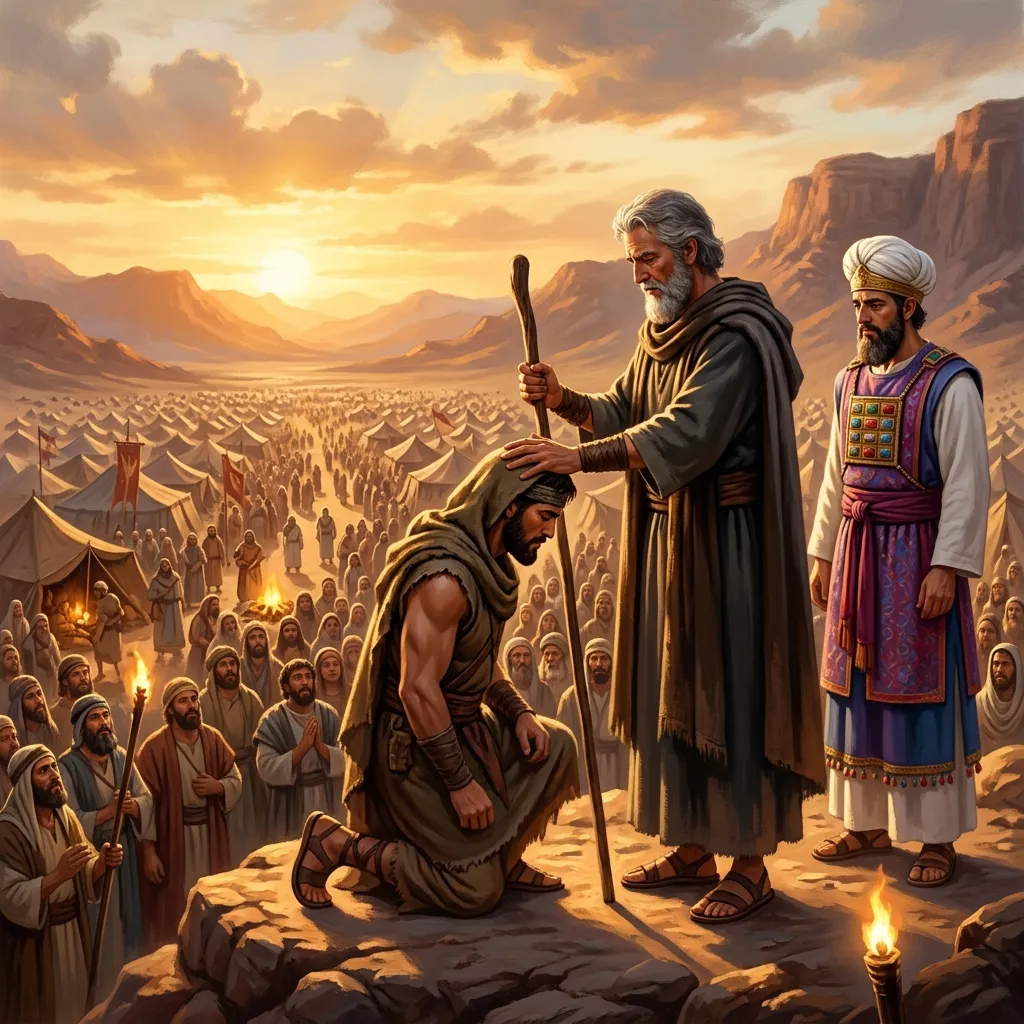
The public commissioning of Joshua was designed as a momentous, holy convocation before the entire nation. Moses summoned Eleazar the High Priest, the seventy elders of Israel, and the vast multitudes of the congregation to gather at the entrance of the Tabernacle of Meeting. The sun gleamed upon the golden pillars of the courtyard and the embroidered fabrics of the sanctuary. In the sight of all the people, Moses brought Joshua forward and set him before Eleazar the priest.
Then Moses placed his aged, calloused hands upon Joshua's head. The biblical verb is *samakh*—to lean upon with full weight. In that sacred gesture of *semikhah*, the transfer of authority was enacted. Moses did not merely touch Joshua's forehead; he leaned his hands upon him, symbolically transferring his own administrative mantle, pastoral burden, and judicial sovereignty. Furthermore, as Yahweh commanded, Moses conferred upon Joshua a portion of his own *hod*—the regal majesty, spiritual splendor, and moral authority that God had uniquely clothed Moses with—so that the children of Israel would instinctively reverence and obey their new leader.
Yet God also established an essential constitutional distinction in Joshua's leadership. Moses had enjoyed direct, unmediated 'mouth-to-mouth' communion with Yahweh; God spoke to him face to face as a man speaks to his friend. Joshua, however, would operate under a balanced, bicameral governance: "He shall stand before Eleazar the priest, who shall inquire before Yahweh for him by the judgment of the Urim. At his word they shall go out, and at his word they shall come in, both he and all the children of Israel with him—all the congregation" (Numbers 27:21). The civil-military leader and the cultic High Priest were bound together in mutual accountability before the divine oracle.
Following the ritual at the Tabernacle, Moses assembled the entire nation to deliver his final, stirring charges recorded in Deuteronomy 31. Looking upon Joshua in the sight of all Israel, Moses proclaimed the thunderous, fourfold mandate that would anchor Joshua's soul through the ferocious battles ahead: "Be strong and of good courage (Chazaq ve-Amats)! For you must go with this people to the land which Yahweh has sworn to their fathers to give them, and you shall cause them to inherit it. And Yahweh, He is the One who goes before you. He will be with you, He will not leave you nor forsake you; do not fear nor be dismayed!" (Deuteronomy 31:7–8).
Then, in a breathtaking finale, Yahweh Himself appeared in the Tabernacle in a pillar of cloud, standing over the door of the tent. Calling Moses and Joshua into the sanctuary, the Lord personally commissioned the new commander: "Be strong and of good courage; for you shall bring the children of Israel into the land which I swore to them, and I will be with you" (Deuteronomy 31:23). When the hands of Moses were lifted from Joshua's head, a supernatural transformation was complete. Deuteronomy 34:9 records the divine testimony: "Now Joshua the son of Nun was full of the spirit of wisdom, for Moses had laid his hands on him; so the children of Israel listened to him, and did as Yahweh had commanded Moses."
The typological brilliance of this transition resounds across the centuries. Moses represents the Law—majestic, holy, and unbending. Yet the Law can never bring fallen humanity into the Promised Land of spiritual rest; the Law exposes sin, guides through the wilderness, and leads us to the boundary of our inheritance, but because of human weakness, the Law must die outside the land. It is Joshua who brings the people into the inheritance! The name Joshua in Hebrew is *Yehoshua*—which in Greek translates directly as *Iesous*, JESUS! What Moses and the Law could not do in that it was weak through the flesh, God did by sending His Son. Our divine Joshua—Jesus Christ—leads His redeemed flock through the waters of death, shatters every spiritual adversary, and settles us forever in the glorious Promised Land of eternal life!
Biblical Keywords & Theological Roots
To be strong, grow firm, prevail, withstand, or take courage; the core imperative commanding spiritual backbone and moral unshakeability in the face of warfare.
To be bold, stout-hearted, alert, or fortified; paired with *chazaq* to denote internal fortitude and unshakable confidence in divine assistance.
To lean upon, lay hands upon, sustain, uphold, or invest; the physical posture of transferring spiritual authority, pastoral burden, and divine blessing.
Splendor, majesty, vigor, honor, or regal authority; the visible charisma and moral weight of leadership that God commanded Moses to impart to Joshua.
Lights or illuminations; sacred lots kept in the High Priest's breastplate, cast before Yahweh to discern divine guidance for national and military decisions.
Ancient Near Eastern & Archaeological Context
The public commissioning of Joshua took place on the plains of Moab at the threshold of the Jordan River. In Ancient Near Eastern royal jurisprudence (observable in Hittite vassal treaties and New Kingdom Egyptian administrative texts), dynastic transition was a volatile moment prone to violent succession crises. The Hebrew act of laying on hands (*semikhah*, from *samakh*, to lean heavily upon) was a formal legal ceremony signifying the actual transference of judicial authority, representative headship, and spiritual charisma from the mentor to the successor. Unlike Moses, who enjoyed unmediated 'face-to-face' auditory dialogue with Yahweh (Exodus 33:11), Joshua was instructed to receive divine tactical direction through Eleazar the High Priest via the sacred lot of the *Urim* and *Thummim* nestled in the breastplate of judgment (Numbers 27:21)—establishing a balanced, bicameral covenant governance between civil-military leadership and cultic-priestly mediation.
Practical Discipleship & Spiritual Application
- God's Kingdom Work Never Dies with His Servants: Moses was the greatest prophet in Old Testament history, yet when his calling concluded, God's work marched forward seamlessly. Leaders are mortal instruments, but the Shepherd of Israel lives forever. Never anchor your faith in human personalities, but in the unchanging God who raises up new champions in every generation.
- Spiritual Succession Requires Genuine Humility and Mentorship: Moses did not cling possessively to his office, nor did he resent his younger successor. He laid his hands upon Joshua with generous joy, transferring his own splendor (*hod*) so that the congregation would obey him. True spiritual leaders prepare, empower, and release the next generation to go further than they went.
- Courage is a Divine Command Grounded in God's Presence: Four times across Deuteronomy 31 and Joshua 1, the mandate rings out: 'Be strong and of good courage!' Biblical courage is not the absence of fear or natural self-confidence; it is obedience fueled by the divine promise: 'Yahweh Himself goes before you; He will not leave you nor forsake you.'
- The Power of the Spirit of Wisdom: Deuteronomy 34:9 declares that Joshua was 'full of the spirit of wisdom, for Moses had laid his hands on him.' Effective leadership in God's church cannot be accomplished by organizational acumen or natural talent alone; it requires the supernatural impartation and continuous indwelling of the Holy Spirit.
⚡ Fast Facts
- Joshua's original birth name was Hoshea (meaning 'salvation'), but Moses prophetically renamed him Joshua (*Yehoshua*, meaning 'Yahweh is salvation') in Numbers 13:16.
- Joshua was of the tribe of Ephraim, the son of Nun, and had served as Moses' loyal personal assistant (*mesharot*) since his youth (Exodus 33:11).
- Unlike Moses, who spoke directly to Yahweh mouth-to-mouth, Joshua was commanded to stand before Eleazar the priest to receive divine strategy through the Urim (Numbers 27:21).
- Moses was 120 years old at this transition, yet Scripture explicitly records that 'his eyes were not dim nor his natural vigor abated' (Deuteronomy 34:7).
❓ Frequently Asked Questions (FAQs)
In the kingdom of God, spiritual authority is never a hereditary dynasty or biological right. Moses had two sons born in Midian—Gershom and Eliezer (Exodus 18:3–4)—yet neither was appointed to leadership. God selected Joshua because of his proven spiritual character, steadfast faithfulness, and indwelling Spirit. Numbers 27:18 reveals the divine criterion: 'Take Joshua the son of Nun with you, a man in whom is the Spirit.' For forty years, while others grumbled in their tents, Joshua had remained faithful: he led the troops against the Amalekites at Rephidim (Exodus 17), lingered in prayer outside the Tabernacle of Meeting when Moses departed (Exodus 33:11), and along with Caleb, brought back a faithful report from Canaan at Kadesh-Barnea, refusing to fear the giants (Numbers 14:6–9). Joshua's leadership was forged in decades of humble, unseen service as Moses' personal attendant. God chooses shepherds whose hearts have been tested and purified in the secret place of obedience.
The act of laying on hands (*semikhah*, from the Hebrew verb *samakh*, meaning 'to lean hard upon') was a profoundly sacred legal and spiritual ritual. In the sacrificial system, a worshiper leaned his hands with full weight upon the head of the sacrificial animal to transfer guilt and establish representation (Leviticus 1:4). When Moses laid his hands upon Joshua in the presence of Eleazar the High Priest and the entire congregation, it was a public, irrevocable act of investiture. Moses symbolically transferred his own spiritual burden, administrative sovereignty, and delegated divine majesty (*hod*) upon Joshua. Deuteronomy 34:9 reveals the immediate supernatural consequence: 'Now Joshua the son of Nun was full of the spirit of wisdom, for Moses had laid his hands on him; so the children of Israel listened to him, and did as Yahweh had commanded Moses.' It publicly authenticated Joshua as God's chosen shepherd, ensuring the nation transitioned smoothly without civil fracture.
The transition from Moses to Joshua is one of the most brilliant, breathtaking dispensational types in all of Scripture. Moses represents the Law: holy, righteous, and good, yet utterly incapable of bringing fallen humanity into the Promised Land of rest because of human weakness and disobedience (Romans 8:3; Hebrews 3–4). Moses can lead the people through the wilderness, instruct them in holiness, and bring them to the boundary of Canaan on Mount Nebo, but the Law cannot cross the Jordan River. Moses must die outside the land! It is Joshua who leads the people into the inheritance. The Greek form of the Hebrew name Joshua (*Yehoshua*) is *Iesous*—JESUS! What Moses (the Law) could not do, Joshua (Jesus, our Savior) accomplishes. Jesus, our divine Joshua, leads His redeemed people across the river of death and judgment into the rich spiritual inheritance of grace, victory, and eternal rest in the Kingdom of God.