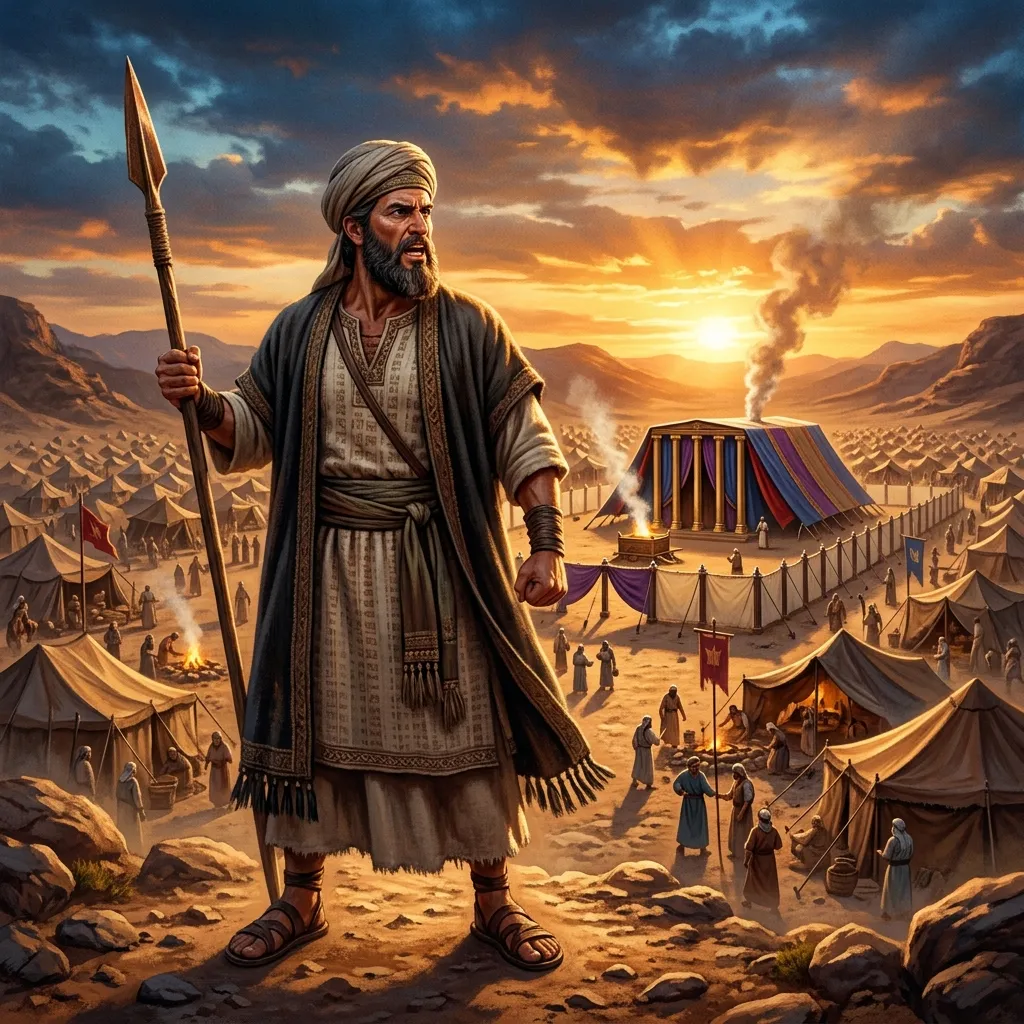
The sprawling wilderness journey had reached its final encampment on the eastern side of the Jordan River. Pitched across the sun-drenched plains of Moab, the children of Israel dwelt at Shittim—the 'Meadow of the Acacias'—directly opposite the fortified Canaanite stronghold of Jericho. The nation was flushed with the intoxicating euphoria of military conquest. In two astonishing campaigns, Israel had annihilated the warlike Amorite federation under King Sihon and obliterated the giant warriors of Bashan under King Og. Furthermore, across the jagged mountain peaks of Moab, King Balak’s desperate attempt to unleash demonic hexes against Israel had backfired in total humiliation; the Mesopotamian diviner Balaam had been sovereignly constrained by the Spirit of God to pour out four majestic oracles of blessing over the encampment, prophesying that the Star of Jacob would crush all adversaries. Israel appeared completely invincible, sheltered under the impenetrable shield of Yahweh's covenant grace.
Yet in the quiet shadows of victory, the deadliest assault in Israel's history was orchestrated not with iron chariots or occult incantations, but through the poisoned dagger of sensual compromise. Unable to collect his astronomical bounty of royal gold through curses, Balaam had delivered a masterclass in demonic subversion to King Balak before departing for the Euphrates. As Numbers 31:16 and Revelation 2:14 solemnly disclose, Balaam taught Balak how to breach Israel's divine defenses: "Lure them into sexual immorality and idolatry, and their own holy God will strike them down!"
The strategy was executed with venomous precision. The daughters of Moab and Midian—including royal princesses of noble bloodlines—began infiltrating the outskirts of the Hebrew camp, adorned in sheer silks and intoxicating perfumes. They invited the men of Israel to their sacred feasts held on the forested summits of Mount Peor. These were not innocent pastoral celebrations; they were the licentious fertility rites of Baal-Peor, the local Canaanite storm and generative deity. In Canaanite fertility religion, ritual intercourse in sacred groves was believed to stimulate the reproductive forces of the earth, combined with dark funerary banquets commemorating the dead (Psalm 106:28). Blinded by lust and flattered by foreign hospitality, thousands of Hebrew men crossed the perimeter of holiness. They drank pagan wine, committed fornication with foreign women, and fell prostrate before the grotesque stone phalluses of Baal-Peor. Numbers 25:3 records the catastrophic spiritual treason in five haunting words: "So Israel was yoked to Baal-Peor." The Hebrew verb *tzamad* denotes two draft animals bound together under a single wooden yoke; the covenant bride of Yahweh had fastened her neck to an abominable idol.
In a flash of blinding fury, the protective holiness of God detonated. The wrath of Yahweh burned against Israel like a raging furnace. Out of nowhere, an invisible, airborne plague erupted across the encampment, cutting down thousands in excruciating agony. Men collapsed in their tents, their lungs filling with fluid, their veins burning as judgment struck the apostates. Yahweh commanded Moses: "Take all the leaders of the people and hang the offenders before Yahweh, out in the sun, that the fierce anger of Yahweh may turn away from Israel!" Moses ordered the judges: "Every one of you kill his men who were joined to Baal-Peor!"
The entire congregation was engulfed in horror. At the entrance of the Tabernacle of Meeting, Moses, the seventy elders, and thousands of weeping Israelites fell on their faces, lifting their voices in broken lamentation as the deadly plague swept through the tribal sectors, piling corpses like autumn leaves. Yet in the very midst of this sacred weeping, an act of breathtaking, blasphemous arrogance pierced the congregation.
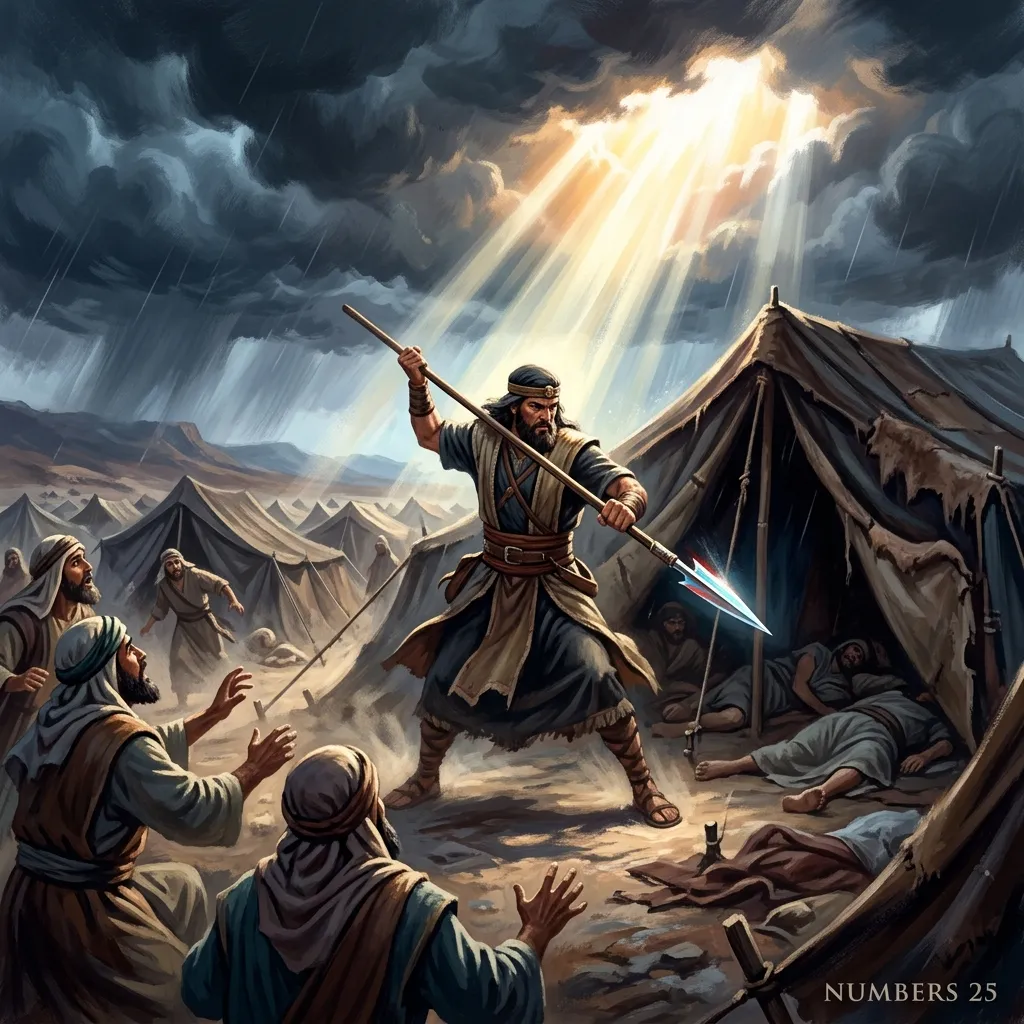
Zimri, the son of Salu, a high prince of the tribe of Simeon and head of an ancestral house, strode arrogantly through the weeping ranks. Flaunting his treason before the eyes of Moses and the entire weeping assembly, Zimri paraded Cozbi, a Midianite princess, the daughter of Zur, a paramount royal chieftain of Midian. With open, brazen defiance of the God of Sinai, Zimri escorted the pagan woman into his inner tent (*qubbah*), a vaulted nuptial chamber, to consummate their illicit liaison while his countrymen died around them. It was the ultimate challenge to Yahweh’s sovereignty: a prince of Israel asserting his right to sin in plain sight of the dying.
Among the weeping crowd stood Phinehas, the son of Eleazar and grandson of Aaron the High Priest. While others were paralyzed by grief, holy indignation exploded within the heart of the young priest. He did not ask for a committee meeting, nor did he enter into a theological debate. Phinehas saw the glory of God trampled underfoot, and he was seized by the very jealousy (*qin'ah*) of the Almighty. Rising up from the dust of the Tabernacle court, Phinehas gripped a heavy, bronze-tipped javelin (*romach*) and marched with fierce, unwavering purpose toward the pavilion of Zimri.
Phinehas pulled aside the tent flap, strode into the inner chamber where Zimri and Cozbi were engaged in their illicit union, and with a single, mighty thrust of both arms, drove the javelin through the body of the Simeonite prince and through the abdomen of the Midianite woman, pinning both apostates to the earth. It was a terrifying, instantaneous execution of divine justice.
The impact was immediate and miraculous. The moment the spear penetrated the rebels, the invisible angel of death sheathed his sword. The devastating plague, which had already wiped out twenty-four thousand men, stopped dead in its tracks! The silence that settled over the plains of Shittim was deafening.
Then the voice of Yahweh thundered directly to Moses, not in condemnation, but in magnificent commendation of Phinehas: "Phinehas the son of Eleazar, the son of Aaron the priest, has turned back My wrath from the children of Israel, because he was zealous with My zeal among them, so that I did not consume the children of Israel in My jealousy!" (Numbers 25:11). God recognized His own burning heartbeat in the young priest. While the nation had compromised with demonic filth, Phinehas alone had loved God’s honor more than his own life, reputation, or safety.
Because Phinehas had stood between the holy God and a rebellious people, Yahweh conferred upon him the highest covenantal honor: "Therefore say, 'Behold, I give to him My covenant of peace (Berith Shalom); and it shall be to him and his descendants after him a covenant of an everlasting priesthood, because he was zealous for his God, and made atonement for the children of Israel!'" (Numbers 25:12–13). Phinehas' javelin was not mere execution; it functioned as an act of propitiatory atonement (*kaphar*). By slaying the ringleaders of apostasy, he vindicated the holiness of the law, removed the curse, and restored covenant fellowship between God and His people.
Centuries later, the inspired psalmist celebrated Phinehas’ deed in language echoing Abraham’s justification: "Then Phinehas stood up and intervened, and the plague was stopped. And that was accounted to him for righteousness to all generations forevermore" (Psalm 106:30–31). His line of the high priesthood remained unbroken through Zadok during King David's reign, Solomon's Temple, and down through the second temple era.
For Christians today, Phinehas points forward across the centuries to the Lord Jesus Christ. When Jesus entered the Jerusalem Temple and saw it corrupted by greedy moneychangers, He was consumed with the same holy zeal: "Zeal for Your house has eaten Me up!" (John 2:17). Yet on Calvary, Jesus did not take up a javelin against guilty sinners; instead, He allowed the javelin of divine justice and the spear of the Roman soldier to pierce His own holy side! On the cross, Christ made the ultimate, eternal atonement, taking upon Himself the lethal plague of human sin. Through His shed blood, He has granted to every believer the true, everlasting Covenant of Peace—a peace that can never be broken.
Biblical Keywords & Theological Roots
To yoke, fasten, bind, couple, or join oneself inextricably; used of draught animals harnessed together, depicting Israel's voluntary, spiritually catastrophic enslavement to Baal-Peor.
Jealousy, ardency, passionate indignation, or holy zeal; the burning divine emotion that refuses to tolerate rivals, mirrored perfectly in Phinehas' righteous heart.
A spear, lance, or javelin; a heavy infantry thrusting weapon with a sharp bronze blade used for rapid, lethal execution of divine justice.
To make atonement, appease wrath, cover over guilt, or cancel condemnation; Phinehas' decisive execution of judgment functioned as an act of propitiatory atonement.
Covenant of peace; a perpetual, unbreakable treaty of divine favor, shalom, and enduring high priestly succession awarded to Phinehas and his descendants forever.
Ancient Near Eastern & Archaeological Context
Numbers 25 occurs at Abel-Shittim ('Meadow of the Acacias') in the fertile Jordan trench opposite Jericho. Baal-Peor was a local Transjordanian hypostasis of Hadad/Baal worshipped on Mount Peor. In Ancient Near Eastern Canaanite fertility religions, human ritual copulation in sacred groves was believed to magically awaken the dormant vitality of nature and guarantee agricultural abundance. Extra-biblical texts, notably the Ugaritic Baal cycle, reveal that worship of Peor involved chthonic funerary banquets commemorating deceased ancestors, explicitly referenced in Psalm 106:28 ('they ate the sacrifices of the dead'). The inner pavilion entered by Zimri is designated in Hebrew as the *qubbah*—a vaulted nomadic tent or inner bedchamber common among Midianite desert pastoralists. Archaeologists excavating Late Bronze Age Jordan Valley sites have recovered double-edged bronze lance heads and javelin points (*romach*) measuring ten to fourteen inches, designed for precise close-quarters thrusting.
Practical Discipleship & Spiritual Application
- Beware of the Subtle Seduction of Compromise When Warfare Fails: Satan could not curse Israel through Balaam's mountain incantations; therefore, he destroyed them through the back door of sensuality and cultural assimilation. If the adversary cannot defeat your faith through direct opposition, he will attempt to seduce you through moral compromise.
- Cultivating Holy Jealousy for God's Glory: In an era of lukewarm tolerance and moral relativism, Phinehas stood out because he was 'jealous with My jealousy' (Numbers 25:11). True love for God hates that which defiles His holy name and breaks covenant fellowship.
- True Peace is Established Through Righteousness, Not Appeasement: Phinehas received the 'Covenant of Peace' precisely because he executed swift, unsparing righteousness. Biblical peace (*shalom*) is never the absence of conflict at the expense of truth; it is the active establishment of God's holy order.
- Decisive Action Halts Generational Plagues: While the community wept at the door of the Tabernacle in paralyzed grief, Phinehas rose up and took decisive action. Lamentation has its place, but there are moments when God requires bold, courageous spiritual warfare to sever the hold of sin.
⚡ Fast Facts
- Phinehas was the grandson of Aaron the High Priest through his third son Eleazar (Exodus 6:25).
- The deadly plague sent by Yahweh killed exactly 24,000 Israelites before Phinehas' intervention stayed it (Numbers 25:9).
- Psalm 106:30–31 records of Phinehas: 'Then Phinehas stood up and intervened, and the plague was stopped. And that was accounted to him for righteousness to all generations forevermore.'
- Zimri was a prince of the tribe of Simeon, and Cozbi was the daughter of Zur, a paramount tribal prince of Midian (Numbers 25:14–15).
❓ Frequently Asked Questions (FAQs)
Numbers 22–24 depicts Balaam repeatedly attempting and failing to curse Israel because God compelled him to bless. However, Numbers 31:16 and Revelation 2:14 peel back the curtain to reveal the dark conspiracy that followed. Unable to collect King Balak's gold through prophetic cursing, Balaam sold Balak the lethal secret: 'Yahweh's blessing over Israel cannot be broken from the outside, but their covenant hedge will collapse if you seduce them from within!' Balaam counseled Balak to send beautiful Moabite and Midianite princesses to entice the Hebrew men into sacred temple orgies and idolatry. Once the men of Israel bowed to Baal-Peor, God Himself would turn against them. It was a masterpiece of demonic strategy: what four mountain summits of enchantments could not accomplish, five minutes of sensual compromise achieved, triggering a plague that wiped out 24,000 covenant men.
In a superficial reading, Phinehas' execution of Zimri and Cozbi might appear to be vigilante violence. However, Scripture interprets it as a supreme act of judicial priesthood, covenant love, and holy mediation. Zimri, a high prince of Simeon, committed treason of the highest order: while Moses, the elders, and the congregation were prostrated in weeping repentance at the Tabernacle as people were dropping dead by the thousands, Zimri brazenly paraded a pagan Midianite princess into his tent to engage in cultic copulation, defying the God of Israel to His face. Phinehas did not act out of personal vengeance, bloodlust, or rage; he was 'jealous with God's jealousy.' His javelin executed the precise death penalty already commanded by Moses (Numbers 25:5). By executing divine justice upon the ringleader of apostasy, Phinehas made propitiatory atonement (*kaphar*), extinguishing God's righteous wrath. Psalm 106:31 echoes the exact phrasing applied to Abraham's faith in Genesis 15:6: Phinehas' zeal was counted to him as enduring covenant righteousness.
In Numbers 25:12–13, Yahweh established an eternal charter: 'Behold, I give to him My covenant of peace; and it shall be to him and his descendants after him a covenant of an everlasting priesthood, because he was zealous for his God, and made atonement for the children of Israel.' This promise guaranteed that the high priestly lineage would perpetually flow through Phinehas' line. Historically, with only a brief temporary interlude during the era of Eli (who was descended from Aaron's fourth son Ithamar), the High Priesthood remained anchored in the line of Phinehas through Zadok during King David's reign, through the dedication of Solomon's Temple, the post-exilic restoration under Joshua son of Jehozadak, and down to the Second Temple era. Prophetically, Phinehas stands as a striking type of Jesus Christ, the ultimate High Priest who, consumed with zeal for His Father's house (John 2:17), offered Himself as the once-for-all atoning sacrifice on Calvary, destroying the work of the devil and establishing the eternal New Covenant of peace for all believers.