The dark, damp corridors of the royal fortress prison had been Joseph's world for years. Two full seasonal cycles had passed since the Chief Cupbearer had walked out of the heavy bronze gates into freedom, while the forgotten Hebrew prisoner continued his quiet, faithful routine among chains and stone cells. But on a sweltering summer morning in the royal capital of Memphis, the sovereign clock of heaven chimed. In the lavish royal palace, Pharaoh—the living Horus, absolute ruler of Upper and Lower Egypt—awoke in trembling terror from twin nocturnal nightmares that no astrologer could unlock.
1. The Nile, the Cannibal Cows, and the Scorched Grain
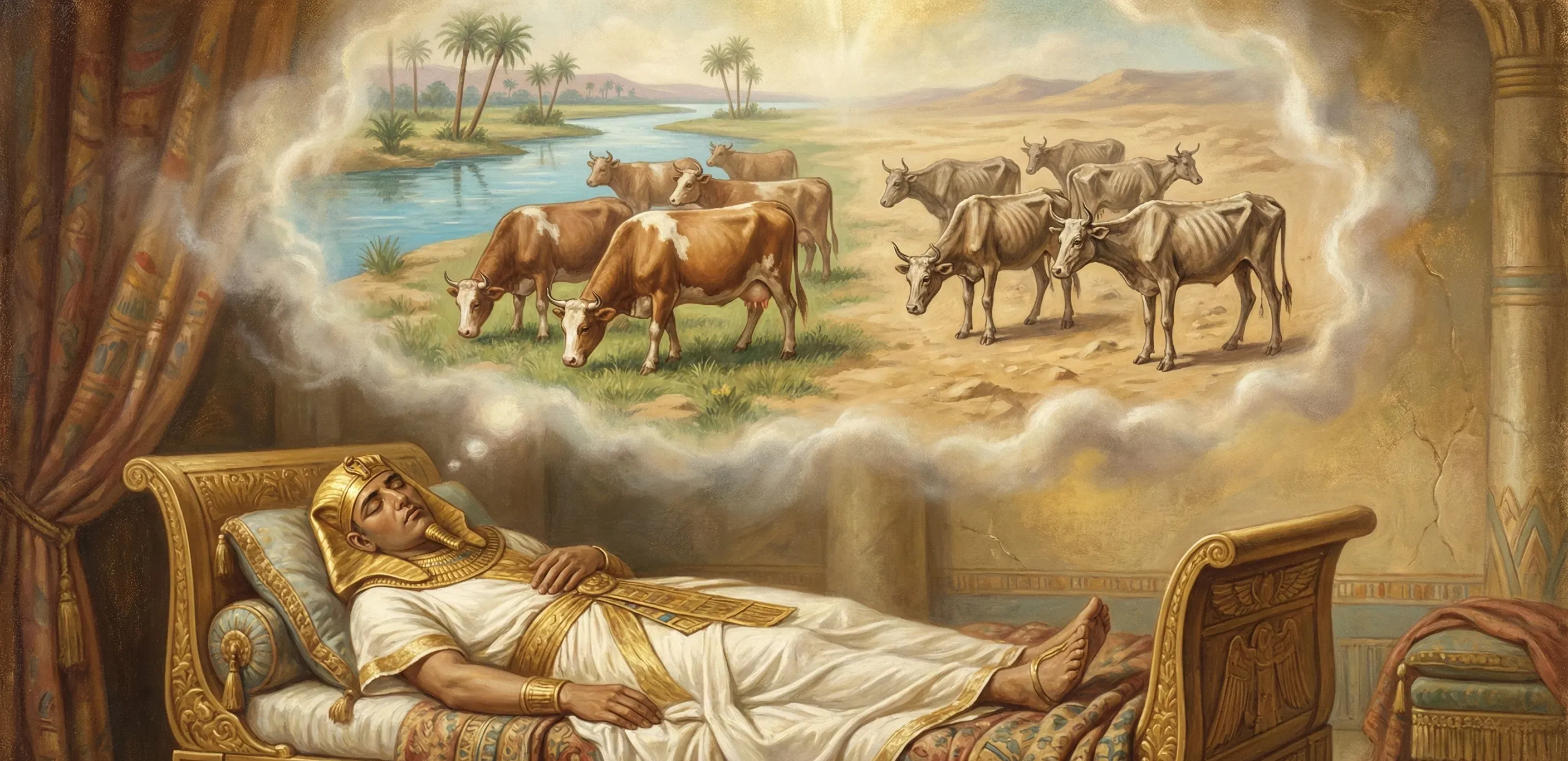
In the first dream, Pharaoh stood upon the fertile banks of the sacred Nile. Suddenly, emerging from the water, came seven plump, sleek, beautiful cows grazing among the lush reed grass (*Achu*). But immediately behind them arose seven other cows—hideous, gaunt, emaciated skeletons of flesh and bone. In a horrifying display of supernatural unnaturalness, the seven starved cows opened their jaws and devoured the seven fat cows; yet even after swallowing them whole, their ribs remained sunken and their appearance as grotesque as before. Pharaoh awoke in cold sweat.
Falling back into troubled slumber, a second dream seized his mind: seven plump, golden heads of wheat sprouted upon a single stalk. Then sprouted seven thin, withered heads, scorched and blackened by the scorching east wind of the Sahara desert (*Khamsin*). The seven withered ears devoured the seven plump ears.
When dawn broke across the empire, Pharaoh's spirit was profoundly agitated. He summoned all the professional magicians (*Chartummim*) and wisest philosophers of Egypt. Court scribes unfurled centuries of dream papyri, consulting occult star-charts and hieroglyphic grimoires. But an eerie, suffocating silence gripped the throne room: "There was no one who could interpret them to Pharaoh" (Genesis 41:8).
2. A Voice from the Dungeon: The Cupbearer Remembers
Standing beside the golden throne, holding the royal goblet, the Chief Cupbearer observed Pharaoh's escalating fury. A sharp jolt of conviction pierced his conscience. Two years of shameful ingratitude dissolved in a flash:
"I remember my faults this day. When Pharaoh was angry with his servants... a young Hebrew man was there with us, a servant of the captain of the guard. And we told him, and he interpreted our dreams for us... and it came to pass, just as he interpreted for us, so it happened." (Genesis 41:9-13)
Pharaoh did not hesitate for a second: "Send for him immediately!"
Royal guards sprinted through the palace courtyards to the prison fortress. Armed soldiers descended into the subterranean dungeon, threw open Joseph's cell, and hauled him out into the blinding glare of the Egyptian sun. But before an outsider could appear before the divine presence of Pharaoh, strict Egyptian court hygiene was mandatory. Joseph was washed with fragrant natron oils, his facial hair and head completely shaven with bronze razors according to Egyptian aristocratic etiquette, and his rough prison rags exchanged for crisp, snow-white linen robes.
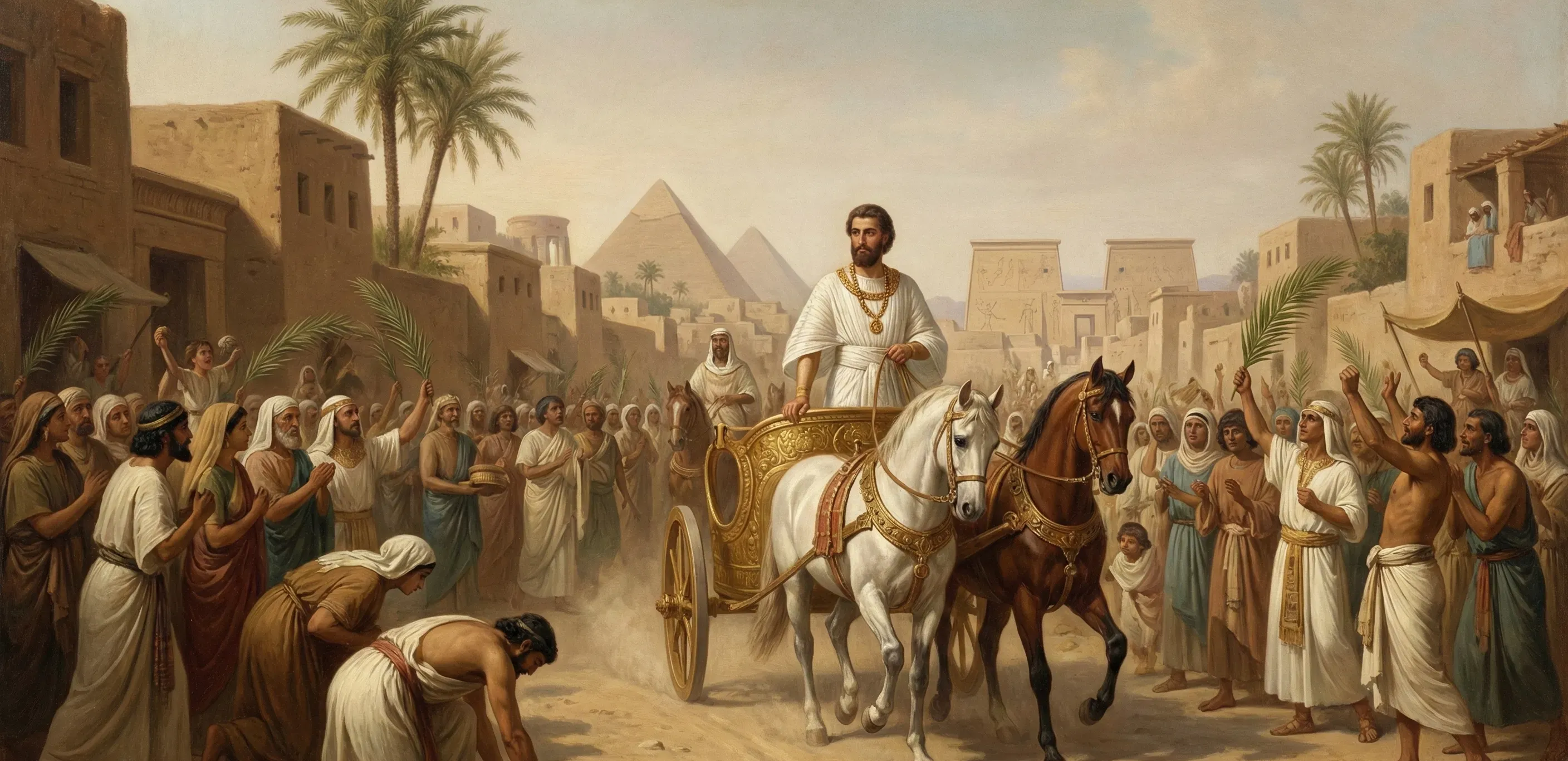
From Pit to Prime Minister: Clothed in fine Egyptian linen and wearing Pharaoh's golden signet ring, Joseph rides in the second chariot of state as crowds bow the knee.
3. Standing Before Pharaoh: Deflecting Glory to Yahweh
Thirty-year-old Joseph stepped into the vast, colonnaded throne room of the Egyptian empire. Beneath towering lotus pillars painted in lapis lazuli and gold, Pharaoh sat upon his gilded throne, flanked by priests and imperial bodyguards.
Pharaoh looked down upon the young Hebrew and said: "I have had a dream, and there is no one who can interpret it. But I have heard it said of you that you can understand a dream, to interpret it."
Here was the ultimate temptation for human pride. Joseph could easily have claimed personal brilliance, flattered the emperor, or negotiated his freedom. Instead, standing before the most powerful monarch on earth, Joseph delivered one of the boldest theological declarations in the Old Testament:
"It is not in me; God will give Pharaoh an answer of peace." (Genesis 41:16)
In a single sentence, the Hebrew youth dismantled Egyptian pride: true wisdom belongs neither to human intellect nor to the pagan pantheon, but exclusively to the sovereign Creator of heaven and earth.
4. The Divine Revelation: Seven Years of Plenty, Seven Years of Famine
Pharaoh recounted the dreams. Listening with supernatural discernment (*Nabon*), Joseph smiled with holy clarity and spoke:
"The dreams of Pharaoh are one; God has shown Pharaoh what He is about to do." The seven good cows and seven good heads of grain represented seven years of unprecedented, bumper agricultural harvests across all the land of Egypt. The Nile would inundate the valley with miraculous precision, filling every granary to overflowing.
"And the seven thin and ugly cows... and the seven empty heads scorched by the east wind are seven years of famine." Immediately following the abundance, a catastrophic, multi-year drought of terrifying severity would consume the ancient Near East. The drought would be so ferocious that all the previous abundance would be completely forgotten, and the famine would devastate the earth.
Joseph explained why the dream was doubled: "Because the thing is established by God, and God will shortly bring it to pass" (Genesis 41:32).
5. The Strategic Plan and the Royal Investiture
Joseph did not stop with interpretation. Moving seamlessly from prophet to master administrator, he presented a comprehensive crisis-management blueprint:
- Let Pharaoh select a man discreet and wise (*Nabon*) and set him over the land of Egypt.
- Appoint agricultural commissioners across all provinces.
- Levy a mandatory twenty-percent reserve tax on all harvest crops during the seven years of plenty.
- Construct fortified granaries within every major urban center under royal seal to store the food for the coming famine.
Pharaoh and his royal counselors were stunned into absolute silence. Looking across his council of veteran aristocrats, Pharaoh asked: "Can we find such a one as this, a man in whom is the Spirit of God?"
Turning to the thirty-year-old former slave, Pharaoh declared: "Inasmuch as God has shown you all this, there is no one as discerning and wise as you. You shall be over my house, and all my people shall be ruled according to your word; only in regard to the throne will I be greater than you." (Genesis 41:39-40).
In a dazzling, instantaneous ceremony of imperial investiture, Pharaoh took his personal gold signet ring from his hand and placed it upon Joseph's finger, vesting him with the power to sign royal legislation. He clothed him in garments of fine Egyptian linen (*shesh*, royal byssus) and draped the heavy golden collar (*Rabad*) around his neck. He gave him the second chariot of state, commanding royal heralds to run before him crying, "Abrek! Bow the knee!"
6. Savior of the World: Granaries of Life
Pharaoh renamed Joseph Zaphenath-Paneah ("God Speaks and He Lives") and gave him in marriage Asenath, daughter of Potiphera priest of On. In a single morning, the Hebrew slave had become Grand Vizier of Egypt.
Joseph did not celebrate with idle luxury. Immediately, he embarked on nationwide tours, building monumental granaries in every city. During the seven years of plenty, the earth produced abundantly: "Joseph gathered very much grain, as the sand of the sea, until he stopped counting, for it was immeasurable" (Genesis 41:49).
Before the famine arrived, God blessed Joseph with two sons: Manasseh ("God has made me forget all my toil and my father's house") and Ephraim ("God has caused me to be fruitful in the land of my affliction"). His personal healing was complete.
Then, the seven years of abundance ended, and the terrifying drought fell upon Egypt, Canaan, and all surrounding nations. When the starving Egyptian populace cried to Pharaoh for bread, Pharaoh gave an empire-wide decree that echoed the salvation of God: "Go to Joseph; whatever he says to you, do."
Joseph threw open the massive storehouses and sold grain to the Egyptians and to all nations who traveled across scorching deserts to buy food. The boy who was thrown into a dry pit had become the bread-giver of the world, positioning the stage for the dramatic, tearful reunion with the very brothers who had betrayed him.
Biblical Keywords & Theological Roots
Discerning, intelligent, endowed with practical administrative wisdom and penetrating spiritual insight; used by Pharaoh to describe Joseph (Genesis 41:39).
Zaphenath-Paneah: Egyptian regal title bestowed by Pharaoh, traditionally translated 'Revealer of Secrets' or 'God Speaks and He Lives'.
A golden collar, royal neck-chain, or ceremonial ornament draped around the neck of high officials during royal investiture in ancient Egypt.
Manasseh: 'Causing to forget'; derived from 'Nashah' (to forget/release), celebrating divine emotional healing from past trauma and familial rejection.
Ephraim: 'Double fruitfulness'; derived from 'Parah' (to bear fruit/multiply), celebrating supernatural blessing and multiplication in the very land of affliction.
Ancient Near Eastern & Archaeological Context
Genesis 41 fits with extraordinary precision into the socioeconomic and political landscape of Egypt during the late Middle Kingdom or Second Intermediate Period (Hyksos era, circa 1750–1550 BC). Ancient Egypt was an agrarian empire entirely dependent upon the annual flooding of the Nile River (*Inundation* or *Akhet*). Each summer, monsoon rains in the Ethiopian highlands swelled the Blue Nile, depositing millions of tons of rich, black volcanic silt across the Egyptian floodplain. If the floodwaters rose too low, catastrophic famine struck; if they crested too high, dikes breached and crops rotted.
Pharaoh's dreams of emaciated cows consuming fat cows along the reed grass (*achu*, an Egyptian loanword used in Genesis 41:2) directly invoked *Hapy*, the god of the Nile flood, and *Hathor*, the bovine goddess of abundance. By predicting seven consecutive years of extraordinary flood surpluses followed by seven consecutive years of extreme drought, Joseph demonstrated that the Hebrew God Yahweh held supreme sovereignty over the cyclical forces of the Egyptian cosmos.
Furthermore, Joseph's state investiture ceremony reflects verbatim the contemporary Egyptian court rituals documented in New Kingdom and Middle Kingdom tomb murals (such as the tomb of Rekhmire, Vizier under Thutmose III). The presentation of the royal signet ring (*djed-khu*), robes of fine Egyptian linen (*shesh*, royal byssus cultivated exclusively for temples and nobility), the golden collar of honor (*shebyu*), and the proclamation of *Abrek* ('Bow the knee!' or 'Make way!') before his secondary state chariot was the formal installation of an Egyptian Grand Vizier (*Tjaty*). Joseph was effectively appointed Chief Justice, Minister of Agriculture, Chancellor of the Exchequer, and Prime Minister rolled into one supreme executive office.
Practical Discipleship & Spiritual Application
- The Unshakable Precision of God's Timing: Joseph languished in slavery and prison for thirteen agonizing years—from age seventeen to thirty. Yet God was neither late nor negligent. Every trial was refining his character, humility, and administrative skills. When God's hour struck, Joseph went from a subterranean dungeon to the prime ministry of the world's greatest empire in a single morning. Trust God's silent delays; His timing is always mathematically perfect.
- Deflecting Glory and Magnifying God Before Secular Powers: When Pharaoh flattered Joseph, saying, 'I have heard that you can understand a dream to interpret it,' Joseph boldly deflected the compliment: 'It is not in me; God will give Pharaoh an answer of peace.' In moments of personal triumph and professional advancement, never steal God's glory. Radiate humility and attribute every gift, insight, and success to the Lord.
- Turning Prophetic Revelation into Practical Administration: Joseph did not merely interpret Pharaoh's dreams; he immediately presented a brilliant, practical, thirty-point logistical strategy to construct granaries, levy a twenty-percent harvest tax, and conserve resources for the crisis. Biblical wisdom is not merely mystical; it is deeply practical, equipping believers to manage resources, navigate economic crises, and serve society with excellence.
- Emotional Healing Precedes True Fruitfulness: Before the famine struck, Joseph named his sons Manasseh ('God made me forget my pain') and Ephraim ('God made me fruitful'). We cannot experience true, enduring fruitfulness (Ephraim) until we allow God to heal the bitter trauma and resentment of our past (Manasseh). Surrender your old wounds to Christ so that your life can overflow with His supernatural fruitfulness.
⚡ Fast Facts
- The Precise Age of Leadership: Joseph was seventeen when sold into slavery (Genesis 37:2) and thirty when standing before Pharaoh (Genesis 41:46)—meaning he spent thirteen long years in the crucible of servitude and imprisonment before entering his divine destiny.
- The Egyptian Shaving Protocol: Genesis 41:14 notes that Joseph 'shaved himself and changed his clothing' before entering Pharaoh's presence; ancient Egyptians regarded Semitic facial hair as unclean, and royal court etiquette strictly mandated complete bodily shaving and clean Egyptian linen.
- The Royal Investiture Regalia: Pharaoh bestowed upon Joseph three distinct imperial symbols of sovereign authority: his personal signet ring (for enacting royal decrees), garments of fine linen (*shesh*, royal priestly byssus), and the golden chain (*Rabad* or *shebyu* collar of gold) awarded for extraordinary state service.
- A Sovereign Global Granary: Joseph constructed regional grain-cities across Egypt, storing grain 'like the sand of the sea' until they stopped keeping records, ultimately feeding not only the Egyptian empire but all surrounding ancient Near Eastern nations during a catastrophic seven-year drought.
❓ Frequently Asked Questions (FAQs)
In ancient Egyptian religion, the Nile River was deified as *Hapy*, the divine source of all life, fertility, and agricultural sustenance. For cows (sacred symbols of the goddess Hathor, provider of nourishment) and grain (the realm of Osiris) to emerge withered and emaciated from the very waters of the Nile was a cosmic sign that Egypt's gods were powerless, and that the sovereign Creator God of the Hebrews held absolute dominion over the climate and fertility of Egypt.
Pharaoh renamed Joseph *Zaphenath-Paneah* (most scholars reconstruct this from Late Egyptian *Dd-pA-nTr-iw.f-anx*, meaning 'God speaks and he lives' or 'The Revealer of Secrets'). Pharaoh also gave him in marriage Asenath ('She who belongs to the goddess Neith'), the daughter of Potiphera, high priest of On (Heliopolis, the center of sun worship). This fully integrated Joseph into the highest echelons of Egyptian nobility, though Joseph's subsequent naming of his sons proves his heart remained steadfastly loyal to the God of Abraham.
Born before the years of famine arrived, Joseph named his firstborn **Manasseh** ('Making to Forget'), declaring: 'For God has made me forget all my toil and all my father's house'—healing the trauma of betrayal. He named his second son **Ephraim** ('Fruitfulness'), declaring: 'For God has caused me to be fruitful in the land of my affliction.' The names encapsulate Joseph's spiritual journey: divine healing of past trauma followed by supernatural multiplication in the very place of suffering.