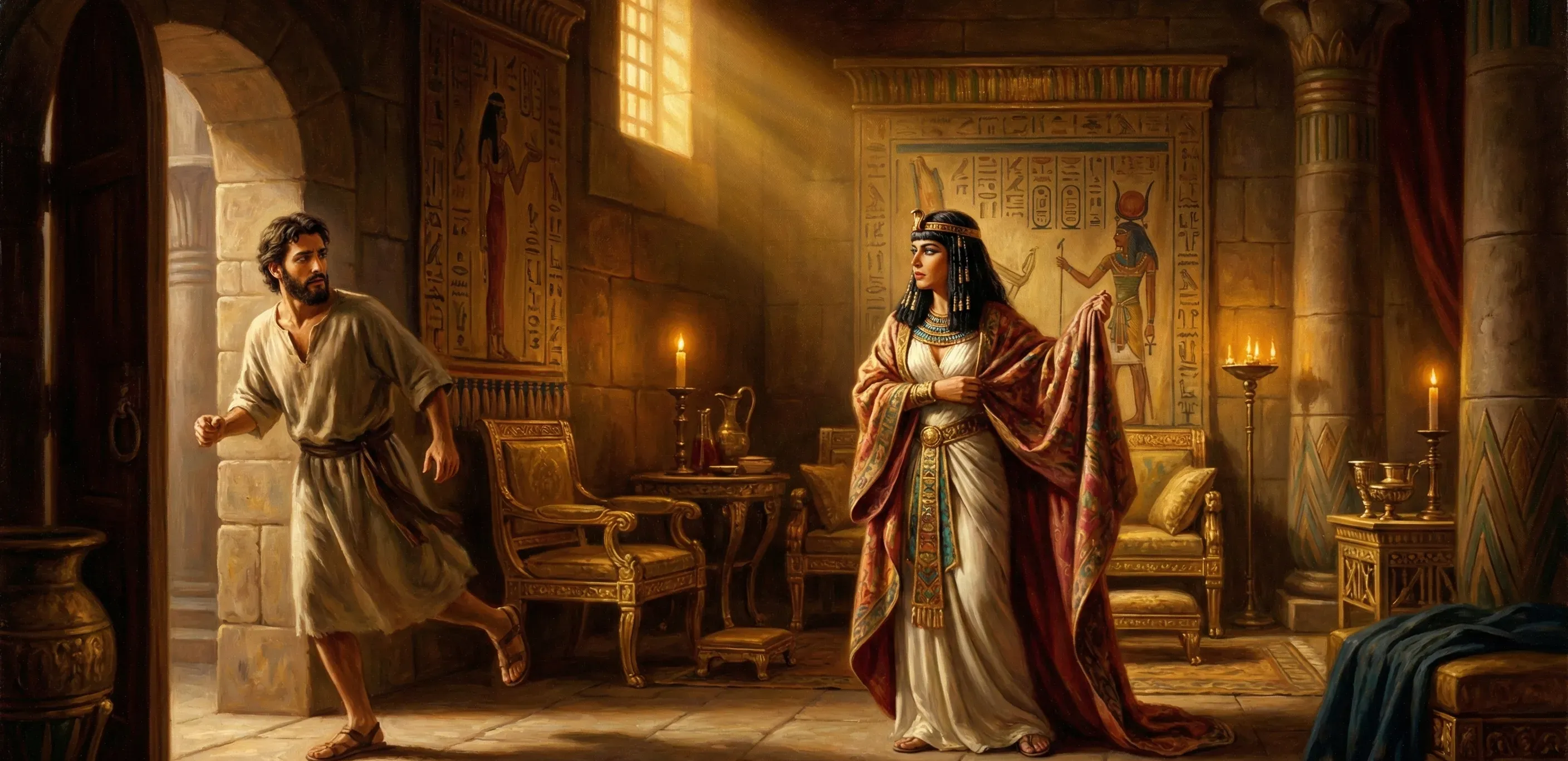
The blazing sun of the Nile Delta beat down upon the bustling slave market of On (Heliopolis). Stripped of his native tongue, bound in iron fetters, and covered in the dust of a five-hundred-mile forced march from Canaan, seventeen-year-old Joseph stood upon the auction block. To the observing eye, this Hebrew youth was completely destroyed—an abandoned runaway sold like common livestock. But beneath the pagan idolatry and towering obelisks of ancient Egypt, an invisible, sovereign shield guarded the young patriarch: "The LORD was with Joseph, and he was a successful man" (Genesis 39:2).
1. The Rise of the Hebrew Slave in Potiphar's House
The hammer fell, and Joseph was purchased by Potiphar, an elite officer of Pharaoh and the Captain of the Guard (*Sar ha-Tabbachim*, commander of the royal bodyguards and executioners). Entering this aristocratic Egyptian estate, Joseph did not surrender to despair, bitterness, or rebellion. Instead, he worked with exceptional diligence, absolute integrity, and quiet godliness.
It did not take long for the pagan captain to observe something supernatural in his new slave: "And his master saw that the LORD was with him and that the LORD made all he did to prosper in his hand" (Genesis 39:3). Every ledger balanced; every harvest flourished; every servant was managed with extraordinary efficiency. Recognizing Joseph's administrative brilliance, Potiphar promoted him through the ranks, finally appointing him chief steward (*mer-per*) over his entire estate.
Scripture paints a picture of total trust: Potiphar surrendered all his assets, bank accounts, and granaries into Joseph's hand, concerning himself with nothing except the food he ate. Under Joseph's consecrated stewardship, Yahweh blessed the Egyptian's house and fields for Joseph's sake.
2. The Fire of Temptation and the Cry of Purity
Moses notes that "Joseph was handsome in form and appearance" (Genesis 39:6)—bearing the striking physical elegance of his mother Rachel. As Joseph went about his daily administrative duties in the palace villa, the roving, predatory eyes of Potiphar's wife locked upon him.
One afternoon, shedding all social modesty, she brazenly propositioned him: "Lie with me."
Consider the enormous pressure upon this lonely, eighteen-year-old youth. He was far from home, hundreds of miles from his father's godly influence. His brothers had betrayed him; his God seemed to have permitted his enslavement. The woman propositioning him held immense social power; she could ruin his career or have him whipped. The pagan Egyptian culture around him was steeped in moral decadence. A momentary compromise could have brought immense earthly perks.
Yet Joseph stood like an unshakeable granite pillar. He refused her with magnificent theological clarity:
"Look, my master does not know what is with me in the house, and he has committed all that he has to my hand. There is no one greater in this house than I, nor has he kept back anything from me but you, because you are his wife. How then can I do this great wickedness, and sin against God?" (Genesis 39:8-9)
Notice that Joseph did not merely cite human loyalty to Potiphar; his primary allegiance was anchored in heaven. To violate the marriage bed was not merely a social scandal—it was high treason against the holy Creator.
Yet the temptation did not subside. "Day after day," she pursued him, whispering illicit propositions across the marble hallways. Joseph maintained strict spiritual boundaries: he refused to listen to her, and he refused even to be in the same room with her.

Light in the Dungeon: Clothed in humility, Joseph ministers comfort and pastoral care to the troubled cupbearer and baker in Pharaoh's royal fortress prison.
3. The Trapped Garment and the False Accusation
The inevitable crisis arrived on a quiet festival day when all the domestic servants were away from the villa. Joseph entered the house to attend to his business duties. Sensing her opportunity, Potiphar's wife ambushed him in the private corridors, lunging forward and seizing the heavy fabric of his outer linen tunic: "Lie with me!"
Joseph did not pause to debate, negotiate, or reason. Recognizing the lethal spiritual snare, he wrenched his body out of the tunic, left the garment in her clutching hands, and fled out into the street. He chose to run naked rather than compromise his soul!
Spurned lust instantly metastasized into vicious, murderous malice. Holding the abandoned garment as tangible evidence, she screamed for her household servants, spinning a venomous, racist lie:
"See, he has brought in to us a Hebrew to mock us! He came in to me to lie with me, and I cried out with a loud voice. And when he heard that I lifted my voice and cried out, he left his garment with me, and fled and went outside." (Genesis 39:14-15)
When Potiphar returned at sunset, she repeated the fabricated slander, inflaming his rage. Under Egyptian law, an enslaved foreigner attempting to rape a noblewoman faced summary impalement or decapitation. Yet remarkably, Potiphar did not execute Joseph; instead, he commanded that Joseph be bound and cast into the Beit ha-Sohar—the specialized royal fortress dungeon reserved for Pharaoh's high-treason prisoners.
4. The Sovereign Sanctuary of the Dungeon
Joseph's descent into darkness seemed total. In Dothan, his brothers had stripped him of his ceremonial tunic and thrown him into a dry pit; now in Egypt, a predatory woman had stripped him of his steward's tunic and thrown him into a subterranean dungeon. Psalm 105:18 records the brutal physical reality of his initial confinement: "They hurt his feet with fetters, he was laid in irons."
Yet even iron chains cannot obstruct the sovereign grace of God:
"But the LORD was with Joseph and showed him mercy, and He gave him favor in the sight of the keeper of the prison." (Genesis 39:21)
Yahweh extended His loyal covenant love (*Hesed*) into the damp, limestone dungeon. Just as he had in Potiphar's house, Joseph refused to wallow in bitterness. He cleaned cells, comforted grieving inmates, and managed logistics with such radiant integrity that the prison warden soon entrusted the entire administration of the prison into Joseph's hands. The prisoner became the prison director!
5. The Royal Conspirators and Their Prophetic Dreams
Years passed in the quiet rhythm of the dungeon. Then, a political storm shook the imperial court: Pharaoh's Chief Cupbearer (*wbt*, who tasted the king's wine against poison) and Chief Baker (*rht-n-bit*, who prepared the royal delicacies) committed an offense against the crown and were cast into Joseph's custody awaiting trial.
One morning, Joseph entered their cell and observed that both high officials were visibly pale, trembling, and distressed. Instead of walking past them with cold indifference, Joseph displayed genuine pastoral compassion: "Why do you look so sad today?"
They replied, "We each have had a dream, and there is no interpreter of it." In ancient Egypt, dream interpretation was a sophisticated occult science reserved for professional magicians who consulted massive library papyri. In prison, they were cut off from their priests.
Joseph looked at them and declared with unshakable theological confidence: "Do not interpretations belong to God? Tell them to me, please." (Genesis 40:8).
- The Chief Cupbearer's Dream: He saw a grapevine with three branches that blossomed and yielded ripe clusters; he squeezed the grapes into Pharaoh's cup and placed it directly into Pharaoh's hand. Joseph decoded the mystery: the three branches were three days. Within three days, Pharaoh would restore him to his royal office. Joseph added a passionate personal plea: "Remember me when it is well with you... mention me to Pharaoh, and get me out of this house. For indeed I was stolen away out of the land of the Hebrews; and also I have done nothing here that they should put me into the dungeon."
- The Chief Baker's Dream: Encouraged by the favorable interpretation, the baker shared his dream: he carried three white baskets on his head filled with baked goods for Pharaoh, but birds came and devoured them out of the top basket. Joseph spoke the hard, terrifying truth without flinching: the three baskets were three days. Within three days, Pharaoh would lift his head—by hanging him upon a tree—and the birds would eat his flesh.
6. Forgotten by Men, Remembered by God
Three days later was Pharaoh's royal birthday. In exact fulfillment of Joseph's words, Pharaoh held a state banquet, restored the Chief Cupbearer to his honorable post of serving wine, and hanged the Chief Baker.
As the cupbearer walked out of the prison gates into the brilliant Egyptian sunshine, Joseph must have watched with racing heart, expecting his release within hours. But Moses concludes Genesis 40 with one of the most painful, heartbreaking sentences in redemptive history:
"Yet the chief cupbearer did not remember Joseph, but forgot him." (Genesis 40:23)
Two full years of silent, agonizing delay dragged on. The seasons turned; the Nile flooded and receded; yet Joseph remained in the dark dungeon. But human ingratitude could not derail the sovereign clock of heaven. God had not forgotten His servant. He was preparing the global stage, waiting for the precise midnight hour when the ruler of the greatest empire on earth would awaken in terror from a dream that only a Hebrew prisoner could unlock.
Biblical Keywords & Theological Roots
To prosper, flourish, advance successfully, or break through barriers; describing the supernatural divine favor that rested upon every enterprise in Joseph's hands.
Steadfast love, unfailing covenant mercy, loyal lovingkindness; used in Genesis 39:21 when Yahweh stood with Joseph in the dungeon and showed him mercy.
To miss the mark, forfeit the path of righteousness, or commit moral rebellion against God's holy standard; uttered in Joseph's refusal of adulterous temptation.
The Round House, state fortress prison; a specialized underground dungeon complex reserved for high-profile royal offenders and prisoners of the crown.
Interpretation, disclosure of divine secrets, the unraveling of mysteries; representing God-given prophetic insight to decode celestial dreams.
Ancient Near Eastern & Archaeological Context
During Egypt's Middle Kingdom and Second Intermediate Period (circa 18th–17th centuries BC), the administrative administration of elite Egyptian households reached its zenith. A noble official like Potiphar, titled 'Captain of the Guard' (*Sar ha-Tabbachim* in Hebrew, corresponding to the Egyptian title *Hery-sedjau* or Commander of Royal Guards), possessed a massive urban estate comprised of residential villas, multi-roomed grain silos, livestock pens, weaving quarters, and administrative archives.
In such estates, the chief steward (*mer-per*, 'overseer of the house') wielded immense executive authority. He held the master's personal seals, managed economic expenditures, supervised hundreds of domestic and agricultural slaves, and coordinated business transactions. For a Semitic teenage slave to rise to the rank of *mer-per* over an Egyptian royal courtier's household was extraordinary, testifying to the undeniable aura of divine competence and administrative brilliance that radiated from Joseph.
Egyptian literature corroborates both the social mores and vulnerabilities of such households. The famous 19th-Dynasty literary narrative preserved on the Papyrus D'Orbiney (*The Tale of Two Brothers*) recounts how the unfaithful wife of Anpu attempted to seduce her husband's virtuous younger brother Bata while he was gathering grain in the storehouse. When Bata indignantly refused out of loyalty to his brother, the spurned wife smeared herself with fat and soot, tore her garments, and claimed Bata had tried to violate her by force—a narrative mirroring Potiphar's wife with astonishing fidelity.
Furthermore, the Egyptian royal court utilized specialized prison fortresses (*khenret* or *Beit ha-Sohar*) where prisoners accused of political intrigue were detained while awaiting royal judgment. High officials such as the 'Chief Cupbearer' (*wbt*)—responsible for tasting wine to protect Pharaoh from poison—and the 'Chief Baker' (*rht-n-bit*) held intimate daily access to the sovereign. In a court ridden with dynastic assassination plots, their imprisonment reflected high-stakes treason investigations.
Practical Discipleship & Spiritual Application
- The Unshakable Reality of God's Presence in Every Condition: Four times in Genesis 39, Scripture emphasizes: 'The LORD was with Joseph.' God was just as fully present with Joseph when he was sold in the slave market and locked in a dark stone dungeon as He was when Joseph managed Potiphar's mansion. True blessedness is defined not by our geographic location or social status, but by the abiding presence of the living God.
- Radical Purity that Flees Temptation: When Potiphar's wife propositioned Joseph day after day, Joseph did not flirt with danger, rationalize compromise, or negotiate with lust. He refused to listen to her, refused to be alone with her, and when physically trapped, he broke free and ran out of the room. True holiness does not negotiate with sexual temptation—it flees with holy urgency.
- Integrity Over Self-Preservation: Joseph left his outer garment in the hands of his accuser, choosing to lose his reputation and freedom rather than lose his spiritual purity. Living with a clean conscience before God is worth any earthly price. God's vindication may tarry, but righteousness will always triumph over slander.
- Ministering to Others in the Midst of Our Own Trials: In the royal prison, Joseph did not retreat into bitter self-pity or passive despair. He diligently served his fellow prisoners. When he noticed the sad, troubled countenances of the cupbearer and baker, he asked with genuine pastoral empathy: 'Why do you look so sad today?' Even when suffering, God calls us to look outside ourselves and minister His love to the brokenhearted.
⚡ Fast Facts
- The Unyielding Refrain: In Genesis 39, the phrase 'The LORD was with Joseph' is repeated four distinct times (verses 2, 3, 21, 23), emphasizing that divine presence is never contingent upon external status—flourishing equally in a master's mansion or a stone dungeon.
- The Official Title of Potiphar: Potiphar served as Pharaoh's 'Captain of the Guard' (Hebrew *Sar ha-Tabbachim*, literally 'Chief of the Executioners'), indicating an elite royal official commanding the bodyguard responsible for state security and high-treason prisoners.
- Archaeological Parallel in Egyptian Literature: The 19th-Dynasty Egyptian literary classic *The Tale of Two Brothers* (preserved on the Papyrus D'Orbiney in the British Museum) tells an almost identical narrative of an older brother's wife attempting to seduce a virtuous younger brother (Bata) and falsely accusing him when spurned.
- The Royal Fortress Dungeon: Joseph was confined in the *Beit ha-Sohar* ('the Round House'), the specialized state prison reserved exclusively for political prisoners, high-ranking courtiers, and royal conspirators accused of crimes against the Pharaoh.
❓ Frequently Asked Questions (FAQs)
In ancient Egypt, an enslaved Semitic foreigner attempting to rape the wife of the Captain of the Guard would normally have faced summary, brutal execution. The fact that Potiphar merely imprisoned Joseph in his own private royal prison strongly suggests that Potiphar knew his wife's predatory character, respected Joseph's proven track record of immaculate integrity, and spared his life while publicly saving face.
When propositioned, Joseph declared: 'How then can I do this great wickedness, and sin against God?' (Genesis 39:9). While recognizing the profound betrayal of Potiphar's trust, Joseph understood that all moral transgression is primarily a direct rebellion against the holy Creator. True moral victory over temptation is rooted not in fear of human discovery, but in a reverent, affectionate awe of the living God.
Humanly, the cupbearer's ingratitude was cruel and heartbreaking. Yet in God's divine timetable, had the cupbearer secured Joseph's immediate release, Joseph would likely have returned to Canaan as a simple shepherd. God kept Joseph in the royal prison until the precise strategic moment when Pharaoh himself dreamed—enabling Joseph to step directly from the dungeon to the prime ministry of the Egyptian empire.