The second part of the Book of Jonah shifts from the depths of the sea to the dry heat of Assyria. It is a powerful exploration of human prejudice versus divine love. Jonah, who had just experienced God's radical mercy in surviving the fish, struggled when that same mercy was extended to Israel's mortal enemies. The narrative challenges us to align our hearts with God's universal compassion.
1. The Preaching at Nineveh
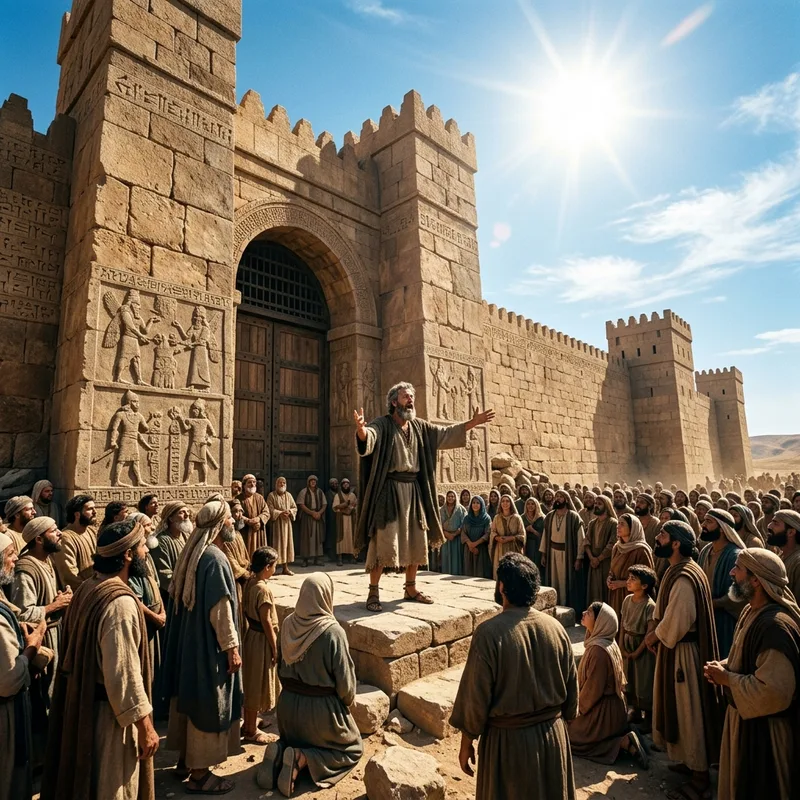
The word of the Lord came to Jonah a second time: "Go to the great city of Nineveh and proclaim to it the message I give you." This time, Jonah obeyed. He traveled to Nineveh, a massive city that required three days to walk across. It was the heart of the mighty Assyrian empire, filled with temples to pagan gods and historic cruelty.
Jonah entered the city and began his mission. As he walked a day's journey into the streets, he shouted his message:
"Forty more days and Nineveh will be overthrown!"
It was a blunt, short sermon. Jonah did not offer a message of hope or grace; he simply declared impending judgment. Yet, the response of the Ninevites was immediate and completely unprecedented.
2. The National Repentance of Assyria
The people of Nineveh believed God's warning. They declared a fast, and everyone, from the greatest to the least, put on sackcloth to show their mourning and repentance. When the news reached the king of Nineveh, he rose from his throne, took off his royal robes, covered himself with sackcloth, and sat down in the dust.
The king issued a royal decree throughout Nineveh:
"Do not let people or animals eat or drink anything. Let both people and beasts be covered with sackcloth. Let everyone call urgently on God. Let them give up their evil ways and their violence. Who knows? God may yet relent and with compassion turn from his fierce anger so that we will not perish."
When God saw what they did and how they turned from their evil ways, He had compassion and relented, choosing not to bring the destruction He had threatened. A pagan city had repented in ashes.
3. Jonah's Anger and His Confession
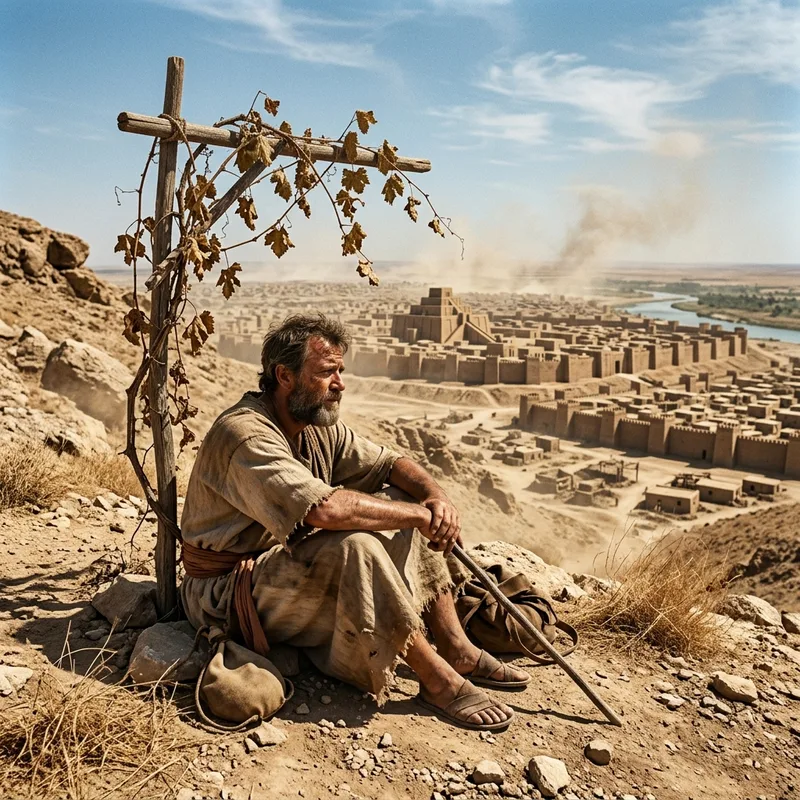 Jonah sat outside Nineveh under a wilted vine, deeply angry that God chose to show mercy and spare the pagan city.
But to Jonah, this was a disaster. He was deeply displeased and became angry. He prayed to Yahweh, and in his anger, he revealed the real reason he had run away to Tarshish:
"Isn't this what I said, Lord, when I was still at home? That is what I tried to forestall by fleeing to Tarshish! I knew that you are a gracious and compassionate God, slow to anger and abounding in love, a God who relents from sending calamity! Now, Lord, take away my life, for it is better for me to die than to live!"
Jonah was angry because God was *too* good. He wanted a narrow God who showed mercy only to Israel, but judged Israel's enemies. God replied with a gentle question: "Is it right for you to be angry?"
4. The Object Lesson: The Plant, the Worm, and the Wind
Jonah went out of the city and sat down east of it. There he made himself a shelter and sat in its shade, waiting to see what would happen to the city, hoping God might still destroy it. Yahweh provided a leafy plant (a gourd) and made it grow up over Jonah to give shade for his head and ease his discomfort. Jonah was very happy about the plant.
But at dawn the next day, God provided a worm, which chewed the plant so that it withered. When the sun rose, God provided a scorching east wind, and the sun beat down on Jonah's head until he grew faint. Once again, Jonah wished to die: "It is better for me to die than to live," he groaned.
God said to Jonah, "Is it right for you to be angry about the plant?"
"It is!" Jonah replied. "And I'm angry enough to die!"
Then Yahweh delivered the final, piercing rebuke of the book:
"You have been concerned about this plant, though you did not tend it or make it grow. It sprang up overnight and died overnight. And should I not have concern for the great city of Nineveh, in which there are more than a hundred and twenty thousand people who cannot tell their right hand from their left, and also many animals?"
The book ends with this open question, leaving the reader to reflect on their own heart. God's mercy extends to all peoples, and He desires that none should perish.
Reflections on the Story:
- The Character of God: Jonah 4:2 contains one of the most beautiful descriptions of God's character in the Bible. He is gracious, slow to anger, and abounding in love.
- Our Prejudices vs. God's Mercy: Jonah wanted mercy for himself (inside the fish) but judgment for others (Nineveh). We must guard against self-righteousness and rejoice when God shows grace to those we deem unworthy.
- The Value of Souls: God valued the 120,000 people of Nineveh far more than Jonah valued the shade plant. Our priorities should align with God's, valuing the eternal souls of people above personal comfort.
⚡ Fast Facts
- Forty Days: Jonah's brief prophetic message was simple: 'Forty more days and Nineveh will be overthrown.'
- National Repentance: The King of Nineveh issued a decree for all people and animals to fast and put on sackcloth.
- God's Compassion: Seeing their genuine change, God spared the city of over 120,000 people from destruction.
- The Lesson of the Plant: God used a leafy plant, a worm, and a hot wind to show Jonah his misplaced priorities.
❓ Frequently Asked Questions (FAQs)
Jonah hated the Assyrian enemies of Israel and wanted to see them judged. He admitted in Jonah 4:2 that he fled to Tarshish because he knew God is gracious, compassionate, slow to anger, and abounding in love, and would forgive them if they repented.
God provided a plant to shade Jonah, making him happy, but then sent a worm to wither it and a hot wind to make him miserable. When Jonah grieved over the plant, God pointed out the irony: Jonah cared for a short-lived plant, but had no pity for a massive city full of people.
The book ends abruptly with a question from God, asking if He should not care about the great city of Nineveh. This leaves the reader with a powerful message about God's universal love for all nations, not just Israel.