The book of Hosea opens not with a majestic vision of heaven or a battlefield triumph, but with one of the most agonizing divine assignments ever recorded. God summoned His prophet to preach through his own heartbeat, commanding him to love a woman who would repeatedly break his heart. Through the intimate tragedy of Hosea and Gomer, Yahweh unveiled the shocking depth of His eternal covenant love (hesed) for an unfaithful people, demonstrating that divine grace pursues even the most undeserving souls into the lowest depths of degradation.
1. The Sacred Call to a Painful Marriage
During the eighth century BC, the Northern Kingdom of Israel under King Jeroboam II enjoyed unprecedented material prosperity and military security. Yet beneath the glittering surface of wealth lay rampant spiritual decay. The altars of Baal and Asherah dotted every high hill, religious prostitution flourished, and the covenant of Moses was openly trampled. The people credited pagan fertility gods for their harvest of grain, wine, and olive oil, while turning their backs on Yahweh who had delivered them from Egypt.
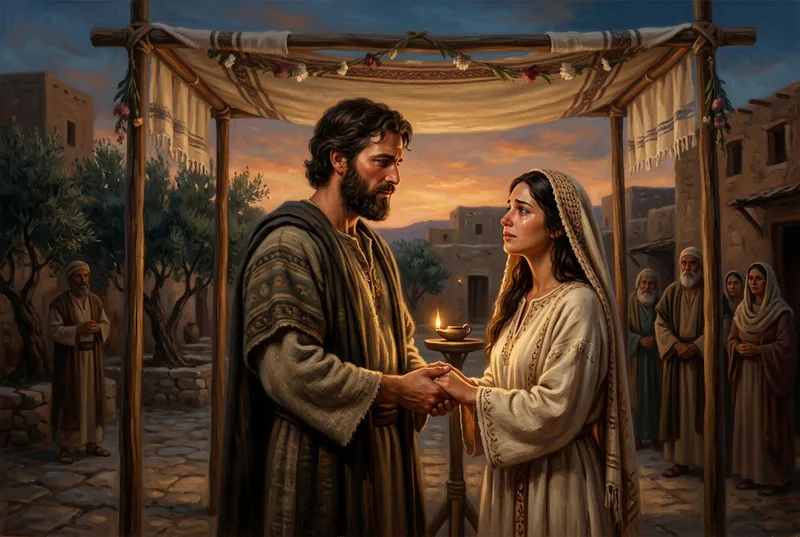
In the midst of this national apostasy, the word of the Lord came to a young prophet named Hosea, son of Beeri. The divine command was startling: "Go, marry a promiscuous woman and have children with her, for like an adulterous wife this land is guilty of unfaithfulness to the Lord." God did not ask Hosea merely to speak words of condemnation from a safe distance; He asked Hosea to enter into the very agony that God Himself felt. Hosea obeyed. He sought out Gomer, daughter of Diblaim, and took her into his home as his lawful wife under the sacred wedding canopy.
In the early seasons of their marriage, Hosea lavished his bride with honor, provision, and tender affection. Yet this marriage was destined to become a living stage upon which the spiritual drama of Israel would unfold. Every meal shared, every silence in the courtyard, and every whisper in the marketplace carried the weight of a prophetic message. Hosea loved Gomer with an unwavering, pure devotion, reflecting Yahweh's tender betrothal of Israel at Mount Sinai.
2. The Prophetic Children and the Broken Home
In time, Gomer conceived and bore a son. The Lord commanded Hosea, "Call him Jezreel, because I will soon punish the house of Jehu for the massacre at Jezreel, and I will put an end to the kingdom of Israel." The name Jezreel, meaning 'God scatters' or 'God sows', was an ominous reminder that the blood-soaked history of the nation would culminate in divine judgment upon its fertile fields.
Later, Gomer gave birth to a daughter. The Lord instructed Hosea, "Name her Lo-Ruhamah (which means 'Not Pitied' or 'No Mercy'), for I will no longer show love to the house of Israel, though I will show love to the house of Judah and save them." The tender heart of a father was required to speak a name of rejection, signifying that Israel had exhausted the patience of the Almighty through relentless idolatry.
After Lo-Ruhamah was weaned, Gomer bore another son. God declared, "Call him Lo-Ammi (meaning 'Not My People'), for you are not my people, and I am not your God." This was the most catastrophic pronouncement imaginable. The foundational covenant promise—'I will be your God and you will be my people'—was officially dissolved by their persistent rebellion. Yet immediately after this harsh sentence, divine grace shone through the darkness. Hosea prophesied that in the very place where it was said to them, 'You are not my people,' they would one day be called 'Children of the living God.'
3. The Wandering Bride in the Slave Market
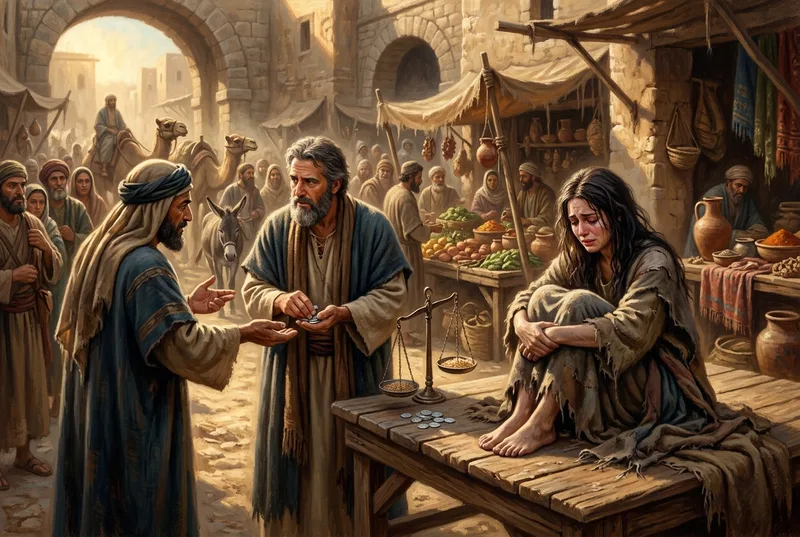 Hosea paid fifteen shekels of silver and five bushels of barley to buy back his unfaithful wife from the auction block of slavery.
Despite Hosea's kindness and the warmth of their home, Gomer's restless heart pulled her away. She began to pursue her former lovers, chasing after the empty promises of pagan fertility cults. She convinced herself that her lovers provided her bread, water, wool, linen, olive oil, and drink, completely ignorant that it was Hosea who had quietly provided for her needs all along. Eventually, her sinful pursuits led to utter disaster. The men who had flattered her abandoned her. Gomer sank lower and lower into poverty and debt until she was stripped of her dignity and placed on the public auction block as a destitute slave.
By all human standards and under the strict letter of ancient law, Hosea had every right to publicly stone her or permanently disown her. He had endured public humiliation, betrayal, and heartbreak. But then came the shocking voice of God in Hosea 3:1: "Go, show your love to your wife again, though she is loved by another man and is an adulteress. Love her as the Lord loves the Israelites, though they turn to other gods."
Hosea did not hesitate. He walked down into the noisy, dusty marketplace where slaves were bought and sold like cattle. He saw Gomer—tattered, weeping, broken, and shamed. Stepping forward before the auctioneer and the mocking crowd, Hosea reached into his pouch. He counted out fifteen shekels of silver—half the price of a common slave—and added a homer and a lethek (about five bushels) of barley to make up the full price. He did not merely forgive her with empty words; he paid for her redemption with his own hard-earned wealth.
4. The Wilderness of Restoration and Divine Romance
Taking Gomer by the hand, Hosea brought her back home. He looked into her tear-filled eyes and spoke with profound tenderness: "You must live with me many days; you must not be a prostitute or be intimate with any man, and I will behave the same way toward you." He established a season of quiet seclusion, not to punish her, but to heal her wounded soul and restore the purity of their covenant.
Through this breathtaking act of restoration, God revealed His master plan for Israel and all humanity. Yahweh declared through the prophet: "Therefore I am now going to allure her; I will lead her into the wilderness and speak tenderly to her. There I will give her back her vineyards, and will make the Valley of Achor (Trouble) a door of hope." In the quiet desert of repentance, Israel would no longer call God 'Baali' (my master), but 'Ishi' (my husband).
God sealed this promise with an eternal wedding vow that echoes across all generations: "I will betroth you to me forever; I will betroth you in righteousness and justice, in love and compassion. I will betroth you in faithfulness, and you will acknowledge the Lord." The story of Hosea and Gomer stands as a monument of unconditional grace. It demonstrates that no matter how far we have wandered, how deeply we have sinned, or how severely we have degraded ourselves, the relentless love of God is willing to pay the highest price to bring us home.
Reflections on the Story:
- The Heart of God in Human Pain: Hosea's heartbreak allowed him to experience the emotional reality of God's grief over human sin. Our disobedience is not merely a legal violation; it wounds the loving heart of our Creator.
- The Cost of True Redemption: Hosea paying silver and barley to redeem his undeserving wife prefigures Jesus Christ giving His very life on the Cross to purchase sinners out of the slave market of sin.
- The Valley of Achor as a Door of Hope: God specializes in transforming our greatest places of failure, shame, and trouble into gateways of restoration and new beginnings.
- Unfailing Covenant Love (Hesed): Human love is often fickle and conditional, but God's love is rooted in His unbreakable covenant nature. When we are faithless, He remains faithful.
⚡ Fast Facts
- Prophetic Marriage: Hosea was commanded to marry Gomer as a living visual sermon to northern Israel.
- Symbolic Names: Their children were named Jezreel (judgment), Lo-Ruhamah (no mercy), and Lo-Ammi (not my people).
- Redemption Price: Hosea bought back his unfaithful wife for fifteen shekels of silver and a homer and a lethek of barley.
- Covenant Restoration: God promised that in the future, 'Not my people' would be called 'Children of the living God.'
❓ Frequently Asked Questions (FAQs)
God used Hosea's painful personal life as a dramatic object lesson. Just as Gomer pursued other lovers despite Hosea's pure love, Israel repeatedly chased pagan idols despite God's covenant faithfulness. Hosea's broken heart reflected the grief of God's own heart.
Jezreel pointed to the coming divine retribution on the house of Jehu in the Jezreel valley. Lo-Ruhamah ('Not Pitied') meant God would temporarily withhold compassion from Northern Israel. Lo-Ammi ('Not My People') declared the broken covenant relationship due to persistent idolatry.
Hosea paying the purchase price to redeem Gomer from the slave market is a profound Old Testament picture of redemption. In the same way, Jesus Christ paid the ultimate price with His own blood to purchase fallen humanity out of the slavery of sin and restore us into loving communion with God.