The word of Yahweh broke like lightning into the tranquil Galilean hills of Gath-hepher, addressing the nationalist prophet Jonah son of Amittai. Jonah was already a respected court prophet in the northern kingdom of Israel; during the prosperous reign of Jeroboam II, he had successfully prophesied the territorial expansion of Israel's borders from the entrance of Hamath to the Sea of the Arabah (2 Kings 14:25). But the divine commission that now fell upon his ears was entirely without precedent in Hebrew history: "Qum lekh el-Nineveh ha-ir ha-gedolah u-qera aleiha! Arise, go to Nineveh, that great city, and call out against it, for their evil has come up before me!" (Jonah 1:2). Yahweh was not sending him to comfort the faithful tribes of Jacob; He was ordering him to cross six hundred miles of desert into the very belly of the brutal Neo-Assyrian Empire, whose imperial shock troops were renowned for impaling captives, flaying enemies alive, and terrorizing the ancient Near East.
The Flight to Tarshish and the Downward Spiral
Jonah understood the theological character of Yahweh far too well. He knew that if he proclaimed divine judgment to the Ninevites, they might repent—and if they repented, the gracious, slow-to-anger God of Israel would spare the very pagan superpower destined to conquer and crush his own homeland. Paralyzed by ethnocentric nationalism and theological resentment, Jonah chose active rebellion. Instead of heading east toward Nineveh, the prophet turned his back on God and hurried southwest to the ancient coastal port of Joppa (modern Jaffa). There he found a Phoenician deep-sea trading galleon bound for Tarshish (Tartessos in southern Spain)—the westernmost limit of the known maritime world, over two thousand miles across the Mediterranean Sea in the diametrically opposite direction.
The biblical narrative records Jonah's spiritual trajectory as a tragic downward spiral: he went down to Joppa, went down into the ship, paid its fare (Sekharah), and went down into the innermost hold of the vessel to flee from the presence of the Lord (mi-lifnei Yahweh). In the suffocating darkness of the cargo hold, exhausted by the psychological weight of his rebellion, Jonah fell into a heavy, unnatural stupor. But the Creator of heaven and earth is not a local tribal deity who can be outdistanced by a wooden hull and woven sails; the heavens belong to Yahweh, and the earth is His footstool.
The Monster Storm and the Pagan Sailors
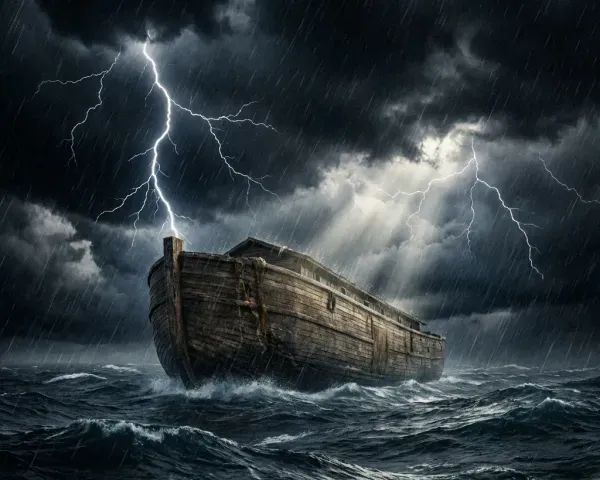
As the ship cleared the Levantine coastline and entered open water, the text declares: "Vayeitil Yahweh ruach-gedolah el-ha-yam! And Yahweh hurled a great hurricane wind upon the sea!" (Jonah 1:4). The Mediterranean erupted into a foaming tempest of catastrophic proportions. Mountainous waves battered the wooden vessel, straining the timber joints until the ship threatened to break into kindling. Seasoned Phoenician mariners, who had weathered countless Mediterranean storms, were seized with mortal terror. In frantic desperation, each sailor began crying out to his own patron deity—Baal-Melqart, Dagon, Ashtoreth, and Mot—while hurling heavy cargo and provisions overboard to lighten the vessel.
Amidst the howling winds and crashing seas, the ship's captain staggered down into the lower hold and discovered Jonah sleeping soundly. Shaking the fugitive prophet violently, the pagan captain roared: "What do you mean, you sleeper? Arise, call out to your god! Perhaps your god will consider us, that we may not perish!" The irony was piercing: a pagan sea captain was rebuking a Hebrew prophet of the Living God, commanding him to pray while the prophet's rebellion had endangered everyone aboard.
The Lot Falls and the Judgment of the Abyss
Determining that this was no ordinary weather phenomenon but a supernatural pursuit driven by divine wrath, the sailors said to one another: "Come, let us cast lots (Goralot), that we may know on whose account this evil has come upon us!" In ancient Near Eastern culture, the lot was understood as an appeal to divine sovereignty (Proverbs 16:33). Under the invisible guidance of God, the lot fell squarely upon Jonah. Surrounded by frantic, wide-eyed sailors, the prophet was interrogated: "Tell us, on whose account has this evil come upon us? What is your occupation? Where do you come from? What is your country? And of what people are you?"
Jonah's answer was an astonishing, self-condemning theological confession: "Ivri anokhi! I am a Hebrew; and I fear Yahweh, the God of heaven, who made the sea and the dry land!" (Jonah 1:9). Upon hearing this, the sailors were struck with exceeding terror. They cried: "What have you done?" For Jonah had already confessed that he was running away from the presence of this cosmic Creator. As the fury of the waves intensified, the sailors asked what they must do to appease this raging sea. Jonah answered with solemn resignation: "Pick me up and hurl me into the sea; then the sea will quiet down for you, for I know that it is because of me that this great tempest has come upon you."
Remarkably, the pagan sailors exhibited far greater moral tenderness and respect for human life than the prophet had displayed toward Nineveh. Rather than tossing him overboard immediately, the crew rowed with exhausting desperation to reach dry land, digging their oars into the surging foam. But the sea grew ever more tempestuous against them. Finally, crying out in terror to Jonah's God—"O Yahweh, let us not perish for this man's life, and do not lay on us innocent blood!"—they took hold of the Hebrew prophet and hurled him over the bulwarks into the roaring abyss. The moment Jonah's body splashed into the churning water, the monstrous tempest ceased instantly; the waves smoothed to glass, and the sea fell into dead silence. Overwhelmed by this instantaneous cosmic display, the pagan sailors feared Yahweh exceedingly, offered a sacrifice, and made solemn vows to the Living God of Israel.
Three Days in the Belly of Sheol and the Cry of Thanksgiving
As Jonah sank down into the suffocating green depths of the Mediterranean, suffocating brine rushed into his throat. His limbs flailed helplessly; the water closed over him to take his life; the deep engulfed him; and thick seaweed (suf) wrapped tightly around his head. He was sinking down to the roots of the underwater mountains, entering the bars of the earth and the dark gates of Sheol (the realm of the dead). In human terms, the fugitive prophet was dead.
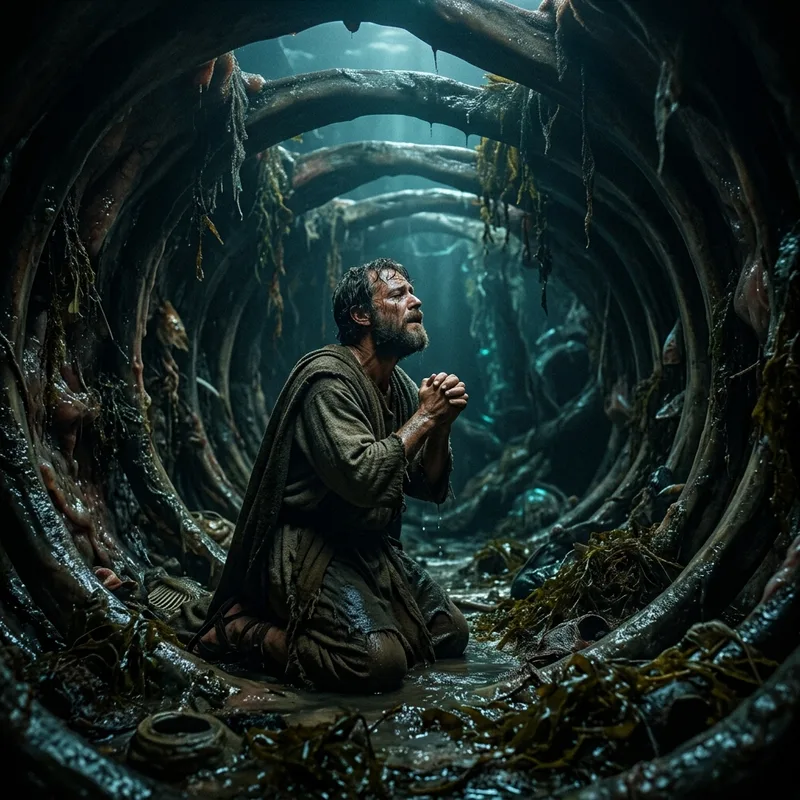
"Vayman Yahweh dag gadol livlo'a et-Yonah! And Yahweh appointed a great fish to swallow Jonah!" (Jonah 1:17). Emerging from the dark oceanic depths, a colossal, divinely prepared sea creature swallowed the drowning man whole. Jonah slid into the cavernous, air-filled digestive chamber of the beast. For three days and three nights, enclosed in pitch-black darkness, surrounded by pungent gastric fluids and the rhythmic pulsing of the great creature's organs, Jonah was suspended between life and death. The creature's belly was simultaneously a tomb of divine judgment and a womb of divine mercy.
Inside the fish's belly, Jonah did not pray for escape or bargain with God; instead, his soul erupted into a sublime, classic Hebrew psalm of thanksgiving (Jonah 2:1–9). He acknowledged that it was Yahweh who had cast him into the deep; he confessed that in his agony he cried out to the Lord, and God heard his voice from the belly of Sheol. He recognized the sheer vanity of idolatry: "Those who cling to empty idols forfeit the steadfast covenant love (chesed) that could be theirs!" (Jonah 2:8). Jonah made a solemn vow to offer sacrifices with the voice of thanksgiving and fulfill his covenant duties, culminating in the foundational theological declaration of Scripture: "Yeshu'atah la-Yahweh! Salvation belongs to Yahweh!"
The lesson was learned: salvation does not belong to Israel, does not belong to human merit, and is not bounded by geography or ethnicity. Salvation is Yahweh's sovereign prerogative alone. Having brought His prophet to absolute brokenness and surrendered praise, Yahweh spoke to the great fish, and the obedient creature surged toward the Mediterranean shoreline, vomiting Jonah out onto dry land (Yabbashah). Bleached, shaken, yet resurrected from the grave, Jonah stood upon the sand—ready at last to hear the word of the Lord a second time.
Biblical Keywords & Theological Roots
Ancient Near Eastern & Archaeological Context
The historical setting of Jonah son of Amittai belongs to the 8th century BC (c. 780–750 BC) during the reign of Jeroboam II in Israel, an era of territorial expansion and relative economic prosperity documented in 2 Kings 14:25. The destination of Jonah's flight, Tarshish, is identified by modern biblical archaeologists and historians with Tartessos, a wealthy Phoenician maritime trading colony located in southwestern Spain (beyond the Pillars of Hercules at the mouth of the Guadalquivir River). By fleeing toward Tarshish from the port of Joppa, Jonah was attempting to sail to the absolute western edge of the known Mediterranean world, placing the entire breadth of the known world between himself and Nineveh, which lay 600 miles to the east along the Tigris River. The Phoenician ship was an open-sea merchant vessel ('ship of Tarshish') manned by polytheistic Canaanite sailors whose religious worldview attributed maritime storms to chaotic sea deities like Yam. The Hebrew term used for the appointed sea creature, 'dag gadol', refers not specifically to a whale in modern biological taxonomy, but to any massive marine creature sovereignly prepared by God. Jonah's subsequent survival for three days in its belly prefigures the sign of Jonah fulfilled in the death, burial, and resurrection of Jesus Christ (Matthew 12:40).
Practical Discipleship & Spiritual Application
- Stop Running and Surrender to Your Divine Calling: When God commands you to step out in obedience, fleeing in the opposite direction only creates storms for yourself and those around you. Lay down your resistance and embrace God's will today.
- Recognize God's Mercy in the Midst of Life's Fiercest Storms: The tempest and the great fish were not instruments of ultimate destruction, but God's severe mercies designed to arrest Jonah's downward spiral. View your present crisis as a divine intervention calling you back to intimacy.
- Pray With Thanksgiving in Your Darkest Hour: Jonah did not wait until he was safely on dry land to praise God; he offered sacrificial thanksgiving from the belly of Sheol. When trapped in pitch-black circumstances, let worship be your weapon of faith.
- Release All Spiritual Prejudices and Share the Gospel Freely: Refuse to harbor bitterness or write off entire groups of people as unworthy of God's grace. The gospel belongs to every nation, tribe, and tongue, and God calls you to be His compassionate ambassador.
Support Independent Biblical Research
Did this study bless you? Help support our independent bilingual research and interactive visual Bible tools.
⚡ Fast Facts
- Jonah was a historical prophet from Gath-hepher in Galilee during the reign of Jeroboam II (2 Kings 14:25).
- Tarshish (Tartessos in southern Spain) was located over 2,000 miles west, the opposite direction from Nineveh.
- The pagan sailors showed remarkable compassion, striving desperately to row to land before reluctantly hurling Jonah overboard.
- Jonah's three days in the fish's belly was explicitly cited by Jesus as the prophecy of His death and resurrection (Matt 12:40).
❓ Frequently Asked Questions (FAQs)
Why did Jonah run away from God's command to preach to Nineveh?
Jonah ran not out of fear, but out of theological resentment and nationalistic prejudice. As revealed in Jonah 4:2, he knew God was gracious, compassionate, and slow to anger. He feared that if the brutal Assyrians repented, God would spare them, preserving a cruel pagan empire that posed an existential threat to his homeland Israel.
Was the 'great fish' that swallowed Jonah a whale or another sea creature?
The Hebrew text uses the phrase 'dag gadol' (great fish), while the Greek New Testament uses 'ketos' (large sea creature). The Bible does not specify modern zoological taxonomy; it was a miraculous, sovereignly prepared marine creature large enough to swallow a human being whole and sustain him alive for three days by divine providence.
How does Jonah's experience prefigure the resurrection of Jesus Christ?
In Matthew 12:39–40, Jesus explicitly declared that the only sign given to His generation would be the 'sign of Jonah.' Just as Jonah was entombed in the belly of the fish for three days and three nights before emerging alive to bring salvation to the Gentiles, so Christ was buried in the heart of the earth for three days before rising victoriously to offer salvation to all nations.