The final days of the prophet Elisha present a powerful narrative of prophetic passion and divine power that outlasted the grave. Even as Elisha lay dying of a terminal illness, his concern remained for the defense of Israel. Through a symbolic arrow and a miracle in a tomb, God demonstrated that His power and the prophetic word are never bound by human weakness or even death itself.
1. The Weeping King and the East Window
When Elisha became sick with the illness from which he was to die, Jehoash the king of Israel came down to visit him. Seeing the great prophet frail and failing on his bed, the king wept over him and cried out, "My father, my father! The chariots and horsemen of Israel!" This was the exact phrase Elisha had used decades earlier when Elijah was caught up in the whirlwind. The king knew that Elisha's spiritual authority was a wall of fire around Israel, far greater than any physical cavalry.
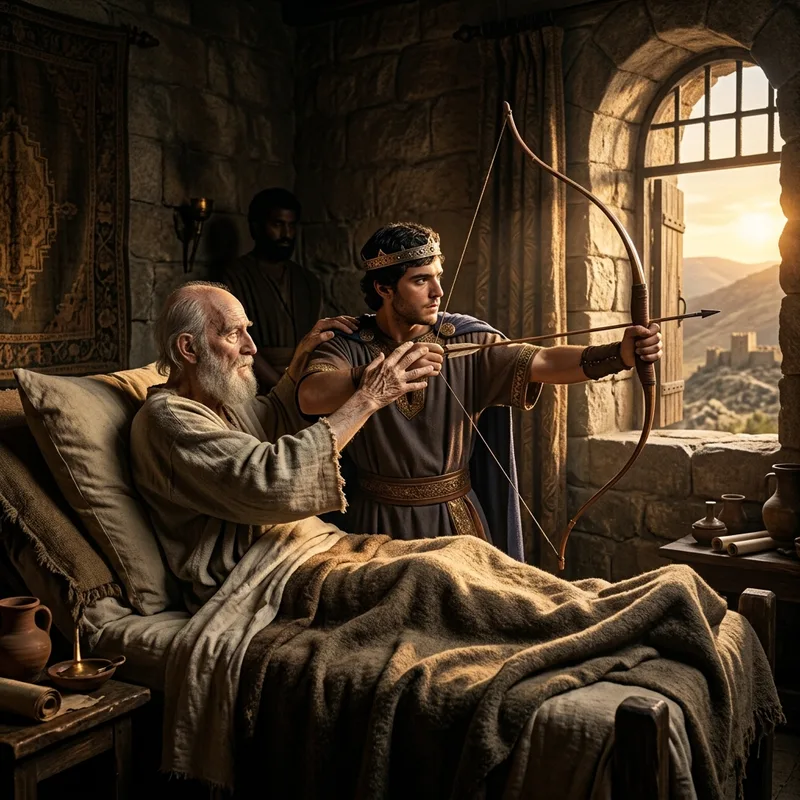
Elisha, though physically weak, was spiritually undiminished. He commanded the king, "Get a bow and some arrows." Jehoash did so. Elisha then said to the king of Israel, "Put your hand on the bow." When the king placed his hand on the weapon, Elisha laid his own frail, aged hands on the king's hands. This act symbolized that it was not by human military might, but by the divine power of God working through the prophet that victory would be secured.
 Elisha laid his hands on the king's hands and said, "Open the east window and shoot!" symbolizing God's arrow of victory over Aram.
"Open the east window," Elisha commanded. Jehoash opened it. "Shoot!" Elisha said. The king shot the arrow, and it whistled out into the morning sky toward the territory occupied by Aram. Elisha declared:
"The Lord’s arrow of victory! The arrow of victory over Aram! You will completely destroy the Arameans at Aphek!"
2. The Test of Zeal: Striking the Ground
Next, Elisha gave the king a test of his faith and resolve. "Take the arrows," he said. The king took them. Elisha commanded, "Strike the ground!"
Jehoash took the arrows and struck the ground three times, and then stopped. He did so half-heartedly, perhaps thinking the action was beneath a king or not fully grasping the prophetic urgency. Elisha, the man of God, was angry with him.
"You should have struck the ground five or six times!" Elisha rebuked him. "Then you would have defeated Aram and completely destroyed it! But now you will defeat it only three times!"
Jehoash had limited his own victory because his faith was lukewarm. He wanted God's help but lacked the passionate, aggressive zeal to pursue full deliverance. Elisha's rebuke stands as a warning against half-hearted faith.
3. Elisha's Death and the Miracle in the Tomb
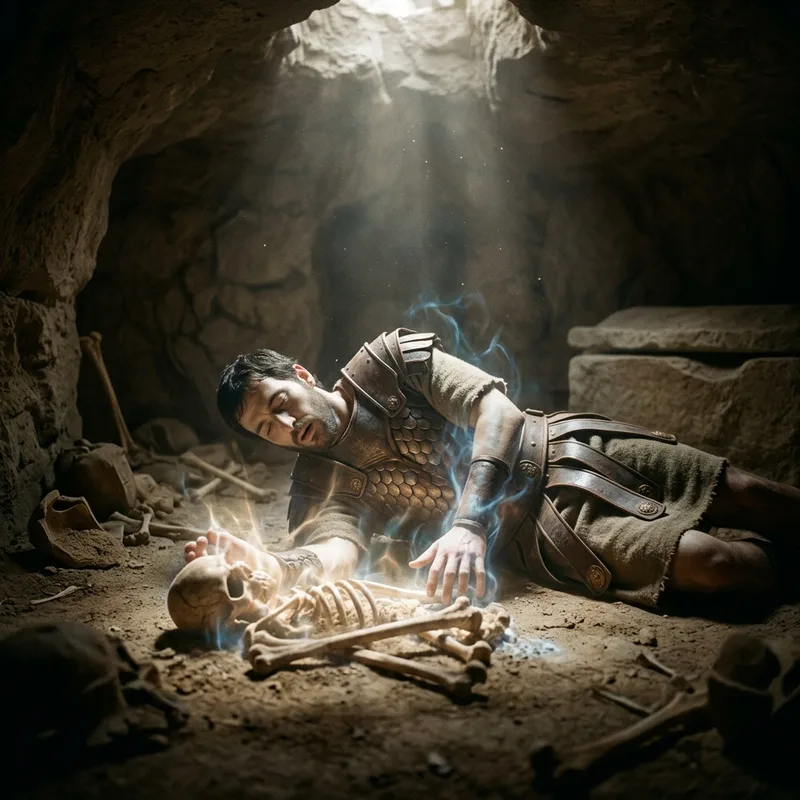
Shortly after this, Elisha died and was buried in a rocky tomb. Months passed, and the Moabite raiders began to invade Israel every spring. One day, a group of Israelites was carrying a body to be buried. Suddenly, they saw a band of Moabite raiders coming toward them in the distance. Terrified and needing to flee quickly, they did not have time to dig a proper grave.
They quickly rolled away the stone of the nearest tomb—which happened to be the tomb of Elisha—and threw the dead body inside. As the corpse fell into the darkness and touched the dry bones of Elisha, the dead man instantly came back to life! He stood up on his feet, fully restored.
This final, astonishing miracle confirmed that the prophetic word given by Elisha before his death was still alive and active. God's power did not decay with Elisha's flesh. King Jehoash did go on to launch three military campaigns against Aram, recovering the cities that had been captured, exactly as the dying prophet had predicted.
Reflections on the Story:
- The Danger of Half-Heartedness: Jehoash's failure to strike the ground repeatedly shows how our lack of zeal and expectation can limit what God wants to do in our lives. We must pursue God with all our heart.
- The Endurance of God's Word: Elisha died, but his prophecies survived him. God's word outlasts its speakers and will surely be fulfilled.
- A Shadow of Resurrection: The resurrection of the dead man who touched Elisha's bones is a beautiful foreshadowing of Jesus Christ. Just as touching Elisha's bones brought physical life, contact with Christ brings eternal life to all who are dead in sin.
⚡ Fast Facts
- King's Lament: King Jehoash wept over Elisha, calling him 'The chariots and horsemen of Israel!'
- The East Window: Shooting an arrow toward the east symbolized God's arrow of victory over Syria.
- Striking the Ground: Jehoash struck the ground only three times, provoking Elisha's anger for his lack of zeal.
- Resurrection Bones: A dead man was resurrected instantly when his body touched Elisha's dry bones in a tomb.
❓ Frequently Asked Questions (FAQs)
Jehoash recognized that Elisha's spiritual presence and prayers were a greater defense for Israel than any physical army or chariots. It was the same lament Elisha had spoken when Elijah was taken up to heaven.
Striking the ground was a prophetic act of faith representing the destruction of Aram. The king's decision to strike only three times showed a lack of complete faith and passion. Elisha wanted the king to strike five or six times for complete victory.
This unique miracle shows that God's power and the fulfillment of His promises are not limited by death. It served as a divine confirmation to Israel that Elisha's final prophecies of victory over Aram would surely come to pass.