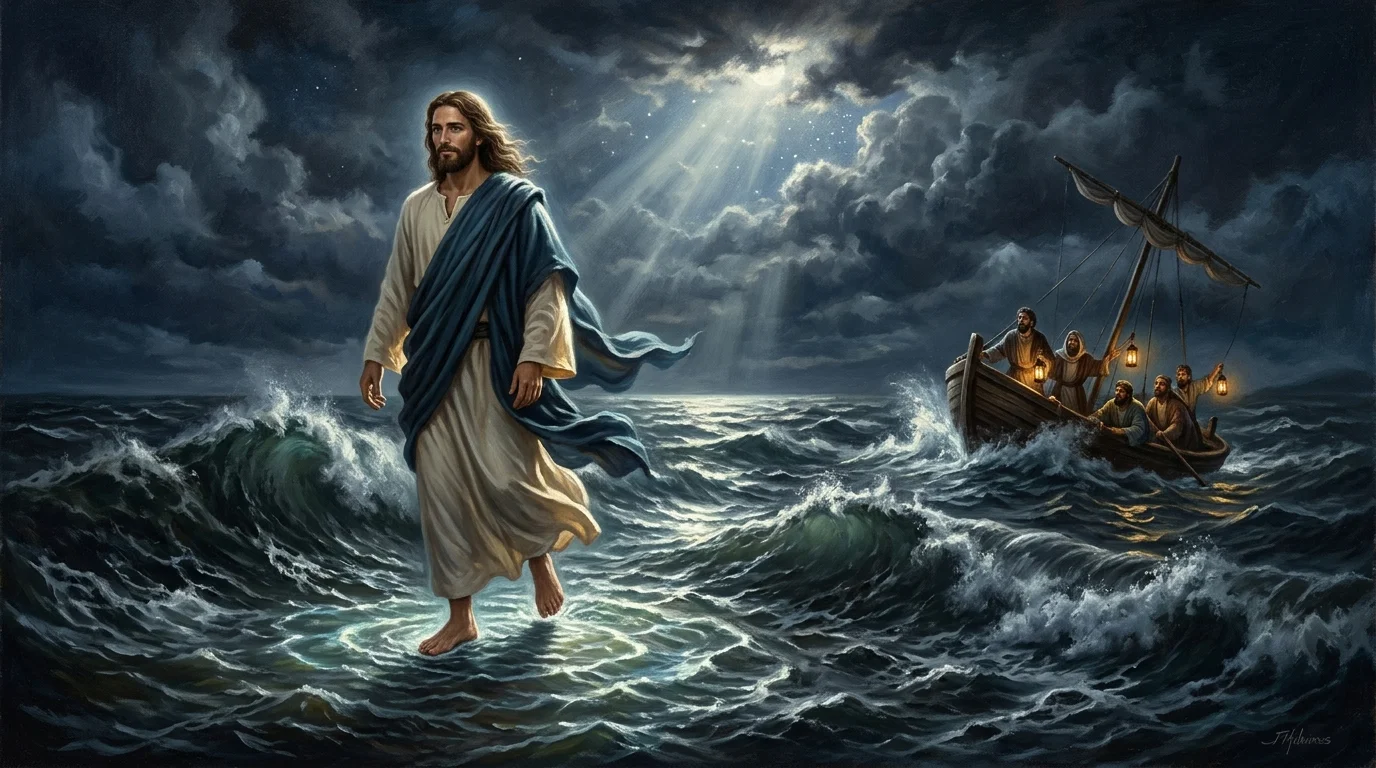
The euphoria on the northeastern slopes of Bethsaida had reached a dangerous, fevered pitch. Twenty thousand fed and satisfied pilgrims were talking of revolution; murmurs spread through the crowd to seize Jesus by sheer physical force and march upon Jerusalem to crown Him King of Israel. Sensing the carnal trap, Christ acted with unyielding decisiveness. Matthew records: "Immediately Jesus made His disciples get into the boat and go before Him to the other side, while He sent the multitudes away" (Matthew 14:22). He forcefully compelled His protesting apostles into their wooden vessel, dispersed the buzzing crowds into the descending twilight, and then turned His back upon the applause of men. Ascending the solitary limestone ridges alone, Jesus spent hours wrapped in the deep, freezing darkness of the mountain heights, pouring out His soul in high priestly intercession before the Father. But far below in the pitch-black basin of the Sea of Galilee, a terrifying drama was unfolding: human strength was grinding to a catastrophic halt against the howling fury of the elements!
1. The Tormented Ship in the Abyss
By midnight, the Sea of Galilee had transformed into a boiling cauldron. Violent cyclonic gales roared down through the steep basalt ravines of Mount Arbel, colliding violently over the subterranean lake. Matthew records the desperate plight of the disciples with a terrifying Greek verb:
"But the boat was now in the middle of the sea, tossed by the waves; for the wind was contrary." (Matthew 14:24).
The word translated "tossed" is basanizomenon—literally battered, harassed, tormented, or tortured! Towering black waves crashed over the wooden gunwales, swamping the deck with freezing water. Four seasoned Galilean fishermen—Peter, Andrew, James, and John—strained their muscles against the heavy ash oars. Their hands were blistered, their shoulders burned with agony, and their clothes were drenched.
John records that they had rowed twenty-five to thirty stadia—about three to four miles into the very center of the lake (John 6:19). They could neither advance toward Capernaum nor retreat to Bethsaida. Trapped in the churning vortex of the deep, every wave threatened to roll the vessel into a watery grave. Hour after hour dragged by in agonizing, hopeless labor.
2. The Sovereign on the Waves
Then came the fourth watch of the night—the Roman military division spanning the freezing, exhausted hours between three and six o'clock in the morning, just before the first faint crack of dawn.
From His mountain vantage point, Mark records an astonishing detail: "Then He saw them straining at rowing, for the wind was against them" (Mark 6:48). Even in the pitch darkness, through the veil of roaring rain and spray, the eyes of the Great High Priest never lost sight of His struggling children!
Descending the mountain, Jesus stepped onto the raging shoreline. And then, without hesitation, the Creator of the universe stepped off the land and onto the liquid surface of the deep!
Matthew records: "Now in the fourth watch of the night Jesus went to them, walking on the sea" (Matthew 14:25).
Contemplate the cosmic majesty of that scene! In ancient Semitic theology, the sea (*Yam*) represented the primordial abyss of chaos, death, and uncontrollable demonic fury. Job had declared fifteen centuries earlier that Yahweh alone "treads on the waves of the sea" (Job 9:8). Psalm 77:19 proclaimed: "Your way was in the sea, Your path in the great waters, and Your footsteps were not known."
Here was Yahweh in human flesh! Christ walked not upon a placid sheet of ice, but across towering liquid crests, stepping serenely upon surging foam as if it were polished basalt. Wind whipped His garments; spray roared around His face; yet the chaotic abyss was nothing more than a carpet beneath His holy sandals!
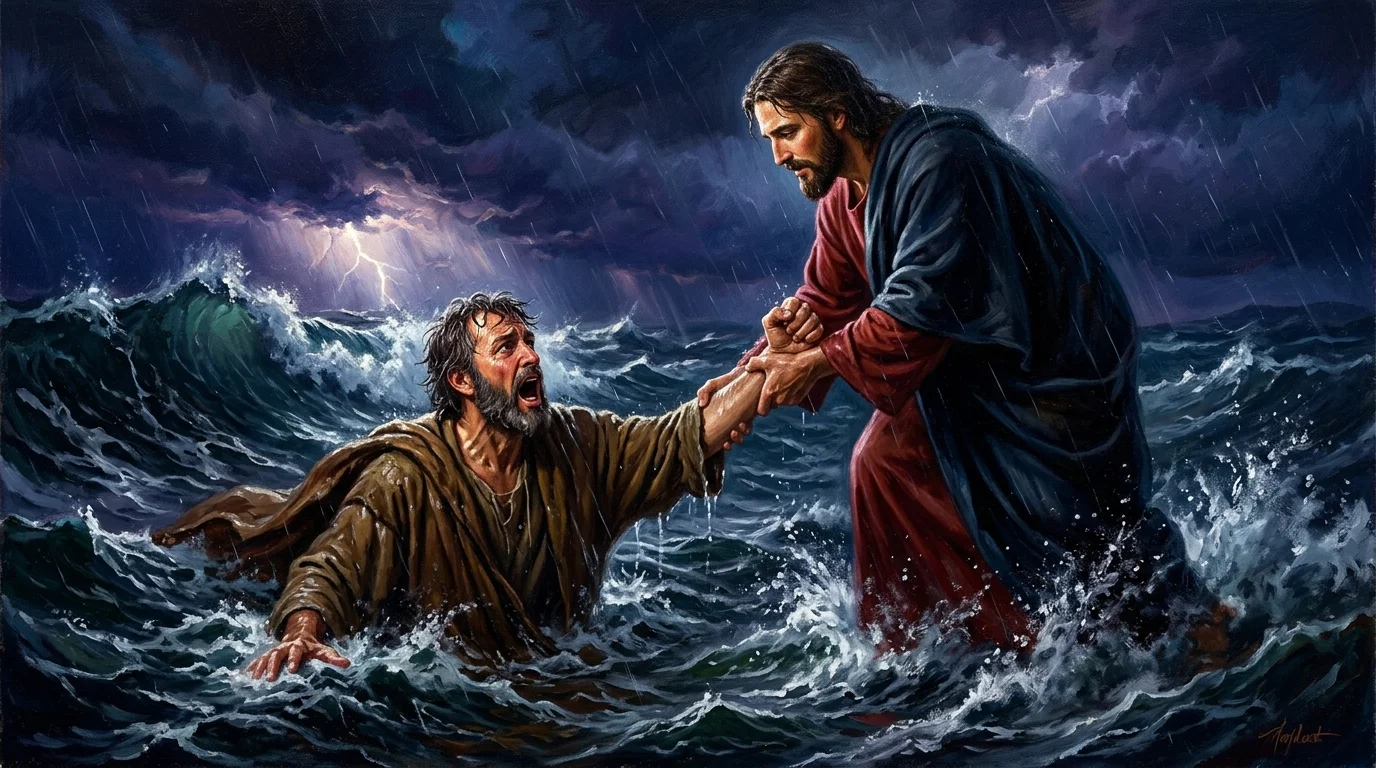 The Grasp of Sovereign Grace: 'Lord, save me!'—Christ stretching forth His hand into the churning foam to snatch Peter from the clutches of the grave.
3. "It Is I; Do Not Be Afraid!"
Through the flying foam and dark mist, the exhausted rowers caught sight of a silhouette striding across the waves. Mark adds an enigmatic detail: "He would have passed them by" (Mark 6:48)—the classic biblical language of a theophany, reminiscent of God passing before Moses at Sinai (Exodus 33:22) and Elijah at Horeb (1 Kings 19:11). Christ was unveiling His transcendent glory!
The disciples did not recognize Him. Superstitious dread gripped their hearts. Matthew records: "And when the disciples saw Him walking on the sea, they were troubled, saying, 'It is a ghost!' And they cried out for fear" (Matthew 14:26).
Grown, hardened fishermen screamed in shrill, paralyzing terror! They believed they were gazing upon a water phantom (*phantasma*)—the harbinger of imminent drowning.
Instantly, before the echoes of their screams died across the waves, the voice of the Son of God cut through the hurricane gale like a clarion trumpet:
"Take heart! It is I; do not be afraid!" (Matthew 14:27; Mark 6:50).
In the Greek text, Christ speaks the supreme revelation of the Godhead: Tharseite, EGŌ EIMI, mē phobeisthe! He uses the uncreated covenant Name: "I AM!" It was the very voice that spoke from the unconsumed bush on Horeb: "Do not fear the storm, for the Creator of the storm is here!"
4. The Radical Leap of Faith
Recognizing that familiar, beloved voice, Simon Peter's impulsive heart caught fire. Standing upon the pitching deck, gripping the wooden gunwale, Peter cried out:
"Lord, if it is You, command me to come to You on the water!" (Matthew 14:28).
Notice Peter's precision: He did not say, "Lord, let me try a water-walking experiment." He did not jump over the side on personal presumption. He recognized that authority belonged entirely to Christ's word: "If it is You, command me!" Peter understood that if Jesus commanded it, the command itself would carry the supernatural enabling power!
Jesus did not deliver a lecture on naval safety. Christ spoke a single Greek word:
"Elthe!"—"Come!" (Matthew 14:29).
What followed is one of the most heroic moments in human history. Peter threw his legs over the wooden side of the tossing vessel. He placed his bare foot down—not onto a solid wooden dock, but onto the turbulent, swirling surface of liquid water!
And the water held him! Natural physics surrendered to divine authority. Matthew records with breathtaking simplicity: "And when Peter had come down out of the boat, he walked on the water to go to Jesus" (Matthew 14:29).
Peter walked on water! Every step was an impossibility; every stride defied gravity. For several glorious paces, anchored in the gaze of Jesus Christ, a frail Galilean fisherman stepped on the waves of death!
5. The Boisterous Wind and the Three-Word Cry
Then, catastrophe struck. Matthew records the tragic turning point:
"But when he saw that the wind was boisterous, he was afraid; and beginning to sink he cried out, saying, 'Lord, save me!'" (Matthew 14:30).
Notice the shift in Peter's senses: He shifted his gaze from the face of Christ to the circumference of the storm. A towering wave rose between him and Jesus; icy spray slashed across his eyes; the howling gale screamed in his ears. Carnal logic snapped back into his consciousness: "Water cannot hold a human body! I am three miles from shore! I am going to drown!"
The Greek word for "beginning to sink" is katapontizesthai—literally being dragged down into the underwater abyss. The water beneath his feet turned from granite back into liquid; gravity reasserted itself, and the cold depths swallowed his legs and waist!
Peter had no time for elaborate liturgical rhetoric. He could not chant Psalm 119. With water splashing into his mouth, he shouted the shortest, most powerful, most urgent prayer recorded in human history:
"Kyrie, sōson me!"—"Lord, save me!"
6. The Saving Grasp and the Cosmic Worship
Matthew records the lightning response of sovereign mercy: "And immediately Jesus stretched out His hand and caught him, and said to him, 'O you of little faith, why did you doubt?'" (Matthew 14:31).
Notice the divine speed: "Immediately!" Jesus did not let Peter go under three times to teach him a harsh lesson. Christ did not fold His arms and lecture him from a safe distance. Reaching down into the frothing brine, Christ's strong carpenter's hand clamped firmly around Peter's trembling wrist, yanking him upward from the jaws of the deep!
Then came the tender, penetrating rebuke: "Oligopiste, eis ti edistasas?"—"O you of little faith, why did you doubt?"
Notice that Jesus did not call Peter apistos (faithless). Peter was not an unbeliever; the eleven other disciples were still clinging white-knuckled to the wooden gunwale inside the boat! Only Peter had the audacity to step out onto the water. His faith was real, but it was oligopistos—small, fragile, and divided (*edistasas*—halted between two opinions). Jesus was not rebuking Peter for stepping out; He was rebuking him for giving up!
Hand in hand, Jesus and Peter walked together across the remaining waves and stepped up into the wooden boat.
The instant Christ's feet touched the deck, the roaring gale abruptly died into absolute, glassy silence. John adds that immediately the boat was supernaturally at the land to which they were going (John 6:21).
A holy, paralyzing awe fell upon the eleven disciples. They had seen Him heal lepers; they had seen Him multiply bread. But now they had seen Him walk across the chaotic abyss and hold the sea in the palm of His hand! Falling face down upon the wet deck among the fishing nets, they poured out their hearts in pure, unreserved Trinitarian adoration:
"Truly You are the Son of God!" (Matthew 14:33).
In that dark night on Galilee, Christ gave every generation of believers an eternal guarantee: When contrary winds buffet your life, when the fourth watch of exhausting darkness threatens to swallow your hope, the Lord of the storm is treading the waves toward you! And when our fragile faith begins to sink beneath the howling winds of circumstance, a three-word cry of faith will always bring the immediate, almighty grasp of His saving hand!
Ancient Near Eastern & Archaeological Context
First-century Galilean fishing vessels, such as the famous 1986 archaeological discovery near Ginosar, were round-bottomed wooden boats measuring approximately 27 feet long, 7.5 feet wide, and 4.3 feet deep. Powered by a single square sail and four rowing oars, these sturdy craft were ideal for commercial seine-net fishing, but notoriously difficult to maneuver against fierce westerly headwinds. The Sea of Galilee is situated 680 feet below sea level in the Great Syrian-African Rift Valley, boxed in by high basalt cliffs and the Golan plateau. Cool air funnels through mountain gorges like the Pigeon's Valley (Arbel Pass) and collides with the warm, humid air over the subtropical lake surface, producing sudden, violent cyclonic gales without warning. Trapped three to four miles from shore in the center of the lake, rowing against opposing 40-knot gales for nine consecutive hours, seasoned Galilean fishermen were physically exhausted and in mortal peril of capsizing.
Support Independent Biblical Research
Did this study bless you? Help support our independent bilingual research and interactive visual Bible tools.
⚡ Fast Facts
- The 'fourth watch of the night' followed Roman military guard divisions, spanning the darkest, coldest hours between 3:00 AM and 6:00 AM dawn
- The Sea of Galilee sits 680 feet below sea level, surrounded by steep basalt gorges that channel sudden, violent cyclonic squalls down from Mount Hermon
- Job 9:8 prophetically declares that Yahweh alone 'treads on the waves of the sea,' revealing Christ's walk as an unmistakable manifestation of divine sovereignty
- The phrase 'It is I' spoken by Jesus is the absolute divine self-disclosure in Greek: 'Egō Eimi' ('I AM'), echoing God's covenant Name at the Burning Bush
❓ Frequently Asked Questions (FAQs)
Following the feeding of the five thousand, the ecstatic crowd plotted to seize Jesus by force and crown Him as a political revolutionary king against Rome (John 6:15). The disciples, still retaining carnal ambitions of earthly dominion, were highly susceptible to this nationalistic fervor. By forcibly sending them away by boat and withdrawing alone to the mountain, Jesus protected His apostles from political temptation and re-centered His own heart in prayerful communion with the Father.
Peter sank not because the water suddenly changed density, but because his focal vision shifted. As long as his eyes were locked on Jesus, divine power suspended natural laws beneath his feet. The moment he diverted his gaze to the 'boisterous wind' and roaring waves, carnal logic and paralyzing fear reasserted themselves. Unbelief severed the conduit of faith, causing him to sink. Yet his immediate three-word prayer ('Lord, save me!') proved that his ultimate refuge remained Christ alone.
In Mark 4, Jesus was asleep inside the boat and rebuked the storm with spoken words: 'Peace, be still.' The disciples responded with terrified bewilderment: 'Who then is this?' But in Matthew 14, Jesus approached from outside the boat, bodily walking across the liquid abyss, demonstrating cosmic mastery over chaos. When He stepped into the vessel and the storm instantly vanished, their response advanced to full Trinitarian confession and worship: 'Truly You are the Son of God!'