
The dust of Galilee was thick with theological hostility. The Jerusalem Sanhedrin had dispatched an elite delegation of scribes and Pharisees to hunt for legalistic violations in Jesus' ministry, fiercely condemning Him for allowing His disciples to eat bread without the punctilious ceremonial hand-washings mandated by rabbinic tradition. Turning His back upon the self-righteous religious establishment, Jesus led His disciples thirty miles northwest, crossing the international frontier into the rugged Mediterranean territory of Tyre and Sidon. It was Gentile Phoenicia—an ancient cradle of pagan idolatry, cedar maritime empires, and the ancestral homeland of Queen Jezebel. Mark notes with poignant brevity: "He entered a house and wanted no one to know it, but He could not be hidden" (Mark 7:24). The scent of sovereign grace cannot be confined by limestone walls! And out from the pagan shadows of that ancient Canaanite coastline emerged a desperate mother whose relentless, scandalous faith was about to extract one of the highest commendations ever spoken by the Son of God!
1. The Cry from the Shadows of Canaan
Matthew introduces the woman with deliberate, jarring historical gravity: "And behold, a woman of Canaan came from that region and cried out to Him, saying, 'Have mercy on me, O Lord, Son of David! My daughter is severely demon-possessed!'" (Matthew 15:22).
Notice Matthew's archaic ethnic terminology: while Mark describes her sociopolitically as a "Greek, a Syrophoenician by race" (Mark 7:26), Matthew deliberately calls her a woman of Canaan (gynē Chananaiā). To a Jewish reader, the word "Canaanite" evoked fifteen centuries of bloodstained spiritual warfare. The Canaanites were the ancient, corrupt inhabitants of the Promised Land whom Israel had been commanded to annihilate. They were the worshippers of Molech and Baal.
Yet look at her confession! She did not approach Jesus as an ordinary Galilean miracle-worker. She addressed Him with titles of sublime messianic theology:
- Kyrie: "Lord!" Acknowledging His divine sovereignty.
- Huios David: "Son of David!" Acknowledging Him as the rightful covenant King of Israel.
What staggering irony! The educated, ordained Pharisees in Jerusalem called Jesus a demon-possessed Sabbath-breaker; yet an uncircumcised, pagan Canaanite mother in Tyre recognized Him as the divine Son of David!
Her agony was unbearable. Her young daughter was "severely demon-possessed" (kakōs daimonizetai)—violently tormented, screaming in convulsions, tortured day and night by an unclean spirit. She did not ask for money or medical advice; she pleaded: "Have mercy on ME!" A loving mother does not view her child's torment as an external tragedy; the child's pain was her own pain.
2. The Agony of Divine Silence
How did Jesus respond to this heartbroken maternal cry? Matthew records one of the most shocking, unsettling sentences in the entire New Testament:
"But He answered her not a word." (Matthew 15:23).
Total, deafening silence. No warm smile. No outstretched hand. No immediate word of healing.
For anyone with fragile, superficial faith, this cold silence would have been a mortal insult. Most people would have turned away in bitter disillusionment, muttering: "He claims to be loving, but He doesn't care about my pain! He is just another prejudiced Jewish rabbi who despises Gentiles!"
The woman did not leave. Instead, she followed behind the apostolic entourage through the dusty streets, shouting and wailing with guttural urgency (krazousa).
Annoyed by the public spectacle, the disciples approached Jesus with an irritable complaint: "Send her away, for she cries out after us!" (Matthew 15:23). The disciples did not care about the dying child; they cared about their dignity. Her desperate wailing was creating an embarrassing public scene.
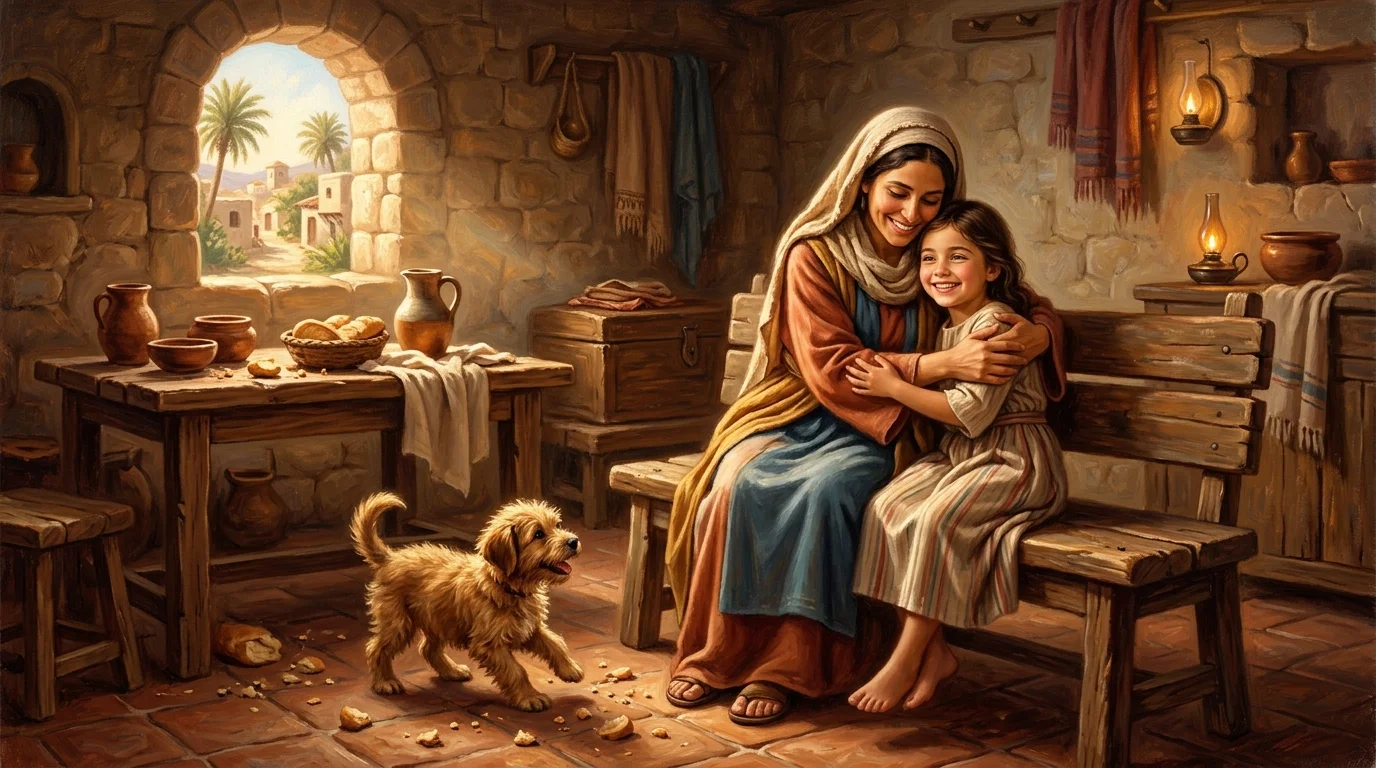 The Abundance of the Master's Table: Joyful restoration inside the home in Tyre as the mother embraces her cured daughter while a puppy plays near bread crumbs.
3. The Test of Covenant Priority
Breaking His silence, Jesus answered His disciples—and in doing so, allowed the listening woman to hear the theological barrier:
"I was not sent except to the lost sheep of the house of Israel." (Matthew 15:24).
Christ articulated the divine order of redemptive history: "to the Jew first, and also to the Greek" (Romans 1:16). During His earthly incarnation, Jesus was commissioned to fulfill the promises made to the patriarchal house of Abraham. He was not a wandering international philosopher; He was the Messiah of Israel inaugurating the New Covenant.
Did this theological rebuff crush her? Did she enter into an academic debate regarding covenant theology?
No! Matthew records her breathtaking reaction: "Then she came and worshiped Him, saying, 'Lord, help me!'" (Matthew 15:25).
She pushed past the frowning disciples. She dropped to her knees directly in the dust before Christ's sandals, falling prostrate in pure worship (prosekynēsen autō). Stripping away all titles she had no legal right to claim—abandoning "Son of David," which belonged to the covenant seed of Abraham—she anchored her plea in the universal mercy of the Creator:
"Kyrie, boēthei moi!"—"Lord, help me!"
It was a cry from the dust. She did not argue her merit; she simply laid her broken maternal heart at the feet of omnipotent grace.
4. The Parable of the Household Dogs
Then came the climactic, most severe test of all. Looking down upon the prostrate woman, Jesus spoke words that would have permanently offended any carnal pride:
"It is not good to take the children's bread and throw it to the little dogs." (Matthew 15:26; Mark 7:27).
In first-century Jewish speech, Gentiles were despised as "dogs" (Hebrew: kelev; Greek: kyōn)—filthy, vicious, diseased scavengers roaming outside city garbage dumps.
Yet look closely at the Greek text! Jesus did not use the offensive term for wild scavengers (kynes). He deliberately chose the tender diminutive: kynaria—little pet dogs or domestic puppies that lived inside Greco-Roman households!
Christ presented an intimate family parable: In a loving home, a father prepares a wholesome loaf of bread for his hungry children sitting at the dining table. It is neither proper nor loving to snatch the bread out of the children's mouths and toss it to the family puppies under the table. The children must be fed first!
Nine hundred and ninety-nine people out of a thousand would have exploded in fury. They would have stood up, spat upon the ground, and screamed: "How dare You call me a dog! I am an educated Phoenician citizen! I came to You for help and You insult me!"
Pride takes offense and walks away empty. But humble faith discerns the secret smile behind the Savior's testing words!
5. The Crumbs of Omnipotence
Instead of being offended, the woman demonstrated a flash of theological genius and sublime humility that left the entire company breathless:
"Yes, Lord, yet even the little dogs eat the crumbs which fall from their masters' table!" (Matthew 15:27).
What an astonishing reply! She did not deny Christ's assessment. She said: "Nai, Kyrie!"—"Yes, Lord! You are absolutely right! I am not a covenant child. I have no seat at Israel's banquet table. I have no claim on Abraham's inheritance. If You say I am a little dog, then a little dog I am!"
And then, she turned Christ's own metaphor into the triumphant lever of her faith: "Yet, Lord, You said 'kynaria'—the little household puppies! Household puppies do not live outside in the garbage heap; they live under the master's table! And when the master's children eat, crumbs naturally fall to the floor! I am not asking for the loaf; I am not asking You to deprive Israel! All I need is a single, tiny crumb!"
Consider the breathtaking theology embedded in her response: She perceived that Jesus Christ is so infinitely, immeasurably colossal in power and grace that what would be a full feast for an entire Gentile city is merely a discarded crumb falling from His divine table! A single crumb of His omnipotence was more than enough to shatter Satan's dominion over her daughter thirty miles away!
6. "O Woman, Great Is Your Faith!"
Jesus was utterly captivated. The Greek text pulses with divine delight. Christ threw open the gates of heaven and proclaimed:
"O woman, great is your faith! Let it be to you as you desire." (Matthew 15:28).
The exclamation "Ō gynai!" was an outburst of holy admiration. In all the Gospels, Jesus repeatedly rebuked His own disciples for having "little faith" (oligopistoi). But to this pagan Canaanite mother, Christ gave the supreme apostolic accolade: "Megalē sou hē pistis!"—"Great is your faith!"
He gave her a blank check from the bank of heaven: "Let it be to you as you desire!" Mark records Christ's tender dismissal: "For this saying go your way; the demon has gone out of your daughter" (Mark 7:29).
Jesus did not travel thirty miles to Tyre to lay hands on the child; He did not shout across the distance. He simply spoke the word of authority.
The woman believed His word without demanding a sign. She turned around and walked the long miles back to her home. Pushing open the wooden door, she stepped into the courtyard.
The shrieking was gone. The violent convulsions were gone. The demonic terror had evaporated. Lying peacefully upon the clean wooden couch, sleeping with sweet, rhythmic breath, was her precious little daughter—fully, permanently healed! And playing on the terracotta tiles nearby was the family puppy.
The Canaanite woman stands as an eternal beacon for every desperate soul who feels disqualified, rejected, or ignored: Faith that refuses to be offended, faith that humbles itself into the dust, and faith that clings to the inexhaustible sufficiency of Christ will always inherit the fullness of the Master's table!
Ancient Near Eastern & Archaeological Context
Following intense, dangerous confrontations with Pharisees and scribes who had journeyed all the way from Jerusalem to condemn His disciples for eating with unwashed hands (Matthew 15:1–20), Jesus withdrew northwest into the Gentile district of Tyre and Sidon. Situated along the Mediterranean coast of modern Lebanon, Phoenicia was an ancient cradle of Canaanite paganism—the very land from which Princess Jezebel had introduced the state worship of Baal and Asherah into Israel nine centuries earlier. Under Jewish rabbinic tradition, Gentile territory was ritually unclean; stepping onto pagan soil contracted defilement. Yet Jesus deliberately crossed this territorial boundary. The Canaanites were the ancient inhabitants of the land whom Israel had failed to completely eradicate (Judges 1). In the eyes of first-century Jews, a Canaanite was the quintessential outsider: uncircumcised, idolatrous, and spiritually hopeless. By entering Tyre, Christ entered the very stronghold of the enemy to demonstrate that the boundaries of God's redemptive grace transcend racial, national, and historical enmities.
Support Independent Biblical Research
Did this study bless you? Help support our independent bilingual research and interactive visual Bible tools.
⚡ Fast Facts
- The Canaanites were ancient, sworn biblical enemies of Israel whom Joshua was commanded to dispossess, making her ethnic background socially and religiously scandalous
- Mark identifies her as 'Syrophoenician by race'—a Hellenized Gentile living in the coastal territory of Roman Syria (Phoenicia), the historical birthplace of Jezebel's Baal worship
- The Greek word Jesus used for dogs was 'kynaria' (diminutive for domestic household puppies or pet dogs), distinct from 'kynes' (wild, vicious scavengers roaming ancient streets)
- In all four Gospels, Jesus marvels and commends 'great faith' (megalē pistis) in only two individuals: this Canaanite woman and the Roman centurion in Luke 7—both Gentiles!
❓ Frequently Asked Questions (FAQs)
Christ's silence was not callous rejection, but an intentional pedagogical test. In ancient Jewish culture, rabbis completely ignored Gentile women. By remaining silent and voicing the theological objections of the covenant ('lost sheep of Israel'), Jesus drew forth her diamond-like faith from beneath the surface. He tested whether she was merely using 'Son of David' as a superstitious magical formula, or whether she possessed true, self-effacing faith that refused to let God go without a blessing.
First-century Jews contemptuously called Gentiles 'dogs' (*kynes*)—unclean, vicious scavengers. But Jesus softened the term using the affectionate diminutive *kynaria* (pet household puppies dining inside family quarters). He presented an earthly household parable: children at the table are fed first, and pets wait for their portion. Rather than taking offense, the woman brilliantly seized Christ's metaphor: if she is counted even as a household pet, she belongs under the Master's table where divine abundance overflows!
Her response demonstrated radical humility coupled with breathtaking confidence in Christ's infinite power. She conceded her unworthiness: she did not demand the status of a covenant child or claim a seat at the banquet table. Yet she recognized that Jesus is so infinitely rich in grace and omnipotence that a mere crumb falling from His hands contained more than enough supernatural authority to annihilate a demon thirty miles away!