The dramatic clash between the living Word of God and the arrogant defiance of earthly rulers is nowhere more starkly depicted than in the account of Jeremiah’s scroll and King Jehoiakim. In the fourth year of Jehoiakim (605 BC), as the Babylonian army under Nebuchadnezzar crushed Egypt at the decisive Battle of Carchemish, God issued an urgent, sovereign call of mercy to the nation of Judah. While an ungodly tyrant sought to obliterate divine truth in a blazing winter fire, the indestructible Word of Yahweh rose triumphant from the ashes, proving that human tyrants perish, but the Word of our God stands forever.
1. The Writing of the First Scroll by Baruch
In 605 BC, the Word of the Lord came to Jeremiah saying: "Take a scroll of a book, and write on it all the words that I have spoken to you against Israel, against Judah, and against all the nations, from the day I spoke to you, from the days of Josiah even to this day. It may be that the house of Judah will hear all the disaster that I purpose to do to them, that everyone may turn from his evil way, that I may forgive their iniquity and their sin." (Jeremiah 36:2-3).
Even at this late hour, on the brink of geopolitical disaster, God’s ultimate goal was not destruction, but repentance and forgiveness. Jeremiah summoned his faithful disciple, friend, and scribe, Baruch son of Neriah. For months, as Jeremiah dictated word for word with tears and passion, Baruch dipped his reed pen into black soot-ink, meticulously inscribing the sacred Hebrew consonants onto sheets of stretched parchment stitched together into a magnificent holy scroll.
Because Jeremiah was barred from the Temple precincts by corrupt religious authorities, he instructed Baruch: "I am restricted; I cannot enter the house of the Lord. Therefore you go, and read from the scroll which you have written from my mouth, the words of the Lord in the ears of the people in the Lord’s house on a day of fasting."
2. Reading the Scroll in Solomon's Temple
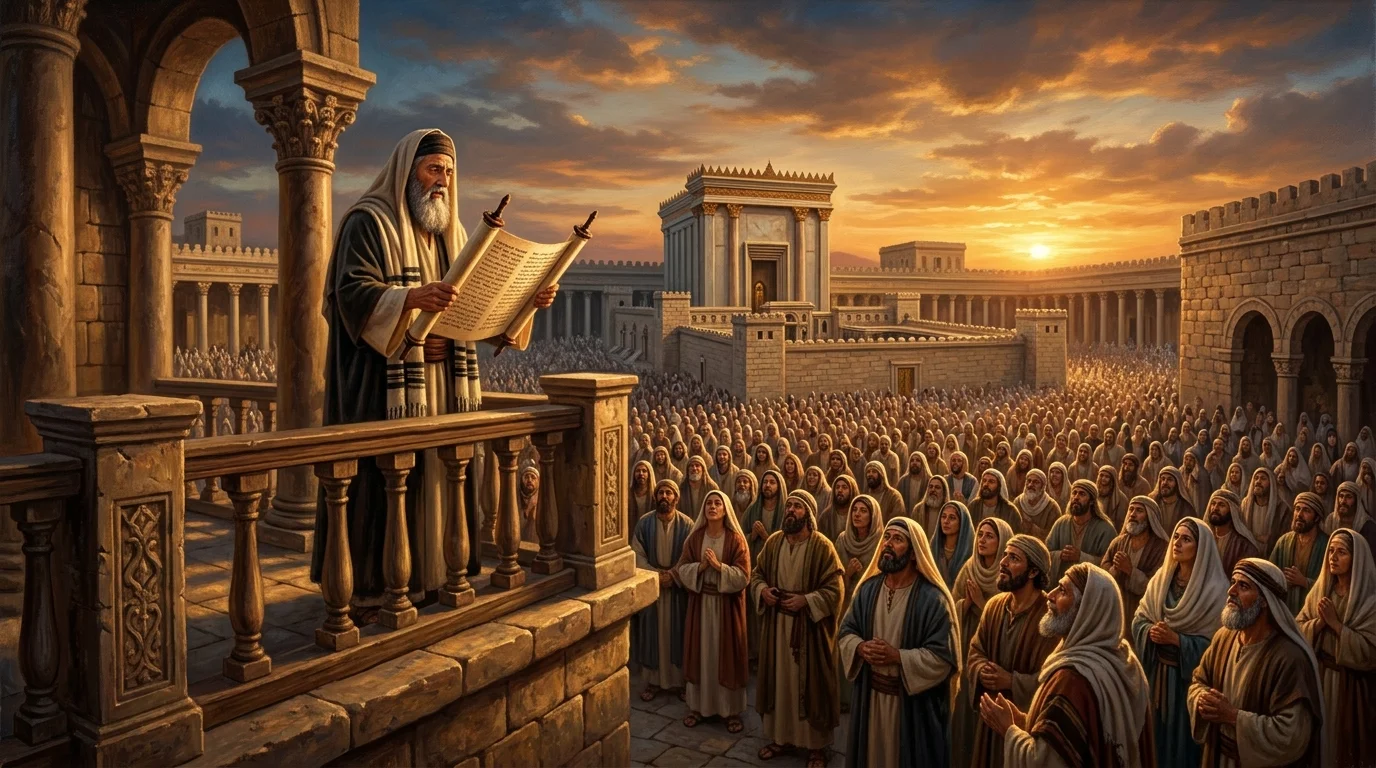
In the ninth month of the following winter (December 604 BC), a national fast was proclaimed in Jerusalem as Babylonian armies marched south along the Mediterranean coast. Pilgrims from every town in Judah flooded into the sacred courtyards. Baruch climbed to the upper court of the Temple, standing at the entry of the New Gate of the Lord’s house outside the chamber of Gemariah the scribe.
Unrolling the long parchment, Baruch began to read aloud the piercing words of Yahweh. The crowd stood in stunned silence as the warnings of coming Babylonian invasion, calls to repentance, and righteous judgments echoed across the temple colonnades. A young noble named Micaiah son of Gemariah heard the reading, ran down to the royal palace secretary’s chamber where all the royal princes were sitting, and reported everything Baruch had proclaimed.
Trembling with conviction, the princes summoned Baruch and had him read the scroll before them. Scripture records that when they heard all the words, "they turned in fear one to another" and said, "We must surely tell the king all these words." But knowing the murderous temper of King Jehoiakim, they wisely advised: "Go and hide, you and Jeremiah, and let no one know where you are!"
3. King Jehoiakim Cuts and Burns the Sacred Scroll
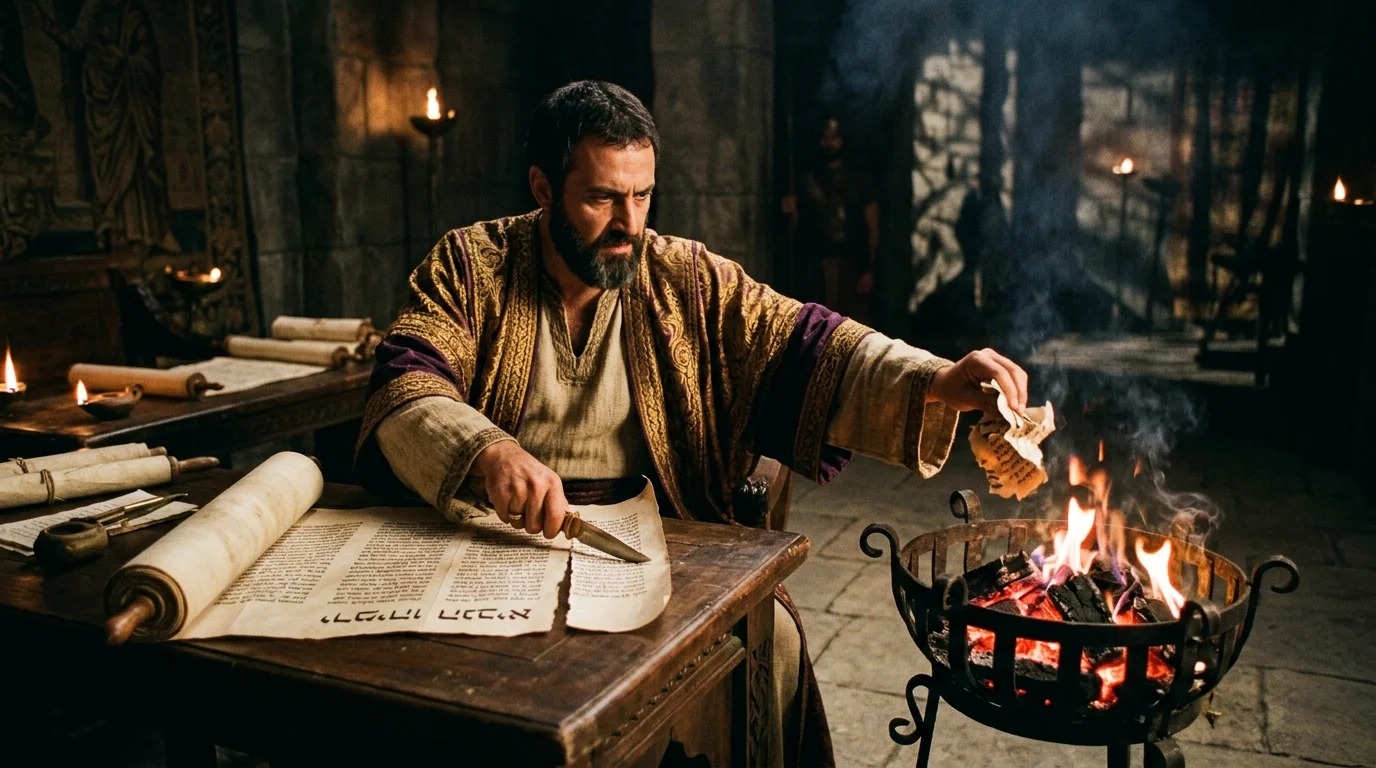 Sitting in his winter chamber, King Jehoiakim used a scribe's knife to cut the scroll into shreds and cast it into the fire, displaying brazen defiance against God.
The princes brought the scroll into the royal inner apartment where King Jehoiakim was sitting in his winter room, with a charcoal fire burning in the brazier before him. An attendant named Jehudi began reading the scroll aloud to the king and his counselors.
The contrast between King Jehoiakim and his godly father, King Josiah, was staggering. When Josiah heard the Book of the Law thirty years earlier, he tore his royal robes and wept in broken repentance. But Jehoiakim sat hardened, cynical, and arrogant. As Jehudi read three or four columns of holy text, the king reached out with a scribe’s razor-knife, cut those columns off the scroll, and tossed the parchment directly into the blazing fire!
Column by column, three brave officials—Elnathan, Delaiah, and Gemariah—begged the king not to burn the scroll, but Jehoiakim refused to listen. He watched with insolent satisfaction until the entire sacred manuscript was reduced to charred ashes in the brazier. Jehoiakim then ordered his officers to arrest Jeremiah and Baruch, "but the Lord hid them." (Jeremiah 36:26).
4. The Second Scroll: The Indestructible Word of God
Jehoiakim foolishly believed that by burning the physical parchment, he had destroyed the prophecy and escaped the judgment. But God spoke to Jeremiah in their hidden sanctuary:
"Take another scroll, and write on it all the former words that were on the first scroll which Jehoiakim the king of Judah has burned... And concerning Jehoiakim king of Judah you shall say, 'Thus says the Lord: You have burned this scroll... Therefore his dead body shall be cast out to the heat of the day and the frost of the night.'" (Jeremiah 36:28, 30).
Jeremiah took a second scroll, gave it to Baruch, and dictated not only every single word from the first scroll, "and there were added besides to them many similar words." (Jeremiah 36:32). Jehoiakim could burn the ink and animal skin, but he could not burn the eternal decree of Almighty God. Within a few short years, Jehoiakim died in disgrace, Jerusalem was besieged, and the prophetic words of the second scroll were fulfilled in meticulous detail.
5. Archaeological Discoveries: The Bullae of Baruch and Gemariah
The historical authenticity of Jeremiah 36 was dramatically confirmed in the late 20th century by stunning archaeological discoveries in the City of David. Excavations led by Israeli archaeologist Yigal Shiloh uncovered a royal archive containing clay seal impressions (called *bullae*) used to seal official papyrus and parchment scrolls.
Among these ancient clay seals, archaeologists discovered the actual seal impression of **"Gemariah, son of Shaphan the scribe"**—the exact official in whose temple room Baruch read Jeremiah's scroll (Jeremiah 36:10). Even more astonishing, a private collection unveiled a clay seal bearing the ancient Hebrew inscription: **"Belonging to Berekhyahu (Baruch), son of Neriyahu (Neriah), the scribe."** These remarkable artifacts connect modern readers directly to the very hands that penned the sacred text of Jeremiah 36.
6. The Eternal Victory of Scripture Over Tyranny
Throughout millennia, political rulers, emperors, and totalitarian regimes have sought to eradicate the Bible. Roman Emperor Diocletian ordered all Christian Scriptures burned in 303 AD; Voltaire proclaimed the Bible would be extinct within a century; communist dictators banned and destroyed Bibles. Yet, like Jeremiah's second scroll, the Word of God continually multiplied. Today, the Bible remains the most printed, translated, read, and life-transforming book in human history.
Spiritual Reflections & Practical Life Application:
- The Word of God is Indestructible: Throughout history, tyrants, skeptics, and regimes have attempted to ban, burn, and outlaw the Bible. Yet Scripture outlives every critic. "The grass withers, the flower fades, but the word of our God stands forever." (Isaiah 40:8).
- Two Responses to God's Truth: Like Josiah, will you humble yourself and repent when convicted by God's Word, or like Jehoiakim, will you harden your heart and silence the truth?
- God Protects His Faithful Servants: When the king sent assassins to kill Jeremiah and Baruch, "the Lord hid them." God is your ultimate refuge when you take a stand for righteousness.
- Defiance Accelerates Judgment: Burning the warning did not cancel the impending storm; it only sealed Jehoiakim's doom. True peace is found only in surrendering to God's loving counsel.
⚡ Fast Facts
- Written in the 4th year of King Jehoiakim (605 BC)
- Baruch son of Neriah served as Jeremiah's faithful amanuensis (scribe)
- Jehoiakim burned the scroll in his winter apartment brazier after hearing only 3-4 columns
- God commanded a second scroll with additional judgments against Jehoiakim
❓ Frequently Asked Questions (FAQs)
Jeremiah was restricted or debarred from entering the Temple grounds (Jeremiah 36:5) due to previous arrests and hostility from temple authorities, so he commissioned Baruch to read it on a national fast day.
Unlike his godly father King Josiah who tore his clothes in repentance upon hearing the Law, Jehoiakim showed brazen contempt by cutting the scroll into shreds with a scribe's knife and burning it piece by piece in the winter fire.
God prophesied through the second scroll that Jehoiakim would have no descendant to sit on David's throne, and his dead body would be cast out to the heat of the day and frost of the night with the burial of a donkey.