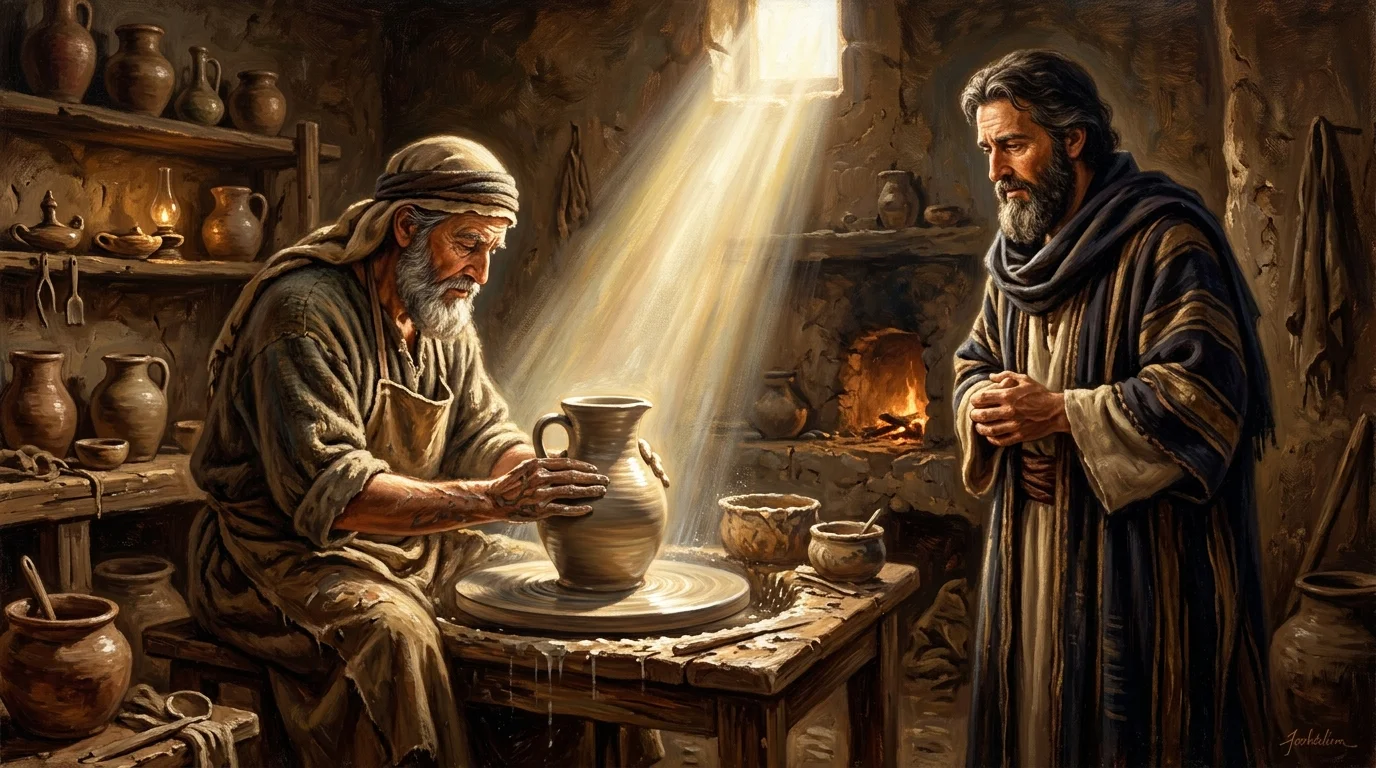
In the sacred visual theology of the Old Testament, few metaphors capture the profound balance between divine sovereignty, human fragility, and redeeming grace quite like the Potter’s House. In Jeremiah 18 and 19, God bypassed the academic lectures of the temple courts and brought His weeping prophet down into the dusty, gritty workshop of an ordinary artisan. There, amidst the rhythmic hum of the spinning stone wheel and the scent of wet Judean earth, God unveiled the eternal truth: humanity is clay, God is the Master Potter, and in His hands, marred lives can be supernaturally remade into vessels of eternal honor.
1. The Command to Go Down to the Potter's House
The Word of the Lord came to Jeremiah with a simple yet intriguing directive: "Arise, and go down to the potter’s house, and there I will cause you to hear My words." (Jeremiah 18:2). Jeremiah obeyed without hesitation. He walked down the steep, rocky slopes of the City of David to the lower artisan quarters in the Hinnom Valley, where generations of master potters had established their workshops near natural clay beds, abundant spring waters, and sun-drenched terraced drying fields.
Stepping into the workshop, Jeremiah breathed in the rich, earthy atmosphere. Sunlight filtered through the stone window, illuminating a seasoned artisan sitting quietly upon a low wooden bench before his double stone wheels. The potter’s foot kicked the heavy, circular lower stone, which turned the vertical axle and spun the smaller upper work stone at rapid speed. On that upper wheel sat a mound of damp, malleable Judean clay, glistening under the gentle streams of water trickling from the potter's fingers.
2. The Marred Clay Remade in the Potter's Hands
As Jeremiah watched in rapt fascination, the potter pressed his thumbs into the center of the spinning clay, opening a deep cavity and pulling up thin, graceful walls. The artisan was shaping a delicate, noble pitcher destined for royal service in the palace or sacred libations in the sanctuary.
Suddenly, an unexpected flaw emerged. Perhaps there was an undetected grain of sand, an air bubble, or an inherent weakness in the clay’s composition. Under the rotational friction and the artisan's pressure, the thin walls wobbled, buckled, and collapsed in upon themselves! The vessel was marred, ruined, and deformed upon the spinning stone.
An impatient or unskillful worker might have cursed, scraped the ruined mess off the wheel, and thrown it into the garbage heap. But this master potter did something breathtakingly gentle. With steady, unhurried patience, he collapsed the ruined clay back into a solid, unified lump. He centered it once more on the wheel, wet his hands, applied fresh pressure, and began shaping it again:
"And the vessel that he made of clay was marred in the hand of the potter; so he made it again into another vessel, as it seemed good to the potter to make." (Jeremiah 18:4).
Then the Word of Yahweh broke into Jeremiah's heart with thunderous clarity: "O house of Israel, cannot I do with you as this potter? says the Lord. Behold, as the clay is in the potter’s hand, so are you in My hand, O house of Israel!" (Jeremiah 18:6). God declared that nations and human destinies are not governed by blind fate or fatalistic ruin. If a rebellious nation repents, God will turn away His judgment and reshape them for glory; but if a blessed nation turns to arrogance and idolatry, God will reshape them for divine discipline.
3. The Shattered Flask at the Potsherd Gate
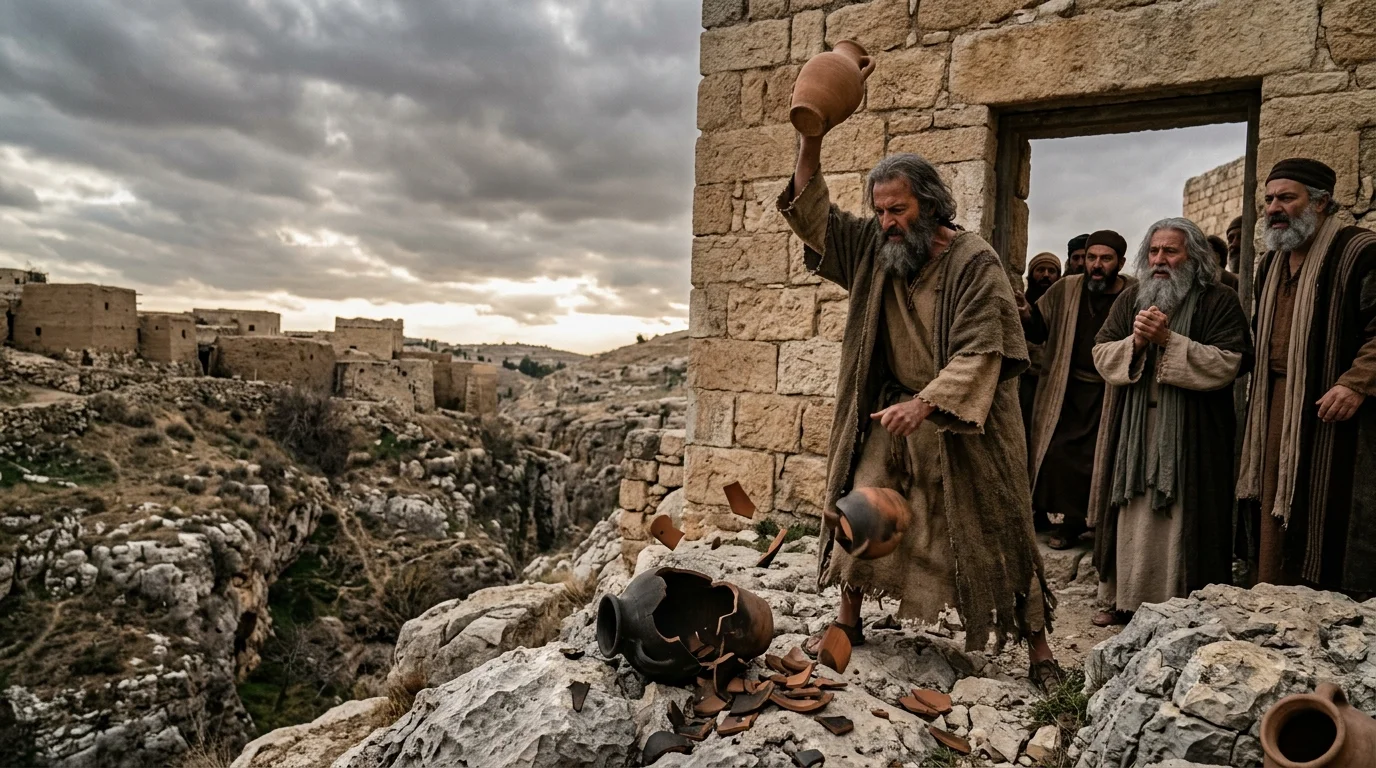 At the Potsherd Gate overlooking Topheth, Jeremiah shattered an earthenware flask before the elders, proclaiming the irreversible fall of an unrepentant city.
In Jeremiah 19, the visual sermon took a sobering, terrifying turn. God commanded Jeremiah: "Go and buy a potter’s earthenware flask, and take some of the elders of the people and some of the senior priests." He was instructed to lead them out through the Potsherd Gate (the gate where broken ceramic refuse was dumped) overlooking the dreaded Valley of Ben-Hinnom.
This valley was infamous as Topheth, the demonic site where apostate kings like Ahaz and Manasseh had sacrificed their own sons and daughters in the blazing fire to the pagan deity Molech. Standing on the precipice overlooking the valley of horrors, Jeremiah delivered God's blistering indictment against the bloodthirsty idolatry of the ruling class.
Then, before the shocked eyes of the senior priests and elders, Jeremiah lifted the hardened, kiln-fired clay flask high above his head and violently smashed it down onto the jagged rocks below! Ceramic shards exploded across the stones with a deafening crash.
Jeremiah declared the final verdict of Almighty God: "Even so will I break this people and this city, as one breaks a potter’s vessel, that cannot be made whole again!" (Jeremiah 19:11). Wet clay on the spinning wheel can be reshaped by grace as long as it remains pliable; but hardened pottery that has been baked in the furnace of unrepentant sin and obstinate rebellion will face shattering judgment that no human power can ever reassemble.
4. The Master Potter in the New Testament: Vessels of Mercy
The dual parables of the potter's wheel and the shattered flask echo through the New Testament with profound theological weight. In Romans 9:20-24, the Apostle Paul confronts human pride:
"But indeed, O man, who are you to reply against God? Will the thing formed say to him who formed it, 'Why have you made me like this?' Does not the potter have power over the clay, from the same lump to make one vessel for honor and another for dishonor?"
Paul reveals that through Jesus Christ, God has made known the riches of His glory on the "vessels of mercy, which He had prepared beforehand for glory." (Romans 9:23). When we surrender our brokenness at the foot of the Cross, the Master Potter does not discard us; He places our flawed, cracked lives back upon the wheel of grace, washing us in the water of His Word, and shaping us into glorious vessels fit for the Master's eternal use.
5. Archaeological Insights: Ancient Judean Pottery & The Potsherd Gate
Modern archaeological excavations around Jerusalem, particularly in the City of David and the Hinnom Valley, have uncovered numerous ancient pottery workshops dating to the Iron Age II period (8th to 6th centuries BC). Thousands of ceramic storage jars bearing the royal seal *LMLK* ("Belonging to the King") along with Hebrew potters' stamps confirm the thriving ceramic industry described in Jeremiah 18.
The Potsherd Gate (also known in Hebrew as the *Sha'ar Hacharsith* or Gate of Potsherds) opened directly onto the steep terraces of the Valley of Hinnom, where discarded broken pottery was thrown. By choosing this specific gate, Jeremiah utilized a location surrounded by centuries of shattered ceramics to visually reinforce God's message: a broken, kiln-fired jar cannot be pieced back together; an unrepentant, hardened heart faces total, irreversible judgment.
6. Theological Significance: Absolute Sovereignty & Human Responsibility
The parable of the potter's house beautifully reconciles the theological tension between divine sovereignty and human moral accountability. God does not treat human beings as lifeless robots, but as moral agents capable of repentance. When God announces judgment, that warning is conditional—designed to evoke brokenness and turn souls toward mercy. In the hands of Jesus Christ, the Great Potter, even the most scarred and fractured lives are cleansed by His blood, filled with the Holy Spirit, and fashioned into vessels of eternal glory.
Spiritual Reflections & Practical Life Application:
- Remain Pliable and Tender in God's Hands: As long as you maintain a soft, humble, and repentant heart toward the Holy Spirit, God can rework any past failure, broken dream, or spiritual scar into a vessel of profound beauty.
- Beware of Spiritual Calcification and Hardening: Do not allow pride, bitterness, or persistent secret sin to bake your heart into brittle ceramic. A hardened heart will eventually shatter under the weight of life's trials.
- Trust the Pressure of the Potter's Hands: When life spins rapidly and you feel the uncomfortable, shaping pressure of God's fingers upon your character, do not panic. The Master Potter knows the glorious design He is fashioning.
- You Are a Vessel of Honor: You are not defined by the flaws of your past. In Christ, the Potter makes all things new (2 Corinthians 5:17). Yield completely to His loving craftsmanship today.
⚡ Fast Facts
- Ancient potters used dual stone wheels spun by foot power
- A spoiled vessel was not discarded but reshaped by the master potter
- The smashed flask at Potsherd Gate symbolized irreversible destruction if unrepentant
- Prophetically reveals God's absolute sovereignty over nations and individuals
❓ Frequently Asked Questions (FAQs)
God taught that just as clay is completely subject to the potter's hands, Israel and all nations are in Yahweh's hands. If a nation repents, God will relent of disaster; but if it turns to evil, He will reshape it for judgment.
In Jeremiah 19, God commanded him to buy an earthenware flask and smash it in the Valley of Ben-Hinnom before the elders. Unlike soft wet clay that can be remade, baked pottery once shattered cannot be put back together, symbolizing complete national destruction.
The Apostle Paul quotes this passage in Romans 9:20-21, emphasizing God's sovereign right as the Potter over vessels of wrath and vessels of mercy prepared for glory.