The call of Jeremiah marks one of the most intimate, vulnerable, and destiny-defining encounters in sacred Scripture. Chosen before the foundation of his physical frame, this young priest from the quiet village of Anathoth was thrust into the turbulent epicenter of international geopolitics and spiritual collapse. While mighty empires clashed and Judah hurtled toward catastrophic judgment, God did not summon a seasoned military general or a charismatic politician; He summoned a sensitive, trembling youth whose tears would echo through the corridors of eternity. The prophet's life serves as an immortal testimony that God's sovereign calling transforms human inadequacy into unbreakable spiritual fortitude.
1. Historical and Geopolitical Setting of Jeremiah’s Era
The historical backdrop of Jeremiah's ministry was characterized by rapid geopolitical upheaval and profound moral decay. The great Assyrian Empire, which had dominated the ancient Near East for centuries and destroyed the northern kingdom of Israel in 722 BC, was rapidly collapsing under civil strife and external rebellion. Rising to imperial prominence was the Neo-Babylonian Empire under Nabopolassar and his brilliant crown prince, Nebuchadnezzar. Meanwhile, Egypt under Pharaoh Necho sought to reassert control over the Levant. Judah found itself physically, politically, and strategically trapped between these colossal military giants.
Spiritually, Judah was recovering superficially from the horrific fifty-five-year reign of wicked King Manasseh, who had filled Jerusalem with innocent blood, erected altars to Baal in the Temple courts, and sacrificed children in the Valley of Hinnom. Although young King Josiah launched a noble spiritual reformation upon rediscovering the Book of the Law in 622 BC, the repentance of the general population was largely outward and superficial. The spiritual rot was deep-seated, the hearts of the people remained attached to pagan idols, and divine judgment was inevitable unless genuine, national brokenness occurred.
2. Sovereign Election Before the Womb
Jeremiah was born into a priestly family in Anathoth, a quiet Levitical town nestled in the rugged territory of Benjamin, just three miles northeast of Jerusalem. His father Hilkiah was a priest descended from the line of Abiathar (whom Solomon had exiled to Anathoth centuries earlier). From early childhood, young Jeremiah was immersed in the sacred scrolls of the Torah, ancient temple liturgies, and Israel's covenant history. Yet God had designed an office far higher and wider than the local Levitical priesthood for this young man.
In the thirteenth year of King Josiah’s reign (approximately 627 BC), the Word of Yahweh broke into Jeremiah’s quiet life with sovereign, earth-shaking clarity:
"Before I formed you in the belly I knew you; and before you came forth out of the womb I sanctified you; I have appointed you a prophet to the nations." (Jeremiah 1:5).
This breathtaking declaration revealed the eternal foreknowledge and predetermined purpose of Almighty God. The Hebrew verb for "I knew you" is yada, denoting deep, covenantal intimacy and sovereign choice. Jeremiah’s ministry was not an afterthought, a human ambition, or an accidental vocational choice; he was consecrated, set apart, and commissioned in the eternal counsel of God before his mother ever felt his first movement in her womb. This foundational truth gave Jeremiah the inner supernatural strength to survive forty years of relentless isolation, mockery, imprisonment, and grief.
3. The Reluctant Prophet & The Divine Touch
Overwhelmed by the staggering weight of this global assignment, young Jeremiah recoiled in terror and acute self-doubt. He looked at his youth, his lack of rhetorical eloquence, and the formidable culture of corrupt elders, hardened priests, and ruthless kings:
"Ah, Lord God! Behold, I do not know how to speak, for I am only a youth." (Jeremiah 1:6).
In Hebrew, the word used for youth is na'ar, describing an adolescent or young unmarried man under twenty-five years of age. But Yahweh instantly dismantled Jeremiah’s human excuses with divine authority and comforting reassurance:
"Do not say, 'I am only a youth.' For to whomsoever I shall send you, you shall go, and whatever I command you, you shall speak. Do not be afraid because of them, for I am with you to rescue you, declares the Lord." (Jeremiah 1:7-8).
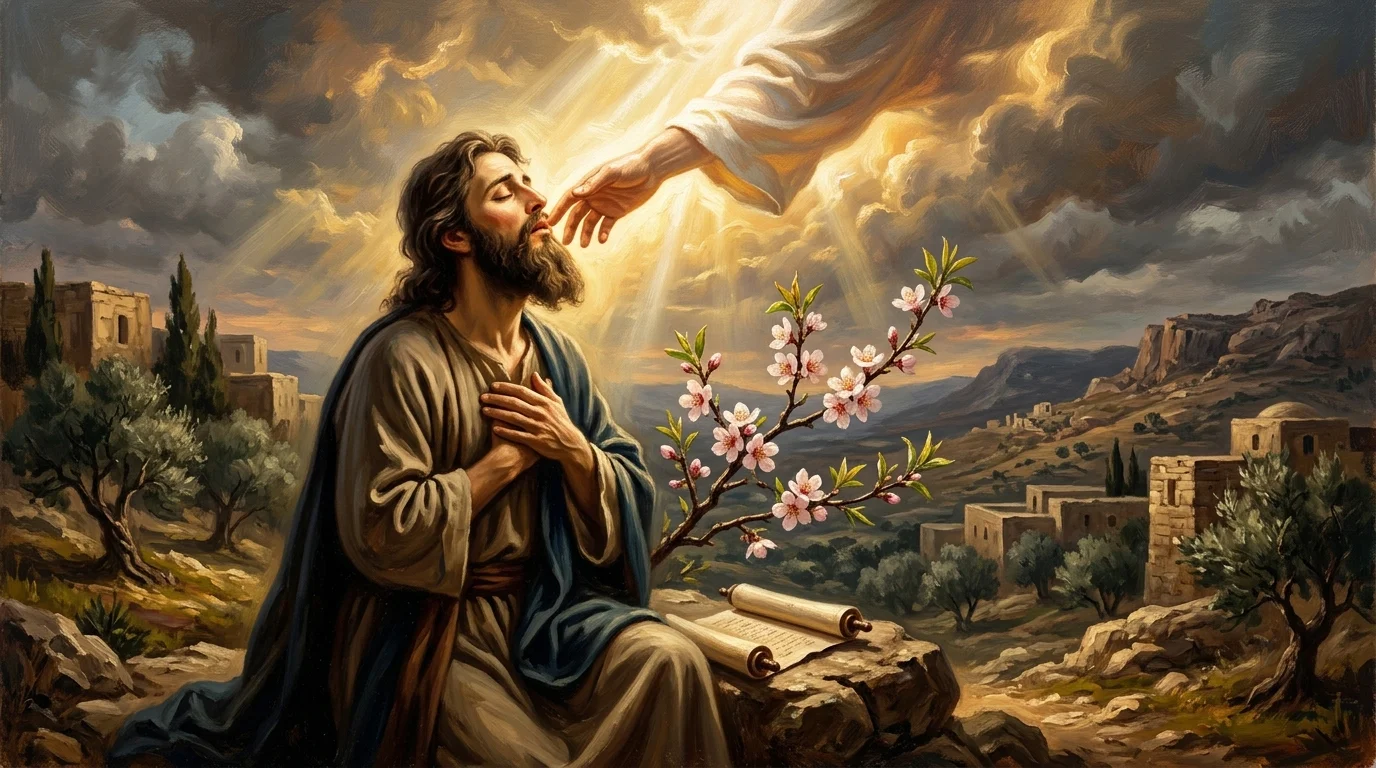
Then occurred a moment of profound spiritual empowerment. Yahweh stretched out His hand and touched Jeremiah’s lips, declaring: "Behold, I have put My words in your mouth. See, I have this day set you over nations and over kingdoms, to pluck up and to break down, to destroy and to overthrow, to build and to plant." With that single divine touch, Jeremiah was transformed from an insecure village boy into God's sovereign ambassador possessing words capable of tearing down empires and planting divine destinies.
4. Two Prophetic Visions: The Almond Branch and the Boiling Pot
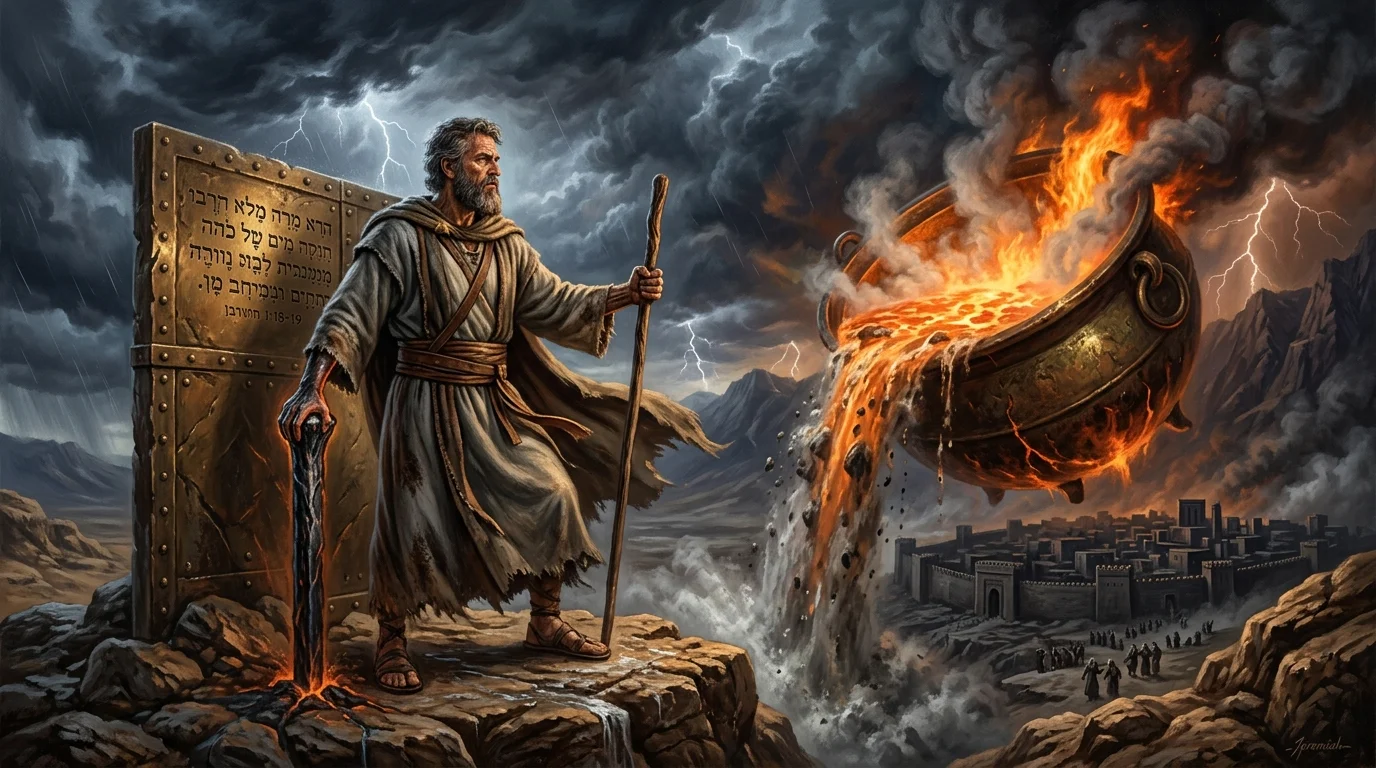 God revealed to Jeremiah the boiling pot tilting from the north and established him as an unyielding iron pillar and bronze wall against the kings of Judah.
To seal his prophetic commission, God gave Jeremiah two vivid visual signs. First, Yahweh asked: "Jeremiah, what do you see?" Jeremiah replied, "I see a branch of an almond tree." In Hebrew, the almond tree is called Shoqed, derived from the root verb meaning "to be alert, awake, or vigilant," because it is the very first tree to burst into white blossoms during the freezing late winter, announcing spring. God said, "You have seen well, for I am watching (Shoqed) over My word to perform it." God assured him that every prophetic sentence spoken would come to pass without failure.
Next, God asked: "What do you see a second time?" Jeremiah answered: "I see a boiling pot, and its face is tilted away from the north." God explained that from the north, disaster would pour out upon all the inhabitants of the land. The giant cauldron of boiling water represented the ruthless military juggernaut of the neo-Babylonian Empire under Nebuchadnezzar, ready to spill out over the rebellious mountains of Judea in righteous judgment for their rampant idolatry, child sacrifices, and covenant apostasy.
5. The Iron Pillar and Fortified Bronze Wall
God did not promise Jeremiah an easy, comfortable, or popular ministry. In fact, God promised him total hostility from every sector of society—the kings of Judah, the royal princes, the wealthy landowners, the false court prophets, and even his own priest relatives in Anathoth who plotted his death. But God guaranteed supernatural resilience:
"For behold, I have made you today a fortified city, an iron pillar, and bronze walls against the whole land—against the kings of Judah, its officials, its priests, and the people of the land. They will fight against you, but they shall not prevail against you; for I am with you to rescue you, declares the Lord." (Jeremiah 1:18-19).
For the next forty-two years, through tears, beatings, stocks, and muddy cistern dungeons, Jeremiah remained faithful to this solemn commission. He wept over Jerusalem's impending doom, earned the title of the "Weeping Prophet," yet stood immovable as an iron pillar of truth until the very end. His prophetic life pointed forward to Jesus Christ, the ultimate Prophet who wept over Jerusalem and faithfully bore the Word of the Father amidst national rejection.
6. Christological Connections: The Ultimate Prophet of Tears
The life and calling of Jeremiah foreshadow the earthly ministry of Jesus Christ in profound detail:
- Chosen Before Birth: Just as Jeremiah was sanctified in the womb, Jesus was conceived by the Holy Spirit and named before His birth as the Savior of the world (Luke 1:31-35).
- The Prophet of Rejection: Jeremiah was rejected by his hometown of Anathoth and his own brethren; Jesus was rejected by Nazareth and His own people (John 1:11, Mark 6:4).
- Weeping Over Jerusalem: Jeremiah wept bitterly over the impending destruction of Solomon's Temple; Jesus wept over Jerusalem, foretelling that not one stone of Herod's Temple would be left upon another (Luke 19:41-44).
- The New Covenant: Jeremiah was the only Old Testament prophet to explicitly prophesy the "New Covenant" written on human hearts (Jeremiah 31:31-34), which Jesus instituted with His own blood at the Last Supper (Luke 22:20).
Spiritual Reflections & Practical Life Application:
- God Knows You and Has an Eternal Blueprint: Long before human parents planned you, God sanctified and destined you for eternal purpose. Your identity is rooted in divine design, not human circumstance or cultural trends.
- Human Inadequacy is the Canvas for Divine Power: When you feel too young, untrained, or weak, God's grace shines brightest. God does not call the qualified; He qualifies the called through His holy presence.
- God Watches Over His Word: Like the blossoming almond branch, God's promises never sleep or fail. What He has spoken concerning your life, your family, and your spiritual destiny will surely come to pass.
- Uncompromising Courage in Hostile Times: When you stand firmly on God's Word, He equips you to be an iron pillar—unyielding against peer pressure, cultural compromise, and spiritual opposition. Stand strong in the Lord!
⚡ Fast Facts
- Called in the 13th year of King Josiah (around 627 BC)
- Known as the 'Weeping Prophet' for his deep grief over Judah's sin
- The almond branch symbolized God actively watching over His Word
- Promised to be an iron pillar and bronze wall against kings and priests
❓ Frequently Asked Questions (FAQs)
Jeremiah protested saying, 'Ah, Lord God! Behold, I do not know how to speak, for I am only a youth.' God commanded him not to fear, promising His presence and touching his mouth to place divine words within him.
The almond tree (Hebrew: Shoqed), which blossoms first in early spring, symbolized that God was actively watching (Hebrew: Shoqed) over His word to perform it. The boiling pot tilted from the north symbolized the invading Babylonian army coming to execute judgment upon Judah.
Jeremiah prophesied for over forty years, through the reigns of Josiah, Jehoahaz, Jehoiakim, Jehoiachin, and Zedekiah, until the catastrophic destruction of Jerusalem and the exile to Babylon.