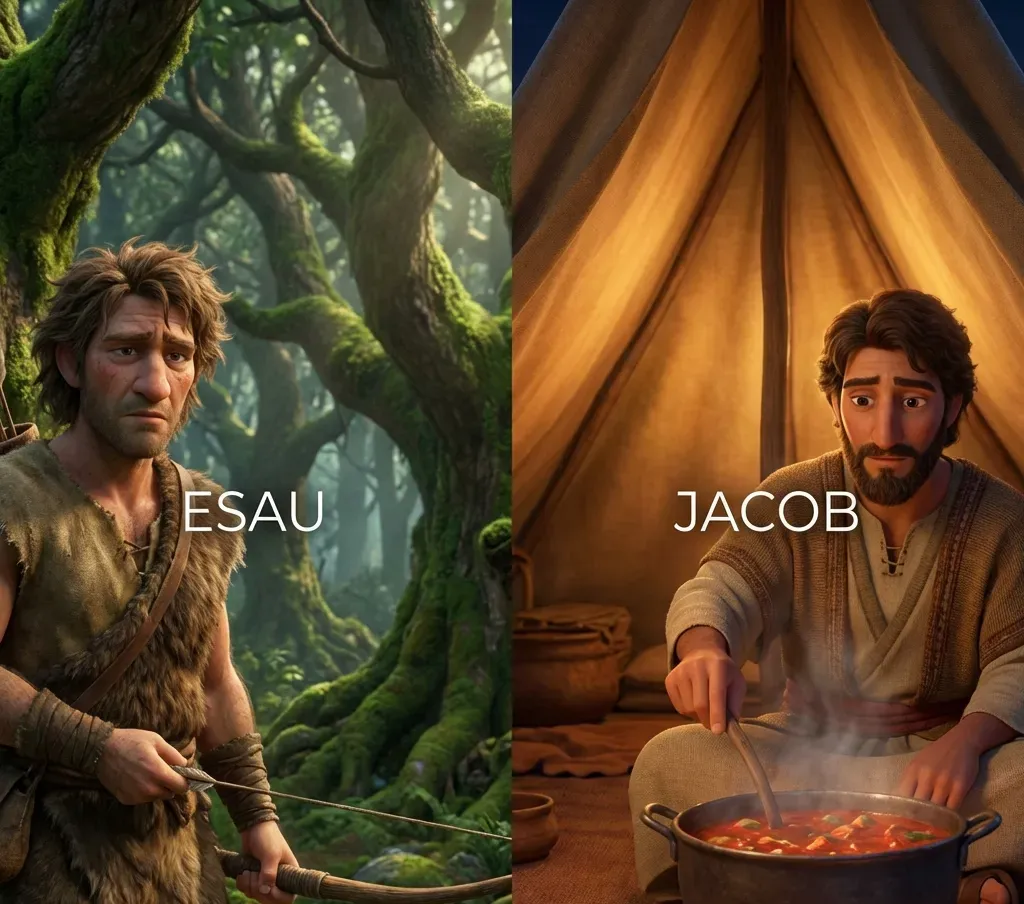
For twenty long, agonizing years after their marriage, Isaac and Rebekah endured the painful trial of barrenness. Like Abraham before him, Isaac did not seek carnal solutions or concubines; he pleaded with Yahweh on behalf of his wife. God heard the patriarch's cry, and Rebekah conceived. But within her womb, a violent struggle erupted. The unborn children clashed so fiercely that Rebekah, bewildered and overwhelmed, sought the counsel of the Lord, asking: 'If it is all right, why am I like this?'
1. The Prenatal Struggle and the Divine Oracle
The answer she received from Yahweh was an earth-shattering oracle of divine election that would dictate the next two thousand years of redemptive history:
'Two nations are in your womb, two peoples shall be separated from your body; one people shall be stronger than the other, and the older shall serve the younger.' (Genesis 25:23).
In the patriarchal culture of the ancient Near East, the firstborn son enjoyed unquestioned supremacy: the legal rights of primogeniture, a double portion of the family inheritance, and undisputed spiritual and political leadership over the clan. But God's sovereign economy regularly upends human hierarchy. Before the children were born, before either had performed a single deed of good or evil, God sovereignly decreed that the covenant blessing would bypass the firstborn and rest upon the younger.
When the time came for Rebekah to give birth, the delivery room witnessed a visual preview of their lifelong conflict. The first child emerged red all over, covered with thick hair like a rough hairy garment; they named him Esau ('Hairy' or 'Rough'). Immediately after, his twin brother came out, his tiny hand gripping tightly to Esau's heel. They named him Jacob (Hebrew: Ya'akov, derived from Akev, meaning 'Heel-Catcher', 'Supplanter', or 'Overreacher').
2. A Tale of Two Lifestyles and the Fatal Stew
As the boys grew, their temperaments and vocations diverged radically. Esau became a skillful hunter, a man of the open fields, rugged, impulsive, and governed by immediate sensory desires. Jacob was a mild, contemplative man (Hebrew: Tam—quiet, orderly, civilized), dwelling contentedly in the domestic safety of the tents.
Tragically, parental favoritism fractured the unity of the home: 'And Isaac loved Esau because he ate of his game, but Rebekah loved Jacob.' (Genesis 25:28). Isaac, blinded by his culinary appetite for wild game, indulged Esau's carnal independence, while Rebekah, treasuring the divine oracle in her heart, nurtured Jacob.
The simmering tension reached a boiling point on an ordinary afternoon. Jacob had spent hours slowly simmering a rich, aromatic stew of red lentils, seasoned with wild herbs. Suddenly, Esau burst into the tent, stumbling in exhaustion from an unsuccessful hunt. Parched, famished, and gripped by sensory desperation, Esau stared at the steaming pot and demanded: 'Please feed me with that same red stew, for I am weary!'
Jacob, living up to his supplanter name, spotted an immediate opportunity. With calculating coldness, he said: 'Sell me your birthright (Bekhorah) as of this day.'
The birthright was the sacred jewel of the patriarchal household. It carried the priesthood of the family, spiritual oversight, and the custody of the Messianic promise made to Abraham. But to Esau, future spiritual glory was utterly worthless compared to immediate stomach satisfaction. He shrugged with cynical disdain: 'Look, I am about to die; so what is this birthright to me?'
Jacob insisted: 'Swear to me as of this day.' Esau swore an inviolable oath, legally transferring his birthright for a single meal. Jacob handed him the fresh bread and the bowl of red lentil stew. Esau ate, drank, arose, and walked away. With surgical precision, the inspired author records the terrifying epitaph of Esau's spiritual bankruptcy: 'Thus Esau despised (Bazah) his birthright.' (Genesis 25:34).
 Gripped by carnal appetite, Esau bartered away his eternal covenant birthright for a single bowl of red lentil stew.
3. The Plot of Deception in Isaac's Twilight
Years passed. Isaac was old, his eyesight completely extinguished by cataracts, and he sensed the approach of death. Despite knowing the divine oracle spoken to Rebekah, and despite knowing that Esau had married pagan Hittite women who brought grief of mind to the family, Isaac determined to pass the formal, irrevocable patriarchal blessing onto his favorite son, Esau.
Summoning Esau, Isaac said: 'Take your quiver and your bow, go out to the field and hunt wild game for me. Make me savory food (mat'ammim), such as I love, and bring it to me that I may eat, that my soul may bless you before I die.'
Rebekah overheard the private conversation. Panic seized her. Believing that God's plan was about to be derailed by her husband's spiritual obstinacy, she took matters into her own hands. Rather than praying and trusting Yahweh to fulfill His word, she orchestrated an elaborate, dangerous conspiracy of deception.
She commanded Jacob to quickly fetch two choice young goats from the herd. She cooked them with rich spices to mimic the taste of wild venison. When Jacob protested—not out of moral conviction, but out of fear of being caught and cursed: 'My brother Esau is a hairy man, and my skin is smooth. What if my father feels me?'—Rebekah answered with reckless resolve: 'Let your curse be on me, my son; only obey my voice.'
She clothed Jacob in Esau's finest garments—robes infused with the wild scent of open fields and aromatic resins. Then she wrapped the skins of the young goats around Jacob's smooth hands and the exposed nape of his neck. Bearing the steaming meat and freshly baked bread, Jacob stepped into the dimly lit tent of his blind father.
4. The Stolen Blessing and the Piercing Voice
Jacob stood before his aged father and said, 'My father.' Isaac answered, 'Here I am. Who are you, my son?'
Without hesitation, Jacob crossed the threshold into absolute falsehood: 'I am Esau your firstborn; I have done just as you told me; please arise, sit and eat of my game, that your soul may bless me.'
Isaac was suspicious. The timing was suspiciously fast. 'How is it that you have found it so quickly, my son?' Jacob committed the ultimate blasphemy, dragging God into his deceit: 'Because the LORD your God brought it to me.'
Still unconvinced, the blind patriarch said: 'Come near that I may feel you, my son, whether you are really my son Esau or not.' Jacob drew close. Isaac's trembling hands felt the coarse goat skins on Jacob's wrists and neck. Confused by the conflicting sensory evidence, Isaac uttered that haunting, timeless realization: 'The voice is Jacob's voice, but the hands are the hands of Esau.' (Genesis 27:22).
Isaac smelled the fragrance of Esau's garments and kissed his son. Convinced, the patriarch ate the meat, drank the wine, and poured out the supreme, irrevocable prophetic blessing:
'May God give you of the dew of heaven, of the fatness of the earth, and plenty of grain and wine. Let peoples serve you, and nations bow down to you. Be master over your brethren, and let your mother's sons bow down to you. Cursed be everyone who curses you, and blessed be those who bless you!' (Genesis 27:28-29).
5. The Bitter Cry of Esau and the Broken Family
Jacob had scarcely left his father's presence when Esau returned from the hunt. He prepared savory meat, walked into the tent with cheerful expectation, and said: 'Let my father arise and eat of his son's game, that your soul may bless me.'
Isaac trembled with violent, uncontrollable shuddering: 'Who? Where is the one who hunted game and brought it to me? I ate all of it before you came, and I have blessed him—and indeed he shall be blessed!'
When Esau heard his father's words, he let out a great and exceedingly bitter cry (Tze'akah Gedolah)—a wail of visceral anguish that pierced the desert silence. He wept openly, falling at his father's feet: 'Bless me—me also, O my father!'
Isaac replied in agony: 'Your brother came with deceit and has taken away your blessing.' Esau bitter cried out: 'Is he not rightly named Jacob? For he has supplanted me these two times: he took away my birthright, and now look, he has taken away my blessing!' But the spoken word of patriarchal benediction was legally final. Isaac could only pronounce a secondary, harsh prophetic destiny: Esau would dwell away from the fatness of the earth, living by his sword, serving his brother until he broke the yoke from his neck.
Esau harbored murderous hatred in his heart, consoling himself with a terrifying vow: 'The days of mourning for my father are at hand; then I will kill my brother Jacob.'
6. The Painful Aftermath and the Fugitive's Flight
Human manipulation had triumphed, but its fruit was unmitigated disaster. The covenant family was shattered. Rebekah, warned of Esau's death threat, was forced to send Jacob away into exile to her brother Laban in Haran, promising to send for him 'in a few days.' She never saw her beloved son again; she died before Jacob ever returned.
Jacob, having sought the blessing through trickery, left his comfortable home as a penniless fugitive, walking with only a wooden staff across hundreds of miles of wilderness. For the next twenty years, the deceiver would be brutally deceived by Laban, working under the scorching sun and freezing night winds. Yet through this painful crucible of discipline, God was at work, stripping away Jacob's self-reliance to forge a vessel fit for the kingdom of God.
Theological Summary:
- Sovereign Election and Divine Grace: Romans 9:11-13 makes clear that God chose Jacob before birth to demonstrate that salvation is not based on human heritage, birth order, or personal righteousness, but solely on God's sovereign mercy.
- The Fatal Danger of Profane Living: Esau represents the worldly individual who treats sacred things with casual disregard. Hebrews 12:17 warns that when he desired to inherit the blessing afterward, he was rejected, finding no place for repentance though he sought it with tears.
- The Futility of Carnal Manipulation: We cannot accomplish God's righteous will through unrighteous means. Jacob and Rebekah's deception brought twenty years of exile, fear, and family destruction. God will fulfill His promises in His own time without our deceitful schemes.
- God's Relentless Disciplining Grace: God did not discard Jacob because of his sin; instead, God lovingly disciplined him. Through hardship and trials in Haran, God steadily transformed Jacob the trickster into a man of brokenness, humility, and genuine faith.
Biblical Keywords & Theological Roots
Birthright; the primogeniture privilege granting the firstborn son a double share of the estate and spiritual headship as family priest.
Blessing; an irreversible, prophetic patriarchal benediction transmitting the divine promises of fertility, dominion, and Messianic lineage.
Heel / to grab the heel, supplant, overreach, or outwit; the root of Jacob's name reflecting both his physical birth and carnal conniving nature.
To despise, hold in contempt, disdain, or treat as utterly worthless; describing Esau's fatal attitude toward his sacred spiritual birthright.
A great and exceedingly bitter cry; describing Esau's agonizing, gut-wrenching wail upon discovering that the blessing had been irrevocably given away.
Ancient Near Eastern & Archaeological Context
In the patriarchal era of the Middle Bronze Age, the social and legal fabric of the ancient Near East placed immense value upon primogeniture (the rights of the firstborn). Excavations at Nuzi and contemporary Hurrian legal tablets from northern Mesopotamia provide remarkable parallels to Genesis 25 and 27. These ancient legal archives reveal that birthrights were legally transferable commodities: brothers could formalize the barter or sale of ancestral inheritance shares in exchange for tangible goods, livestock, or grain.
Furthermore, ancient Near Eastern customary law held that a patriarch's formal deathbed blessing—delivered as a solemn oral will (*verba novissima*) in the presence of witnesses or accompanied by a shared covenant meal—carried absolute, irreversible legal force. Once the father laid hands upon a son and pronounced the prophetic benediction, the transfer of authority, land rights, and family headship was legally sealed. It could not be cancelled or reassigned, even if obtained under false pretenses. The culinary setting of Genesis 27—Isaac requesting savory venison (*mat'ammim*) from the hunt before delivering his testament—mirrors ancient Near Eastern banquet rituals that ratified monumental covenant covenants before the presence of the deity.
Practical Discipleship & Spiritual Application
- Guarding Eternal Inheritance against Carnal Appetites: Esau sacrificed his sacred spiritual destiny for a momentary bowl of hot soup. We must constantly examine our hearts to ensure we never trade our spiritual purity, communion with God, or eternal reward for the fleeting pleasures of sin.
- Abandoning the Trap of Human Deception: Rebekah and Jacob believed God's promise, but tried to fulfill it through human deceit, lying, and manipulation. God's righteous promises never need the assistance of the devil's methods; scheming always produces a harvest of sorrow, alienation, and regret.
- The Destructive Poison of Parental Favoritism: Isaac loved Esau because he ate of his wild game, while Rebekah favored quiet Jacob. Favoritism fractures families, breeds bitter sibling rivalry, and damages generations. We must love and shepherd our children with God's impartial grace.
- God's Sovereign Grace upon Flawed Vessels: Jacob was a deceiver and an opportunist, yet God sovereignly chose him to carry the Messianic seed. God does not call the qualified; He qualifies the called, working through decades of refining discipline to transform Jacob the supplanter into Israel the prince with God.
⚡ Fast Facts
- The Pre-Natal Oracle: Before the twins were born, God declared to Rebekah: 'Two nations are in your womb... the older shall serve the younger' (Genesis 25:23), establishing sovereign election prior to any moral works.
- The Dual Inheritance: The 'Birthright' (Bekhorah) included a double portion of the physical estate and the spiritual priesthood of the family, whereas the 'Blessing' (Berakhah) was the formal, irrevocable prophetic deathbed impartation of covenant headship.
- The Meaning of Edom: Esau was named 'Edom' (meaning 'Red') not only because of his ruddy, hairy appearance at birth, but primarily because he begged for the 'red stew' (ha-adom ha-adom hazzeh), memorializing his carnal exchange.
- Legal Finality of the Spoken Word: In ancient Near Eastern jurisprudence (corroborated by the Nuzi tablets), a dying patriarch's formal oral blessing carried binding legal authority that could not be revoked, even if procured through deception.
❓ Frequently Asked Questions (FAQs)
Hebrews 12:16-17 brands Esau as 'godless' (profane) because he despised eternal spiritual privileges for a moment of physical gratification. Esau was not literally on the brink of starvation in his father's wealthy camp; rather, he prioritized sensual appetite over the spiritual responsibility of carrying the Messianic covenant line, treating holy things with cheap contempt.
No. While God had sovereignly ordained that the older would serve the younger, He never commanded or endorsed Rebekah and Jacob's dishonest manipulation. Jacob suffered severe disciplinary consequences for his deceit: he had to flee for his life, never saw his beloved mother again, was himself deceived by Laban for twenty years, and lived in constant terror of Esau's vengeance.
The Apostle Paul cites the oracle 'Jacob I loved, but Esau I hated' (Malachi 1:2-3, Romans 9:11-13) to prove that God's covenant purpose rests entirely upon divine sovereign grace rather than human merit, physical birth order, or human exertion. 'Hate' in Semitic idiom denotes choosing one over another for a specific covenant role, not malicious personal hatred.