Jacob was running for his life. The comfortable nomadic tents of Beersheba, the gentle doting of his mother Rebekah, and the security of his ancestral heritage had vanished in an instant. Behind him lay a fractured home, a deceived, broken-hearted father, and a furious twin brother who had sworn a blood-oath to murder him the moment their father breathed his last. Ahead lay an intimidating five-hundred-mile trek through hazardous mountain passes and scorching desert wastes toward Haran. Stripped of his dignity, carrying only a pilgrim's staff, Jacob walked into the barren highlands of Canaan as a fugitive—guilty, terrified, and profoundly alone.
1. The Stony Pillow and the Sunset of Desolation
The first legs of the journey took Jacob into the rugged limestone ridge of Luz, roughly twelve miles north of Salem (ancient Jerusalem). The sun sank rapidly behind the western ridges, casting long, purple shadows across the desolate karst plateau. Night in the Judean hill country was perilous: predatory beasts, hyenas, and nomadic marauders prowled the dark mountain trails.
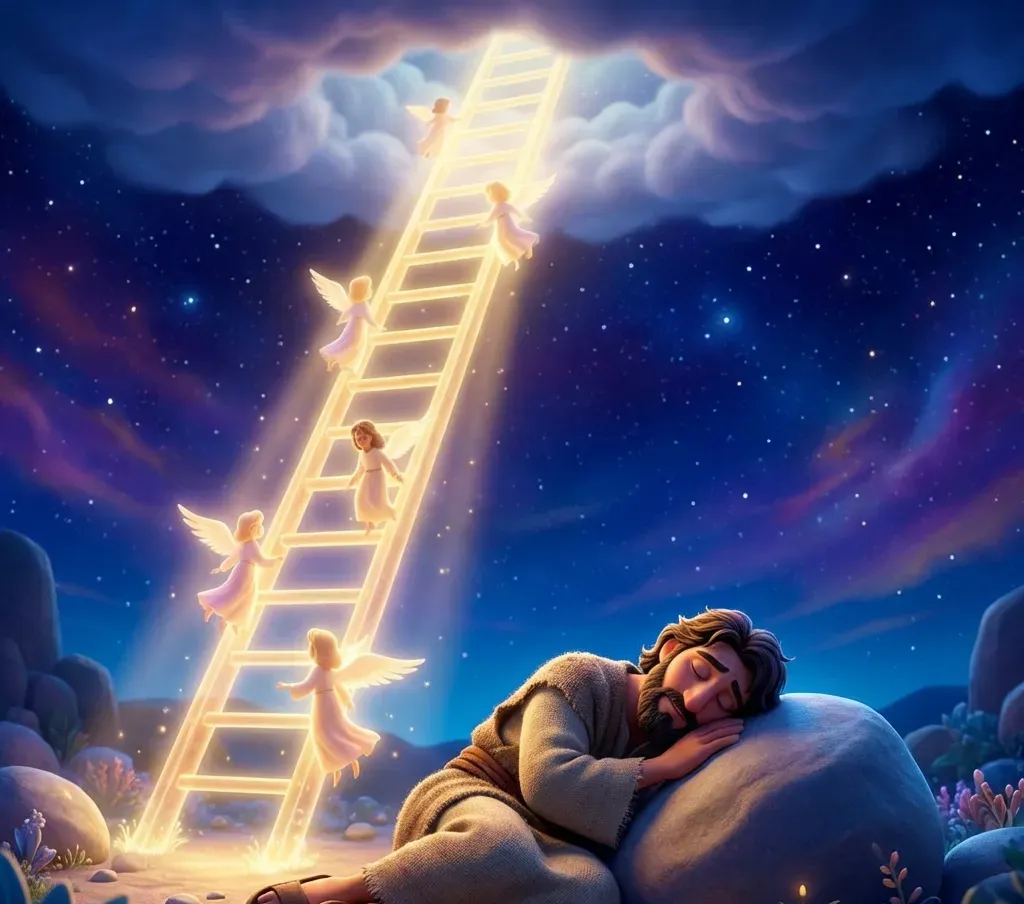
Unable to reach the safety of a fortified town before the gates were barred, Jacob halted in the open wilderness. The ground was hard, cold, and unforgiving. He surveyed the barren landscape, selected a smooth, flat limestone slab, positioned it beneath his head as a pillow, and wrapped his rough shepherd's cloak tightly around his shivering body.
Consider the psychological and spiritual agony of the patriarch's heart in that dark hour. He had manipulated his brother and lied to his father to secure the patriarchal blessing. He had obtained the legal words of benediction, but what was the actual fruit? Esau possessed the vast family flocks, the servants, and the tents; Jacob possessed only the hard dirt and a cold stone beneath his head. He must have wondered in bitter tears whether the holy God of Abraham and Isaac had permanently abandoned him for his deceit.
2. The Celestial Stairway: The Sullam of Heaven
Exhausted by grief and physical exertion, Jacob slipped into deep sleep. And there, in the dark theater of the subconscious, the veil between physical reality and uncreated glory was torn asunder.
Jacob beheld a vision that shook his soul to its foundations: a magnificent, radiant stairway (Hebrew: Sullam) planted firmly upon the dark earth, its towering summit piercing the highest heavens. It was not a rickety wooden ladder, but a colossal celestial highway—a ramp of dazzling light bridging the cosmic chasm between earth and heaven.
Upon this luminous bridge, the angelic hosts of God—celestial messengers and ministering spirits—were ascending and descending in harmonious, unending order. They were ascending from the earth to bring human petitions and conditions before the throne, and descending from heaven to execute divine protection and sovereign providence over the earth. Earth was not an isolated, godforsaken rock spinning in cold cosmic indifference; it was actively linked to the nerve center of the universe.
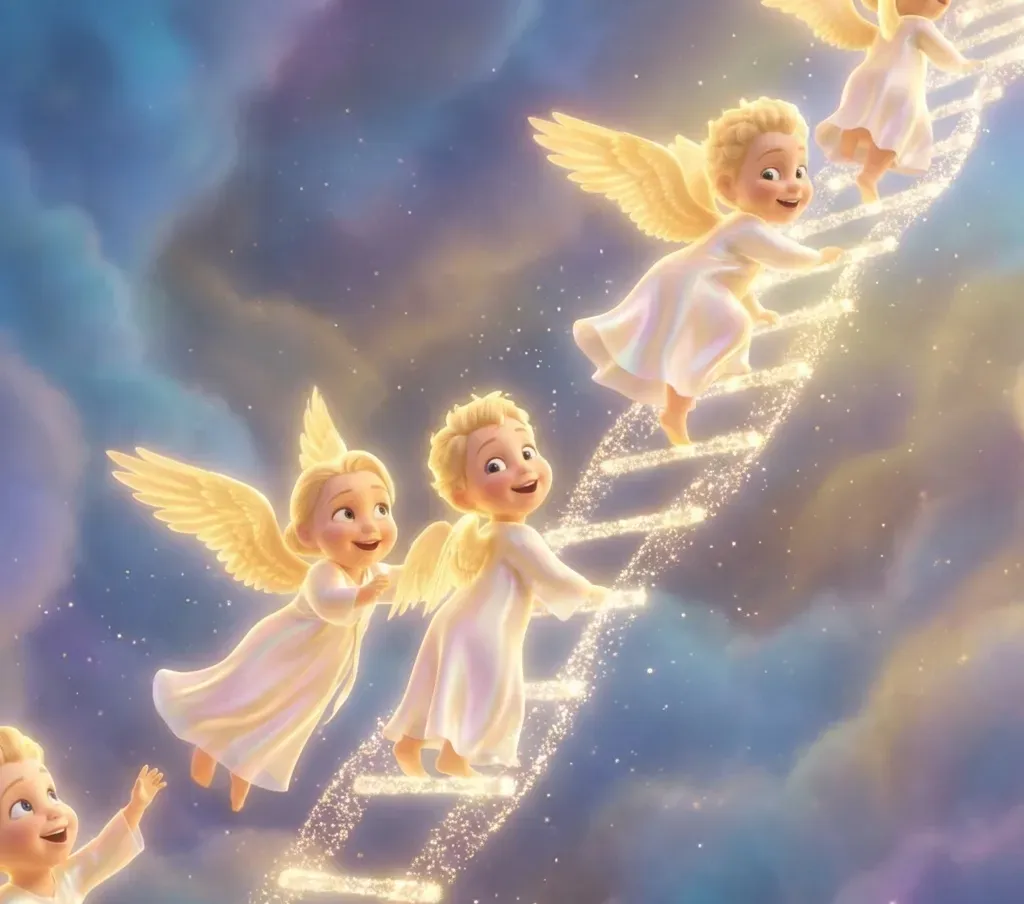 A cosmic stairway rested upon the earth, its summit reaching the heavens, with the angels of God ascending and descending in glory.
3. The Unconditional Covenant of Grace
As Jacob gazed upward with awe, the vision culminated in supreme transcendence: above the celestial stairway stood Yahweh Himself. The Lord did not thunder in wrath; He did not recount Jacob's lies or demand an apology. Instead, the Sovereign of the cosmos spoke words of breathtaking, unmerited grace:
'I am the LORD God of Abraham your father and the God of Isaac; the land on which you lie I will give to you and your descendants. Also your descendants shall be as the dust of the earth; you shall spread abroad to the west and the east, to the north and the south; and in you and in your seed all the families of the earth shall be blessed.' (Genesis 28:13-14).
Every promise previously given to Abraham and Isaac was now formally, legally transferred to Jacob. The blessing was not lost; it was ratified by the voice of God Himself. Then came the tenderest, most personal promise ever spoken to a lonely pilgrim:
'Behold, I am with you and will keep you wherever you go, and will bring you back to this land; for I will not leave you until I have done what I have spoken to you.' (Genesis 28:15).
Notice the fivefold divine pledge: I am with you... I will keep you... I will bring you back... I will not leave you... I will fulfill all I have promised. This was unconditional grace in its purest biblical expression. Jacob had brought nothing to the table except deceit, exhaustion, and a stone pillow. But God met him with sovereign mercy, anchoring the fugitive in His eternal covenant purposes.
4. Holy Dread: 'How Awesome is this Place!'
Jacob awoke from his sleep, the morning sun cresting the eastern ridges of Gilead. The vision had vanished, but the atmosphere remained thick with the weight of divine holiness. Trembling with sacred awe, the patriarch whispered into the morning mist:
'Surely the LORD is in this place, and I did not know it!' (Genesis 28:16).
He was gripped by holy dread (Nora) and declared: 'How awesome is this place! This is none other than the house of God, and this is the gate of heaven!' (Genesis 28:17).
Jacob realized a monumental theological truth: God is not confined to formal sanctuaries, holy family shrines, or the comfort of domestic tents. God is present in the bleakest, most desolate wilderness. The place had seemed common and desolate only because Jacob's eyes had been blind to the unseen spiritual reality that enfolded him.
5. The Pillar of Oil and the Naming of Bethel
Rising early in the morning, Jacob took the stone that had served as his hard pillow and stood it upright as a sacred memorial pillar (Matzevah). From his travel provisions, he took his flask of olive oil and poured it lavishly over the top of the stone, consecrating it as an altar of witness.
He renamed the ancient Canaanite site of Luz: he called it Bethel, meaning 'The House of God'. The hard stone of his suffering had been transformed into the foundational monument of his spiritual life.
Then Jacob made a solemn, historic vow (Neder) before the Lord:
'If God will be with me, and keep me in this way that I am going, and give me bread to eat and clothing to put on, so that I come back to my father's house in peace, then the LORD shall be my God. And this stone which I have set as a pillar shall be God's house, and of all that You give me I will surely give a tenth to You.' (Genesis 28:20-22).
Theologians have long debated the conditional phrasing of Jacob's vow ('If God will... then the LORD shall be my God'). In one sense, it reflects the residual calculating nature of Jacob the bargainer. Yet, in a deeper sense, the Hebrew grammar can accurately be translated: 'Since God will be with me... the LORD shall be my God.' Jacob was grasping the hem of God's promise. He pledged that he would never worship any other god, that Bethel would be his holy sanctuary, and that he would honor God through the sacred practice of the tithe (giving a tenth of all future income).
6. Christological Fulfillment: The True Ladder of John 1:51
Two thousand years later, beside the waters of the Jordan, Jesus Christ encountered a cynical, guileless Israelite named Nathanael. When Nathanael marveled at Jesus' supernatural insight, the Lord unveiled the ultimate mystery of Jacob's ladder:
'Most assuredly, I say to you, hereafter you shall see heaven open, and the angels of God ascending and descending upon the Son of Man.' (John 1:51).
Jesus revealed that Jacob's ladder was not an architectural monument; it was a person. Jesus Christ is the true Sullam. Through His divine nature, He touches the highest heaven; through His holy human incarnation, He plants His feet firmly upon the dust of our broken earth. The cross of Jesus Christ is the ultimate celestial stairway that bridges the infinite gulf between holy God and sinful humanity, opening the Gate of Heaven to all who believe.
Theological Summary:
- The Omnipresence and Proximity of God: God is not distant or confined to sacred buildings. In our darkest wilderness moments—when we feel abandoned, ashamed, and exhausted—God is present, watching over us and preparing divine breakthroughs.
- Sovereign, Unmerited Grace: God met Jacob at his lowest point of moral failure not with judgment, but with covenant promises. Divine election is rooted entirely in God's mercy, transforming broken sinners into instruments of His redemptive plan.
- Christ the Living Ladder: John 1:51 confirms that Jesus Christ is the sole mediator between God and man (1 Timothy 2:5). Through His cross, the heavens are torn open, and divine fellowship is restored forever.
- Consecration and Sacrificial Giving: Genuine encounters with God lead to transformed lives. Like Jacob anointing his stone pillow and pledging his tithes, believers respond to grace through radical consecration, joyful worship, and faithful stewardship.
Biblical Keywords & Theological Roots
Ladder, celestial stairway, or ramp; a unique biblical term representing the sovereign highway of communication between heaven and earth.
House of God (Beth = House, El = God); the sacred title given to the desolate wilderness of Luz after God's presence transformed it into holy ground.
A standing pillar, sacred stone monument, or memorial marker set erect and anointed to commemorate a divine covenant encounter.
Awesome, dreadful, terrifying, or inspiring profound holy reverence; describing Jacob's trembling awe upon awakening in the presence of God.
A vow, voluntary sacred pledge, or covenant consecration of tithes made in response to divine protection and grace.
Ancient Near Eastern & Archaeological Context
In the ancient Near East during the early second millennium BC, the ancient town of Luz sat high upon the spine of the central Judean hill country, roughly twelve miles north of modern Jerusalem. Perched at an elevation of nearly 2,900 feet along the historic 'Way of the Patriarchs' (the primary north-south ridge road connecting Shechem, Bethel, Hebron, and Beersheba), the surrounding landscape is marked by exposed, terraced limestone ridges, wind-swept rocky plateaus, and sparse vegetation.
In Mesopotamian religious cosmology, the architectural pinnacle of religious worship was the monumental ziggurat—a massive multi-tiered mudbrick pyramid equipped with monumental external stairways (*simmiltu* in Akkadian). In pagan theology, these ziggurats functioned as artificial sacred mountains built by human slave labor, designed to entice capricious gods to descend down to earth to receive animal sacrifices. Genesis 28 radically deconstructs this human-centered religious pride. Jacob built nothing; he was a penniless, guilt-ridden fugitive fleeing for his life with only a stone for a pillow. Yet, in pure unmerited grace, the sovereign Creator of the universe established His own cosmic stairway, descending to touch earth at a desolate limestone outcrop, revealing that access to the presence of God is entirely a gift of divine initiative rather than human architectural exertion.
Practical Discipleship & Spiritual Application
- Discovering God's Presence in Desolate Wilderness Seasons: Jacob confessed, 'Surely the LORD is in this place, and I did not know it.' When you find yourself in a lonely, fearful, or barren season of life, resting upon hard circumstances, recognize that God is intimately near, ready to reveal His glory in unexpected places.
- Resting in the Unconditional Grace of the Covenant: God did not appear to Jacob to condemn his deceit, scold his past, or demand penance. God met Jacob at his lowest point of bankruptcy with unmerited promises of presence and protection. God's grace always precedes and empowers our transformation.
- Christ Jesus as the Only Bridge to the Father: Jesus is the true Sullam who spanned the infinite abyss between holy heaven and fallen earth. Through Christ's incarnation, death, and resurrection, heaven is permanently opened, and every believer has direct, unfettered access into the Holy of Holies.
- Memorializing Divine Encounters and Practicing Faithful Stewardship: Jacob took the stone of his wilderness pillow, anointed it as an Ebenezer pillar, and pledged a faithful tithe back to God. When God meets us in grace, our natural response must be worship, sacred remembrance, and joyful, dedicated stewardship of all He entrusts to us.
⚡ Fast Facts
- Hapax Legomenon: The Hebrew word for ladder or stairway ('Sullam') appears only once in the entire Hebrew Bible (Genesis 28:12), highlighting its unique theological role as a divine bridge.
- The Unconditional Guarantee: In this vision, God made zero moral demands upon Jacob; Yahweh unconditionally promised: 'I am with you and will keep you wherever you go... I will not leave you until I have done what I have spoken to you' (Genesis 28:15).
- The Anointing of the Stone: Pouring olive oil upon the stone pillar ('Matzevah') was a formal ancient act of consecration, setting apart common stone as sacred space and prefiguring temple altars.
- The Christological Fulfillment: Jesus explicitly applied Jacob's ladder to Himself in John 1:51, declaring that He is the sole living mediator upon whom the angels of God ascend and descend.
❓ Frequently Asked Questions (FAQs)
While often pictured as a simple wooden carpenter's ladder, the Hebrew 'Sullam' more accurately denotes a massive, terraced celestial stairway or ramp, reminiscent of Mesopotamian ziggurats. But whereas pagan ziggurats represented human efforts to construct towers up to the gods, Jacob's ladder was sovereignly anchored by God Himself from heaven down to earth, bridging the infinite chasm caused by human sin.
Jacob's vow ('If God will be with me and keep me... then the LORD shall be my God') reflects the fragile beginning of his faith. Still carrying the calculating instincts of a trader, Jacob framed his response conditionally. Yet, even in this immature bargain, Jacob took a crucial step of personal covenant commitment, adopting his father's God as his own and instituting the sacred principle of tithing.
In John 1:51, Jesus told Nathanael: 'Most assuredly, I say to you, hereafter you shall see heaven open, and the angels of God ascending and descending upon the Son of Man.' Jesus revealed that He Himself is the true Bethel—the living House of God—and the true Ladder. Christ's incarnation and cross form the singular bridge reconciling holy God and fallen humanity.