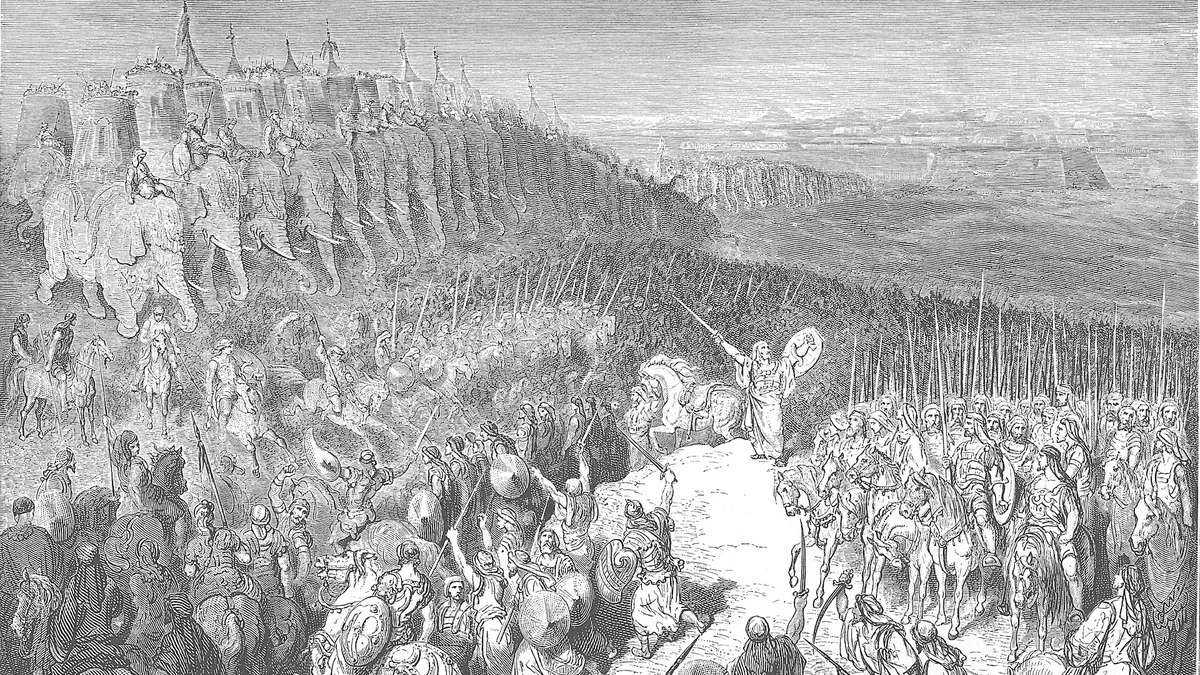
Between the closing sentence of Malachi and the opening announcement of the Gospel of Matthew lies a vast, four-hundred-year canyon of time. In traditional Bibles, this era is represented by a single blank page, often termed the 'Four Hundred Silent Years.' Yet while heaven spoke no new scripture and sent no inspired prophet, God was far from idle. Behind the scenes of geopolitical history, Almighty God was moving empires like chess pieces across a global board. Through the clash of Persian kings, the lightning conquests of Alexander the Great, the fiery martyrdom of the Maccabees, and the iron consolidation of the Roman Empire, God was meticulously orchestrating the world for one transcendent moment: 'the fullness of the time' when God would send forth His Son.
1. Daniel's Prophetic Blueprint of Four Empires
Centuries earlier, in the royal courts of Babylon, God gave the prophet Daniel visions of four successive world empires that would govern the Middle East until the coming of the Messiah (Daniel 2 & 7):
- The Head of Gold / Winged Lion: Babylon (605–539 BC).
- The Chest of Silver / The Bear: Medo-Persia (539–331 BC).
- The Belly of Bronze / Four-Winged Leopard: Greece under Alexander (331–63 BC).
- The Legs of Iron / Terrifying Beast: Rome (63 BC onwards).
During the silent years, every single detail of Daniel’s prophecies was fulfilled with breathtaking, microscopic precision.
2. Alexander the Great and the Gift of a Universal Language
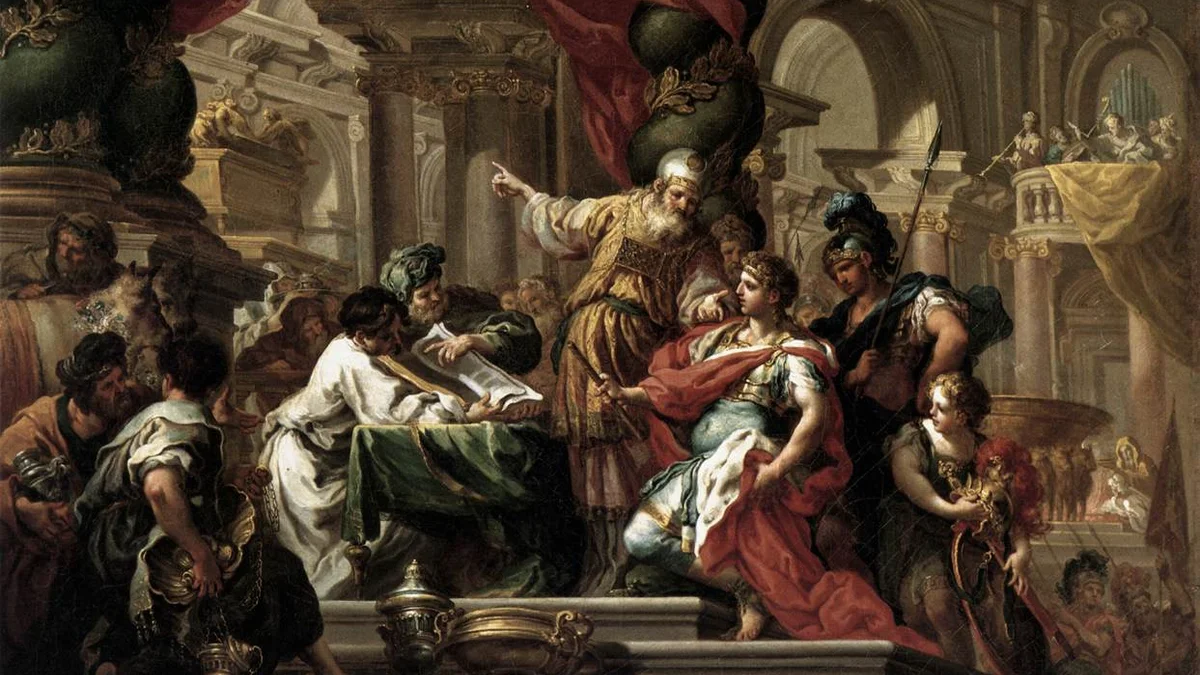 Sebastiano Conca's classical painting depicting Alexander the Great visiting the Temple of Jerusalem in reverence before the High Priest.
In 334 BC, twenty-year-old **Alexander the Great** of Macedon charged across the Hellespont. Within a decade, Alexander conquered Persia, Egypt, and marched all the way to India. According to Jewish historian Flavius Josephus, when Alexander approached Jerusalem, the High Priest Jaddua went out to meet him wearing his sacred priestly robes and golden plate. Alexander bowed in reverence, explaining that he had seen this very high priest in a dream in Macedonia, and was shown the book of Daniel prophesying that a Greek king would overthrow Persia!
Alexander brought with him **Hellenization**—the spread of Greek philosophy, architecture, and above all, **Koine Greek** (common Greek). For the first time in human history, the Mediterranean world shared a single, universal language of commerce, literature, and philosophy.
Around 250 BC in Alexandria, Egypt, seventy-two Jewish scholars translated the Hebrew Scriptures into Greek, creating the **Septuagint (LXX)**. Now, Gentiles and dispersed Jews across the civilized world could read the prophecies of the coming Messiah in the common tongue!
3. The Tyranny of Antiochus Epiphanes and the Abomination of Desolation
Following Alexander's premature death at age thirty-two, his empire fragmented among his four generals (fulfilling Daniel 8:8). Judea became a bloody battleground between the Ptolemies of Egypt (King of the South) and the Seleucids of Syria (King of the North).
In 175 BC, a mad tyrant named **Antiochus IV Epiphanes** ("God Manifest") seized the Seleucid throne. Determined to stamp out Jewish monotheism and enforce Greek paganism, Antiochus marched into Jerusalem in 167 BC:
- He outlawed circumcision, Sabbath keeping, and the dietary laws under penalty of public execution.
- He ordered all Torah scrolls found to be shredded and burned.
- He committed the ultimate sacrilege: erecting a statue of Greek god Zeus on the holy altar of burnt offering in the Temple and sacrificing a sow (pig), sprinkling its broth inside the Holy of Holies (the *Abomination of Desolation* foretold in Daniel 11:31).
4. The Maccabean Revolt and the Miracle of Hanukkah
In the village of Modi'in, when a Syrian officer demanded that an aged priest named **Mattathias** sacrifice to pagan gods, Mattathias refused: "Even if all the nations obey the king, I and my sons will walk in the covenant of our fathers!" When an apostate Jew stepped forward to comply, Mattathias killed him and the Syrian officer, fleeing to the Judean mountains with his five sons.
Mattathias’s third son, **Judas Maccabeus** ('The Hammer'), launched an astonishing guerrilla war against the mighty Syrian armies. Outnumbered ten to one, relying solely on prayer and tactical ambushes, Judas routed four Seleucid armies!
In December 164 BC (precisely three years after its desecration), the Maccabean warriors liberated the Temple Mount. They tore down the defiled altar, built a new one, cleansed the courts, and rededicated the sanctuary with joyful praise, instituting the eight-day **Feast of Dedication (Hanukkah)**. Centuries later, Jesus Himself walked in the Temple during this very feast (John 10:22).
5. The Iron Fist of Rome and the Pax Romana
Independence under the Hasmonean dynasty lasted barely a century before civil war erupted between two brothers, Hyrcanus and Aristobulus. In 63 BC, Roman general **Pompey the Great** marched into Jerusalem, entered the Holy of Holies (surprised to find it empty), and made Judea a Roman province.
Rome brought three unprecedented global advantages that would facilitate the explosion of the Gospel:
- Pax Romana (Roman Peace): The Roman legions ruthlessly suppressed regional warfare and cleared the seas of piracy.
- The Roman Road Network: Over 50,000 miles of paved, paved stone highways connected Britain to the Euphrates, allowing missionaries like Paul to travel with unprecedented speed and safety.
- The Synagogue Network: Dispersed Jewish communities across every major Roman city provided ready-made pulpits where the Old Testament was read every Sabbath.
6. Galatians 4:4: The Fullness of Time
The apostle Paul summarizes this magnificent four-hundred-year divine orchestration in one immortal verse:
"But when the fullness of the time had come, God sent forth His Son, born of a woman, born under the law, to redeem those who were under the law, that we might receive the adoption as sons." (Galatians 4:4-5).
The timing was not accidental. If Christ had come during the Persian Empire, the language would have been localized. If He had come during the chaotic Greek wars, travel would have been impossible. But God waited until the universal Greek language, Roman roads, global spiritual disillusionment, and intense messianic expectation converged. The stage was set, the prophetic clock struck twelve, and the silence was about to be broken!
Spiritual Reflections & Practical Life Application:
- God’s Silence Is Not His Absence: When heaven feels silent in your life and you hear no new voice, remember the 400 years. God is orchestrating unseen circumstances, preparing people and resources behind the scenes.
- Stand Against Cultural Assimilation: The Maccabees risked their lives rather than bow to secular pagan pressure. In a culture that demands you compromise biblical truth, stand firm in Christ!
- God Operates on 'The Fullness of Time': Your breakthrough has an appointed hour on God's calendar. Do not grow impatient; trust His perfect timing.
- The King of Kings Reigns Over History: Alexander, Caesar, and Antiochus thought they ruled the world, but they were merely paving the way for the carpenter of Nazareth. Jesus Christ is the Lord of history!
⚡ Fast Facts
- Often called the '400 Silent Years' because no inspired biblical prophet spoke in Israel from ~430 BC to John the Baptist
- Alexander the Great conquered the Persian Empire in 331 BC, spreading the Greek language (Koine Greek) worldwide
- The Hebrew Old Testament was translated into Greek (the Septuagint / LXX) in Alexandria around 250 BC
- The Feast of Dedication (Hanukkah / Festival of Lights) originated in 164 BC when the Maccabees cleansed the desecrated Temple
❓ Frequently Asked Questions (FAQs)
The silence was not divine absence, but divine incubation. The prophetic canon of the Old Testament was complete. God allowed human pride, Greek philosophy, and Roman militarism to demonstrate their spiritual emptiness, building an intense global hunger for the true Redeemer.
In 167 BC, the Seleucid king Antiochus IV Epiphanes entered the Jerusalem Temple, erected a statue of Zeus on the altar of burnt offering, sacrificed a pig upon it, banned circumcision and Sabbath keeping on pain of death, and burned Torah scrolls, precisely fulfilling Daniel 11:31.
God orchestrated world conditions perfectly for the Gospel: (1) Greek language provided a universal medium of communication, (2) Roman roads and Pax Romana enabled safe global travel, (3) Jewish synagogues provided staging grounds across the empire, and (4) deep spiritual longing prepared hearts for Christ.