 ### The Shadows of the Hill Country
In the days of Herod the Great, the ruthless Idumean client king appointed by Rome over Judea, a quiet, elderly couple lived in an obscure village nestled in the Judean hill country. Their names were Zechariah and Elizabeth.
Zechariah was a priest belonging to the division of Abijah—the eighth of twenty-four priestly courses established by King David a millennium earlier (1 Chronicles 24:10). Elizabeth was also of pristine Aaronic lineage, a literal "daughter of Aaron."
Scripture describes this couple with an epitaph of unmatched moral beauty:
> "And they were both righteous before God, walking in all the commandments and ordinances of the Lord blameless." (Luke 1:6)
Yet behind their blameless integrity lay a lifelong, private sorrow:
> "But they had no child, because Elizabeth was barren, and they were both well advanced in years." (Luke 1:7)
In first-century Jewish culture, childlessness was not merely a personal disappointment; it was a crushing social stigma. Neighbors whispered that secret sin must be lurking behind closed doors, for children were regarded as the visible token of divine blessing (Psalm 127:3). Year after year, decade after decade, Zechariah and Elizabeth had knelt in tears, begging God for a son.
Now, the biology of youth was long gone. Elizabeth's hair was silver; Zechariah's hands trembled with age. The cradle remained empty. The prayers of their youth seemed buried forever in the silent vault of heaven.
 ### The Golden Altar and the Angelic Visitation
With roughly twenty thousand priests residing throughout the land, the opportunity for an ordinary rural priest to minister inside the Temple was strictly regulated. Twice a year, for one week at a time, each priestly course traveled to Jerusalem to perform the sacred services.
Every morning and evening, the most sacred, solemn moment of the entire temple liturgy arrived: **the Offering of Incense** inside the Holy Place (*Heikhal*).
Because this privilege was so awe-inspiring—stepping into the very chamber adjacent to the Holy of Holies where the veil hung before the Ark—no priest was permitted to perform it more than once in his entire lifetime. Each day, the priests assembled at dawn in the Chamber of Hewn Stone to cast sacred lots (*mif'al*). Many aged priests lived and died without their name ever being drawn.
On this particular morning, as the casting of lots concluded, the name was announced:
**Zechariah of the course of Abijah!**
Zechariah's heart must have pounded against his chest. In the twilight of his life, the sovereign hand of God had selected him for his once-in-a-lifetime encounter.
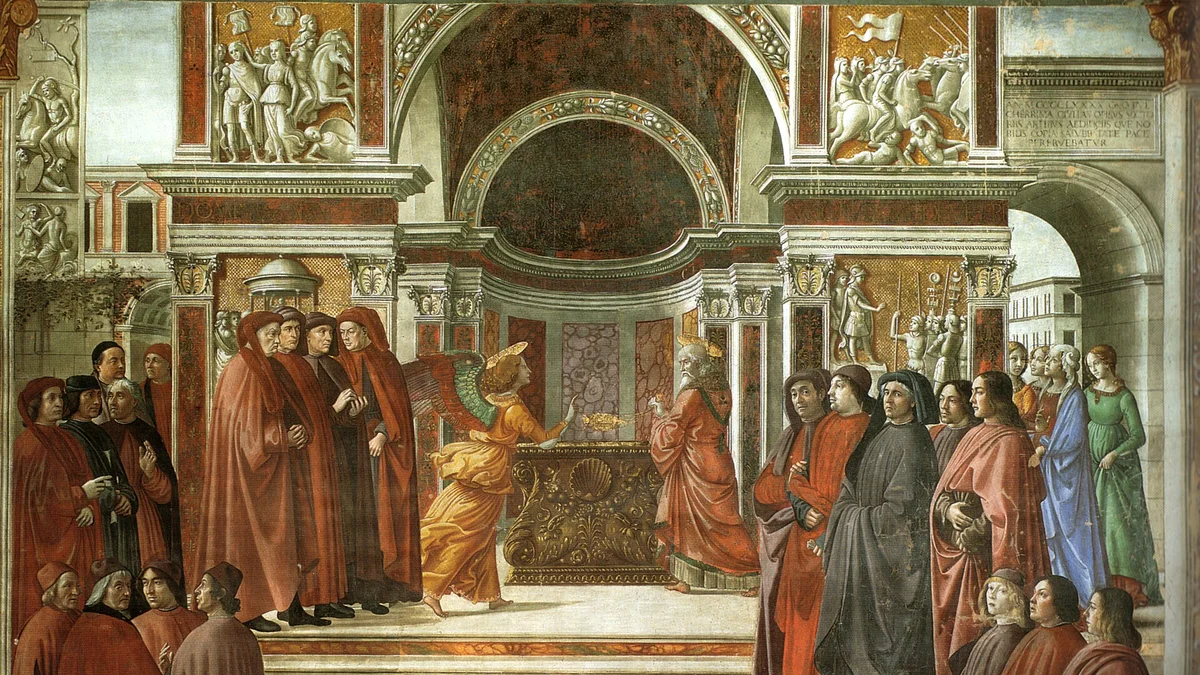
Clothed in clean white linen vestments, with bare feet, Zechariah walked slowly up the twelve steps of the Temple porch. Two assisting priests accompanied him to arrange the glowing embers from the altar of burnt offering onto the golden Altar of Incense (*Mizbach ha-Ketoret*). They bowed and retreated, leaving Zechariah standing alone in the hushed, golden chamber.
Outside, in the Court of Israel and the Court of Women, thousands of worshipers fell prostrate in silent prayer (*Luke 1:10*). The sweet aroma of burning frankincense, myrrh, and cinnamon rose in a white cloud toward the ceiling, symbolizing the prayers of Israel ascending to heaven.
As Zechariah poured the incense onto the burning coals, the air suddenly thickened with celestial majesty. A dazzling, radiant figure materialized out of thin air:
> "Then an angel of the Lord appeared to him, standing on the right side of the altar of incense. And when Zechariah saw him, he was troubled, and fear fell upon him." (Luke 1:11–12)
In ancient Jewish thought, the right side of the altar was the side of divine mercy and favorable answers. Standing before the terrified old priest was Gabriel, the archangel who stands in the immediate presence of God, who had last appeared to the prophet Daniel five centuries earlier!
Gabriel spoke with the thunder of eternity:
> "Do not be afraid, Zechariah, for your prayer is heard; and your wife Elizabeth will bear you a son, and you shall call his name John. And you will have joy and gladness, and many will rejoice at his birth." (Luke 1:13–14)
Gabriel unfolded the child's cosmic destiny:
- He would be great in the sight of the Lord.
- He would drink neither wine nor strong drink, consecrated as a lifelong Nazarite.
- He would be filled with the Holy Spirit from his mother's womb.
- He would turn many of the children of Israel to Yahweh their God.
- He would go before the Messiah **in the spirit and power of Elijah**, to turn the hearts of the fathers to the children, fulfilling the final words of Malachi 4:5–6!
Four hundred silent years were shattered in a single sentence.
### The Stumble of Faith and Nine Months of Silence
Instead of bursting into praise, Zechariah's analytical mind pushed back against the miracle:
> "How shall I know this? For I am an old man, and my wife is well advanced in years." (Luke 1:18)
Zechariah looked at his wrinkled skin, remembered Elizabeth's barrenness, and demanded an empirical guarantee (*"How shall I know this?"*).
Gabriel's countenance blazed with holy authority:
> "I am Gabriel, who stands in the presence of God, and was sent to speak to you and bring you these glad tidings. But behold, you will be mute and not able to speak until the day these things take place, because you did not believe my words which will be fulfilled in their proper time." (Luke 1:19–20)
Outside, the waiting crowd began to wonder why the priest was tarrying so long in the Holy Place. Usually, the priest offered the incense quickly and exited immediately, lest the people fear he had been struck dead for improper ritual.
When Zechariah finally emerged onto the porch steps, the Levites handed him the silver trumpet to pronounce the Aaronic Blessing: *"Yahweh bless you and keep you; Yahweh make His face shine upon you..."* (Numbers 6:24–26).
Zechariah raised his trembling hands. He opened his mouth—but no sound came out! He could only gesture frantically with his hands. The crowd instantly perceived that he had seen a supernatural vision in the sanctuary.
His week of temple duty ended. Zechariah made the long journey home to the hill country. Soon afterward, the impossible happened: Elizabeth conceived! For five months she hid herself in joyous seclusion, whispering: *"Thus the Lord has dealt with me, in the days when He looked on me, to take away my reproach among people"* (Luke 1:25).
### The Circumcision: "His Name Is John"
In the sixth month of Elizabeth's pregnancy, her young virgin cousin Mary arrived from Nazareth, having received her own angelic annunciation. The moment Mary's greeting reached Elizabeth's ears, the unborn infant leaped in Elizabeth's womb, and Elizabeth was filled with the Holy Spirit, crying out: *"Blessed are you among women, and blessed is the fruit of your womb!"* (Luke 1:41–42). The unborn forerunner was already bearing witness to the unborn King!
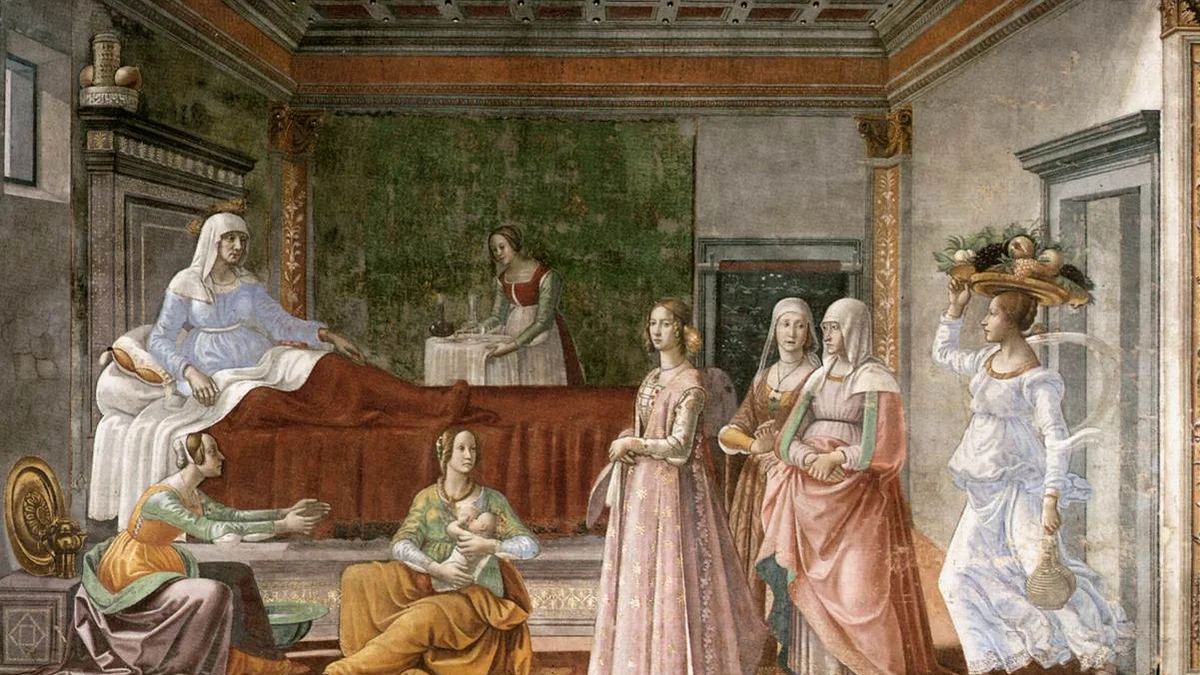
When Elizabeth's full time came, she gave birth to a healthy baby boy. Neighbors and relatives rejoiced with her, marveling at God's mercy.
On the eighth day, the family gathered for the covenant rite of circumcision. The relatives naturally assumed the baby would be named Zechariah after his father.
Elizabeth spoke up with quiet firmness:
> *"No; he shall be called John."*
The relatives objected: *"There is no one among your relatives who is called by this name!"* They turned to the mute father, making signs to ask what he would have the child named.
Zechariah asked for a wooden writing tablet (*pinakidion*) dusted with wax. Taking a stylus, he carved four definitive words:
> "His name is John." (*Yochanan: Yahweh is gracious*) (Luke 1:63)
Not *"I would like him to be called John,"* nor *"His name shall be John,"* but **"His name IS John."** Zechariah's doubt was dead. His obedience was total.
At that exact instant, the angelic discipline ended:
> "Immediately his mouth was opened and his tongue loosed, and he spoke, praising God." (Luke 1:64)
A holy awe (*phobos*) fell upon all who lived in the surrounding Judean hills. People whispered throughout the region: *"What kind of child will this be?"* For the hand of the Lord was unmistakably upon him.
### The Benedictus: The Song of the Sunrise
Filled with the Holy Spirit, Zechariah opened his mouth not to complain about his nine months of forced silence, but to prophesy. His song—known to church history as the **Benedictus** (from its first Latin word, *"Blessed"*)-is one of the most sublime theological doxologies in the entire Bible:
> "Blessed is the Lord God of Israel, for He has visited and redeemed His people, and has raised up a horn of salvation (*Qeren Yeshuah*) for us in the house of His servant David, as He spoke by the mouth of His holy prophets, who have been since the world began!" (Luke 1:68–70)
Notice Zechariah's spiritual maturity: he did not begin by singing about his own miracle baby. He began by exalting the Davidic Messiah whom Mary was carrying! God had remembered His holy covenant and the oath He swore to father Abraham.
Then, looking down into the face of his newborn son, the aged father prophesied:
> "And you, child, will be called the prophet of the Highest; for you will go before the face of the Lord to prepare His ways, to give knowledge of salvation to His people by the remission of their sins, through the tender mercy of our God, with which the Dayspring from on high (*Anatole ex Hypsous / Shachar mi-Marom*) has visited us; to give light to those who sit in darkness and the shadow of death, to guide our feet into the way of peace." (Luke 1:76–79)
The silence was broken. The morning star was shining. The forerunner had arrived, and over the eastern horizon of human history, the eternal Dayspring was about to burst forth upon the world.
Biblical Keywords & Theological Roots
Ancient Near Eastern & Archaeological Context
The opening of Luke's Gospel is grounded in precise first-century Second Temple realities documented in the Mishnah (tractate *Tamid*). King David had organized the Aaronic priesthood into twenty-four rotating courses (1 Chronicles 24), of which Abijah was the eighth. By the Herodian era, an estimated 18,000 to 20,000 priests lived throughout Judea and Galilee. Because so many priests served, the sacred privilege of offering incense in the Holy Place (*Heikhal*) was determined by casting lots (*mif'al*), and a priest was permitted this cosmic honor only once in his entire lifetime. The incense offering occurred twice daily (at the morning sacrifice around 9:00 AM and the evening sacrifice around 3:00 PM), symbolizing the prayers of God's people ascending to heaven (Psalm 141:2; Revelation 8:3–4). Archaeological excavations at Ein Karem in the Judean hill country have unearthed first-century ritual immersion baths (*miqva'ot*) and domestic structures matching the traditional hometown of Zechariah and Elizabeth.
Practical Discipleship & Spiritual Application
- Never write off your 'unanswered' prayers: God has not forgotten the sincere petitions of your youth; in His sovereign timetable, He answers when it brings maximum glory to His Kingdom.
- Serve faithfully in quiet routines: Zechariah walked blamelessly in ordinary priestly duties for fifty years before his miraculous visitation—faithfulness in the mundane prepares the stage for the miraculous.
- Submit your doubts to holy silence: when God gives promises too colossal for your human reason to grasp, choose reverent quietness rather than speaking words of cynical unbelief.
- Welcome the Dayspring into your shadows: bring your lingering griefs, fear of death, and dark seasons into the sunrise of Christ's tender mercies to guide your feet into the way of peace.
Support Independent Biblical Research
Did this study bless you? Help support our independent bilingual research and interactive visual Bible tools.
⚡ Fast Facts
- Zechariah belonged to the priestly division of Abijah—the 8th of 24 priestly orders established by King David nearly 1,000 years earlier (1 Chronicles 24:10).
- Because there were roughly 20,000 priests in Israel, the privilege of offering incense in the Holy Place was granted to an individual priest only once in his entire lifetime.
- Gabriel appeared specifically at the right side of the golden Altar of Incense—the traditional side associated in Hebrew thought with divine favor and answered prayer.
- John the Baptist was a lifelong Nazarite who drank neither wine nor strong drink, living in the Judean wilderness until the day of his public manifestation to Israel.
❓ Frequently Asked Questions (FAQs)
Why was Zechariah punished with muteness while Mary was not punished for asking a similar question?
While both Zechariah and Mary asked questions upon receiving angelic announcements, their underlying heart postures were radically different. Zechariah asked in skeptical unbelief: 'How shall I know this? For I am an old man, and my wife is well advanced in years' (Luke 1:18). As an experienced priest familiar with the miraculous births of Isaac, Samson, and Samuel, he demanded an empirical sign because he doubted God's power. In contrast, Mary asked in pure, surrendered inquiry: 'How can this be, since I do not know a man?' (Luke 1:34). She believed Gabriel's words completely, but sought clarification on the mechanics of a virgin conception without a human husband.
What was the spiritual and symbolic significance of the Altar of Incense?
The golden Altar of Incense (*Mizbach ha-Ketoret*) stood in the Holy Place immediately before the veil separating it from the Holy of Holies. The burning of sacred frankincense and spices produced a fragrant cloud that drifted upward, symbolizing the intercessory prayers of God's people ascending to the throne of heaven (Psalm 141:2; Revelation 5:8; 8:3–4). When Gabriel appeared at the incense altar, it signified that God had inhaled both the corporate prayers of Israel for the Messiah and the personal prayers of Zechariah for a child, answering both in a single redemptive stroke.
Why did the neighbors and relatives insist on naming the baby Zechariah after his father?
In ancient Near Eastern and Jewish tradition, naming a firstborn son after his father or grandfather was standard practice to preserve the family name and heritage (patronymics). When Elizabeth announced 'No; he shall be called John,' the relatives objected that no one in their family had that name (Luke 1:60–61). Zechariah confirmed the name on a writing tablet (*pinakidion*): 'His name is John' (*Yochanan*, 'Yahweh is gracious'). By breaking family tradition to obey Gabriel's command, Zechariah demonstrated that the child belonged unconditionally to God's New Covenant agenda rather than ancestral expectations.