The book of Amos is a thunderous roar from the wilderness against social injustice, religious hypocrisy, and the corruption of power. Rising from the rugged hills of Tekoa, a humble shepherd penetrated the luxurious royal sanctuaries of the Northern Kingdom of Israel. Armed with nothing but the unvarnished truth of Yahweh, Amos confronted a nation intoxicated with prosperity, holding up the uncompromising plumb line of divine righteousness to a crumbling society.
1. The Lion Roars: The Shepherd from Tekoa
In the middle of the eighth century BC, the Northern Kingdom of Israel reached the pinnacle of its imperial grandeur. The aristocracy lived in magnificent ivory palaces, lounged on luxurious couches of damask, anointed themselves with the finest imported oils, and composed indulgent music on harps. They celebrated grand religious festivals at the royal sanctuary of Bethel, offering vast numbers of animal sacrifices and boasting of their piety. But this opulent veneer concealed a rotten core: the wealthy merchants sold the righteous for silver and the needy for a pair of sandals, trampled the heads of the poor into the dust, and manipulated the marketplace scales to defraud the helpless.
God did not choose a polished aristocrat or a professional palace prophet to confront this wickedness. Instead, He reached down into the rocky wilderness of Tekoa, six miles south of Bethlehem in Judah, and laid hold of Amos. Amos was a rustic herdsman and a cultivator of sycamore figs—a tough, sun-scorched laborer who knew the harsh realities of life. The Lord laid a heavy burden on Amos's soul, saying, "Go, prophesy to my people Israel." Amos possessed no formal pedigree, yet he declared with trembling authority: "The Lord roars from Zion and thunders from Jerusalem; the pastures of the shepherds dry up, and the top of Carmel withers!"
Amos journeyed north and stepped into the bustling streets of Samaria and Bethel. He delivered a brilliant rhetorical snare: he began by declaring God's fiery judgment against Israel's pagan neighbors—Damascus, Gaza, Tyre, Edom, Ammon, and Moab—and even Southern Judah. The crowds of Northern Israel cheered as their ancient enemies were denounced. But then, Amos suddenly turned the spotlight directly upon Israel itself: "For three sins of Israel, even for four, I will not relent! They sell the innocent for silver, and the needy for a pair of sandals!" The cheers instantly died in their throats as the prophet exposed their national guilt.
2. The Vision of the Plumb Line and False Scales
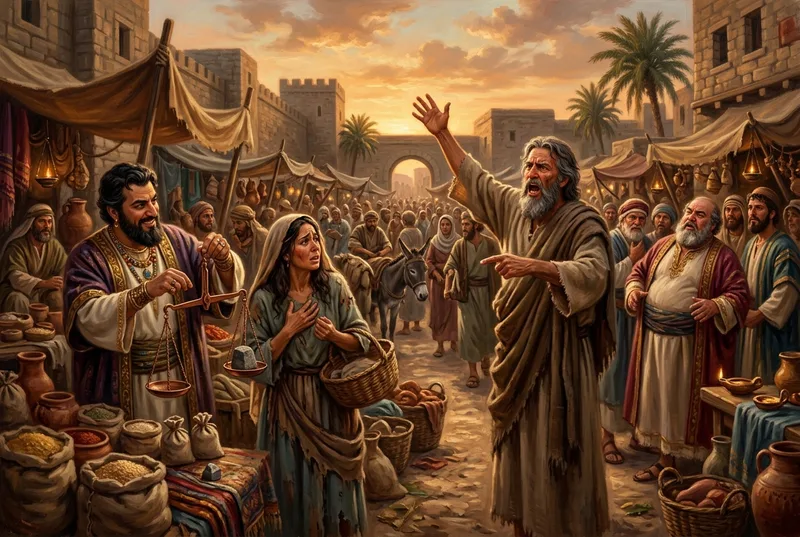 Amos boldly rebuked the wealthy merchants of Samaria who rigged the scales and exploited the poor while maintaining an outward show of religion.
Amos moved through the public markets where the wealthy exploited the desperate. He confronted the merchants who impatiently waited for the Sabbath to end so they could open their grain bins, make the ephah (measuring basket) small and the shekel (weight) heavy, and sell the sweepings of the wheat. God showed Amos a series of five terrifying visions regarding the destiny of Israel: swarms of locusts stripping the fields, a cosmic fire consuming the great deep, and most famously, the vision of the plumb line.
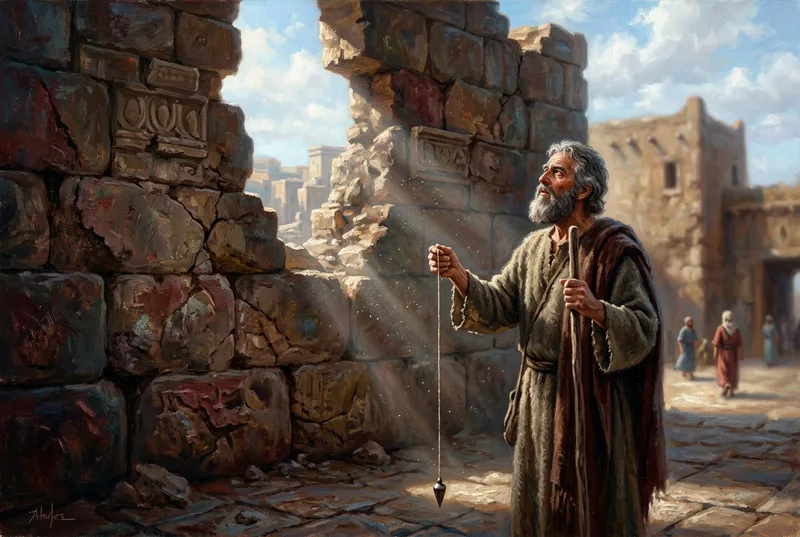
In this third vision, Amos saw the Lord standing beside a high stone wall that had been built true to plumb, holding a plumb line in His hand. The Lord asked, "What do you see, Amos?" "A plumb line," the prophet replied. Then the Lord said: "Look, I am setting a plumb line among my people Israel; I will spare them no longer. The high places of Isaac will be destroyed and the sanctuaries of Israel will be ruined; with my sword I will rise against the house of Jeroboam."
A plumb line is a simple weight on a string that uses gravity to establish an absolute vertical standard. A builder uses it to check whether a wall is standing straight or leaning dangerously. Israel had convinced itself that it was a strong, upright, and blessed nation because of its military victories and economic boom. But when God dropped the plumb line of His holy law against their society, it became glaringly evident that the nation was hopelessly warped, bulging, and on the verge of total collapse. God's standard of justice does not bend to human wealth, political power, or self-righteous traditions.
3. The Confrontation at Bethel: Truth Versus Power
The fearless preaching of Amos shook the religious establishment to its foundations. Amaziah, the high priest of the royal sanctuary at Bethel, was furious. He sent an urgent message to King Jeroboam II: "Amos is raising a conspiracy against you in the very heart of Israel! The land cannot bear all his words. For this is what Amos says: 'Jeroboam will die by the sword, and Israel will surely go into exile, away from their native land.'"
Amaziah then confronted Amos directly, attempting to intimidate the rustic prophet: "Get out, you seer! Go back to the land of Judah! Earn your bread there and do your prophesying there! Don't prophesy anymore at Bethel, because this is the king's sanctuary and the temple of the kingdom!"
Amos did not flinch. He looked the royal priest in the eye and delivered a legendary response that defined true prophetic integrity: "I was neither a prophet nor the son of a prophet, but I was a shepherd, and I took care of sycamore-fig trees. But the Lord took me from tending the flock and said to me, 'Go, prophesy to my people Israel.' Now then, hear the word of the Lord!" Amos then pronounced a chilling personal judgment upon Amaziah: his family would fall, his land would be measured out to others, and Amaziah himself would die in a pagan, unclean land.
4. Let Justice Roll On: The Immortal Call
In the fifth chapter of his book, Amos delivered one of the most powerful and revolutionary passages in all of world literature. He exposed the fatal disconnect between ritual worship and ethical living. God spoke through Amos with scathing clarity: "I hate, I despise your religious festivals; your assemblies are a stench to me. Even though you bring me burnt offerings and grain offerings, I will not accept them. Away with the noise of your songs! I will not listen to the music of your harps!"
God rejected their elaborate worship because it was detached from moral integrity. In place of empty ritualism, the Almighty issued His supreme demand:
"But let justice roll on like a river, righteousness like a never-failing stream!" (Amos 5:24)
True religion, Amos proclaimed, cannot exist without justice for the oppressed, honesty in the marketplace, and mercy for the destitute. While the book warned of the coming Assyrian captivity—symbolized by a basket of ripe summer fruit indicating that Israel's time had run out—it concluded with a radiant promise of future restoration. God promised that the fallen tent of David would one day be rebuilt, and Israel would be planted firmly in their land, never again to be uprooted. Amos's ancient cry continues to resonate today, calling every generation to measure their lives against God's plumb line of truth and to champion justice for all.
Reflections on the Story:
- The Standard of the Plumb Line: We cannot judge our spiritual health by comparing ourselves to human culture or material success. God's eternal Word is the only true plumb line that reveals the alignment of our hearts.
- Worship and Justice are Inseparable: God rejects singing, giving, and church attendance if our daily lives are marked by greed, dishonesty, and indifference toward the poor and suffering.
- God Uses Ordinary Vessels: Amos was neither an educated theologian nor from a priestly lineage; he was an ordinary laborer who was obedient to God's voice. God uses humble, willing hearts to speak truth to power.
- The Inevitability of Divine Justice: A society that builds its prosperity on the exploitation of the weak will eventually collapse under the weight of its own corruption. Righteousness alone exalts a nation.
⚡ Fast Facts
- The Rugged Shepherd: Amos was not a professional court prophet; he was a herdsman and farmer from Tekoa.
- The Plumb Line Vision: God placed a plumb line in the midst of Israel to reveal how far they had deviated from righteousness.
- Basket of Summer Fruit: A vision of ripe summer fruit symbolized that the time was ripe for Israel's judgment.
- The Call for Justice: Amos 5:24 gives the timeless cry: 'Let justice roll on like a river, righteousness like a never-failing stream!'
❓ Frequently Asked Questions (FAQs)
A plumb line is an ancient builder's tool consisting of a weight suspended by a cord, used to determine if a wall is perfectly vertical. God used it as a metaphor to show that Israel's moral and spiritual life was dangerously crooked when measured against His righteous standard.
Amaziah was the royal priest of the idolatrous golden calf shrine at Bethel. He viewed Amos's prophecies as political treason against King Jeroboam II and ordered him to go back to Judah and earn his bread elsewhere.
God rejected their burnt offerings, songs, and feasts because they practiced religion as an empty ritual while actively exploiting the poor, using dishonest scales in the market, and bribing judges in court.