Found in Matthew 13:44, the Parable of the Hidden Treasure is a masterclass in theological brevity. In a single verse, Jesus unveils the staggering worth of the Gospel, showing that encountering the grace of God transforms a person's entire value system and turns radical sacrifice into an act of supreme, unstoppable joy.
1. The Routine Labor and the Sudden Impact
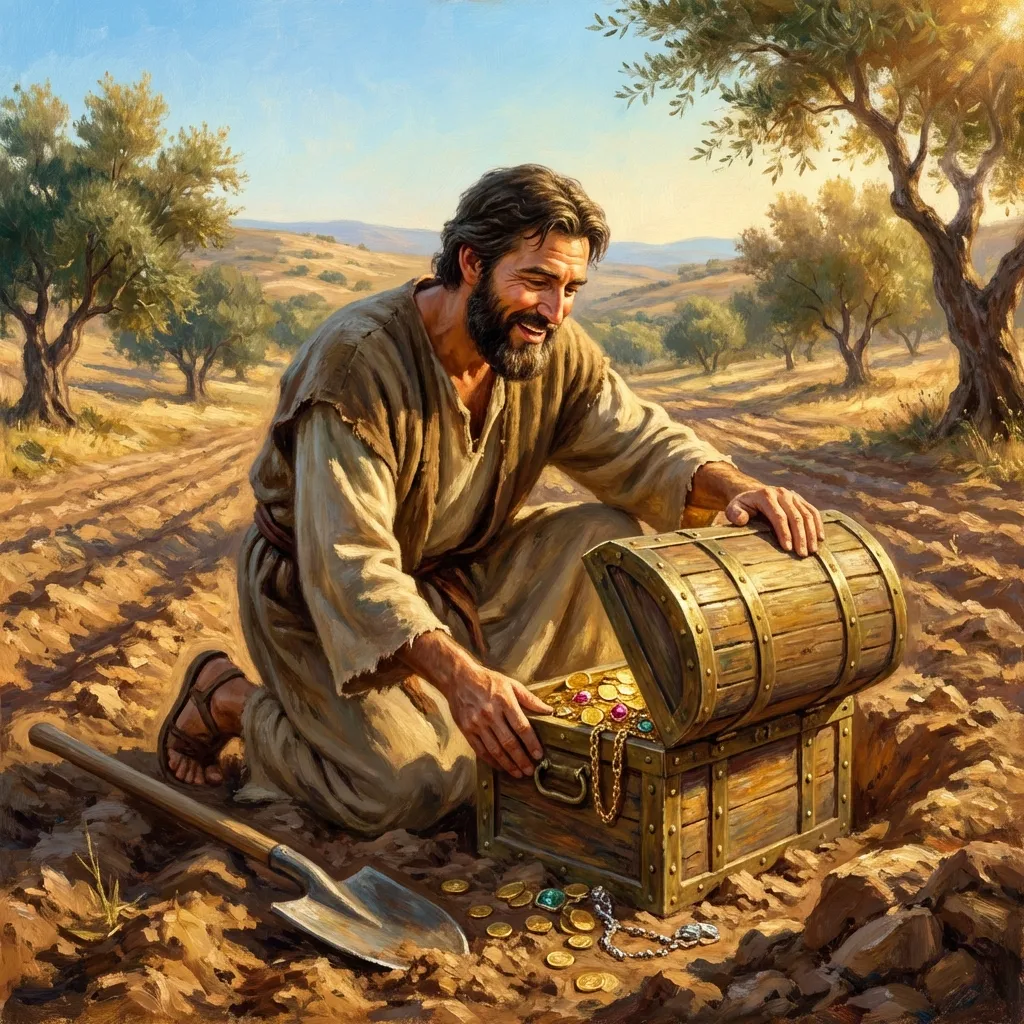
Jesus painted a simple agrarian vignette: "The kingdom of heaven is like treasure hidden in a field. When a man found it, he hid it again, and then in his joy went and sold all he had and bought that field" (Matthew 13:44). The protagonist was an ordinary agricultural laborer, likely a tenant farmer or day wage earner plowing a stony Judean field. As his plowshare cut through the dry soil, it struck something unyielding with a dull metallic thud. Clearing away the earth, he pried open an ancient terra-cotta jar packed with gold shekels, silver coins, and heirloom jewelry. His monotonous workday was shattered by the shock of glory.
2. The Realities of War and Buried Hoards
In the ancient Near East, the soil was the safest bank. Palestine was a land bridge repeatedly trampled by invading armies—Babylonian legions, Persian cavalry, Syrian generals, and Roman cohorts. When war erupted, families buried their life savings in earthen jars, praying for a day of return. In countless instances, the owners were slaughtered or marched into distant exile, leaving their treasures sealed in the limestone earth. For generations, people walked across that field completely oblivious to the fortunes buried beneath their sandals. Even so, millions walk past the Word of God every day, blind to the eternal riches of the Gospel.
3. The Joy-Fueled Renunciation: Selling All
Having concealed the treasure once more, the man did not walk away burdened with anxiety or misery. The text records three magnificent words: "in his joy" (apo tēs charas autou). He sprinted home, rounded up his cattle, his tools, his modest furniture, and his clothes, and auctioned them off. His neighbors undoubtedly thought he had lost his mind: 'Why is he bankrupting himself for an ordinary, rocky plot of dirt?' But the plowman possessed secret knowledge. He knew what lay beneath the topsoil. Selling his meager possessions was not a bitter sacrifice; it was the most profitable, exhilarating transaction of his life.
4. The Incomparable Glory of the Kingdom
This parable shatters the lie that following Jesus is a joyless life of grim deprivation. True repentance does not mean reluctantly relinquishing worldly trinkets; it means having our eyes opened to the infinite glory of Christ! When we behold His holiness, His grace, and the gift of eternal life, the glittering attractions of this dying world lose all their power. We gladly let goods and kindred go, not because we despise life, but because we have found the Pearl, the Treasure, the All in All.
5. Christ: The Ultimate Treasure of Heaven
In the final analysis, the hidden treasure is Christ Himself. The Apostle Paul proclaimed that in Christ "are hidden all the treasures of wisdom and knowledge" (Colossians 2:3). The world sees in Christianity only a collection of rules, a despised cross, and a lowly Savior. But the believer who digs into Scripture discovers the inexhaustible wealth of divine love, forgiveness of sins, peace with God, and eternal adoption. Having found Christ, we have found everything.
Biblical Keywords & Theological Roots
Treasure, deposit of gold, silver, or precious vessels hidden securely in the earth.
To hide, conceal, keep secret; reflecting the hidden, non-obvious nature of God's Kingdom to the worldly-minded.
Transcendent joy, gladness; the deep spiritual delight that fuels cheerful, wholehearted discipleship.
Ancient Near Eastern & Archaeological Context
Throughout centuries of warfare in the Levant—from the Assyrian and Babylonian conquests to the Seleucid and Roman campaigns—wealthy citizens routinely hid silver coins, gold jewelry, and bronze vessels in the earth before fleeing into exile. If the owner was slain in battle or died in captivity, the buried hoard remained forgotten beneath the soil for centuries. The discovery of the Dead Sea Copper Scroll proves the extensive prevalence of buried treasure caches throughout Judea. Under rabbinic jurisprudence (codified later in the Talmudic tractate *Baba Metzia*), a day laborer who uncovered immovable property in a field had to purchase the title to the plot to legitimately claim ownership without legal contention.
🔑 Key Spiritual Takeaways
- The Incomparable Worth of Salvation: The Kingdom of God is a treasure of such magnitude that forfeiting everything else to possess it is the height of wisdom.
- Grace Found Unexpectedly: God often encounters individuals in the mundane routines of daily life, interrupting their ordinary work with divine revelation.
- Joy is the Fuel of Sacrifice: Christians do not give up worldly sins out of bitter legalistic duty, but because the radiant joy of Christ eclipses all earthly pleasure.
- Hidden from the Wise: The mystery of the Gospel is hidden from proud intellectuals but freely unveiled to humble, seeking hearts.
Support Independent Biblical Research
Did this study bless you? Help support our independent bilingual research and interactive visual Bible tools.
⚡ Fast Facts
- Ancient Banking Reality: Because ancient Palestine lacked formal banks and experienced frequent invasions (Babylonians, Persians, Romans), burying wealth in clay jars was the standard method of safekeeping.
- Accidental Discovery: Unlike the merchant seeking pearls, the agricultural laborer was simply plowing someone else's stony field when his plow struck the iron-bound chest.
- Rabbinic Property Law: According to the Mishnah (*Baba Metzia*), if a laborer found scattered coins, they were his; but finding a buried chest required purchasing the entire field to legally secure the treasure.
- Joy-Driven Renunciation: The text specifically highlights that *'in his joy'* (apo tēs charas) he sold all he had—biblical sacrifice is never morbid gloom, but joyful investment.
❓ Frequently Asked Questions (FAQs)
Was the man's action in hiding the treasure and buying the field ethical?
In 1st century rabbinic law (*Baba Metzia*), purchasing land containing an unknown treasure was legally valid since the current landowner did not know of it, had not buried it, and had sold the property 'as is.' More importantly, parables are not moral allegories evaluating real estate ethics, but vivid illustrative analogies focused on a single theological truth: the supreme value of the Kingdom and the joy of sacrificing all to obtain it.
Why is the Kingdom of God described as 'hidden' in the field?
The Kingdom does not arrive with worldly fanfare, armies, or pomp; it is hidden in the humility of the Incarnation, the scandal of the Cross, and the simplicity of the preached Word. To the spiritually blind, the field looks like common dirt, but faith discerns the boundless riches of eternity within it.
What role does joy play in our surrender to Christ?
Matthew 13:44 explicitly notes: 'in his joy he went and sold all that he had.' Biblical renunciation is never a dour, grim duty; it is propelled by overflowing joy (*chara*). When a person catches a glimpse of the beauty of Christ, casting aside earthly garbage is effortless.