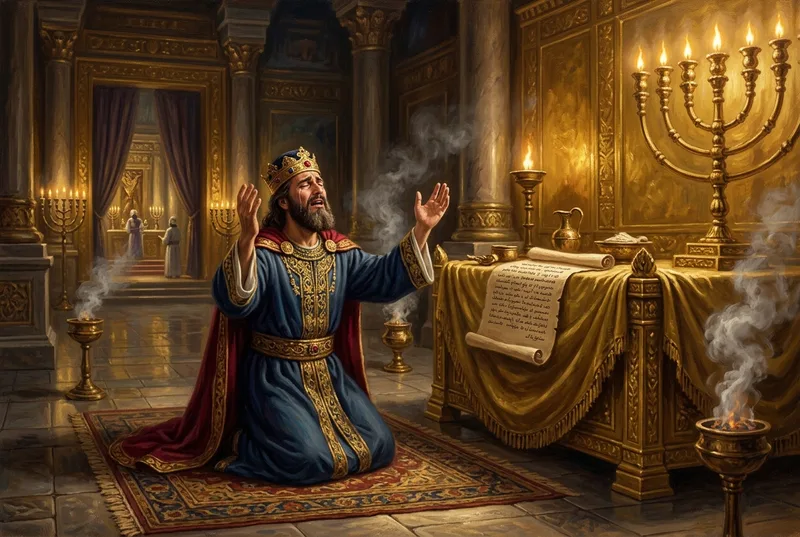
The reign of King Hezekiah is one of the brightest chapters in the history of Judah. Standing in the shadow of the catastrophic fall of the Northern Kingdom, young Hezekiah did not succumb to despair or pagan compromise. Instead, he led his nation into a profound spiritual renaissance, smashing idols, reopening the Temple, and restoring true worship. When the mighty Assyrian army marched against Jerusalem like an unstoppable tidal wave, Hezekiah proved that a king who kneels before Yahweh can overcome the most formidable empire on earth.
1. The Passionate Reformer and the Great Passover
When twenty-five-year-old Hezekiah son of Ahaz ascended the throne of Judah, the spiritual state of the kingdom was disastrous. His wicked father Ahaz had closed the heavy doors of Solomon's Temple, extinguished the sacred lamps, built pagan altars on every street corner of Jerusalem, and even sacrificed his own son in the fire. In the very first month of his reign, Hezekiah acted with uncompromising resolve. He swung open the doors of the Temple of Yahweh, gathered the priests and Levites, and commanded them to sanctify themselves and cleanse the sanctuary from all pagan defilement.
For sixteen intense days, the Levites carried out the accumulated filth of decades, dumping it into the Kidron Valley. When the Temple was purified, Hezekiah restored the daily sacrifices, organized the Levitical choirs with cymbals, harps, and lyres according to the command of King David, and offered hundreds of bulls and sheep in joyful celebration. The king did not stop there; he shattered the sacred stone pillars, chopped down the Asherah poles, and boldly smashed the bronze serpent (Nehushtan) that Moses had made in the wilderness, because the people had turned it into an idol of worship.
Hezekiah then organized an unprecedented national celebration: the Great Passover. He sent couriers with letters throughout all Judah and across the northern territories from Ephraim to Dan, inviting every surviving Israelite to come to Jerusalem. Though many in the north mocked the messengers, humble remnants from Asher, Manasseh, and Zebulun journeyed south. The resulting feast was so glorious, joyful, and filled with the presence of God that the assembly unanimously voted to extend the celebration for another full seven days. Not since the days of King Solomon had there been such joy in Jerusalem.
2. The Assyrian Storm and the Blasphemy of Rabshakeh
Fourteen years into Hezekiah's reign, the dark storm of Assyrian conquest struck Judah. King Sennacherib of Assyria swept down the Mediterranean coast with a massive imperial force, capturing forty-six fortified cities of Judah. Sennacherib established his military headquarters at Lachish and sent his supreme commander, the Rabshakeh, accompanied by a vast army, to demand the unconditional surrender of Jerusalem.
Standing near the aqueduct of the Upper Pool on the road to the Washerman's Field, the Rabshakeh delivered a venomous psychological speech in the Hebrew language so that all the terrified soldiers and citizens sitting on the high city walls could understand. He ridiculed Judah's trust in Egypt, mocked their military weakness, and directly challenged the Almighty: "Do not let Hezekiah deceive you when he says, 'The Lord will deliver us!' Has the god of any nation ever delivered his land from the hand of the king of Assyria? Where are the gods of Hamath, Arpad, and Sepharvaim? Did they rescue Samaria from my hand? How then can the Lord deliver Jerusalem from my hand?"
The citizens on the walls kept absolute silence, answering not a single word, just as King Hezekiah had commanded. But the royal officials tore their clothes in grief and returned to the palace to report the blasphemous threats to the king.
3. Spreading the Letter Before the Lord
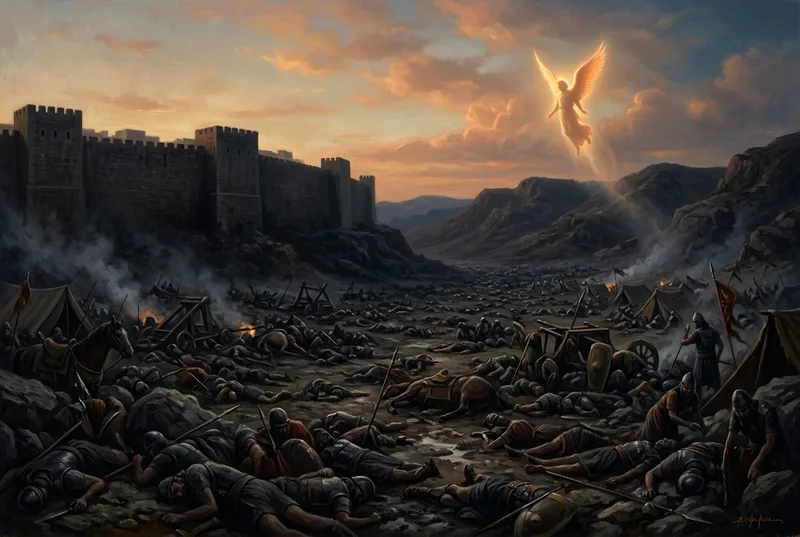 In a single night, the Angel of the Lord struck down 185,000 Assyrian soldiers outside the walls of Jerusalem without an arrow being fired.
When King Hezekiah heard the report, he tore his royal robes, covered himself with sackcloth, and went immediately into the Temple of the Lord. He sent his senior officials to the prophet Isaiah son of Amoz, seeking an urgent word from Yahweh. Isaiah sent back a fearless, comforting message: "Do not be afraid of what you have heard—those words with which the underlings of the king of Assyria have blasphemed me. Listen! When he hears a certain report, I will make him want to return to his own country, and there I will have him cut down with the sword."
Soon after, Sennacherib sent a menacing written letter directly to Hezekiah, warning him that his God would fail him just as all other gods had failed. Hezekiah took the letter, walked into the inner courts of the Temple, and spread it out before the Lord. Falling upon his knees before the golden altar, the king wept and prayed one of the greatest prayers in Scripture:
"Lord, the God of Israel, enthroned between the cherubim, you alone are God over all the kingdoms of the earth! You have made heaven and earth. Give ear, Lord, and hear; open your eyes, Lord, and see; listen to the words Sennacherib has sent to ridicule the living God! ... Now, Lord our God, deliver us from his hand, so that all the kingdoms of the earth may know that you alone, Lord, are God!"
4. The Angel of the Lord and the Midnight Victory
God heard the passionate plea of His servant. Isaiah sent word to Hezekiah, declaring Yahweh's sovereign decree concerning Sennacherib: "The Virgin Daughter of Zion despises you and mocks you! Whom have you insulted and blasphemed? Against the Holy One of Israel! ... He will not enter this city or shoot an arrow here. He will not come before it with shield or build a siege ramp against it. By the way that he came he will return! I will defend this city and save it, for my sake and for the sake of David my servant!"
That very night, while the citizens of Jerusalem slept behind their bolted gates, heaven went to war. The Angel of the Lord went out and struck down 185,000 soldiers in the Assyrian camp. When the few surviving commanders awoke early the next morning, they looked out upon a silent valley filled with fallen, lifeless corpses. Without a single catapult stone launched, without a single sword drawn by an Israelite soldier, and without a single arrow shot into Jerusalem, God had completely annihilated the invincible army of the ancient world.
Broken, terrified, and utterly humiliated, Sennacherib broke camp and fled back to his imperial capital of Nineveh. He never returned to Judah. Years later, while Sennacherib was bowing down in worship inside the temple of his pagan god Nisroch, his own sons Adrammelech and Sharezer struck him down with the sword, fulfilling the prophetic word of Isaiah to the letter. King Hezekiah's victory demonstrated forever that when God's people consecrate themselves and trust fully in Yahweh, no weapon formed against them can prosper.
Reflections on the Story:
- Spreading Our Problems Before God: When faced with overwhelming threats, bad medical reports, or financial crises, we must follow Hezekiah's example—spread our troubles before the Lord in prayer and seek His glory.
- The Power of True Spiritual Renewal: National and personal deliverance began when Hezekiah cleansed the Temple and destroyed idols. God moves in power on behalf of those whose hearts are fully consecrated to Him.
- God Defends His Own Honor: Sennacherib made the fatal mistake of equating the living Creator with lifeless wooden idols. When enemies blaspheme God's name, the Almighty rises to defend His people for His own name's sake.
- Supernatural Deliverance Beyond Human Effort: 185,000 soldiers were defeated without a single arrow shot by Judah. Some battles in our lives can only be won by the supernatural intervention of God while we stand still in faith.
⚡ Fast Facts
- Temple Restoration: In his very first month of reign, 25-year-old Hezekiah reopened and cleansed Solomon's Temple.
- Bronze Serpent Destroyed: Hezekiah smashed Moses' bronze serpent (Nehushtan) because Israel had turned it into an idol.
- The Mocking Speech: Assyrian field commander Rabshakeh spoke in Hebrew to terrify the citizens on the walls of Jerusalem.
- Single-Night Miracle: The Angel of Yahweh struck down 185,000 Assyrian troops without a single arrow being shot into the city.
❓ Frequently Asked Questions (FAQs)
2 Kings 18:5 states: 'Hezekiah trusted in the Lord, the God of Israel. There was no one like him among all the kings of Judah, either before him or after him.' He held fast to the Lord, never stopped following Him, and obeyed all Moses' commandments.
In preparation for the Assyrian siege, Hezekiah engineered a 1,750-foot subterranean aqueduct carved through solid bedrock, channeling water from the Gihon Spring outside the walls directly into the Pool of Siloam inside the city, securing Jerusalem's water supply.
Humiliated, Sennacherib returned to Nineveh. Years later, while he was worshiping in the temple of his god Nisroch, his own sons Adrammelech and Sharezer assassinated him with the sword, fulfilling Isaiah's prophecy in 2 Kings 19:37.