The seventeenth chapter of Second Kings records one of the darkest and most tragic turning points in the history of the covenant people. It is the obituary of an entire nation. For 208 years, the Northern Kingdom of Israel had walked in the foundational sins of Jeroboam, defying the living God and silencing the voices of His prophets. In 722 BC, the divine patience reached its limit. The ruthless war machine of the Assyrian Empire swept across the northern hills, crushing Samaria, scattering the ten tribes, and erasing the Northern Kingdom from the map of the ancient world.
1. The Fatal Rebellion of King Hoshea
By the time Hoshea son of Elah assassinated King Pekah and seized the throne in Samaria, the Northern Kingdom was already a hollow shell of its former glory. The unstoppable military juggernaut of Assyria had already annexed Galilee and Gilead, reducing Israel to a small, tributary vassal state centered around the capital city of Samaria. King Shalmaneser V of Assyria demanded enormous annual tributes of silver and gold, keeping Israel under an oppressive imperial yoke.
Desperate to break free, King Hoshea engaged in a fatal political gamble. He stopped paying his annual tribute to Assyria and sent secret emissaries southward to King So of Egypt, seeking an anti-Assyrian military alliance. But Egypt proved to be a broken reed that pierced the hand of anyone who leaned upon it. When Shalmaneser discovered Hoshea's conspiracy, the Assyrian monarch marched his veteran army westward with ruthless speed. He captured Hoshea, bound him in chains, and threw him into an imperial dungeon. The throne of Israel was left empty, but the fortified city of Samaria refused to surrender.
2. The Agony of the Three-Year Siege
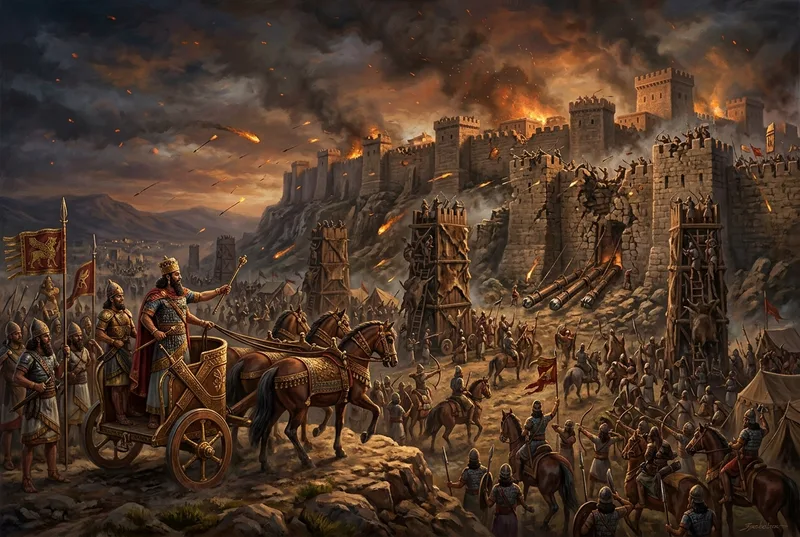 For three agonizing years, the Assyrian war machine battered the formidable hilltop fortifications of Samaria with siege towers and rams.
Built upon a steep, commanding hill by King Omri, the capital city of Samaria possessed formidable double-stone walls, deep cisterns, and massive defensive towers. It was designed to withstand prolonged warfare. The Assyrian legions encircled the mountain, cutting off all supply routes, trade, and communication. For three agonizing years, from 725 to 722 BC, the citizens of Samaria endured the slow, torturous horrors of siege warfare.
Inside the besieged walls, food supplies vanished. Famine and pestilence stalked every street. Yet despite their desperate plight, the people did not turn to Yahweh in repentance; they continued to cry out to their lifeless idols of Baal and Asherah. Outside the walls, the Assyrian army relentlessly constructed siege ramps, rolled forward multi-tiered battering rams, and rained thousands of flaming arrows upon the defenders. During the final stages of the siege, King Shalmaneser died and was succeeded by Sargon II, who completed the conquest. In the summer of 722 BC, the battered stone walls were breached, and the Assyrian soldiers poured into the starving city with drawn swords.
The devastation was total. The palaces of ivory were looted, the pagan temples were leveled to the ground, the storehouses were torched, and thousands of defenders were slaughtered in the streets. The glory of Samaria, which Isaiah had described as a fading flower on the head of a fertile valley, was completely crushed into ashes under the iron heels of Assyrian conquerors.
3. The Great Deportation and the Chains of Exile
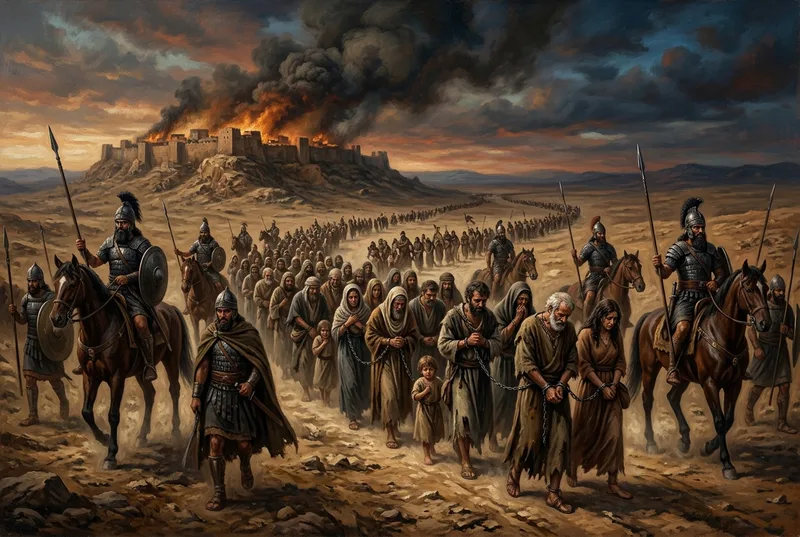
True to their brutal imperial policy of mass population displacement, the Assyrians systematically rounded up the surviving population. Sargon II recorded in his royal annals that he deported 27,290 leading citizens—the royalty, priests, military commanders, artisans, and skilled craftsmen—leaving only the poorest of the land behind. The captives were bound together in long, miserable chains, driven like cattle across hundreds of miles of scorching deserts and rugged mountains toward the distant rivers of Mesopotamia.
The ten northern tribes of Israel were scattered across foreign lands—settled in Halah, along the banks of the Habor River in Gozan, and in the distant mountain towns of the Medes. Separated from their homeland, stripped of their ancestral inheritance, and immersed in pagan cultures, the majority of the ten tribes were assimilated over centuries, entering history as the legendary 'Lost Ten Tribes of Israel'. The golden calves at Dan and Bethel, which Jeroboam had promised would protect them, were carried off as conquered trophies by the Assyrian king.
4. The Divine Indictment: Why Israel Fell
The biblical author of Second Kings does not view the fall of Samaria merely as a geopolitical catastrophe or a military defeat; he frames it as a solemn, righteous judgment from God. In 2 Kings 17:7-23, the Holy Spirit provides an extensive divine indictment explaining why the Northern Kingdom perished:
"All this took place because the Israelites had sinned against the Lord their God, who had brought them up out of Egypt... They worshiped other gods and followed the practices of the nations the Lord had driven out before them."
The charges were devastating: Israel built high places in every town from watchtower to fortified city; they erected sacred stones and Asherah poles on every high hill; they burned incense to idols; they bowed down to the starry hosts and served Baal; they sacrificed their sons and daughters in the fire of Molech; and they practiced divination and sorcery. Most tragic of all, God had sent prophet after prophet—Elijah, Elisha, Micaiah, Amos, Hosea—warning them: "Turn from your evil ways! Observe my commands and decrees!" But they remained stiff-necked, just like their ancestors, rejecting the covenant of their fathers.
To replace the deported Israelites, the King of Assyria brought foreign settlers from Babylon, Cuthah, Avva, Hamath, and Sepharvaim and settled them in the towns of Samaria. Because these settlers did not fear Yahweh, God sent lions among them. In response, an exiled Israelite priest was sent back to Bethel to teach them how to worship Yahweh. This resulted in a compromised, syncretistic religion—they worshipped Yahweh while also serving their ancestral idols. From this mixed population arose the Samaritans of the New Testament era. The tragic story of the fall of Samaria stands as an eternal monument in Scripture: God's covenant patience is immense, but persistent rebellion and spiritual compromise ultimately lead to inescapable ruin.
Reflections on the Story:
- The Certainty of Divine Judgment: God's patience is not permission to continue in sin. For over two centuries God extended mercy through prophets, but when repentance was refused, judgment fell inevitably.
- The Trap of Political Expediency: King Hoshea trusted in an alliance with Egypt rather than turning to Yahweh. Human alliances and worldly solutions can never save a nation or an individual whose spiritual foundation is rotten.
- The Danger of Syncretism: The new settlers tried to worship Yahweh alongside their pagan idols. God demands undivided, wholehearted devotion; half-hearted, mixed worship is no worship at all.
- Preserving a Faithful Remnant: Even in the total collapse of the Northern Kingdom, God preserved the Southern Kingdom of Judah under righteous King Hezekiah, keeping alive the messianic line of David through which Jesus Christ would eventually be born.
⚡ Fast Facts
- Last King of Israel: King Hoshea was the 19th and final monarch of the Northern Kingdom of Israel.
- Three-Year Siege: The fortified hilltop capital of Samaria held out against the Assyrian army for three agonizing years.
- The Year of Fall: In 722 BC, Samaria fell to Assyria, bringing an end to the 208-year history of the divided Northern Kingdom.
- Origin of Samaritans: Assyria resettled foreign pagan captives in Samaria, who intermarried with the remaining poor Israelites.
❓ Frequently Asked Questions (FAQs)
2 Kings 17:7-23 gives the explicit divine indictment: Israel sinned against Yahweh, built high places in all their towns, worshipped golden calves and Baal, practiced child sacrifice and divination, and persistently rejected the warnings of every prophet God sent them.
The Assyrian policy was population transfer (deportation) to break national rebellion. They deported roughly 27,290 leading Israelites to Halah, Gozan, and Media, while importing pagan peoples into Samaria. While scattered, a remnant preserved their identity and joined Judah.
Because the new pagan settlers did not fear Yahweh, God sent lions among them as a sign. In response, the Assyrian king sent back an exiled Israelite priest to Bethel to teach them the law and worship of the God of the land.