The contrast could hardly have been more shattering. Only hours earlier, upon the cloud-swathed summit of Mount Hermon, the veil of Christ’s humanity had been drawn back to disclose uncreated majesty. His garments had blazed with lightning radiance, Moses and Elijah had conversed with Him concerning His coming exodus in Jerusalem, and the sovereign voice of God the Father had thunderously consecrated His beloved Son. Yet as Jesus, Peter, James, and John descended the winding mountain trail back to the dusty plateau of Caesarea Philippi, the sounds of celestial glory were violently swallowed by the harsh cacophony of human anguish, scribal mockery, and the shrieks of a tormented child.
1. The Chaos in the Valley and the Disciples' Humiliation
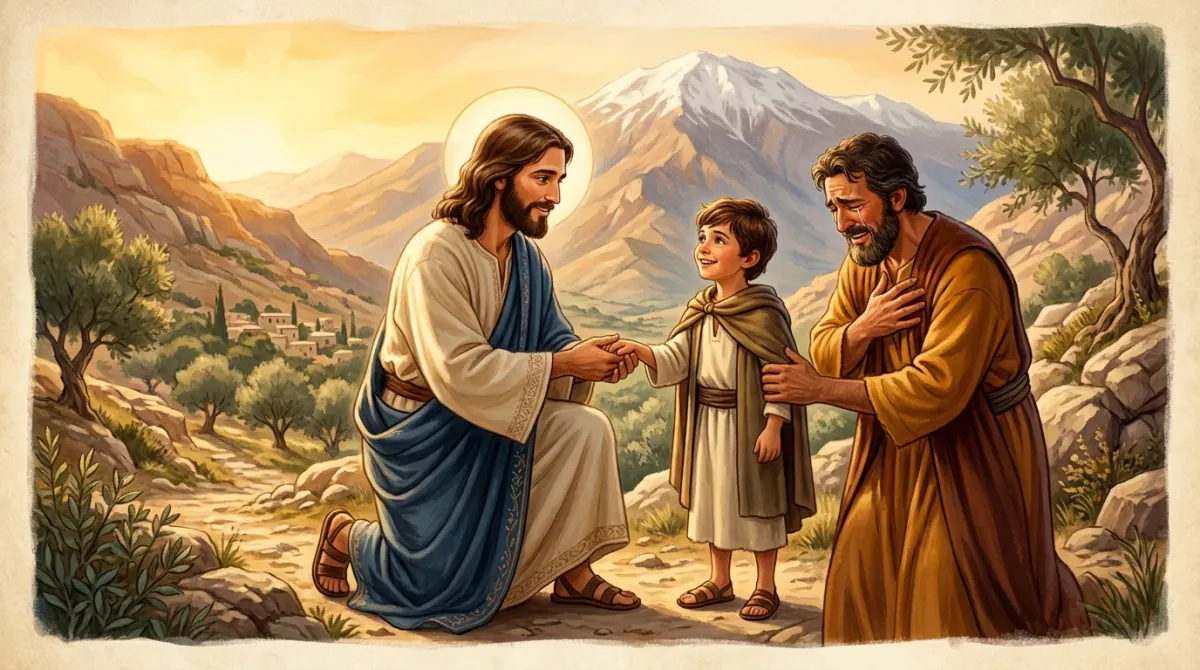
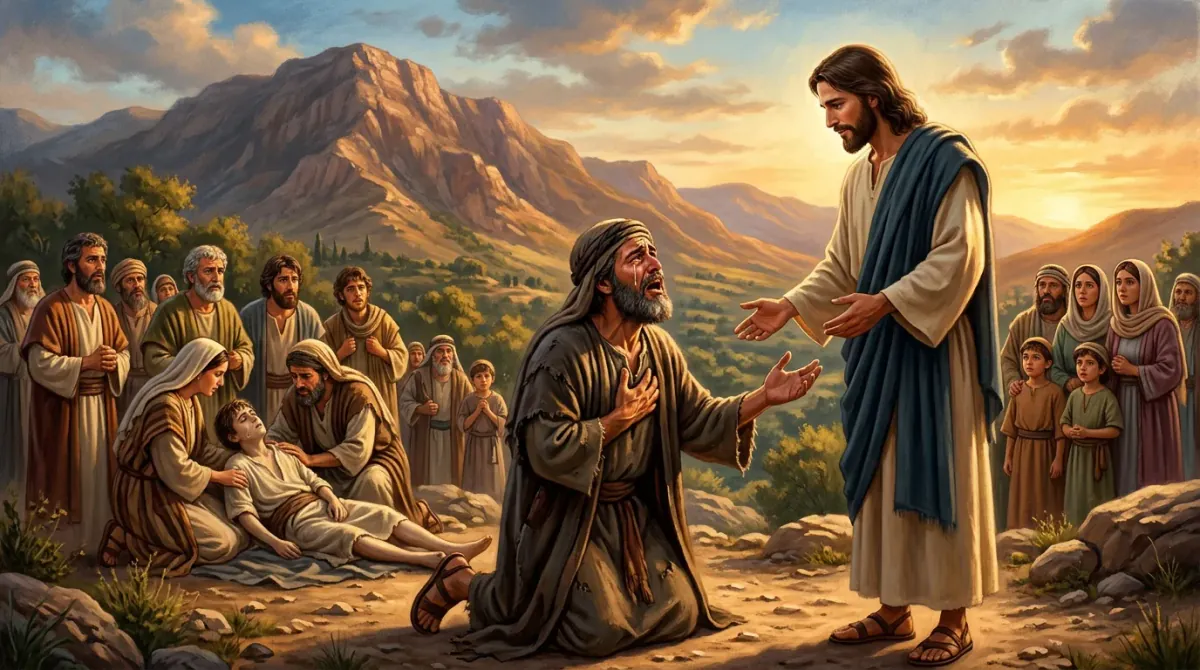 At the foot of Mount Hermon, a weeping father pours out his soul to Jesus: 'Lord, I believe; help my unbelief!'
Reaching the camp, Jesus perceived a tumultuous crowd swirling around the remaining nine disciples. Sharp, accusatory voices rose from the center of the throng: local scribes and Pharisees were interrogating the apostles, their faces twisted in smug vindication. Lying upon the stony ground was a young boy caught in the throes of a horrifying convulsion. He foamed at the mouth, his jaw clattering and grinding in agonizing spasms, his body rigid and bruised from years of violent self-destruction.
Months earlier, when sent two-by-two across the towns of Galilee, these same disciples had cast out demons and healed the sick with joyful astonishment (Mark 6:13). But here, under the watchful, cynical gaze of their sharpest critics, their repeated commands had failed. The unclean spirit had mocked their words, refusing to budge. The apostles stood red-faced, demoralized, and bewildered, trapped between the public failure of their faith and the ruthless cross-examination of the scribes.
Breaking through the crowd, Jesus demanded with unmistakable majesty: "What are you discussing with them?" (Mark 9:16). The aggressive scribes instantly fell silent. Before any disciple could stammer an excuse, a voice pierced the hush from the middle of the crowd. A man fell forward onto his knees in the dust, his eyes rimmed with red veins from countless sleepless nights, his clothes torn and stained with sweat.
2. The Cry of a Broken Father
"Teacher," the father choked, "I brought You my son, who has a mute spirit. And wherever it seizes him, it throws him down; he foams at the mouth, gnashes his teeth, and becomes rigid. So I spoke to Your disciples, that they should cast it out, but they could not" (Mark 9:17–18). Luke’s Gospel adds the poignant detail that this boy was his only child (monogenēs—Luke 9:38). From infancy, this malignant power had systematically sought to murder the lad, flinging him into open domestic cooking fires and deep irrigation wells to drown him.
Hearing the indictment of failure, Jesus let out a deep, grieving sigh: "O faithless generation, how long shall I be with you? How long shall I bear with you? Bring him to Me" (Mark 9:19). Christ was not merely rebuking the powerless disciples or the hostile scribes; He was lamenting the pervasive atmosphere of unbelief that choked the fallen world. The disciples had treated delegated authority as a mechanical technique rather than an expression of continuous spiritual communion.
As the bystanders carried the boy forward, the demon caught sight of Jesus. Knowing that its conqueror stood before it, the unclean spirit unleashed a final, catastrophic spasm of fury. The boy was thrown violently to the earth, rolling in the dust, gnashing his teeth, and foaming profusely. It was an appalling display of satanic malice designed to terrify all who watched.
3. 'If You Can Do Anything'
While the crowd panicked, Jesus remained utterly serene. Looking past the thrashing body of the boy into the grief-stricken eyes of the parent, Christ asked with steady pastoral gentleness: "How long has this been happening to him?" The father replied: "From childhood. And often he has thrown him both into the fire and into the water to destroy him."
Then, worn down by years of dashed hopes and the recent humiliation by the nine apostles, the father uttered a plea laced with understandable hesitation: "But if You can do anything, have compassion on us and help us" (Mark 9:22). His words revealed the agony of a bruised heart. He had heard of the Nazarene's miracles, but after watching nine hand-picked disciples fail miserably, his expectations had plummeted. He placed the burden of capability on Jesus: 'If You can.'
Instantly, Jesus seized upon that conditional clause, flipping the mirror back upon the father's trembling soul: "If you can believe! All things are possible to him who believes" (Mark 9:23). Christ gently exposed the true crisis: the limitation lay not in heaven’s limitless reservoirs of power, but in the conduit of human receptivity. God’s arm is never shortened that it cannot save; rather, the barrier is the paralysis of unbelief that locks heaven's gates.
4. The Most Honest Prayer in Scripture
The Lord's rebuke carried no condemnation; it was an invitation of sovereign love. The father did not retreat into self-defensive excuses, nor did he put on a hypocritical mask of religious piety. Overwhelmed by the holiness and tenderness of Christ, the man broke down in front of the entire assembly. Tears streamed freely down his sunburnt cheeks as he cried aloud the timeless paradox of the human soul:
"Lord, I believe; help my unbelief!" (Mark 9:24)
This is arguably the most transparent, authentic prayer recorded in the Gospels. The father recognized two opposing realities warring inside his breast: a genuine, desperate desire to trust the Master, intertwined with lingering tremors of skepticism bred of bitter disappointment. He did not claim perfection; instead, he confessed his defect and pleaded with Jesus to supply the very faith he lacked. In that moment of unvarnished vulnerability, the conduit of supernatural grace opened wide.
5. The Word of Deliverance and Resurrection Touch
Seeing the crowd running together to witness the spectacle, Jesus moved decisively. Turning His gaze upon the thrashing child, He issued an absolute, royal decree that left no room for negotiation: "Deaf and dumb spirit, I command you, come out of him and enter him no more!" (Mark 9:25). Christ did not merely expel the spirit; He barred it forever from returning to reclaim its victim.
With an ear-splitting shriek that echoed across the valley, the demon convulsed the boy violently one last time and came out. The boy lay entirely motionless upon the stones, pale and limp. The hush that fell over the multitude was deafening. Whispers rippled through the spectators: "He is dead! The boy is dead." Even the father’s heart must have skipped a terrifying beat.
Then, with breathtaking tenderness, Jesus bent down. Reaching out His hand, He took the cold, limp hand of the youth, lifting him up (Mark 9:27). The Greek verb employed here is ēgeiren—the exact theological term used throughout the New Testament for bodily resurrection! At the touch of Christ's fingers, life, warmth, and sound mind surged through the young boy’s veins. He stood upright upon his own feet, clear-eyed, breathing steadily, fully delivered. Jesus placed the boy back into the trembling, tear-soaked arms of his overjoyed father, as the entire crowd stood paralyzed in holy awe at the majesty of God (Luke 9:43).
6. Why Could We Not Cast It Out? Mustard-Seed Faith
Later that evening, after the crowds had dispersed and Jesus sat privately with His disciples inside a house, the nine troubled apostles gathered around Him. Bruised by their public failure, they asked the question that had burned in their consciences all day: "Why could we not cast it out?" (Mark 9:28).
Jesus answered them on two profound levels. First, as recorded in Matthew 17:20, He diagnosed the root cause directly: "Because of your unbelief." He explained that if they possessed faith even as small as a mustard seed—the tiniest seed known in Galilean horticulture—they could say to this imposing mountain of Hermon towering above them, 'Move from here to there,' and it would move, and nothing would be impossible for them. The lesson was staggering: spiritual power is not determined by the volume of human self-confidence, but by the infinite majesty of the living God in whom that tiny faith rests.
Second, in Mark 9:29, Jesus added the spiritual discipline behind true authority: "This kind can come out by nothing but prayer and fasting." The disciples had attempted to wield authority as a mechanical badge or inherited technique, resting on yesterday's laurels while neglecting today’s secret place of intercession. Spiritual power cannot be stockpiled; it is born of desperate, continual, dependent communion with the Father. In the valley of human impossibility, Christ proved that no demon is too fierce, no doubt is too deep, and no mountain is too high for the sovereign touch of the Son of God.
Ancient Near Eastern & Archaeological Context
Following the Transfiguration upon the majestic heights of Mount Hermon, Jesus, Peter, James, and John descended back into the dusty realities of the Caesarea Philippi valley. The contrast could not have been starker. On the mountaintop, uncreated light irradiated Christ's garments, Moses and Elijah appeared in celestial majesty, and the Father's voice thundered from the luminous Shekinah cloud. In the valley below, however, demonic screeching, public embarrassment, and religious cynicism reigned supreme.
A distraught father had brought his only son—who had been tormented from early childhood by a spirit that rendered him mute, deaf, and violently suicidal—to the nine disciples who remained behind. These disciples had previously cast out demons across the villages of Galilee during their missionary journeys (Mark 6:13). Yet here, in full view of hostile scribes who seized upon the failure to discredit Jesus, their prayers and authoritative commands fell completely flat. The boy lay writhing in the dust, foaming at the mouth, while the scribes smugly interrogated the humiliated apostles.
In first-century Jewish exorcism rituals, the practitioner was required to address the occupying spirit and force it to vocalize its specific identity before an incantation could bind it. A 'mute spirit' (pneuma alalon) represented the ultimate theological and occult impossibility: since the demon could not speak through the boy's vocal cords, traditional exorcists had no leverage. By stepping directly into this deadlock, Jesus demonstrated that His authority rested not on mechanistic magic or ritual recipes, but on His sovereign identity as the Lord of glory whose spoken word commands all created and fallen realms.
Practical Discipleship & Spiritual Application
- Honest Prayer Over Pious Posturing: God does not require you to present synthetic, flawless confidence. The prayer 'Lord, I believe; help my unbelief' is welcomed by Jesus because it places vulnerable trust in His mercy rather than human strength.
- Moving Beyond Past Spiritual Success: The disciples failed because they relied on yesterday's spiritual victories rather than today's fresh communion. Spiritual warfare cannot be won on autopilot or memorized formulas; it demands daily, broken fellowship with God.
- The Power of Focused Intercession: The father refused to abandon his tormented boy, carrying him persistently to Jesus despite public mockery and initial failure. Persistent, loving intercession breaks through generational oppression.
- Mustard-Seed Mountain Removal: When confronted by seemingly insurmountable obstacles—chronic sickness, family heartbreak, emotional addiction—remember that the power belongs to God, not your feelings. Even a mustard seed of faith anchored in Christ can overturn immovable mountains.
Support Independent Biblical Research
Did this study bless you? Help support our independent bilingual research and interactive visual Bible tools.
⚡ Fast Facts
- Contrast of Two Realms: In the span of a single morning, Jesus transitioned from celestial glory with Moses and Elijah on the mountain peak directly into raw demonic warfare in the valley below
- Rabbinic Exorcism Barrier: First-century Jewish exorcists believed a demon could only be expelled if it spoke its name; a 'mute' spirit was considered humanly and ritualistically impossible to cast out
- The Anatomy of True Faith: The father's cry ('Lord, I believe; help my unbelief!') models biblical faith—not infallible self-confidence, but humble dependence on Christ in the midst of lingering human weakness
- Mustard-Seed Dynamics: In Matthew 17:20, Jesus explains that spiritual efficacy is not determined by the volume of human willpower, but by the infinite power of the living God in whom that tiny faith rests
❓ Frequently Asked Questions (FAQs)
Why could the nine disciples not cast out the mute spirit?
Earlier in Galilee, Jesus had granted the Twelve authority over unclean spirits, and they had successfully driven out demons. However, over time they began relying on past success, ritual formulas, and delegated routine rather than ongoing, dependent communion with God. Jesus pinpointed their failure as an absence of fresh faith and prayer: spiritual authority cannot be hoarded as personal capital; it must be continually renewed through desperate, humble communion with the Father.
What is the spiritual significance of the father crying 'Help my unbelief'?
The father's honest confession bridges the gap between fragile human hope and divine omnipotence. He did not pretend to possess unflinching, heroic faith, nor did he allow his doubts to keep him from Jesus. By admitting his struggling faith, he invited Christ to become the author and finisher of his faith. Jesus never rejects broken, trembling faith that runs to Him for mercy; He meets us precisely at the point of our confessed inadequacy.
What did Jesus mean by moving mountains with faith like a mustard seed?
In first-century Jewish rabbinic idiom, a 'mountain mover' (oker harim) was a great teacher or leader who resolved seemingly insurmountable difficulties. Jesus radicalized this concept: even the smallest living faith, comparable to a tiny mustard seed (the smallest garden seed known in Palestine), connects a believer to the limitless power of Almighty God. The power lies not in the seed itself, but in the divine soil and living God in whom that faith takes root.