For nearly three years, the eternal King of Glory had walked the dusty roads of Palestine veiled beneath mortal flesh. He had hungered in the wilderness, wept at the grave of Lazarus, bled under thorns, and endured the sneers of petty religious hypocrites. Those who looked upon Him with natural eyes saw only an itinerant carpenter from the despised hill town of Nazareth. But on a freezing, starry night, high upon the craggy, snow-draped shoulders of an exceeding high mountain, the veil of Christ's humanity was violently torn aside. In a solitary, cosmic moment between earth and heaven, the uncreated, primordial radiance of Almighty God burst forth from the Son, transforming His face into blinding solar brilliance, illuminating the ancient foundations of the Law and the Prophets, and bringing the audible thunder of the Father down from the Shekinah cloud to proclaim the absolute supremacy of Jesus Christ over the cosmos!
1. The Ascent into the Cold Heights
Matthew anchors the event with chronological precision: "Now after six days Jesus took Peter, James, and John his brother, led them up on a high mountain by themselves" (Matthew 17:1).
Why "after six days"? In Exodus 24:16, the glory of Yahweh rested upon Mount Sinai, and the cloud covered it six days; on the seventh day God called to Moses out of the midst of the cloud. The Gospel writers intentionally evoke the sacred memory of Sinai: a new Exodus was dawning, and a greater than Moses was ascending the holy mount.
Leaving the remaining nine disciples in the foothills of Caesarea Philippi, Jesus drew His inner triumvirate—Peter, James, and John—into the lonely heights. Climbing the steep limestone crags of Mount Hermon as the sun set, the air grew razor-sharp and freezing. Luke reveals the sacred purpose of the ascent: "He went up on the mountain to pray" (Luke 9:28).
While the Son of God knelt upon the cold rock, pouring out His heart in deep communion with the Father, the three disciples succumbed to physical exhaustion. Luke notes with gentle realism: "Peter and those with him were heavy with sleep" (Luke 9:32). Wrapped in their woolen mantles, shivering in the alpine chill, the fishermen drifted into unconsciousness.
2. The Uncreated Sun: Metemorphōthē
While the disciples slept, heaven invaded earth. Matthew records the staggering transformation:
"And He was transfigured before them. His face shone like the sun, and His clothes became as white as the light." (Matthew 17:2).
The Greek verb is metemorphōthē. It does not denote an external light shining upon Jesus, like moonlight reflecting off water. When Moses descended Mount Sinai, his skin shone because it had reflected the residual glory of God like a mirror (Exodus 34:29). But Jesus did not reflect light; He was the Light! The eternal, uncreated glory that Christ had shared with the Father before the foundation of the world (*Logos*) supernaturally erupted from within His mortal frame.
His face—ordinarily weathered by the Galilean sun and lined with pastoral grief—blazed with the unbearable brilliance of the noonday sun! Mark adds a vivid, eyewitness detail: "His clothes became shining, exceedingly white, like snow, such as no launderer on earth could whiten them" (Mark 9:3). His coarse peasant tunic radiated with pure, pulsating, celestial luminescence, brighter than lightning!
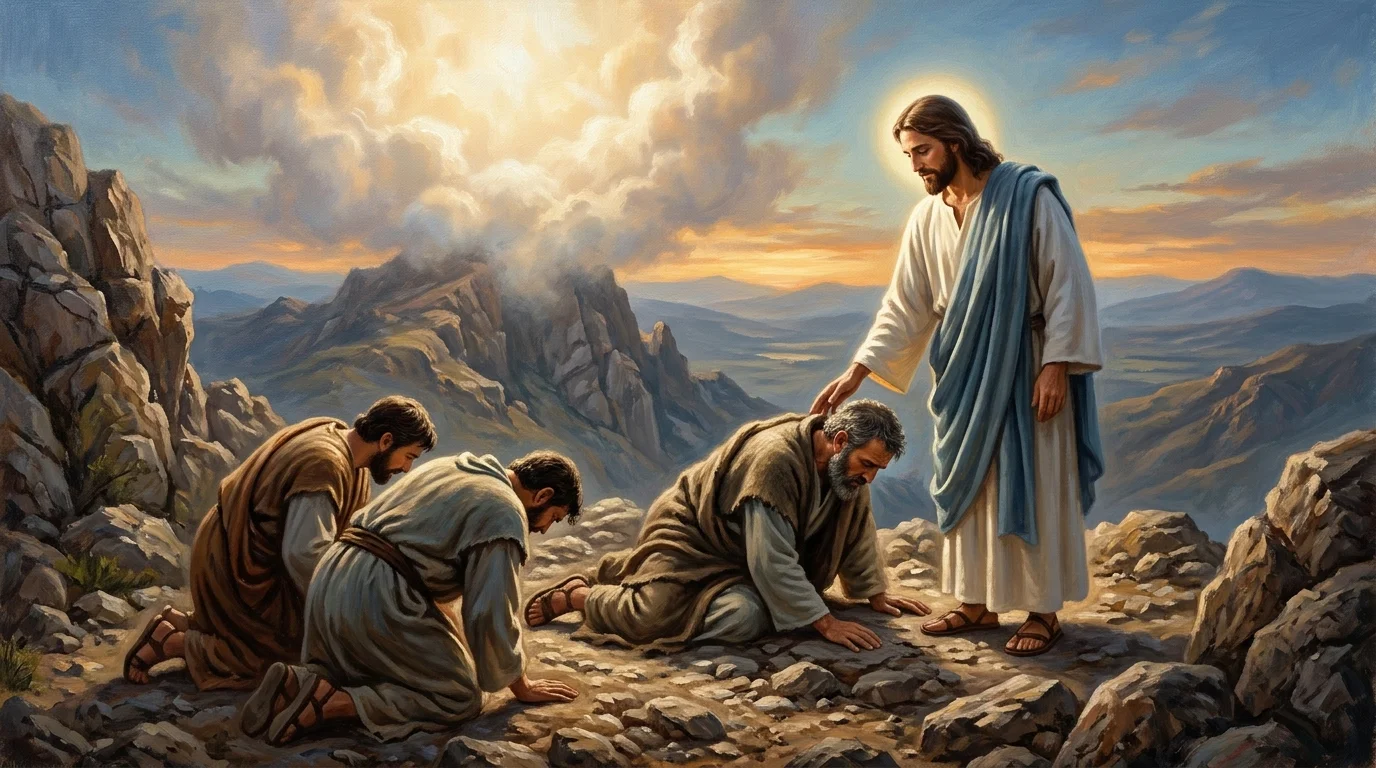 The Touch of Peace: 'Arise, and do not be afraid'—Christ extending His loving hand to restore the terrified apostles as the golden Shekinah cloud dissipates into dawn.
3. The Law, the Prophets, and the New Exodus
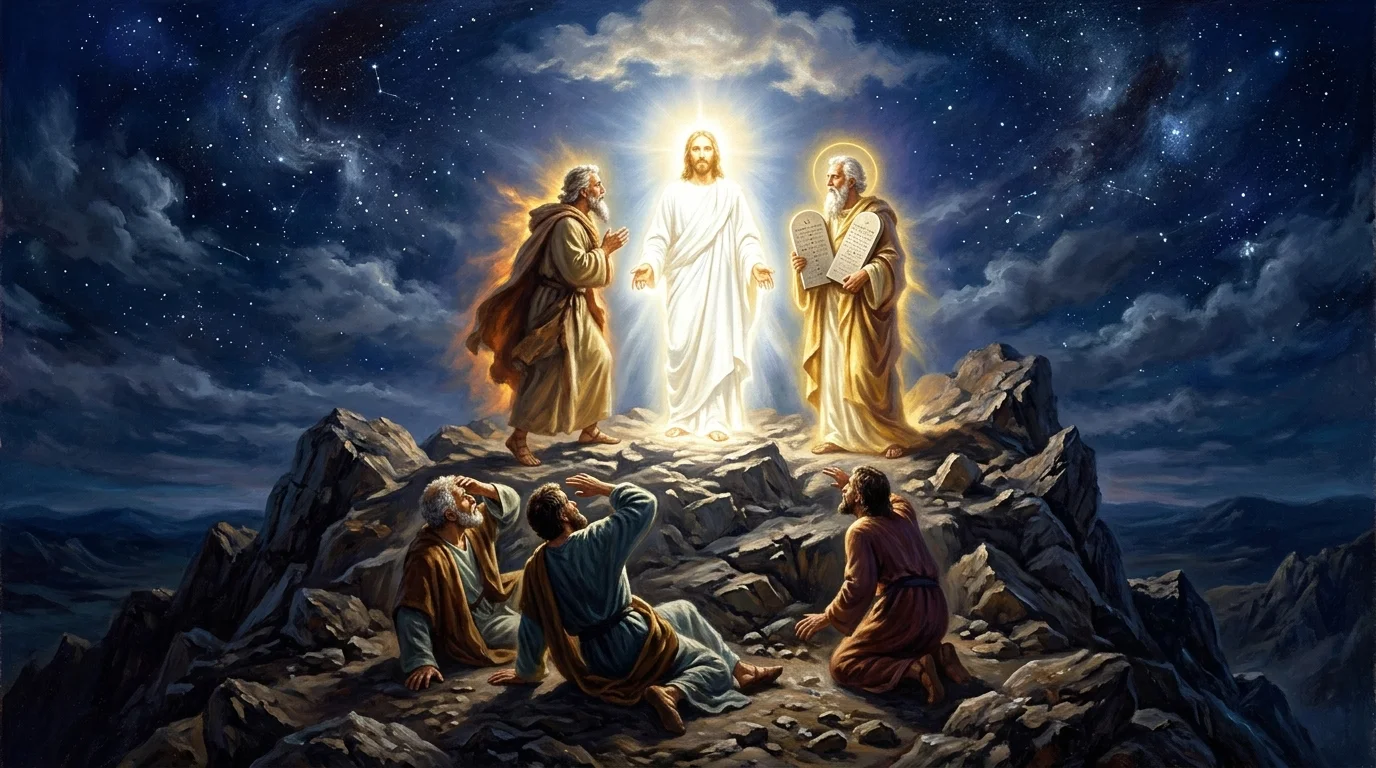
Awakened by the blinding luminescence that shattered the midnight darkness, Peter, James, and John rubbed their eyes in holy terror. And there, standing within the radiant aura of Christ's glory, were two men:
"And behold, Moses and Elijah appeared to them, talking with Him." (Matthew 17:3).
What a breathtaking assembly!
- Moses: The great Lawgiver through whom God gave the Torah atop Mount Sinai. Moses had died fourteen hundred years earlier on Mount Nebo, buried by the secret hand of God (Deuteronomy 34:6). He was forbidden from entering the earthly Canaan under the Law; but now, under the grace of the Son, Moses finally stood inside the Promised Land!
- Elijah: The premier champion of the Prophets, who had challenged the 850 false priests of Baal on Mount Carmel and been translated bodily into heaven in a whirlwind of fire (2 Kings 2:11).
Together, they represented the two pillars of the Hebrew Scriptures: The Law and the Prophets.
What were they discussing with the King of Glory? Were they discussing cosmological mysteries or the architecture of heaven? Luke provides the sublime answer:
"[They] appeared in glory and spoke of His decease which He was about to accomplish at Jerusalem." (Luke 9:31).
The Greek word for "decease" is tēn exodon autou—literally His Exodus!
Moses had led the first Exodus out of Pharaoh's Egyptian bondage through the blood of a Passover lamb. Now, Moses and Elijah conversed with the ultimate Paschal Lamb about the true, cosmic Exodus: His approaching death upon the Roman cross outside Jerusalem, His shattering of the grave, and His victorious ascension to the right hand of the Father, liberating humanity forever from the slavery of sin and Satan!
4. Peter's Blunder and the Overshadowing Cloud
Peter was completely overwhelmed. As Moses and Elijah began to depart, Peter felt an agonizing reluctance to leave this celestial paradise and return to the demonic sickness and Roman oppression of the valley below.
Blurting out the first words that entered his racing mind, Peter stammered:
"Lord, it is good for us to be here; if You wish, let us make here three tabernacles: one for You, one for Moses, and one for Elijah!" (Matthew 17:4).
Mark gently excuses Peter's impulsive outburst: "He did not know what to say, for they were greatly afraid" (Mark 9:6).
Peter proposed building three skēnas—leafy booths commemorating the joyous Feast of Tabernacles (*Sukkot*). In his sincere yet carnal excitement, Peter made a catastrophic theological error: By proposing three equal tabernacles, he inadvertently placed Jesus on the same horizontal level as Moses and Elijah! He treated Jesus as an exalted member of a prophetic committee—the third luminary alongside the Lawgiver and the Prophet.
Heaven would not permit the Son of God to be placed in an egalitarian trio!
Before the words had completely left Peter's lips, heaven interrupted: "While he was still speaking, behold, a bright cloud overshadowed them!" (Matthew 17:5).
It was the nephelē phōteinē—the luminous Shekinah glory cloud that had guided Israel through the Red Sea and filled Solomon's Temple with terrifying splendor! The cloud swept down from the heavens, completely enveloping the mountain summit in a golden, incandescent fog of holy majesty.
5. The Voice of the Father: "Listen to Him!"
Enveloped inside the terrifying radiance of the Shekinah, an audible, thunderous voice boomed from the heart of the cloud—the very voice of God the Father:
"This is My beloved Son, in whom I am well pleased. Hear Him!" (Matthew 17:5; Luke 9:35).
Trace the breathtaking divine proclamation:
- "This is My beloved Son!": Moses was a faithful servant in all God's house (Hebrews 3:5); Elijah was a bold prophet. But Jesus is neither servant nor mere prophet—He is the eternal, consubstantial Son of the Living God!
- "In whom I am well pleased": Reaffirming the eternal pleasure announced at Christ's baptism in the Jordan (Matthew 3:17).
- "Hear Him!": In the Greek imperative: Autou akouete!—"To Him alone you must listen!" Fulfilling Moses' ancient prophecy in Deuteronomy 18:15: "Yahweh your God will raise up for you a Prophet like me from your midst... Him you shall hear!"
The Law was given through Moses; the Prophets spoke through Elijah. But the final, definitive, sovereign Word of God to the cosmos is Jesus Christ! (Hebrews 1:1–2). When Christ speaks, Moses and Elijah must lay down their crowns and fall silent!
The impact of that divine thunder was devastating. Matthew records: "And when the disciples heard it, they fell on their faces and were greatly afraid!" (Matthew 17:6). Shattered by the uncreated holiness of God, the three apostles collapsed face down in the dust, trembling in mortal dread, waiting for death.
6. Jesus Only: From Glory to the Valley
How long they lay prostrated in the dust, they did not know. But in that terrifying silence, a warm, gentle, human hand reached down and touched Peter's shaking shoulder.
A tender voice—the familiar voice of their Master—whispered into their ears:
"Arise, and do not be afraid." (Matthew 17:7).
Slowly, hesitantly, the disciples lifted their eyes from the cold rock.
The blinding solar brilliance was gone. The blinding lightning was gone. The thunderous cloud had dissipated into the quiet morning mist. And Matthew records the ultimate theological climax:
"When they had lifted up their eyes, they saw no one except Jesus only." (Matthew 17:8).
"Jesus only!" (ton Iēsoun monon). Moses was gone; Elijah was gone. The Law had pointed to Him; the Prophets had foretold Him; and now they quietly withdrew into the shadows of eternity, leaving the Son of God standing alone as the sole Redeemer, Mediator, and Lord of all creation!
Decades later, facing Roman execution in a dark prison cell, the Apostle Peter penned his final testament, recalling that sacred night atop the mountain:
"For we did not follow cunningly devised fables when we made known to you the power and coming of our Lord Jesus Christ, but were eyewitnesses of His majesty. For He received from God the Father honor and glory when such a voice came to Him from the Excellent Glory: 'This is My beloved Son, in whom I am well pleased.' And we heard this voice which came from heaven when we were with Him on the holy mountain!" (2 Peter 1:16–18).
As Jesus and the three disciples descended the mountain into the valley below, Christ commanded them to tell no one of the vision until the Son of Man had risen from the dead. At the foot of the mountain, a demon-possessed boy and a mocking crowd awaited them. Christ did not remain on the mountain of glory; He walked down into the valley of human suffering, setting His face like flint toward Jerusalem and the Roman cross, so that all who believe in Him might one day share in His eternal, transfigured glory!
Ancient Near Eastern & Archaeological Context
The Transfiguration occurred six days after Peter made his monumental confession at Caesarea Philippi: 'You are the Christ, the Son of the living God' (Matthew 16:16). Caesarea Philippi lay at the southwestern base of Mount Hermon—the highest peak in the Levant, rising 9,232 feet above sea level, perpetually capped with snow. While ancient Christian tradition from the fourth century (popularized by Cyril of Jerusalem) associated the event with Mount Tabor in lower Galilee, modern biblical geography overwhelmingly favors the majestic slopes of Mount Hermon. Mount Tabor was only 1,800 feet high and housed a fortified Roman military garrison on its summit in the first century, offering zero solitude. In contrast, the remote, snow-draped crags of Mount Hermon provided the ideal solitary sanctuary where Jesus could ascend into heavenly communion. In Jewish apocalyptic and historical tradition, Mount Hermon had been desecrated in Genesis 6 by rebellious fallen angels; by transfiguring on its holy heights, Jesus reclaimed the mountain of cosmic rebellion as the staging ground for the unveiling of the Kingdom of God.
Support Independent Biblical Research
Did this study bless you? Help support our independent bilingual research and interactive visual Bible tools.
⚡ Fast Facts
- The Transfiguration is widely believed by modern geographers to have occurred on Mount Hermon (elev. 9,232 ft) near Caesarea Philippi, rather than lower Mount Tabor in lower Galilee
- The Greek word 'metemorphōthē' signifies a transformation from within, revealing the intrinsic uncreated deity that Christ had veiled beneath mortal flesh since the Incarnation
- Moses died and was buried by God on Mount Nebo (Deut 34), while Elijah was caught up bodily in a whirlwind (2 Kings 2); together they represent the Law and the Prophets pointing to Christ
- In Luke 9:31, Moses and Elijah spoke with Jesus about His 'exodos'—a Greek term deliberate chosen to portray the Cross and Resurrection as the ultimate cosmic Exodus from sin and death
❓ Frequently Asked Questions (FAQs)
Moses represented the Law (Torah) and Elijah represented the Prophets (Nevi'im)—the two foundational pillars of the entire Old Testament economy. Both men had experienced mountain theophanies at Sinai/Horeb (Exodus 33; 1 Kings 19) where they caught glimpses of God's passing glory. On the Mount of Transfiguration, they stood in the presence of the embodied Glory Himself. Their presence testified that the Law and the Prophets find their ultimate culmination, authority, and fulfillment in Jesus Christ.
Peter's intention was born of well-meaning reverence, proposing three booths (*skēnas*) reminiscent of the joyous Feast of Tabernacles. However, by offering equal shelters for Jesus, Moses, and Elijah, Peter inadvertently placed the Son of God on the same horizontal level as human servants. The Father immediately interrupted Peter with the thundering cloud: Moses and Elijah vanished, leaving 'Jesus only.' Servants give way to the Son; the shadows yield to the Substance.
Just days earlier, Jesus had shocked His disciples by announcing that He was going to Jerusalem to be rejected, tortured, and crucified. The disciples were shattered by the prospect of a suffering Messiah. The Transfiguration provided an undeniable glimpse of Christ's eternal, unshakeable glory, assuring the apostles that the Cross was not a tragic accident or Roman defeat, but the sovereignly appointed path to resurrection glory.