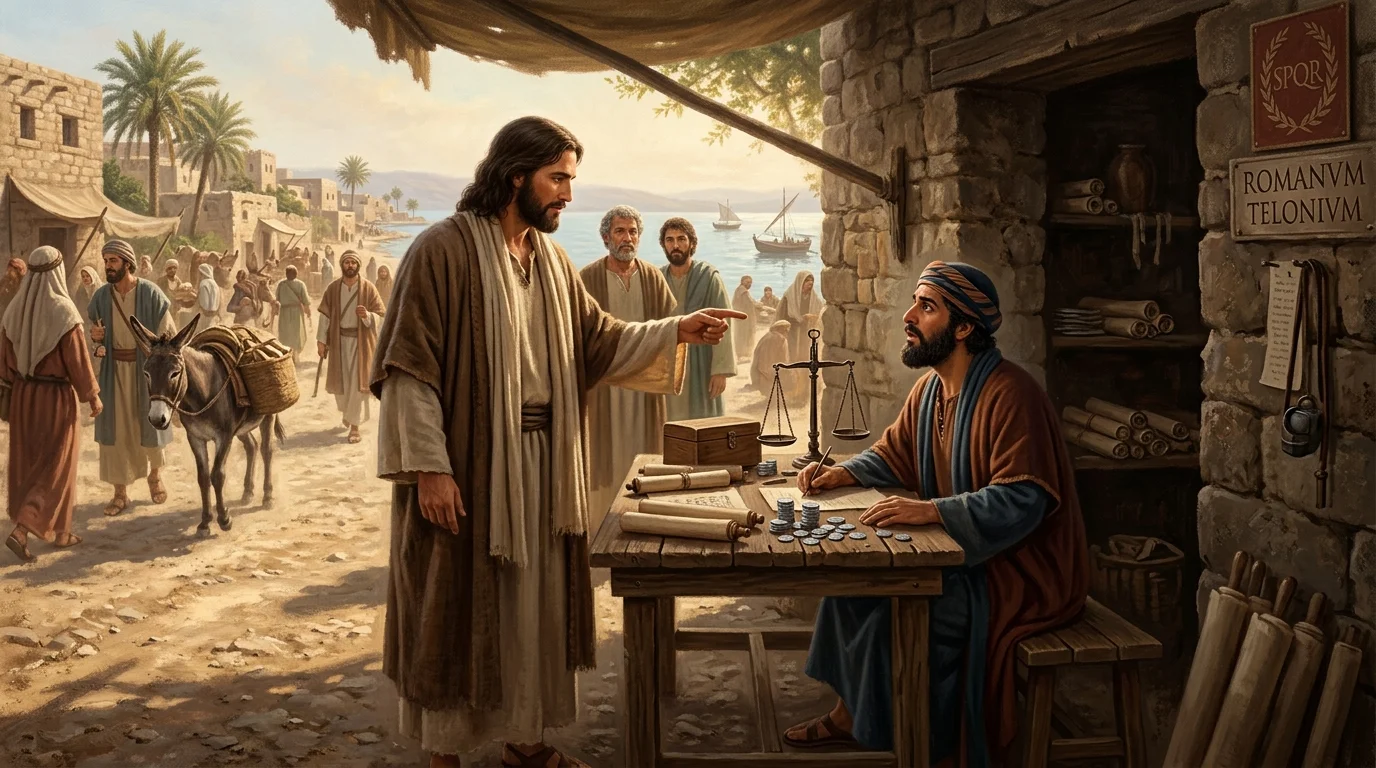
Under the scorching morning sun of Capernaum, the imperial toll booth along the bustling Via Maris was alive with the clink of Roman denarii, the braying of laden pack mules, and the sullen murmurs of merchants forced to pay transit tariffs. Seated beneath the awning of the tax office sat Levi, son of Alphaeus—a man wealthy in coin but bankrupt in soul, despised by his fellow countrymen as a Roman collaborator and traitor to Israel. Yet on this ordinary Galilean morning, the dust of the road parted as Jesus of Nazareth walked straight past the crowds, stopped directly before the customs desk, and shattered an outcast's destiny with two revolutionary words: "Follow Me." What followed was a seismic clash between Pharisaic legalism and divine mercy, culminating in a joyful feast of outcasts and the immortal revelation of the Great Physician and the new wineskins of the Kingdom.
1. The Customs Toll Booth on the Via Maris
Capernaum was not a quiet pastoral retreat; it was a humming geopolitical intersection. Positioned right on the border between the tetrarchies of Herod Antipas and Herod Philip, all international freight moving between Egypt, Damascus, and Mesopotamia had to pass its stone checkpoints. Tariffs were levied on everything: dried lake sardines, olive oil, spelt grain, timber, and pack animals.
Levi sat inside the telōnion (tax office), holding reed pens, ink pots, and certified parchment ledgers. He was a mokhes qatan—a small tax collector who assessed arbitrary duties on passing travelers. In the eyes of the pious Pharisees and the common Jewish peasantry, tax collectors were moral lepers. They were categorized in rabbinic literature alongside harlots, thieves, and swineherds. They were barred from entering the basalt synagogue, forbidden from serving as legal witnesses in trials, and considered ritually defiled because of their constant contact with Gentile money and Roman officials.
Levi had chosen wealth over community, gold over worship. Yet wealth could never silence the agonizing emptiness within his heart. Surrounded by piles of silver shekels and copper leptons, Levi knew that every coin he counted was stained with the tears and curses of his brethren. He was an outcast trapped in a prison of his own making.
2. The Sovereign Call: "Akolouthei Moi"
As Jesus walked along the lake shore after teaching the multitudes, He drew near the customs booth. The disciples following Christ must have stiffened; pious Jews routinely walked on the opposite side of the road to avoid even the shadow of a tax collector's booth.
Jesus did not cross the street. He walked directly up to the wooden table where Levi was counting coins. The bustling crowd fell silent in anticipation. Would this holy Prophet denounce the corrupt extortionist? Would He call down the righteous wrath of God upon this lackey of Caesar?
Jesus looked into Levi's eyes. It was a gaze that stripped away the cynicism of the toll booth, looking past the Roman ledger into the bruised and longing soul beneath. With absolute sovereign authority and infinite tenderness, Christ uttered two words:
"Follow Me." (Greek: Akolouthei moi).
The imperative was immediate, decisive, and all-encompassing. Luke, with surgical brevity, records the staggering response: "So he left all, rose up, and followed Him." (Luke 5:28). Levi did not pause to balance his books, settle his accounts, or consult his family. He pushed the cash boxes away, stepped around the desk, and left his entire life behind. For Peter and John, leaving their nets was an immense step of faith, yet they still owned their boats and could return if necessary. For Levi, abandoning his imperial contract with Herod Antipas meant there was no going back; his tax franchise was gone forever. He surrendered temporal security to gain eternal treasure!
3. The Great Banquet of Grace in Matthew's Courtyard
Levi—now bearing the new name Matthew, meaning "Gift of Yahweh" (Mattityahu)—could not keep this glorious salvation to himself. He did not slip away into secret discipleship. Instead, he threw open the doors of his spacious villa and hosted what Luke calls a megalēn dochēn—a grand, magnificent celebration feast!
Whom could an excommunicated tax collector invite to a banquet? He could not invite the neighborhood rabbis, the city elders, or the righteous aristocracy. So Matthew invited the only companions he had: his fellow tax collectors, extortionists, gamblers, and marginalized sinners.
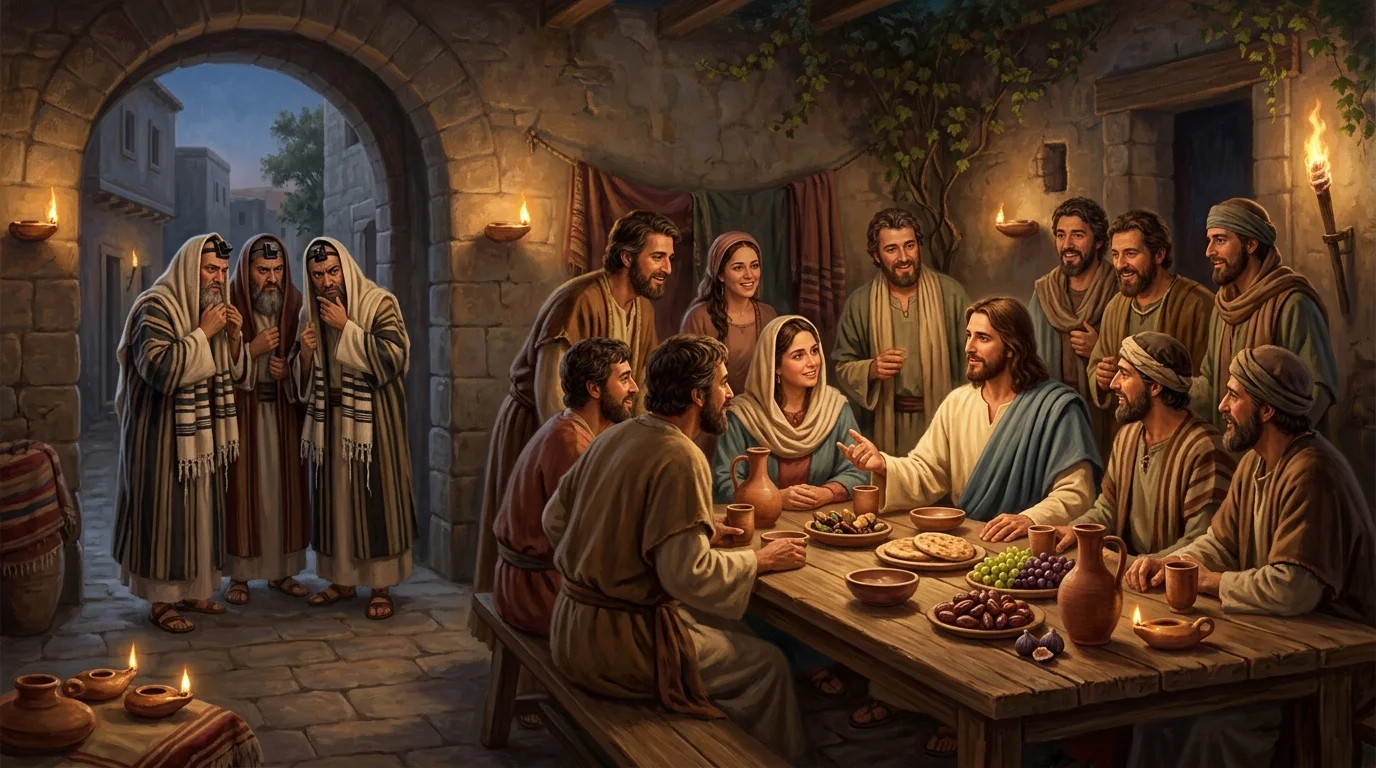
The open stone courtyard was filled with music, overflowing dishes of roasted lamb, barley bread, figs, pomegranates, and flowing carafes of wine. And at the center of the head banquet couch, reclining in warm, unguarded fellowship, sat Jesus of Nazareth!
Around Christ sat men whose hands were hardened by deceit, whose lives had been scarred by greed, and whose hearts had never known forgiveness. Jesus did not sit among them with a stern scowl of moral superiority. He broke bread with them, drank from their cups, laughed in their joy, and listened to their stories. In that candlelit courtyard, heaven touched earth, and outcasts discovered that God was not an angry tyrant, but a loving Father welcoming home His prodigal children.
4. The Murmuring of the Scribes and Pharisees
Outside the arched courtyard gate, the atmosphere was dark with indignation. Scribes and Pharisees had gathered, peering over the low stone walls with curled lips and blazing eyes. To their meticulous legalistic minds, what was happening inside that courtyard was a catastrophic violation of holiness.
In ancient Judaism, eating together (chaburah) was a solemn covenant transaction. To share salt and bread with a person was to endorse their moral character and bind oneself to their destiny. The Mishnah explicitly warned: "Let not a man associate with the wicked, not even to bring him near to the Torah."
Too cowardly to challenge Jesus directly, the Pharisees cornered His disciples in the alleyway, hissing:
"Why does your Teacher eat and drink with tax collectors and sinners?" (Matthew 9:11).
The accusation was lethal. If Jesus was truly the Messiah of Israel, how could He defile Himself with the dregs of society? Did He not understand that their touch brought contamination?
5. The Great Physician's Royal Manifesto
Jesus overheard their whispered criticisms. He did not apologize, retreat, or attempt to sanitize His actions. He stepped toward the gate and delivered an immortal medical and theological axiom that dismantled their self-righteous system forever:
"Those who are well have no need of a physician, but those who are sick. But go and learn what this means: 'I desire mercy and not sacrifice.' For I did not come to call the righteous, but sinners, to repentance." (Matthew 9:12–13).
With peerless diagnostic brilliance, Jesus redefined the problem. Sin is not merely a legal infraction; it is a fatal spiritual disease! The tax office and the street were not crime scenes to be avoided; they were infectious trauma wards requiring divine treatment. Where else should a doctor be found except in the presence of the dying?
Then, turning the scalpel upon the Pharisees themselves, He said: "Go and learn what this means..." This was the exact sarcastic phrase premier rabbis used when reprimanding ignorant schoolboys. He quoted Hosea 6:6, exposing that their scrupulous external rituals of fasting and ceremonial washing were completely devoid of the heart of God, which beats with covenant lovingkindness (Hesed). The Pharisees were dying of the terminal cancer of self-righteousness, yet were too blind to ask for the Cure; the sinners knew they were sick, and gladly received the Great Physician's healing touch!
6. New Wine into New Wineskins
As the feast continued, another challenge arose. Disciples of John the Baptist, influenced by the ascetic solemnity of their imprisoned prophet, approached Jesus alongside the Pharisees, asking: "Why do we and the Pharisees fast often, but Your disciples do not fast?" (Matthew 9:14).
Fasting in first-century Judaism had devolved from heartfelt repentance into an exhibition of competitive piety. The Pharisees fasted twice a week—on Mondays and Thursdays—whitening their faces so all could admire their austerity.
Jesus answered with radiant wedding imagery: "Can the friends of the bridegroom mourn as long as the bridegroom is with them? But the days will come when the bridegroom will be taken away from them, and then they will fast." (Matthew 9:15). In Jewish custom, the week of wedding celebrations was exempt from all fasting and mourning; it was a sacred season of unbridled joy. Jesus was the celestial Bridegroom! The Messianic wedding banquet had dawned in their midst. How could anyone fast when the King of glory was sitting at the table?
Then Christ unveiled the revolutionary nature of the New Covenant through two unforgettable parables of everyday life:
First, no one tears a piece of unshrunk, raw wool from a new garment to patch an old, worn tunic. When washed, the new patch will shrink, pulling away from the delicate old threads and creating an even worse tear.
Second, "Nor do they put new wine into old wineskins, or else the wineskins break, the wine is spilled, and the wineskins are ruined. But they put new wine into new wineskins, and both are preserved." (Matthew 9:17).
In biblical times, wine was stored in containers crafted from the entire tanned skins of goats or sheep. Fresh, fermenting new wine (oinos neos) released powerful expanding gases. A new, supple wineskin possessed the elasticity to stretch with the pressure. But an old wineskin had become dry, rigid, and brittle. If new wine was poured into it, the unyielding leather would violently burst, spilling the precious vintage into the dust.
The theological lesson was monumental: Jesus did not come to sew a little patch of grace onto the decaying garment of Pharisaic legalism, nor did He come to pour the explosive, intoxicating power of the Holy Spirit into the dried-out vessels of dead human traditions! The Old Covenant types and shadows were fulfilled. The Kingdom of God demanded new hearts, new minds, and new structures capable of holding the boundless grace of God.
From that humble courtyard in Capernaum, Matthew walked forth not only as a redeemed disciple, but as the inspired chronicler who would use his scribal pen to author the First Gospel. The man who once tabulated Caesar's coins became the ambassador who recorded the royal genealogy and the eternal Kingdom of Jesus Christ!
Ancient Near Eastern & Archaeological Context
First-century Capernaum was an international frontier town strategically situated along the Via Maris ('Way of the Sea'), the lucrative imperial trade corridor connecting Damascus and Egypt. Because Capernaum bordered the administrative realms of Herod Antipas (Galilee/Perea) and Philip the Tetrarch (Iturea/Trachonitis), all cross-border caravans, grain shipments, and fishing vessels were subjected to transit tolls, sales taxes, and commodity duties. The Roman tax system auctioned off tax-farming franchises to wealthy contractors ('publicani'), who employed local sub-collectors ('mokhes'). These local Jewish agents were infamous for extortion, padding assessments to enrich themselves while enriching the Roman oppressor. Consequently, tax collectors were socially ostracized, classified alongside thieves and murderers, forbidden from giving legal testimony in court, and expelled from synagogue worship. Matthew (Levi son of Alphaeus) sat at this despised toll booth when Jesus arrived. Matthew's swift abandonment of his government lease was an irreversible economic sacrifice; unlike fishermen who could return to their nets, a tax collector who vacated his imperial ledger forfeited his position forever.
Support Independent Biblical Research
Did this study bless you? Help support our independent bilingual research and interactive visual Bible tools.
⚡ Fast Facts
- In first-century Roman Galilee, Jewish tax collectors ('mokhes') were viewed as traitorous extortionists and ritual outcasts barred from synagogues and legal courts
- Matthew instantly abandoned a secured, lucrative civil franchise under Herod Antipas, whereas fishermen disciples could theoretically return to their boats
- The Greek phrase 'megalēn dochēn' (Luke 5:29) indicates a lavish reception banquet, demonstrating Matthew's immense wealth and generosity
- Fermenting new wine produces expanding carbon dioxide gases that shatter rigid, dried-out old goatskin containers ('askoi palaioi')
❓ Frequently Asked Questions (FAQs)
In ancient Near Eastern culture, sharing table fellowship ('chaburah') was the ultimate covenant sign of intimate friendship, mutual acceptance, and moral endorsement. Pharisees believed that dining with ritual outcasts contracted ceremonial defilement and compromised holy separation. By breaking bread with despised tax gatherers and sinners, Jesus crossed profound social and religious chasms, demonstrating that divine grace seeks and embraces moral outcasts rather than shunning them.
By comparing Himself to a physician ('iatros'), Jesus reframed the purpose of His Messianic mission. A doctor does not avoid the sick out of fear of disease, but enters the sickroom to diagnose, heal, and restore. The self-righteous Pharisees considered themselves spiritually healthy and morally whole, thus rejecting Christ's cure; the acknowledged sinners recognized their terminal spiritual sickness and desperately received Christ's forgiving grace.
The unshrunk cloth and new wine skins symbolize the vibrant, unconstrained life of the New Covenant inaugurated by Christ. The old garment and dried goatskins represent the rigid, ceremonial framework of Pharisaic traditionalism and Mosaic shadows. The radical grace, Holy Spirit power, and joy of the Kingdom of God cannot be poured into obsolete legalistic structures; the New Covenant requires new hearts and a completely transformed spiritual reality.