In the middle of the first century, a theological wildfire threatened to consume the young churches of Galatia (modern-day Turkey). False teachers known as Judaizers had infiltrated the congregations, demanding that Gentile converts submit to circumcision, ancient dietary taboos, and the rigid ceremonial codes of the Mosaic Law to be truly saved. In response, the apostle Paul wrote what Martin Luther called his 'Katie von Bora'—the Epistle to the Galatians, Christianity's Magna Carta of spiritual freedom. In chapter 5, Paul dismantles legalism and delivers one of the most breathtaking portraits of the transformed human soul ever recorded: the nine-fold Fruit of the Holy Spirit.
1. The Theological Battleground: Legalism vs. Spiritual Life
Before diving into the virtues, we must understand why Paul contrasts the Works of the Flesh with the Fruit of the Spirit. Legalism assumes that human beings can become holy by compiling checklists of rules: "Do not touch, do not taste, do not handle." But the law, while holy and good, is like a mirror—it can show you that your face is dirty, but it has no water to wash it.
Paul reveals the startling paradox of legalism in Galatians 5:16–18: when you try to conquer sin by external rules alone, you actually inflame the sinful nature. The flesh (sarx) produces 'works' (erga)—ugly, manufactured, exhausting striving that leads to sexual immorality, strife, jealousy, outbursts of anger, and rivalries (Galatians 5:19–21).
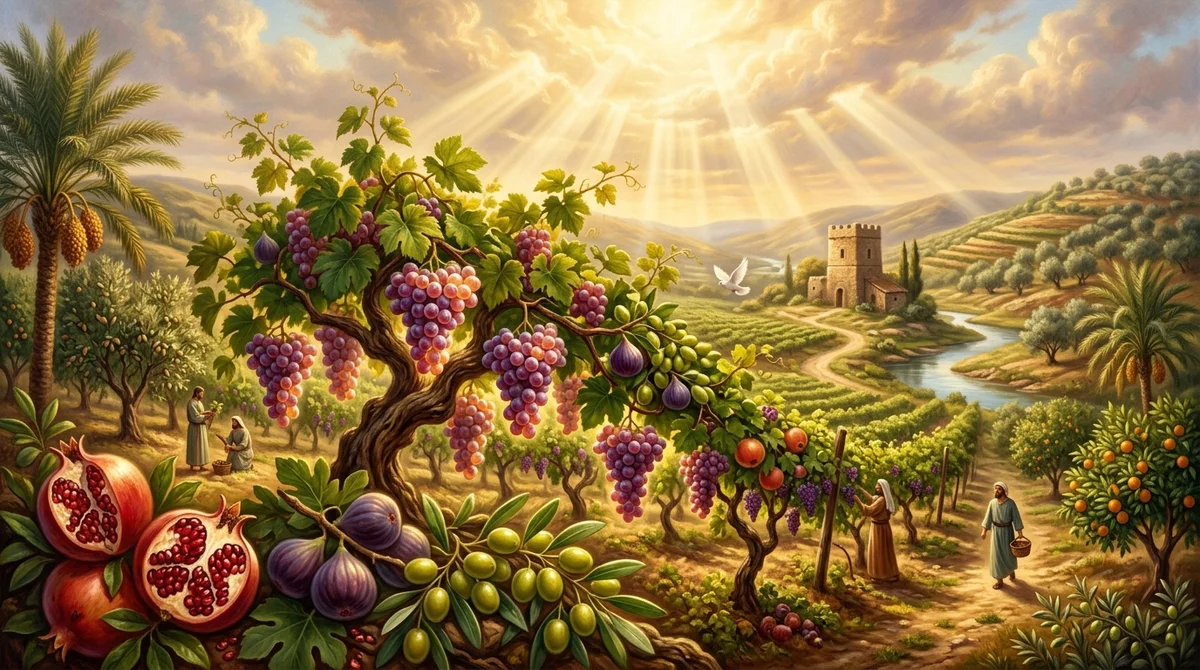
By contrast, the Holy Spirit does not give us a heavier yoke of rules; He imparts supernatural life. Just as an apple tree does not groan, strain, and sweat to produce apples, a believer rooted in intimate union with Jesus Christ naturally, organically bears the sweet character of the Son of God.
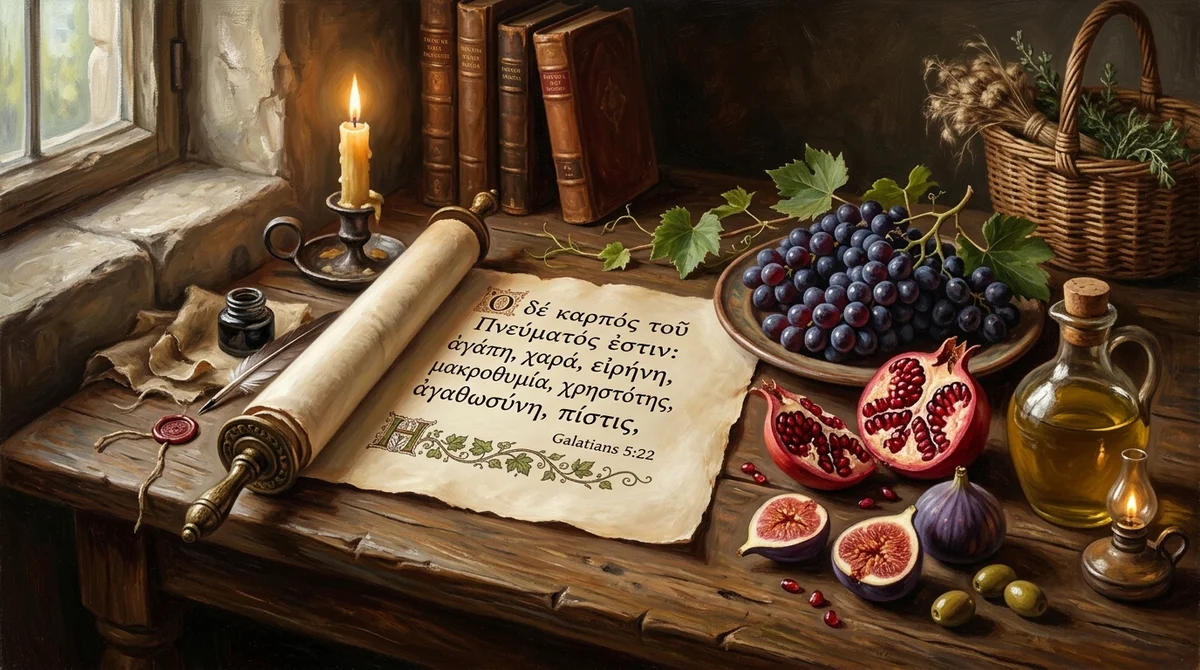 The Divine Harvest: The nine Greek virtues of Galatians 5:22-23 that define the supernatural character of Jesus Christ.
2. The Grammar of Grace: Why 'Fruit' is Singular
In Galatians 5:22, Paul writes: "Ho de karpos tou Pneumatos estin..." (But the fruit [singular] of the Spirit is...). He deliberately avoids the plural noun karpoi ("fruits").
This grammatical choice contains profound theology:
- A Single Indivisible Cluster: The nine virtues are not separate items on a cafeteria line where you can select joy and peace while rejecting self-control. They are like a single orange with nine juicy segments, or a diamond with nine sparkling facets.
- The Portrait of Christ: The Fruit of the Spirit is nothing less than the personality and character of Jesus Christ Himself formed in the believer (Galatians 4:19). Where Jesus is present, all nine attributes are present.
3. The First Triad: God-Ward Intimacy (Love, Joy, Peace)
The first three virtues describe the inner spiritual climate of a heart anchored in unbroken fellowship with the Triune God.
1. Love (Agapē) — The Queen of Virtues
Paul begins with Agapē because it is the mother root from which all other eight virtues sprout. In ancient Greek, four distinct words described love: storgē (family affection), eros (romantic passion), philia (brotherly friendship), and agapē.
Agapē was rarely used in classical Greek literature until the New Testament seized it to describe the radical, unconditional, self-sacrificial love of God demonstrated at Calvary (Romans 5:8; 1 John 4:8). Agapē is not a fleeting emotional feeling or sentimental affection; it is a relentless, deliberate decision of the will to seek the absolute highest good of another person, even when they are undeserving or hostile. When the Holy Spirit fills a believer, agapē enables them to forgive enemies, serve the ungrateful, and lay down their life for others.
2. Joy (Chara) — Supernatural Delight Independent of Circumstances
The world knows happiness, which is rooted in 'happenstance'—it rises and falls based on bank accounts, health, pleasant weather, and external comfort. When circumstances crumble, worldly happiness vanishes.
Christian joy (chara) is a deep, bubbling, indestructible fountain rooted in the eternal reality of God's presence, sovereignty, and salvation. In the New Testament, chara is closely tied to charis (grace). Joy is the soul's response to the grace of God. It is why Paul and Silas could sing hymns of praise at midnight while bleeding in a filthy Philippian dungeon (Acts 16:25), and why Jesus, "for the joy set before Him, endured the cross" (Hebrews 12:2).
3. Peace (Eirēnē) — The Divine Shalom of Whole Rest
In secular Greek, eirēnē meant simply the absence of war or civil tranquility. But when baptized into biblical revelation, it carries the rich Hebrew concept of Shalom: absolute wholeness, total well-being, unbroken harmony with God, and tranquil rest in His providence.
Spiritual peace operates on two levels:
- Peace WITH God (Objective): Through justification by faith, the enmity between holy God and sinful humanity has been permanently abolished by the blood of the Cross (Romans 5:1).
- The Peace OF God (Subjective): A supernatural fortress that garrisons the mind and emotions (Philippians 4:7), silencing panic even when walking through the valley of the shadow of death.
4. The Second Triad: Neighbor-Ward Compassion (Patience, Kindness, Goodness)
The second group of three virtues manifests horizontally in our social relationships, family life, workplace, and church community.
4. Patience / Longsuffering (Makrothumia) — The Long Holding of Wrath
The compound Greek word makrothumia is formed from makros ("long") and thumos ("wrath, passion, fire"). It literally means "taking a long time to boil over"—the patient restraint of anger when provoked.
Ancient pagan Greeks viewed makrothumia as a sign of weakness; they believed a strong man should retaliate immediately when wronged. Christianity revolutionized this concept: God is makrothumos—slow to anger and abundant in mercy (Exodus 34:6; 2 Peter 3:9). In a believer, patience is the supernatural capacity to endure difficult people, prolonged trials, and unfair treatment without retaliating, grumbling, or losing hope.
5. Kindness (Chrēstotēs) — Tender, Practical Mercy
Chrēstotēs carries the nuance of gracious usefulness, sweet benevolence, and tenderhearted consideration. It is grace in work clothes.
In Titus 3:4, Paul writes of "the kindness (chrēstotēs) and love of God our Savior." Kindness is the gentleness that refuses to crush a bruised reed (Isaiah 42:3). It looks like King David seeking out the crippled Mephibosheth to seat him at the royal banquet table (2 Samuel 9), or Jesus speaking with dignified compassion to the rejected Samaritan woman at the well (John 4). A kind Christian makes Christ attractive and approachable to a cynical, wounded world.
6. Goodness (Agathōsynē) — Moral Integrity in Action
While kindness is gentle and tender, agathōsynē is moral backbone—active, courageous virtue that confronts evil and champions righteousness.
Agathōsynē is not passive sweetness; it can be bold and firm. We see this holy goodness when Jesus entered the Temple and overturned the tables of corrupt moneychangers (Matthew 21:12), defending the sacred purpose of God’s house. Goodness hates injustice, defends the orphan and widow, practices radical generosity, and stands unflinchingly for truth even when unpopular.
5. The Third Triad: Inner Integrity & Mastery (Faithfulness, Gentleness, Self-Control)
The final three virtues govern the inner character, reliability, humility, and disciplined passions of the believer.
7. Faithfulness (Pistis) — Unshakable Loyalty & Trustworthiness
In theological contexts, pistis often means saving faith (trusting Christ for salvation). But in the catalog of fruit, it refers to faithfulness, fidelity, and reliability.
A faithful person is one whose word is their bond. They do not quit when ministry becomes exhausting; they do not break marriage vows when passion fades; they do not steal company time when the boss is absent. God Himself is defined by covenant faithfulness: "Great is Your faithfulness; Your mercies are new every morning" (Lamentations 3:23). When the Spirit cultivates pistis, you become an oasis of dependable integrity in an age of broken promises and shifting loyalties.
8. Gentleness / Meekness (Prautēs) — Power Under Perfect Control
No word in the English language has been more misunderstood than meekness. Our culture equates meekness with weakness, cowardice, or being a passive doormat.
In ancient classical Greece, prautēs was used to describe a wild stallion that had been captured, trained, and disciplined by a master horseman. The stallion had lost none of its explosive strength, lightning speed, or fire; but its raw power was now completely harnessed and surrendered to the gentlest tug of the rider's bridle.
Jesus described Himself as "meek and lowly in heart" (Matthew 11:29). Moses was called the meekest man on earth (Numbers 12:3), yet he boldly confronted the Pharaoh of Egypt. Gentleness is not the absence of power; it is infinite power under total divine restraint. It answers insult with soft wisdom (Proverbs 15:1) and restores fallen brothers with quiet tenderness (Galatians 6:1).
9. Self-Control (Enkrateia) — Mastery Over Desires
Paul climaxes the list with enkrateia, derived from en ("in") and kratos ("strength, dominion, power"). It literally means "inner strength" or "holding oneself within."
In the ancient world, Greek philosophers prized enkrateia as the highest virtue for athletes competing in the Olympic games. An athlete who could not control their diet, sleep, tongue, or sexual impulses would never win the laurel wreath (1 Corinthians 9:25).
In the life of a Christian, self-control is not stoic asceticism; it is the Holy Spirit seated on the throne of our appetites, passions, speech, thoughts, and digital consumption. Proverbs 25:28 warns: "Like a city whose walls are broken through is a person who lacks self-control." Enkrateia rebuilds the spiritual walls of your soul so that demonic temptations cannot invade at will.
6. 'Against Such Things There Is No Law' (Galatians 5:23b)
Why does Paul add this fascinating conclusion?
In Rome and Jerusalem, laws existed to restrain theft, murder, perjury, and treason. But no government on earth has ever passed a law that says: "You are loving too much," "You are far too peaceful," or "Your kindness is illegal."
More deeply, Paul is showing the legalists in Galatia that the Holy Spirit accomplishes from within what thousand-page legal codes could never enforce from without. When you are filled with the Spirit, you transcend the restrictive demands of the law, because love is the complete fulfillment of all righteousness (Romans 13:8–10).
7. How Fruit Actually Grows: The Secret of John 15
You cannot produce the Fruit of the Spirit by white-knuckled striving, self-help techniques, or moral resolutions. Spiritual fruit is the byproduct of abiding:
"I am the vine; you are the branches. Whoever abides in me and I in him, he it is that bears much fruit, for apart from me you can do nothing." (John 15:5)
A branch does not produce grapes by straining; it produces grapes simply by remaining connected to the sap, minerals, and life flowing from the root.
- Saturate in the Word: Let the pure water of Scripture wash away worldly cynicism and plant seeds of faith daily.
- Practice Constant Communion: Walk in unceasing prayer, turning every frustration into dialogue with the Father.
- Welcome the Vinedresser's Pruning: When God allows trials, setbacks, or suffering, understand that the Father is pruning dead wood so you may bear more fruit (John 15:2).
- Crucify the Flesh Daily: "Those who belong to Christ Jesus have crucified the flesh with its passions and desires" (Galatians 5:24). Say a decisive 'no' to selfish ambition and a joyful 'yes' to the Holy Spirit.
Conclusion: Look at your life today. Do people taste the sweetness of Christ when they interact with you, or the sour bitterness of human flesh? Yield your heart afresh to the Holy Spirit right now, stay deeply rooted in Jesus the True Vine, and watch heaven’s harvest blossom in your soul.
⚡ Fast Facts
- Singular Grammar (Karpos): Paul deliberately uses the singular Greek noun 'karpos' ('fruit'), not the plural 'karpoi' ('fruits'), revealing that these nine virtues are not isolated cafeteria choices but an interconnected, indivisible cluster produced by one Holy Spirit.
- Triadic Architectural Pattern: The nine virtues form three harmonious triads: God-ward intimacy (Love, Joy, Peace), Neighbor-ward social grace (Patience, Kindness, Goodness), and Inner self-ward integrity (Faithfulness, Gentleness, Self-control).
- Effort vs Abiding (Erga vs Karpos): In Galatians 5:19, Paul describes demonic and human lusts as 'works' (erga—manufactured human sweat), but in verse 22 he shifts to 'fruit' (karpos—supernatural organic growth flowing from intimacy with Christ).
- The Rule of Lawlessness (Verse 23): Paul concludes with 'against such things there is no law' (kata tōn toioutōn ouk estin nomos), meaning no legalistic moral code can produce or surpass the supernatural beauty of Holy Spirit character.
❓ Frequently Asked Questions (FAQs)
In Galatians 5:22, the Greek word 'karpos' is singular to emphasize that the nine attributes are a single unified package representing the character of Jesus Christ Himself. You cannot pick and choose to have 'love' without 'self-control' or 'joy' without 'patience'. While Spiritual Gifts (charismata) are distributed differently to individual believers, the Fruit of the Spirit is the universal, non-negotiable spiritual DNA meant to be formed in every disciple.
Spiritual Gifts (1 Corinthians 12) represent divine empowerment for ministry tasks (what you do), given sovereignly in a moment. The Fruit of the Spirit (Galatians 5) represents Christlike character (who you are), cultivated gradually through abiding and trials. Gifts without Fruit lead to spiritual pride and destruction (1 Corinthians 13:1-3), whereas Fruit validates authentic discipleship.
Fruit cannot be manufactured by human willpower or legalistic striving. As Jesus taught in John 15:4-5, a branch cannot bear fruit of itself unless it abides in the vine. Practically, abiding involves daily surrender through prayer, saturating the mind with God's Word, keeping in step with the Holy Spirit's convictions, yielding through suffering, and actively putting to death the desires of the sinful nature (Galatians 5:24).