In the damp shadows of a Roman rented house around AD 61, the apostle Paul sat under constant guard. Chained day and night by his wrist to an elite soldier of the Emperor’s Praetorian Guard, Paul heard the rhythmic clink of metal armor with every shift of the watch. Most men in his chains would have seen only an instrument of cruel imperial oppression. But through the inspired eyes of the Holy Spirit, Paul saw something infinitely grander: a living, breathing blueprint of the supernatural arsenal God provides to every believer in Jesus Christ.
1. The Reality of the Invisible Battlefield (Ephesians 6:10–12)
Before Paul describes a single piece of armor, he delivers a sobering wake-up call to the church in Ephesus and to every generation that follows:
"Finally, my brothers, be strong in the Lord, and in the power of his might. Put on the whole armor of God, that you may be able to stand against the wiles of the devil. For our wrestling is not against flesh and blood, but against the principalities, against the powers, against the world's rulers of the darkness of this age, and against the spiritual forces of wickedness in the heavenly places." (Ephesians 6:10–12)
Paul uses the Greek word pale (wrestling)—a brutal, hand-to-hand, skin-to-skin combat where defeat meant utter ruin. Yet he makes it crystal clear: our true enemy is never our difficult spouse, our hostile boss, a political opponent, or a persecutor. The moment we fight people with human weapons of bitterness, anger, and slander, we have already lost the battle. Behind earthly hostility operate demonic hierarchies: principalities (archas), powers (exousias), cosmic world-rulers of darkness (kosmokratoras), and spiritual hosts of wickedness (pneumatika tēs ponērias).
Human strength, positive thinking, or willpower are utterly useless against angelic adversaries. Therefore, Paul commands: "Be strong in the Lord, and in the power of HIS might" (kratos tēs ischyos). We do not fight for victory; we fight from the victory Christ already won on the Cross (Colossians 2:15).
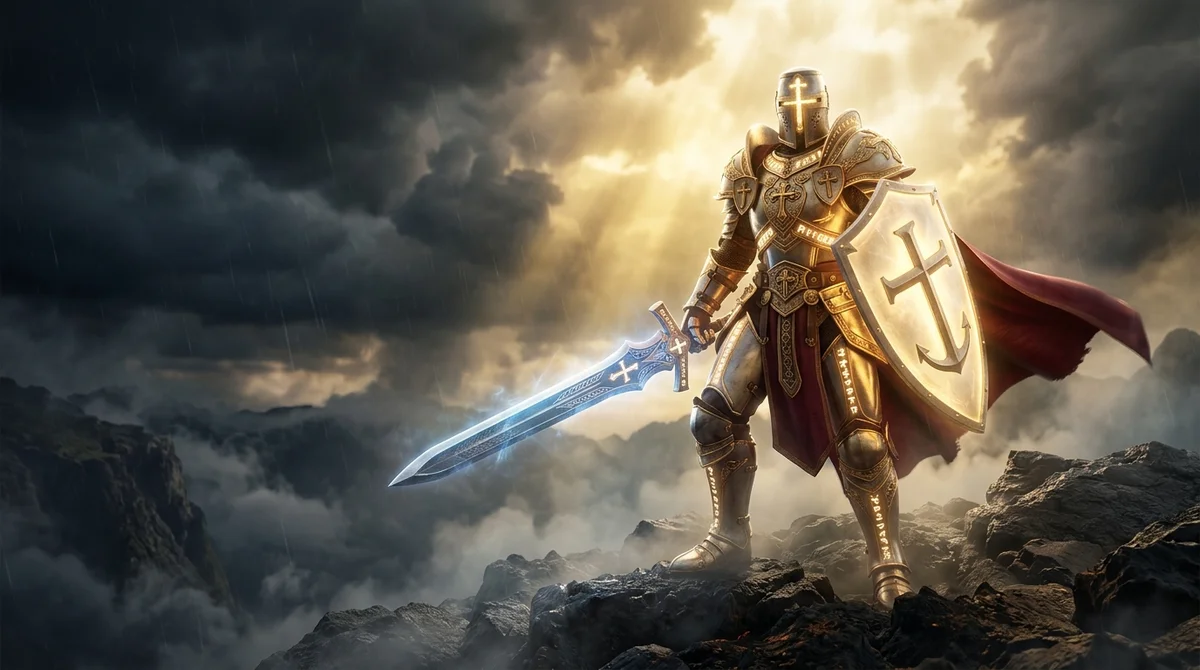
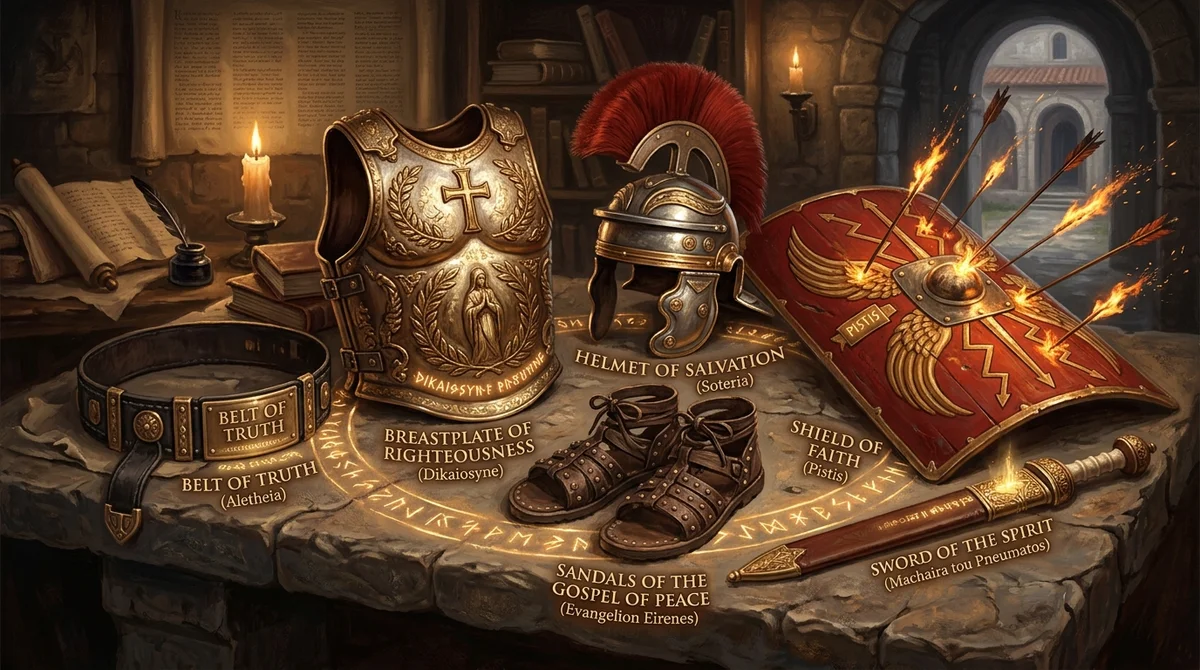 The Divine Arsenal: The six Roman legionary weapons transformed by Paul into spiritual safeguards for believers.
2. The Belt of Truth: Fastening Your Core (Ephesians 6:14a)
"Stand therefore, having the utility belt of truth buckled around your waist..."
In the Roman military, the belt (Latin: cingulum militare; Greek: zōnē) was not a decorative fashion accessory. It was the foundational anchor of the entire armor. The heavy leather belt cinched the soldier's loose tunic so he would not trip during combat. Crucially, it held the scabbard for the gladius sword and supported the weight of the breastplate. If the belt was loose, the soldier was paralyzed and defenceless.
The Spiritual Reality: Satan is the "father of lies" (John 8:44). His primary strategy is not to attack with horns and pitchforks, but to inject subtle deceptions: "Did God really say?" (Genesis 3:1), "God doesn't love you," or "You will never change." When we buckle the belt of God’s objective Truth (alētheia) around our minds, we filter every emotion, cultural trend, and lie through the lens of God's Word. Furthermore, it implies subjective truthfulness—living with radical integrity and transparent honesty before God and others.
3. The Breastplate of Righteousness: Guarding the Heart (Ephesians 6:14b)
"...and having put on the breastplate of righteousness..."
The Roman breastplate (Latin: lorica segmentata; Greek: thōrax) was a cuirass of overlapping iron strips or solid bronze that covered the soldier’s vital organs—most notably the heart, lungs, and liver. In battle, a slice to the arm might hurt, but a thrust to the chest was fatal.
The Spiritual Reality: In biblical psychology, the heart represents the center of emotions, desires, and conscience. Satan is the "Accuser of the brethren" (Revelation 12:10). He attacks the believer’s heart with toxic shame, guilt, and condemnation: "Look at what you did. How could God ever accept you?" If a Christian relies on their own self-righteousness or good deeds for defense, that breastplate will shatter under the first blow.
The breastplate Paul commands us to wear is the imputed righteousness of Jesus Christ (2 Corinthians 5:21; Romans 8:1). When Satan points out your genuine flaws, your response is not: "I am good," but: "Christ died for me, and His flawless righteousness covers my heart." This positional righteousness then flows outward into practical, holy living (1 John 3:7).
4. The Sandals of the Gospel of Peace: Firm Grounding & Readiness (Ephesians 6:15)
"...and having fitted your feet with the preparation of the Good News of peace..."
Roman infantry dominated the ancient world largely because of their footwear: the caligae. These were open-toed, heavy-duty military sandals studded underneath with sharp iron hobnails. They served two crucial functions:
- Unshakable Traction: The cleats dug deep into mud, slippery slopes, and rocky terrain so the legionary would never slip during a brutal cavalry charge.
- Rapid Mobility: They allowed Roman legions to march 25 to 30 miles a day across rough terrain without blistering, outmaneuvering their enemies.
The Spiritual Reality: The Greek word for preparation is hetoimasia, meaning a state of alert readiness and firm footing. The Good News provides dual peace: peace with God (Romans 5:1—reconciliation that removes fear of judgment) and the peace of God (Philippians 4:7—an inner calm that guards the heart in crisis). When your feet are anchored in the gospel, you stand immovable against panic, and you are constantly prepared to bring the light of Christ to a broken world.
5. The Shield of Faith: Extinguishing the Flaming Arrows (Ephesians 6:16)
"Above all, taking up the shield of faith, with which you will be able to quench all the fiery darts of the evil one."
Paul does not use the word for a small round buckler (aspida). He deliberately chooses thyreos, derived from the word for "door" (thyra). This was the massive Roman scutum—a 4-foot by 2.5-foot curved oblong shield made of layered wood, glued canvas, and bound in calf-leather. Before entering battle, legionaries soaked their shields in water. When enemy archers fired hollow-reed arrows dipped in blazing pitch, the arrows would embed into the wet leather and instantly be extinguished rather than igniting the shield or splashing flaming naphtha onto the soldier.
Furthermore, Roman soldiers locked their shields together side-by-side to form the impenetrable testudo (tortoise) formation. A lone soldier was vulnerable, but a united wall of shields was unshakeable.
The Spiritual Reality: The enemy fires daily "flaming arrows"—sudden intrusive thoughts of fear, blasphemous doubts, lust, despair, or suspicion of others. Faith (pistis) is not positive thinking; it is active trust in the character and promises of God. When an arrow of doubt hits ("God has abandoned you"), the Shield of Faith answers: "He has said, I will never leave you nor forsake you" (Hebrews 13:5). Notice also the communal aspect: we need the fellowship of the Church (locked shields) to survive intense spiritual warfare.
6. The Helmet of Salvation: Protecting the Mind (Ephesians 6:17a)
"And take the helmet of salvation..."
The Roman helmet (Latin: galea; Greek: perikephalaia) was forged from solid bronze or iron, complete with cheek guards and a neck protector. It was engineered to deflect devastating blows from enemy battle-axes and heavy Celtic broadswords aimed directly at the skull. A soldier with wounded limbs might survive, but a blow to the head was instant death.
The Spiritual Reality: The battlefield of spiritual warfare is predominantly between our ears. The mind is where thoughts, philosophies, doubts, and worldviews collide. In 1 Thessalonians 5:8, Paul calls this piece "the hope of salvation as a helmet." The helmet guards our cognitive thoughts with the absolute certainty of our eternal destiny in Christ. When the enemy whispers that our faith is futile or that death is the end, the helmet of salvation reminds us that our future is sealed, our sins are washed, and our victory is eternal.
7. The Sword of the Spirit: The Offensive Weapon (Ephesians 6:17b)
"...and the sword of the Spirit, which is the word of God."
Up to this point, every single piece of armor has been purely defensive. Now, Paul introduces the only weapon designed for offense: the sword (machaira). Significantly, the machaira was the famous Roman short sword (18 to 24 inches), engineered not for wild swinging from a distance, but for deadly, surgical thrusting in close-quarters hand-to-hand combat.
Notice the specific Greek word Paul uses: he does not say logos (the broad, general revelation of God), but rhēma—an utterance, a specific, spoken word of scripture applied directly to a precise situation.
The Master's Example: We see the ultimate demonstration of this sword in Matthew 4 when Jesus was tempted in the Judean wilderness. When Satan attacked with three distinct temptations, Jesus did not argue with philosophical debates or summon legions of angels. For each temptation, He brandished the rhēma of God: "It is written... It is written... It is written..." (quoting Deuteronomy). To wield this weapon, a Christian must memorize, understand, and boldly speak the Word of God into specific moments of temptation, fear, and oppression.
8. The Seventh Weapon: Praying in the Spirit (Ephesians 6:18)
"With all prayer and requests, praying at all times in the Spirit, and being watchful to this end in all perseverance and requests for all the saints."
Grammatically, verse 18 is directly connected to the donning of the armor. A soldier may be fully outfitted in gleaming iron, but if he is unconscious, asleep, or out of communication with the Supreme Commander, his armor is useless. Prayer is the communication system and the divine power grid that energizes every piece of the armor.
Paul uses four expansive "alls":
- All prayer: Using every form of communication—thanksgiving, intercession, lament, and adoration.
- At all times: Unceasing communion throughout the day, not just brief morning rituals.
- In the Spirit: Guided, empowered, and aligned with the desires of the Holy Spirit (Romans 8:26).
- For all the saints: Shifting our focus from selfish preservation to kingdom intercession for the global body of Christ.
9. Daily Practical Application: Putting on the Armor
How does a modern believer "put on" this armor each morning?
- Belt of Truth: Begin your day by renouncing lies and confessing God's truth over your identity, family, and purpose.
- Breastplate of Righteousness: Thank Jesus for His cross, resting in His grace rather than self-condemnation or pride.
- Shoes of Peace: Step out into your workplace or home with a heart of reconciliation, ready to share the peace of Christ.
- Shield of Faith: Whenever anxiety or doubt flares up, immediately lift up a specific biblical promise to quench the spark.
- Helmet of Salvation: Take every thought captive to the obedience of Christ (2 Corinthians 10:5), fixing your gaze on eternal hope.
- Sword of the Spirit: Speak scripture aloud against temptation, discouragement, and spiritual heaviness.
- Continuous Prayer: Walk in constant, breathing conversation with God throughout the day.
Conclusion: In Christ, the victory is already decided. The battle you face today is not to win the war, but to stand firm in the triumph of King Jesus. Stand firm, soldier of the Cross. Put on the whole armor of God, and having done all, stand.
⚡ Fast Facts
- Roman Chains Connection: Paul penned Ephesians while under house arrest in Rome (c. AD 60-62), chained 24/7 to a rotating squad of elite Praetorian legionaries whose armor was right before his eyes.
- The Scutum Shield: The 'Shield of Faith' refers to the Roman 'thyreos'—a massive 4x2.5 foot curved wooden door-shield soaked in water before battle to extinguish flaming pitch arrows.
- Two Greek Words for Sword: Paul specifically chose 'machaira' (a lethal 18-inch close-quarters thrusting gladius) rather than 'rhomphaia' (a giant unwieldy two-handed broadsword), highlighting surgical scripture application.
- The Seventh Weapon: While six pieces of armor are worn, Paul introduces a crucial seventh offensive necessity in verse 18: relentless prayer and petition in the Spirit.
❓ Frequently Asked Questions (FAQs)
The primary purpose stated four times in Ephesians 6:11-14 is 'to stand' (Greek: stēnai). The armor is not designed for territorial conquest or human aggression, but to maintain the victory that Jesus Christ already achieved on the Cross, preventing Satan from stealing our peace, righteousness, or spiritual grounding.
Historically, Roman soldiers advanced shoulder-to-shoulder in tight phalanx formations and were trained never to turn around and flee. Spiritually, this symbolizes that God provides total supernatural protection when we face battles in faith, but retreating in fear leaves a believer vulnerable to the enemy's assault.
Putting on the armor is a conscious daily posture of faith exercised through prayer and scripture: choosing God's truth over cultural lies (Belt), resting in Christ's imputed righteousness instead of guilt (Breastplate), walking in reconciliation and readiness (Shoes), trusting God's promises against fiery doubts (Shield), guarding the mind with salvation's certainty (Helmet), and speaking specific Bible verses against temptation (Sword).