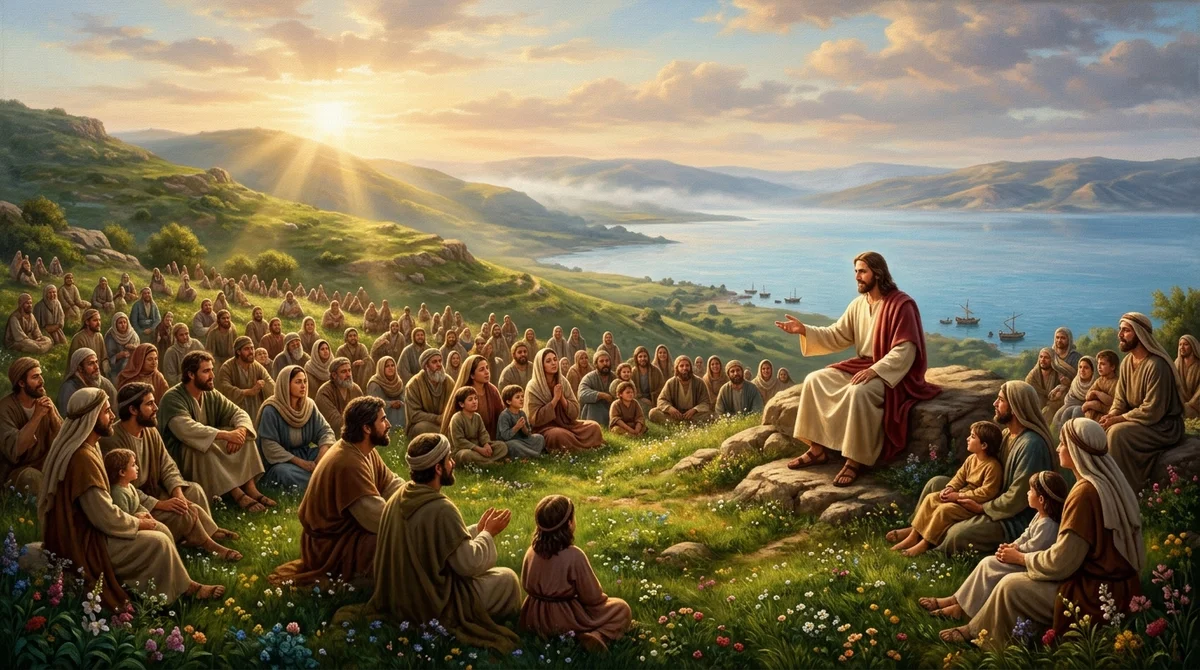
In the spring of approximately AD 30, on the sun-drenched northern shores of the Sea of Galilee, Jesus of Nazareth climbed a gentle, amphitheater-like hillside near Capernaum. Below Him gathered a sprawling, desperate crowd—fishermen with calloused hands, destitute widows, tax collectors, Roman sympathizers, and religious zealots. Sitting down in the customary posture of a Jewish rabbi, Jesus opened His mouth and delivered what is universally recognized as the most profound, revolutionary, and disruptive ethical discourse in human history: The Sermon on the Mount (Matthew 5–7).
1. The Mountain Setting: The Greater Moses and the New Covenant
The location of this sermon is rich with prophetic symbolism. Fifteen centuries earlier, Moses had ascended Mount Sinai amid thunder, lightning, thick smoke, and terrifying trumpet blasts to receive the Ten Commandments written on cold stone tablets (Exodus 19–20). The people were forbidden even to touch the mountain under penalty of death.
Now, on a peaceful Galilean hillside covered in blooming anemones and mustard flowers, God incarnate sits among His people. He does not shout from a blazing fire; He speaks in gentle, authoritative tones. Jesus does not come to abolish Moses’ Law, but to fulfill it (Matthew 5:17)—to etch its true spiritual heartbeat not on tablets of stone, but upon the living tables of transformed human hearts (Jeremiah 31:33; 2 Corinthians 3:3).
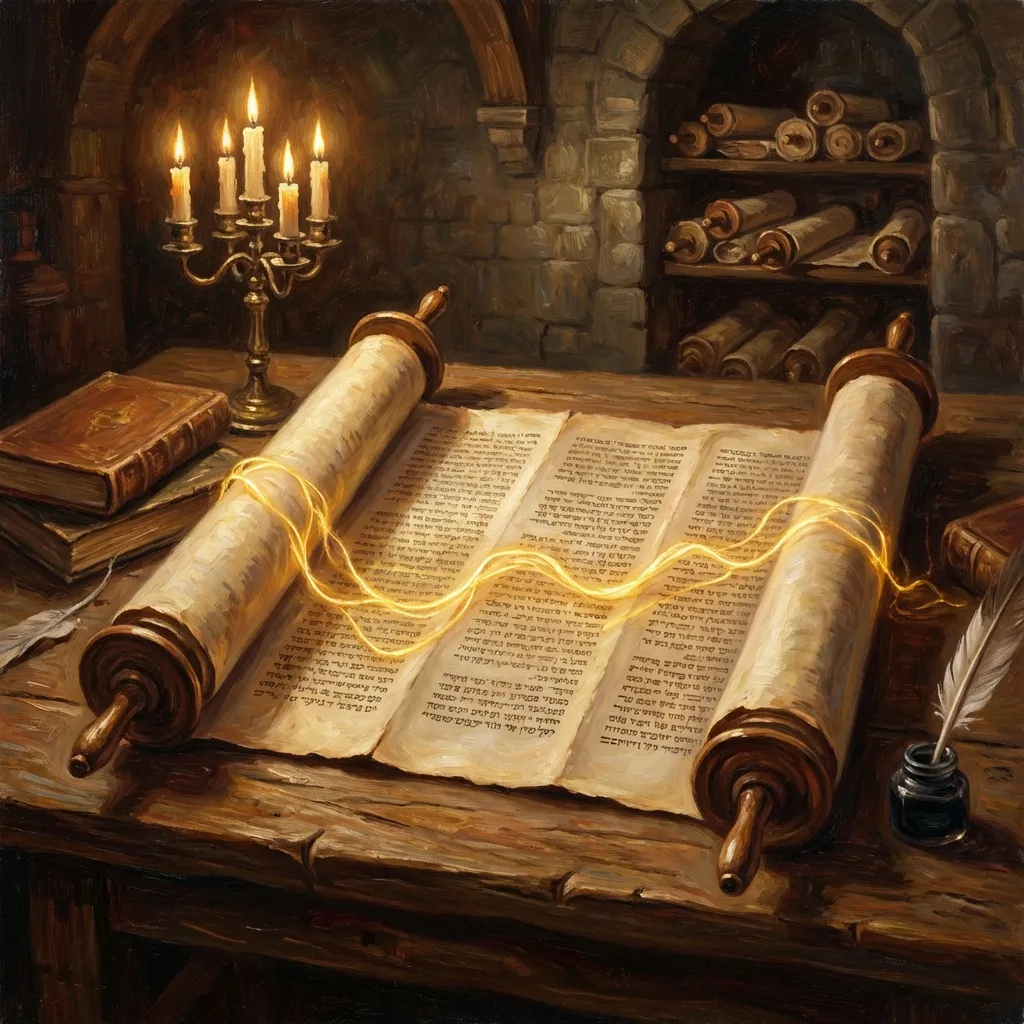
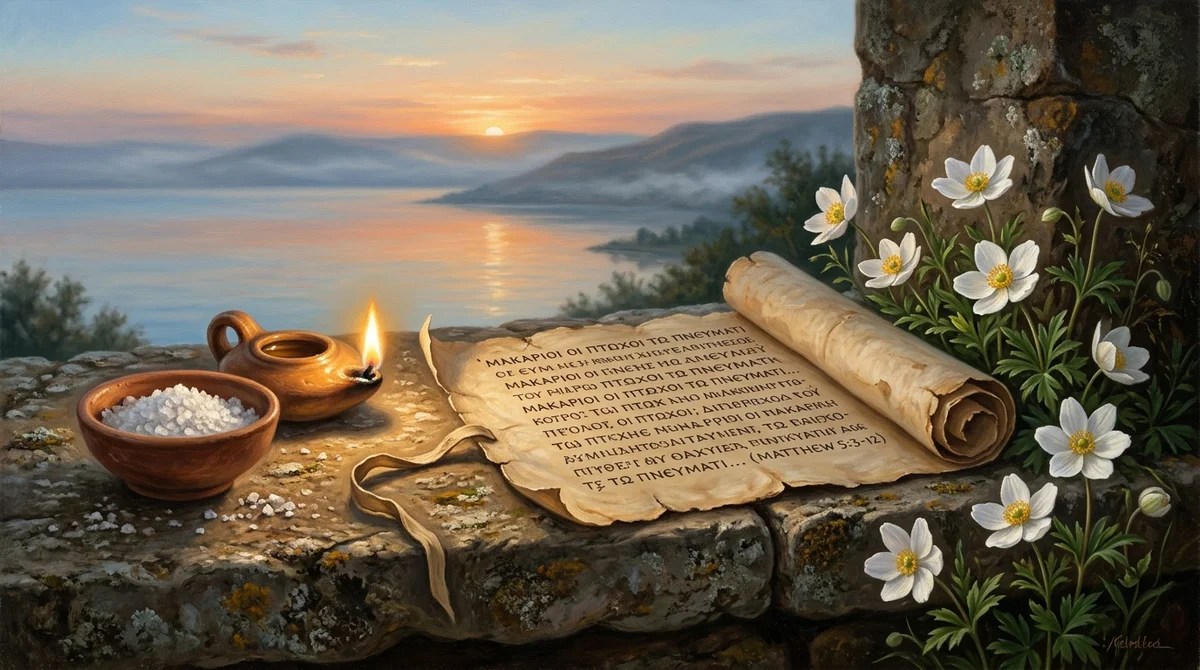 The Blueprint of the Kingdom: The ancient Greek text of Matthew 5:3-12 (The Beatitudes) accompanied by the Salt and Light of Christian witness.
2. The Eight Beatitudes: The Upside-Down Kingdom (Matthew 5:3–12)
Jesus begins His manifesto not with a list of rigid prohibitions, but with eight explosive declarations of Blessing (Latin: Beatitudines; Greek: Makarioi). In the Greco-Roman world, the 'blessed' man was the wealthy aristocrat, the invincible military general, or the powerful Caesar. Jesus stands worldly wisdom on its head:
1. "Blessed are the poor in spirit, for theirs is the kingdom of heaven." (v. 3)
Jesus does not use the Greek word penēs (a working-class person who struggles to make ends meet). He chooses ptōchos—a destitute beggar cowering in the dust, completely devoid of resources, with cupped hands begging for crumbs. To be 'poor in spirit' means acknowledging our absolute spiritual bankruptcy before a holy God. We bring zero self-merit to the table. The kingdom of heaven belongs only to those who admit they cannot save themselves.
2. "Blessed are those who mourn, for they shall be comforted." (v. 4)
The Greek verb penthountes describes the deepest, most agonizing grief—the sorrow of losing an only child. In God's economy, this is not merely grief over earthly bereavement, but holy sorrow over our own sins and the brokenness of a world alienated from God (Psalm 51:17; 2 Corinthians 7:10). Those who weep over sin will taste the supernatural comfort of divine forgiveness.
3. "Blessed are the meek, for they shall inherit the earth." (v. 5)
As explored in biblical Greek, praeis (meekness) does not mean weakness or spineless passivity. It describes a mighty warhorse harnessed and responsive to the master's reins—power under perfect divine control. While ruthless empires conquer through bloodshed and tyranny, Jesus promises that the gentle, surrendered disciples will ultimately inherit the renewed cosmos.
4. "Blessed are those who hunger and thirst for righteousness, for they shall be filled." (v. 6)
In the ancient arid East, hunger and thirst were not mild mid-day cravings; they were desperate, life-or-death realities. To hunger and thirst for righteousness (dikaiosynē) means craving conformity to God's will with the same biological urgency a starving man seeks bread or a parched traveler seeks an oasis in the desert. God promises they will be chortazō—supernaturally gorged and fully satisfied.
5. "Blessed are the merciful, for they shall obtain mercy." (v. 7)
Eleēmones means active, compassionate empathy that steps into the misery of another to bring relief. Having received unconditional mercy from God, a kingdom citizen refuses to hold grudges, exact revenge, or nurse bitterness. Mercy begets mercy.
6. "Blessed are the pure in heart, for they shall see God." (v. 8)
The Greek katharos implies unmixed, unalloyed integrity—free from deceit, divided motives, and hypocritical pretense. While the Pharisees washed the outside of cups and vessels, Jesus demands undivided internal loyalty. Only those cleansed by the blood of Christ will behold the unveiled glory of the King (Psalm 24:3–4; Hebrews 12:14).
7. "Blessed are the peacemakers, for they shall be called sons of God." (v. 9)
Notice Jesus does not say peace-lovers (who avoid conflict at all costs), but eirēnopoioi (peace-makers). Peacemaking is costly, active labor: reconciling estranged people, breaking cycles of retaliatory hostility, and bringing the Gospel of reconciliation to lost sinners. In doing so, they mirror their Heavenly Father, who made peace with rebels through the blood of the Cross (Colossians 1:20).
8. "Blessed are those who are persecuted for righteousness' sake..." (vv. 10–12)
Jesus concludes with a reality check: living an authentic kingdom life in a fallen world will inevitably provoke hostile backlash. When the world insults, defames, and oppresses believers because of Christ, Jesus commands: "Rejoice and be exceedingly glad, for great is your reward in heaven!" Persecution is the badge of prophetic fellowship.
3. Salt and Light: The Believer's Cultural Mandate (Matthew 5:13–16)
Having outlined the inward character of a disciple, Jesus turns to their outward societal influence:
- Salt of the Earth: In antiquity, salt was the primary antiseptic and preservative against meat rot. Believers are placed in culture to retard moral decay, preserve biblical truth, and bring divine flavor to human society. If the church loses its distinctiveness and compromises with worldly culture, it becomes utterly worthless (mōranthē—insipid).
- Light of the World: A city built on a limestone hill (like Safed, visible from Galilee) cannot be concealed. Disciples do not hide their faith under a basket; through sacrificial good works and bold truth, they shine the light of God into moral darkness so the Father is glorified.
4. The Six Antitheses: Heart-Level Righteousness (Matthew 5:21–48)
Six times in Matthew 5, Jesus utilizes a revolutionary rhetorical formula: "You have heard that it was said... BUT I SAY UNTO YOU." With staggering divine authority, Jesus penetrates beneath external ritual to expose the hidden motives of the heart:
- Murder & Anger (vv. 21–26): The sixth commandment prohibits murder, but Jesus reveals that murderous hatred, unrighteous anger (orgē), and venomous insults (calling a brother Raca or fool) incur the same divine condemnation.
- Adultery & Lust (vv. 27–30): The seventh commandment forbids physical adultery, but Jesus states that looking at a person with lustful intent constitutes heart-level adultery. He calls for radical spiritual surgery: cutting off compromising habits rather than losing your soul.
- Divorce (vv. 31–32): Upholding the sacred permanence of the marriage covenant against casual cultural dismissals.
- Oaths & Integrity (vv. 33–37): Rather than relying on elaborate religious oaths to sound trustworthy, a Christian's character should be so upright that a simple "Yes" means yes, and "No" means no.
- Retaliation vs. Non-Resistance (vv. 38–42): Replacing the judicial principle of "an eye for an eye" with radical personal graciousness: turning the other cheek and walking the extra Roman mile.
- Love for Enemies (vv. 43–48): The climax of Jesus' ethics: anyone can love those who love them; but God sends rain on the just and the unjust. We are commanded to pray for our persecutors, culminating in: "Be perfect (teleioi—complete, mature), as your heavenly Father is perfect."
5. Secret Devotion vs. Religious Theater (Matthew 6:1–18)
In chapter 6, Jesus tackles the three pillars of Jewish piety: giving alms, praying, and fasting.
He warns against religious hypocrisy (Greek: hypokritēs, meaning a stage actor wearing a painted mask). When giving to the poor, do not sound a trumpet; let your left hand not know what your right hand is doing. When fasting, do not disfigure your face to win human applause. When praying, do not babble empty repetitions like the pagans, but enter your secret closet and pray to your Father in secret.
Here, Jesus gives the sublime template for all prayer: The Lord's Prayer (Matthew 6:9–13), teaching us to hallow God's name, seek His kingdom first, trust Him for daily bread, extend forgiveness, and seek deliverance from evil.
6. Curing Anxiety: The Birds and the Lilies (Matthew 6:25–34)
In a world paralyzed by economic stress, health panic, and uncertainty, Jesus delivers the ultimate antidote to fear:
"Therefore I tell you, do not worry about your life, what you will eat or drink; or about your body, what you will wear... Look at the birds of the air; they do not sow or reap or store away in barns, and yet your heavenly Father feeds them. Are you not much more valuable than they?" (Matthew 6:25–26)
Jesus points to the wild Galilean crows flying overhead and the purple anemones blooming on the slope. If God clothes temporary grass with more splendor than King Solomon in all his royal robes, how much more will He care for His redeemed children?
The master key to mental peace is found in verse 33: "Seek first the kingdom of God and His righteousness, and all these things will be added to you." Worry does not empty tomorrow of its troubles; it only empties today of its strength.
7. The Two Foundations: Building on the Rock (Matthew 7:24–27)
Jesus concludes His monumental sermon with a dramatic architectural parable. Two builders set out to construct a house. Both face the exact same violent Galilean storm: flash floods rush down the wadis, gale-force winds batter the walls, and torrential rains fall from heaven.
- The Foolish Builder: Built on the soft, shifting sand of human opinion and moral ease. The storm struck, the foundation collapsed, and "great was the fall of it."
- The Wise Builder: Dug deep and anchored the foundation into the immovable bedrock of Christ’s words and obedience. When the storm slammed against it, the house stood firm.
Conclusion: The difference between spiritual life and spiritual ruin is not whether you hear the words of Jesus, but whether you put them into practice. Step out onto the Rock today. Let the manifesto of the King become the foundation of your life.
⚡ Fast Facts
- Acoustic Amphitheater: The traditional Mount of Beatitudes near Tabgha on the Sea of Galilee forms a natural acoustic bowl where offshore thermal breezes carry a speaking voice clearly to a crowd of 5,000 to 7,000 listeners.
- The Greater Moses: Just as Moses climbed Mount Sinai to receive the Old Covenant on stone tablets, Jesus sits on the Mount to deliver the New Covenant written on human hearts with divine authority.
- The Word 'Makarios': Translated as 'Blessed', the Greek 'makarios' does not mean lucky or wealthy; it describes the invulnerable, self-contained joy of the gods that no earthly tragedy can diminish.
- Astonishing Authority (Matthew 7:28-29): The crowds were spellbound because Jesus taught not like the scribes (who endlessly quoted past rabbis), but as the supreme Author and Lawgiver speaking on His own divine authority.
❓ Frequently Asked Questions (FAQs)
The central theme is the 'Upside-Down Kingdom of God'—a revolutionary lifestyle governed by internal heart transformation rather than external religious performance. Jesus exposes that true righteousness is not merely avoiding murder or adultery outwardly, but rooting out anger, lust, pride, and greed inwardly through love, humility, and total trust in the heavenly Father.
The Beatitudes are not harsh legalistic commands that earn salvation; they are divine proclamations of grace describing what a heart looks like when regenerated by the Holy Spirit. They describe the authentic character of a kingdom citizen who recognizes their spiritual bankruptcy, hungers for God's righteousness, and reflects Christlike mercy in a broken world.
Jesus is not condemning healthy moral discernment or doctrinal evaluation (He commands us to identify 'false prophets by their fruit' later in the chapter). Rather, He condemns hypocritical, self-righteous, condemning fault-finding where a person tries to pick a tiny speck out of a brother's eye while ignoring the giant hypocritical plank in their own.